

Having been nominated for his previous animated short films Lavatory – Lovestory and We Can’t Live Without Cosmos, Konstantin Bronzit is no stranger to the Academy Awards. Indeed, he returns to the Oscars this year with his third nomination for Best Animated Short Film with The Three Sisters. While he’s no stranger to the Academy, his initial festival run that led him to the 2026 nomination caused some controversy when he submitted his new film under a pseudonym, a move which caused much speculation but motives for which he happily clarifies here with Directors Notes, as well as telling us more about the making of his new short, as part of DN’s continuing Oscar Nominees interview series.
The Three Sisters is the story of three grown siblings living a very isolated life on a tiny island. When they fall on hard times and are forced to rent out one of their three little houses to a gruff sailor, the delicate equilibrium on the island is thrown off balance as each of them reacts in their own way to the uncouth mariner’s presence. It’s a delightful and entertaining short film full of heart and humour, visually led with an immersive soundscape. As well as taking us through the film’s life on the festival circuit, Bronzit talks to us about the inspiration for the short and the process of bringing it to life with the help of his contemporaries.
You’ve said that you don’t try to bring a specific visual style of animation to your stories, instead letting the story determine what style should be used to tell it. How did you settle on the style for The Three Sisters?
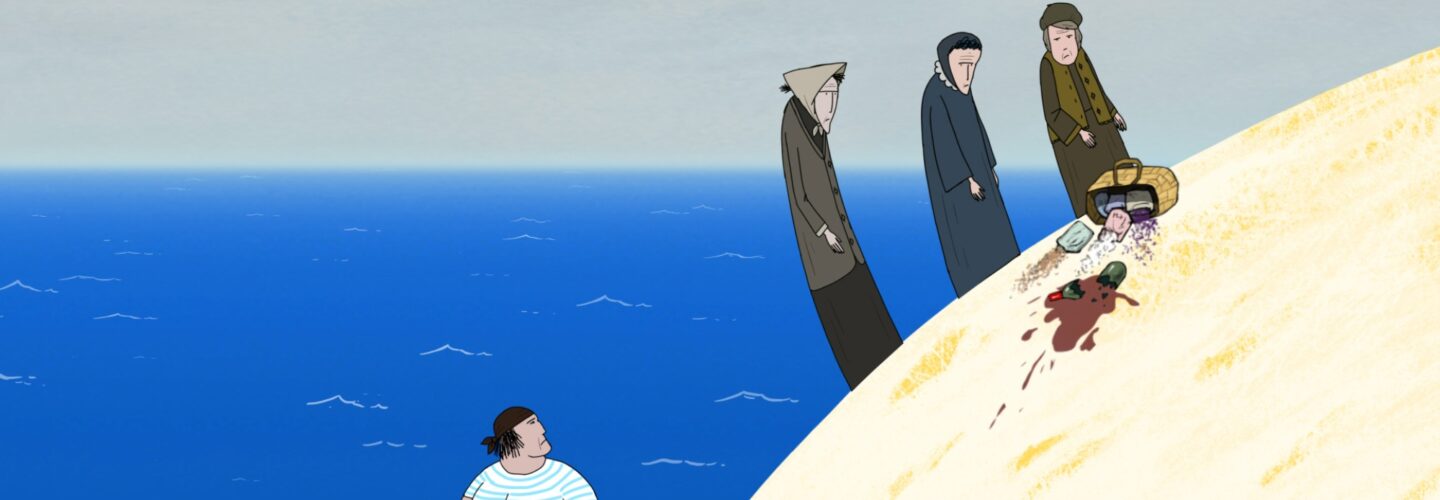
Style is my sore spot. Because the art production side, for me, is the hardest part. This despite me having received a very good classical education in how to draw. But visual style isn’t about drawing. While there are plenty of good artists, very few of them can become art directors. My method is built not on thinking up a visual style, but seeing the film with your inner eye as something already there, fully formed.
Sometimes I manage to do this right away, like what happened with Lavatory – Lovestory, and other times it turns into agony (At the Ends of The Earth). In the case of The Three Sisters, I got partially lucky: when the story began to assemble itself bit by bit, somehow I was able to imagine this lonely island in the sea, all in yellow sand, where there stood three plain houses of bright white limestone weathered by seawater and wind. But picturing the three sisters was stubbornly difficult and I once again called upon Roman Sokolov, who lives in France, for help. He had helped me greatly with We Can’t Live Without Cosmos and He Can’t Live Without Cosmos. So working together, we were able to get it done.
My method is built not on thinking up a visual style, but seeing the film with your inner eye as something already there, fully formed.


The initial inspiration for the story came from your friend Dmitry Vysotsky on the flight home from the Oscars in 2016, but the floodgates didn’t really open for a couple of years. What sparked that momentum and how long did it take to settle on the final story with all its intricate details?
That for me is the eternal difficulty: you can express an idea in a few words, but how do you turn these few words into a full script? That is where the agony starts. I had the same experience with Lavatory – Lovestory, the idea for which was also put up by Dmitry. So we have this sort of funny tandem. It was only after about two years of constant thought that suddenly the story came to life literally in a single night. You could call that the flash of inspiration. There were also several years of agony with nothing to show for The Three Sisters, but I don’t remember any particular spark or enlightenment.
Most Popular
First I saw – I really saw, as opposed to thinking it – that the sisters live on an island, underscoring their seclusion and even loneliness. And then a sailor came to mind, almost automatically. But how does he get there? Everything needs a ‘why’. Alright, they’re losing the money they use to buy the necessities of life… Gradually, everything began to fall into place. Maybe I’m just slow-witted if I need so much time to come up with such simple things. And yes – the brain is always attuned to nuance, to the tiny detail that drives the narrative forward.
When the sisters each come out of their dreary shells when the sailor arrives, what inspired the distinctive looks for each one?
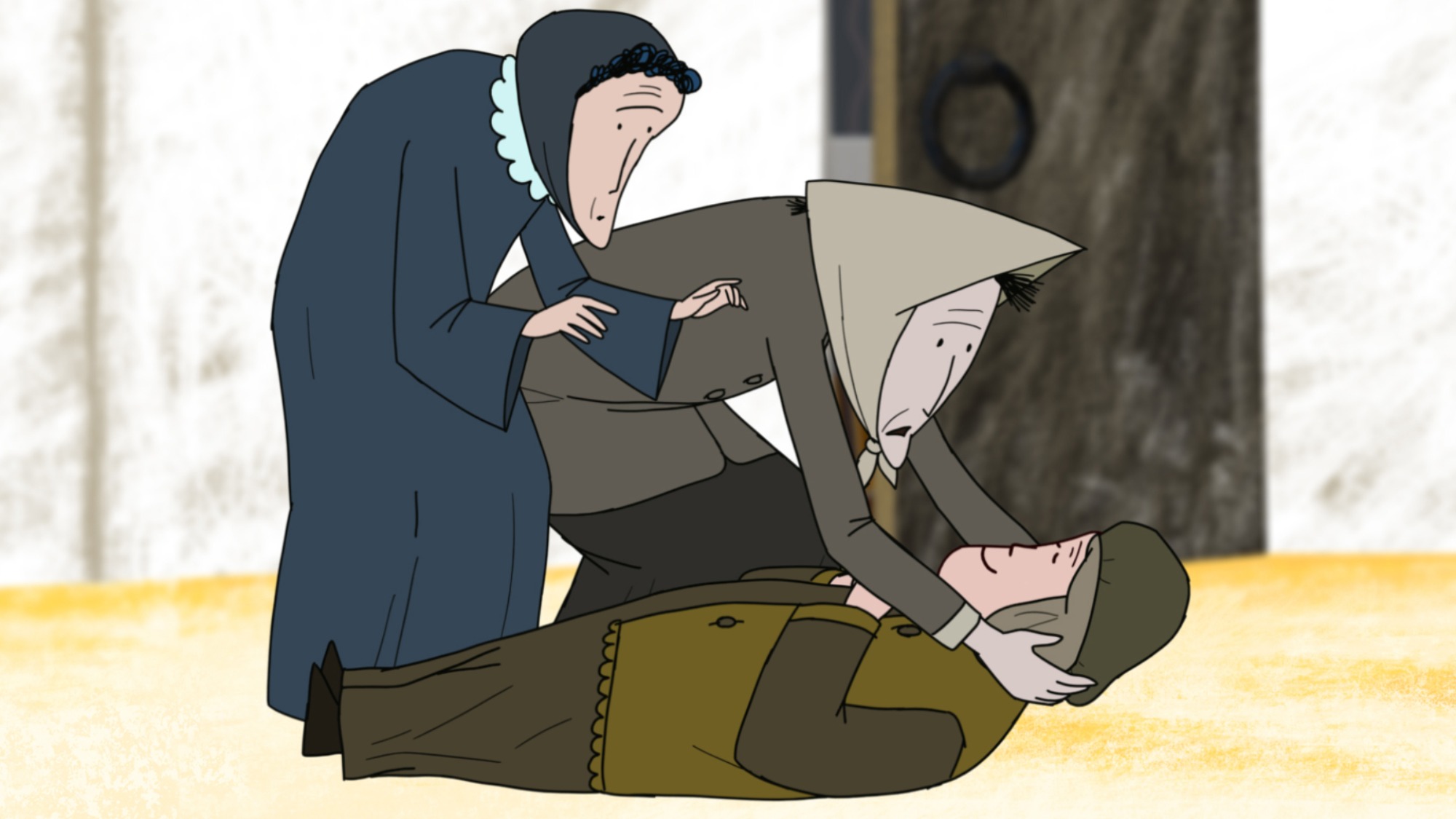
I don’t know if “inspired” is the right word. There’s a wisp of a nuance in the very beginning – the youngest of the sisters is watching a faraway sailboat at sea. She’s clearly thinking about something. Maybe dreaming of someone. And she’s the first to react to the arriving sailor. What gets the other two sisters so worked up is not the sailor, but their younger sister’s behaviour. They suddenly see her small, instant success, which triggers a feeling of rivalry. Our eternal desire to be better than everyone else. That’s vanity, not inspiration. And it has nothing to do with men or women specifically. People will always find something to fight over. That’s probably why we were kicked out of Paradise.
Can you tell us about your process of putting this animation together and the equipment you used?
On the one hand, my process is very traditional: we draw key poses and in-betweens, and refine. All this happens in simple computer programs, just like with most 2D animators. Everything is bog-standard, there’s no ‘secret’. On the other hand, our great Yuri Norstein long ago said a phrase that stuck with me: “Every frame should flow into a gesture.” This has become an inner tuning fork for me ever since. It informs my approach to animation in everything that I do.
In every scene – short ones, long ones, any scene at all – every character should prepare and make a main gesture that articulates their attitude towards what is happening and uncovers or underscores the scene’s meaning to the viewer. Without this gesture, the meaning of the scene crumbles.

There are some wonderful moments of humour and comic timing in the sound design throughout The Three Sisters. How much of this was planned and how much was discovered in post-production?
I’m a director who tries to plan everything. That’s why for me, making an animatic takes two thirds of a film’s entire production timeline. I worked on the animatic for We Can’t Live Without Cosmos for three years. Actually doing the animation and post-production took just one year. The situation with The Three Sisters was similar – I spent about three years honing the animatic. Why so long? Because even with a story that had come together overall, there are a lot of nuances that you have to think through so that each new scene logically follows from the previous one. Then you need to sew these scenes together so that the viewer doesn’t see the seams and everything appears to be part of a single sweep of action. This is very difficult and doesn’t always turn out. So, this takes time.
Even with a story that had come together overall, there are a lot of nuances that you have to think through so that each new scene logically follows from the previous one.
I take great time and care with the sound for the animatic as well. The sound in the final versions of my films is practically identical to my animatics. With the way I do things, the film is ‘ready’ even before post-production. I think it was the great French director René Clair who aptly said: “The film is ready, the shooting is all that remains to be done.” It’s a similar situation for me. But in actuality, no matter how hard I try, it’s not possible to ‘think’ the entirety of the film in advance.
There is one fine point in the film that wasn’t in the animatic, I thought of it and added it when the film was practically done: when the younger sister initially brings the washed and ironed clothes into the sailor’s room, before stepping in she straightens her hunchback, with a crunch in her spine.

You first released the film onto the festival circuit under the pseudonym ‘Timur Kognov’ to ensure unbiased opinions of the film when going to selection panels and juries. What experiences prompted you to make this decision and how do you interpret the result?
I am grateful that you get the idea behind the gambit, as reflected in a question that is both simple and well put. As you know, those who didn’t understand it and ascribed other reasons to it – they didn’t like my inquiry. But the question is so broad that there can be no short answer.
In his diaries, Andrei Tarkovsky describes how at the Cannes Film Festival, where his film was going to be in competition, the jury had another famous Soviet director. Tarkovsky instantly knew that this director would try to sink his film. And so they did. A bit later, when I myself was a mere budding director, my teacher Alexander Tatarsky told me how his film had been sunk at a European festival by another famous director. I, too, later began participating in festivals and saw this myself. But I should add the caveat that the opposite also occurs – a famous director makes a so-so movie and the jury feels it would be awkward to not award a prize. So, a famous name can be a double-edged sword. It can push judges both for and against.
I decided to be an idealist and create the perfect situation when a film is watched without preconceptions by an audience who knows nothing about the author.
Competition in art works in truly strange ways. Imagine Sotheby’s is auctioning off two paintings, one by Sylvester Stallone (did you know that Sylvester Stallone paints?) and the other by an unknown artist. Let’s call him Timur Kognov. The paintings are similar. But that’s not important to the buyers. We all know which painting will bring in the big bucks. But suddenly Stallone comes out and says that both paintings were painted by him, and that ‘Kognov’ is his pseudonym – its price will instantly soar even though the painting itself is unchanged. Only the signature on it has changed. So I decided to be an idealist and create the perfect situation when a film is watched without preconceptions by an audience who knows nothing about the author.
Professional curiosity was what inspired me. I felt deep down that I wouldn’t make a completely awful film, but would this film from a no-name director make it through the crush of festival competition? I think everyone realizes how I risked ending up with nothing: imagine the film not being picked up at any of the festivals, then sitting in the director’s archive unknown to anyone, with five or six years of work in vain.
Everything was headed that way until the film was noticed at the eleventh hour, at the Santa Barbara Film Festival! The main outcome is to give hope to many beginning and not-so-beginning directors. We have all had that traumatic experience of getting endless festival rejections: “Unfortunately, your film was not selected into our competition, but keep up the good work”, and all that. We directors can only keep going, keep our heads down and live in the hope that we’ll get lucky and our films maybe aren’t so bad.


What were some of the experiences, both positive and negative, of this experiment and is it something you would do again?
I’ve already told you about the main experience that I had. But there was another, very unexpected one. There were people from a few festivals (fortunately, just a handful of them) who perceived my action as a personal affront and took offense, although I tried every which way to explain that I was putting my own film to the test, and not anything or anyone else. But we know that if someone doesn’t want to hear something, no reasoned arguments can change that. And they began to criticize not just me, but the film.
The reason was that the film hadn’t been chosen at their festivals, which led to cognitive dissonance on their part – a discomfort that they as professionals had done something wrong. Hence the resentment and search for my non-existent hidden motives for sneaking into European festivals. I say European festivals specifically, because festivals in the U.S. and many other places don’t care which country is indicated on the submission. This is both professionally correct and proper. You might say, big deal, so what if they get offended or criticize you. The unpleasantness is that they started doing this out in the open, publicly, putting their opinion above that of their colleagues from the other festivals where the film did make the cut, including the Santa Barbara festival, where Timur Kognov’s film won.
To close my thoughts on this topic, I’ll say the obvious – that for a moviemaker to be disparaging towards an Oscar-nominated film and its author during the height of the Oscar season is, to my view, unprofessional and extremely unbecoming. As for my desire to try this all again, I don’t think I will. It’s like telling the same joke twice.
For a moviemaker to be disparaging towards an Oscar-nominated film and its author during the height of the Oscar season is, to my view, unprofessional and extremely unbecoming.
After enjoying Oscar recognition in the past with your films Lavatory – Lovestory and We Can’t Live Without Cosmos, why do you think your work consistently appeals to the Oscar-qualifying festivals and what, if any, advice do you have for fellow animators hoping to also make it to the Academy Awards?
Do you mean to imply I have a ‘recipe’? I wish I did… What I do have is plenty of fear – you pin big hopes on what you’re doing, but simultaneously live in fear that it was all nonsense. I’m afraid that our lot in life is to work and work. Although I often think of the words of our great director Fyodor Khitruk: “The hardest thing is to tell a simple story.” That’s what his advice is – to learn to tell simple stories in a way that the viewer forgets about everything else in the world.

Now that The Three Sisters has been released on the world’s biggest stage, what’s next for you?
As they say, “If you want to make God laugh, tell him your plans.” For a while I’ve been nursing the idea of not directing. I might switch over to teaching. Another incredible teacher of mine, Anatoly Prokhorov, once said that “Directing is a profession for midlife: you need to start at the right time (not too early) and stop at the right time (not too late).” Because if you fail at either of those, you’ll make a fool of yourself.
Incidentally, you’ll find Prokhorov’s name under Special Thanks in the credits for The Three Sisters, like you can in most of my previous films, even though Anatoly didn’t get to participate in the project, having passed away before I started making it. This credit is my eternal thanks to him for being the one who made me into a director. I have the feeling that by making the film without him, it’s as if I’ve passed his test.
And finally, what short film by another filmmaker would you recommend to our Directors Notes audience and why?
I’m afraid I won’t be original here. The film will be one everyone knows, Father and Daughter, by Michaël Dudok de Wit. Yuri Norstein once said, ”A film can be both cold and good at the same time. But a film like that, you can easily split it into its components, reassemble it and get the original film. That’s not too interesting. There needs to be a secret. A secret that the author is not conscious of. If we take apart this film, we can’t put it back together.” Father and Daughter has this secret. The ingredients that went into the movie are seemingly obvious. The story is simple as can be. But the result can’t be repeated.
Plus Norstein’s Heron and Crane and Hedgehog in the Fog. When it comes to their vivid visuals and degree of empathy, compassion and existential longing alongside sad irony, no other films are their equal.


Good day. Please, I really would love to see your film. I can’t find anywhere to watch it online. Was hoping you could advise me. I’m more than happy to pay to see you work, it looks rather wonderful.
Thanks and good luck.
Chris Wright.
Hey Chris, The Three Sisters isn’t available online as of yet but there might be an in person screening of the oscar nominated short films in your area in the run up to the awards.