


Whether you’re a neophyte filmmaker keen to see your debut on the big screen, a seasoned pro with a precision tailored plan to get your magnum opus all the way to the Oscars, a small festival wanting to bring compelling new cinema to your local community or a mammoth A-lister like Sundance or TIFF setting the cinematic agenda for the season, then one platform alone looms large above all others – FilmFreeway! Unquestionably, the dominant player when it comes to film festival submissions across the globe, if you have a film that you want to screen at festivals or are a film festival that seeks submissions, there really aren’t any other viable choices. Much has been written and speculated about FilmFreeway through the years after it arrived on the scene in 2014 as a four-person Canada-based upstart which took on and ultimately bested the predatory Withoutabox, but with the company largely refusing interviews, there’s been a decided lack of response to the suggestions, questions and complaints generated by filmmakers and festivals alike. Fortunately, the appointment of new General Manager Matt Toigo nine months ago has opened up the opportunity for more transparency into FilmFreeway, its workings, and plans for the future. And so, in this latest instalment of the Directors Notes Industry Insights series, we interview Matt and ask him everything you ever wanted to know about FilmFreeway – from scam festivals to advice for maximising your success on the platform as a filmmaker or film festival.
[The following interview is also available to watch at the end of this article.]
Hi Matt, thank you for joining us on Directors Notes. Could you introduce yourself and tell us a little about FilmFreeway?
My name is Matt Toigo. I’m the General Manager of FilmFreeway. I’ve been here about nine months so far. My background is in engineering, data, and product work. It’s been awesome to join this business and the larger film festival and filmmaker ecosystem. The user problems are super interesting: helping filmmakers get to the best festivals, figure out how to market their film and their creative vision, and ultimately connect people. Getting filmmakers to the best festivals and festivals the best submissions leads to a better festival. It’s been a really fun journey so far, and I’m excited for everything we’ve done and are working on.
I know that your background is as a developer across many years and various companies. What interested you in heading up the FilmFreeway team?
Software is a means to an end. People like me get excited about writing code, but ultimately, websites are there to help people. I like to work at places with really interesting problems and situations that I’m passionate about. Before here, I worked for six years at The Knot, a big wedding planning company. The problem there was to help couples find wedding vendors and get through the stressful process of getting married. I only want to work at companies where I really like the mission. When you work somewhere, there are good days and bad days, but myself and my team are all really proud of what we do and feel good about it. I’ve worked in consulting previously, where I just had to work for whoever. But being here and connecting filmmakers and film festivals is a user mission that I think is amazing.
When you’re a new filmmaker, it’s daunting. You’re putting yourself out there. A film can be your identity, and you’re putting it out there to be accepted or rejected by a festival. It’s a very vulnerable, tricky moment. I want to lead with empathy and make sure we’re sensitive to everything filmmakers need and help them find the best festivals. Also, film festivals are often small businesses. People don’t always realize that. They’re hard to run, both financially and in terms of people. They’re total passion projects. Everyone is there because they’re passionate about film as a medium and helping new filmmakers. It’s another group I want to make sure we give everything they need. I just love the mission of the company and am excited to help both those groups.
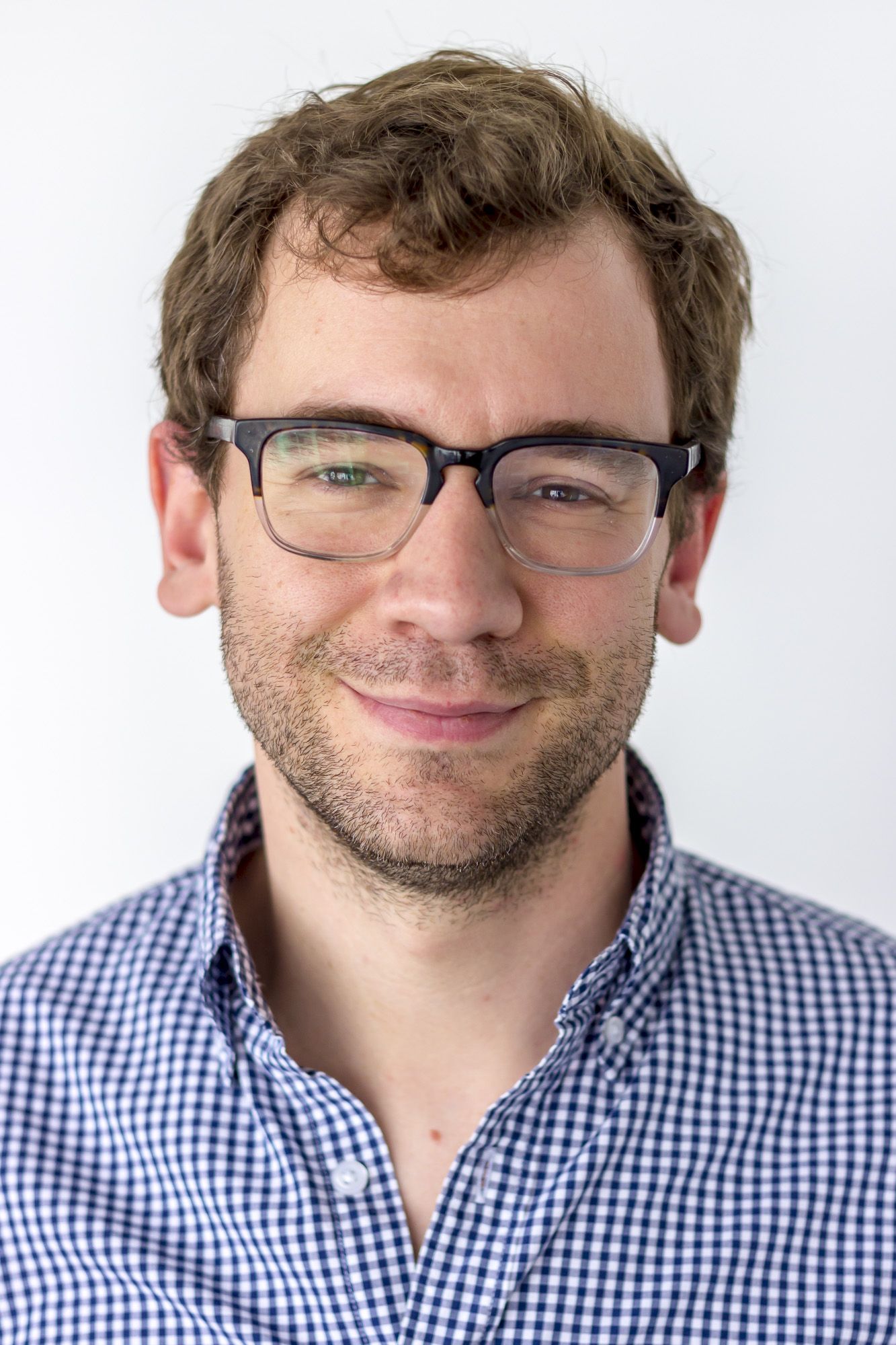
I like to work at places with really interesting problems and situations that I’m passionate about.
Given that you don’t have a traditional film background, how are you bridging that knowledge gap to inform the work you do at FilmFreeway?
I’m doing that in two main ways. I’m talking to everyone I can who’s a filmmaker or runs a film festival. I’ve talked to some local DC folks, taking them out to lunch to learn what they need. Any festival that reaches out to me, I generally try to make time to talk to them. I’m a big believer that I can’t fix everything, but I can always try to make time to ensure everyone is heard and listened to. I also have someone helping me who has run a few film festivals and advises me on some things because I want to make sure I don’t make too many missteps.
Lastly, we have a fantastic customer service team. They’ve seen every single issue a filmmaker or festival has had. They’ve been here a while and previously weren’t involved in coming up with features to build. I brought them in closely with my engineering team, and they help decide what we build. They’ve seen it all, handle hundreds of tickets a day, and know what users need. I’ve mostly been listening to them and making sure we’re really listening to our users as much as we can.
Speaking of the team, it’s hard to nail down how big it actually is. I’ve seen it as low as six and as high as 36 across four continents. Can you provide some clarity? What is the actual structure?
We’re about at 10 people right now. The core team is customer service, engineering, and a product owner we just hired. That product owner is there to ensure we serve what filmmakers and festivals need. We’re owned by Cast & Crew, so I have some legal, marketing, and SEO help from people in those divisions, but the core team is only about 10 people. We actually just got everyone together for the first time in Las Vegas, and I got to meet everyone I’ve worked with on a screen for the last nine months. That was fun.
Most Popular
FilmFreeway was initially seen as a saviour from Amazon’s Withoutabox. Once Withoutabox bit the dust, FilmFreeway became the dominant platform by quite a margin. From your perspective, what do you feel the platform’s responsibility is, as basically the monopoly on filmmaker-festival relationships?
It’s a really important responsibility. We’ve become the de facto list of where film festivals are. We don’t have all the festivals—there are some I know we don’t have, and a few we’re looking to get—but we are the gateway. It is a free, open internet but we’re able to offer both filmmakers and festivals a lot of exposure to the other side of the platform. We’re a two-sided marketplace.
I take the responsibility seriously because I want to ensure everyone gets to the right festivals and people get traction with their projects.
On the filmmaker side, we owe it to them to give them a platform to interact with festivals in a reasonable way and ensure they’re informed: When are the deadlines? Was your film accepted? Also, help them learn more about festivals: Does this festival provide feedback? What are the categories? Here are reviews and photos. The biggest thing for filmmakers is helping them research festivals and understand the festival ecosystem. For film festivals, it’s ensuring they have all the tools they need with their programming committee to understand all the submissions, judge them fairly, and communicate with filmmakers fairly about what was accepted and what was not. Those are vulnerable moments sometimes. I’m very sensitive to ensuring we’re giving both groups what they need.

As far as responsibility, we’re part of the ecosystem. We’ve joined up with the Film Festival Alliance and are working with them, and also Art House Convergence. Those are two important groups. The Film Festival Alliance ensures festivals have others to work with and talk to about similar problems. Art House Convergence supports independent cinemas, which are the heart of many festivals. It’s hard to run an independent cinema, but they’re really special places where weird, unique films have a place to be watched. We’re a part of that ecosystem, and I take the responsibility seriously because I want to ensure everyone gets to the right festivals and people get traction with their projects.
One thing that has come up time and again, especially post-pandemic, is a charge of the platform falling prey to enshittification. The view is that at first, FilmFreeway was a beacon, but once it owned the market, things started to change and people felt their concerns weren’t being addressed. That negative sentiment is quite a hill to climb. How are you and the team attempting to address those views? I know you’ve launched a newsletter, for example.
I’d love to know more about the specific features people have issues with. Obviously, like all businesses, we’re trying to increase revenue, but the ways we’re doing that right now are mostly by adding value in our marketing products for festivals. I’d love to know more about what specific features someone doesn’t dig or how they’re working. You used the term you used; the traditional term is ‘rent-seeking’ to use the business parlance. I hadn’t really heard that directly. I do sometimes monitor the filmmakers’ and film festival subreddits, but I hadn’t caught that exactly.
Like all businesses, we’re trying to increase revenue, but the ways we’re doing that right now are mostly by adding value in our marketing products for festivals.
My work right now is more around system upgrades and renovation work, improving our festival marketing products, and easing things for new filmmakers. We just ran a session on auditing: You’ve signed up, how do we get you through to creating your first project and getting to your first film festival? We’ve heard there’s a lot of overwhelm: you sign up, and now what? You have all these film festivals. Where do I submit? So we’ve had feedback on that. I’d love to know more about specific criticism.
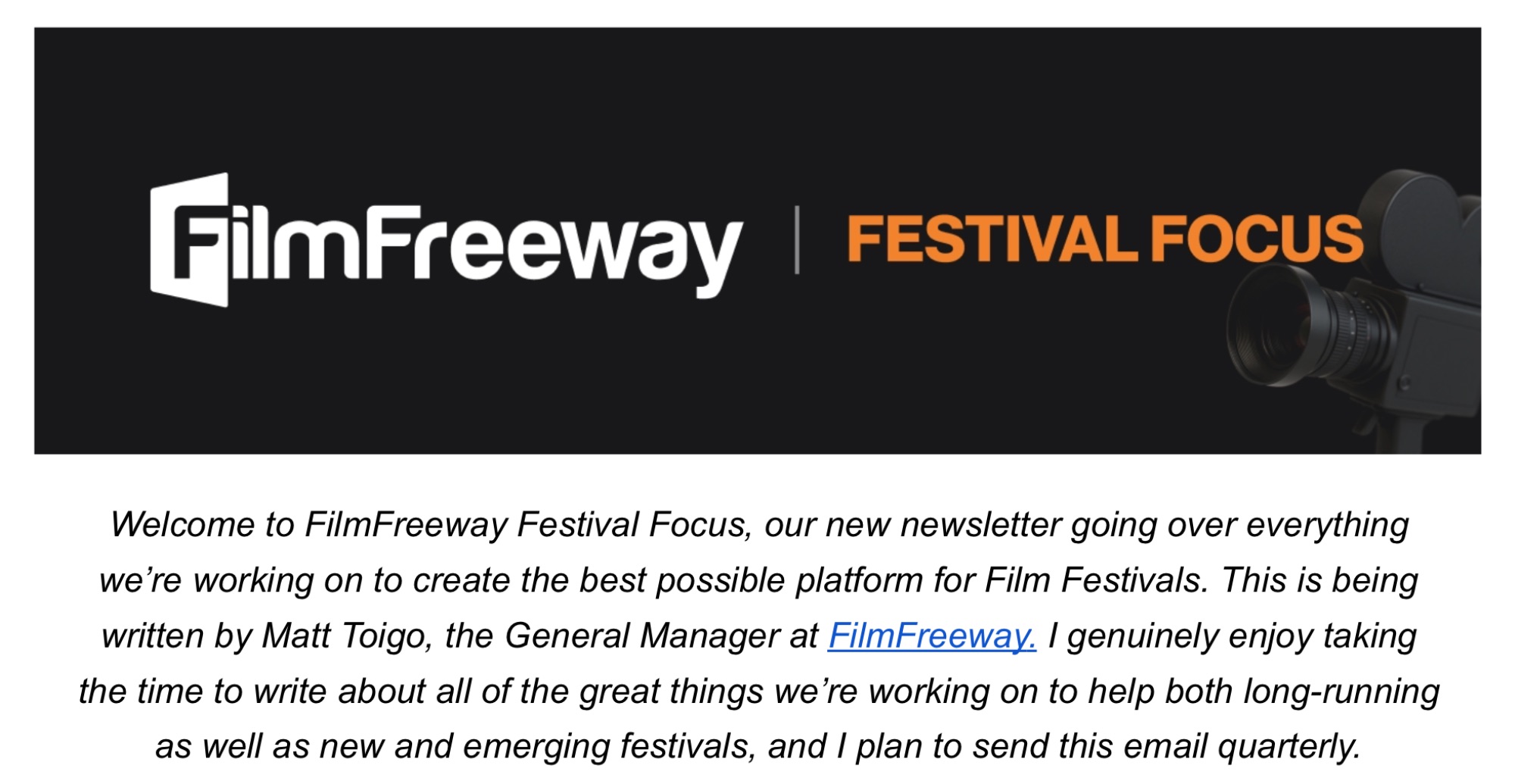
We have a letter going to all our filmmakers now, FilmFreeway Insider, and I just spun up the Festival Focus newsletter. Previously, there wasn’t really the communication that was needed. This is a platform people use daily and are passionate about, so they’ll have a lot of ideas and opinions. At a minimum, I need to communicate with them about what we’re doing, why we’re doing it, and what feedback they have. We do have a bit of an uphill battle to build better communication channels because they weren’t where they needed to be. I’m working on that. I made time for this call, and I’m always willing to talk to people.
Yeah, and I appreciate you taking the time. I was chasing your predecessor, Andrew Lapica, for a couple of years to try to get an interview and got brushed aside. Full disclosure, I emailed you maybe four or five days ago, and now we’re doing the call. That’s a massive improvement.
I’m glad to hear that.
I’m curious what the percentages are for how FilmFreeway makes its money. There are the fees from festivals, the Gold service, and marketing/advertising.
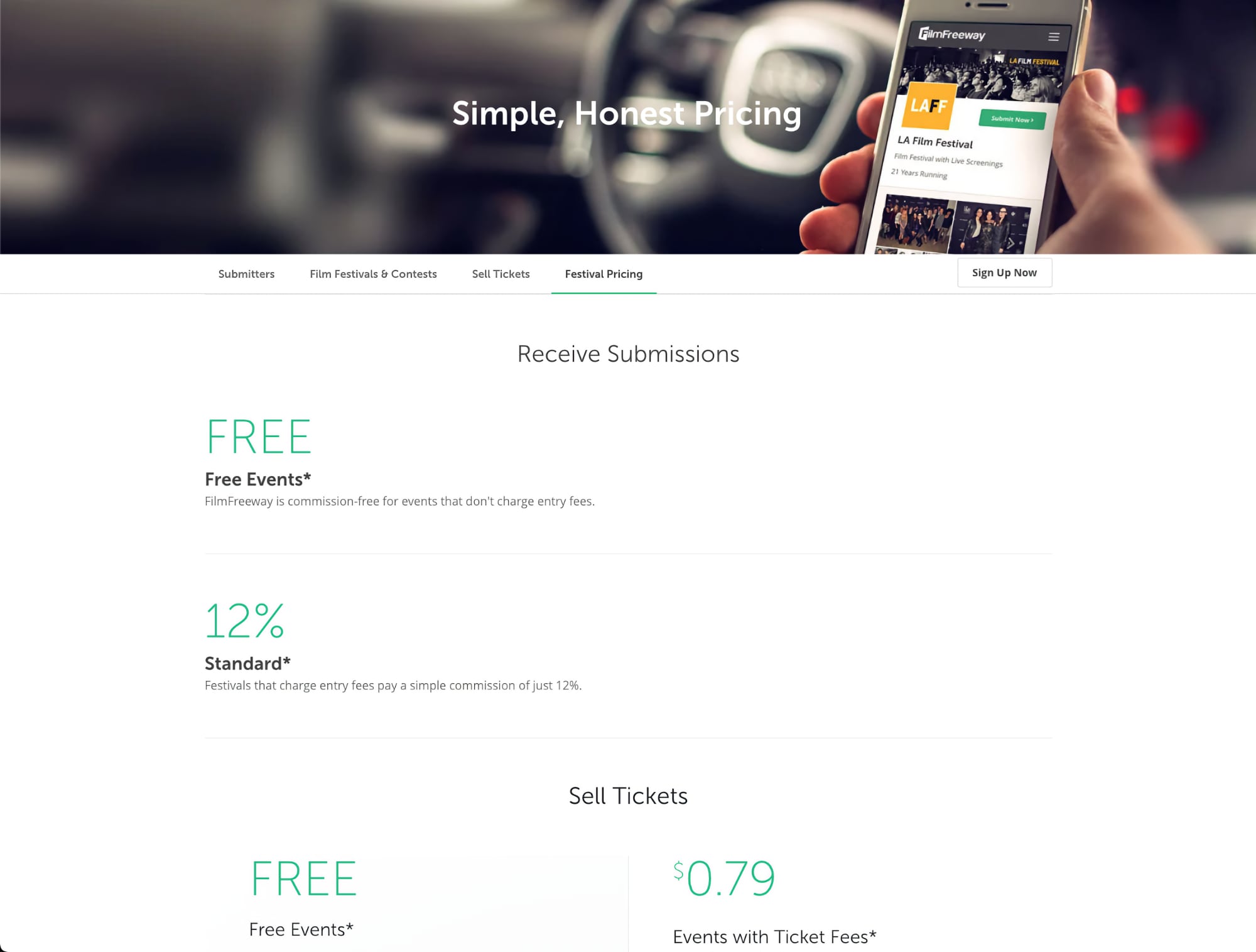
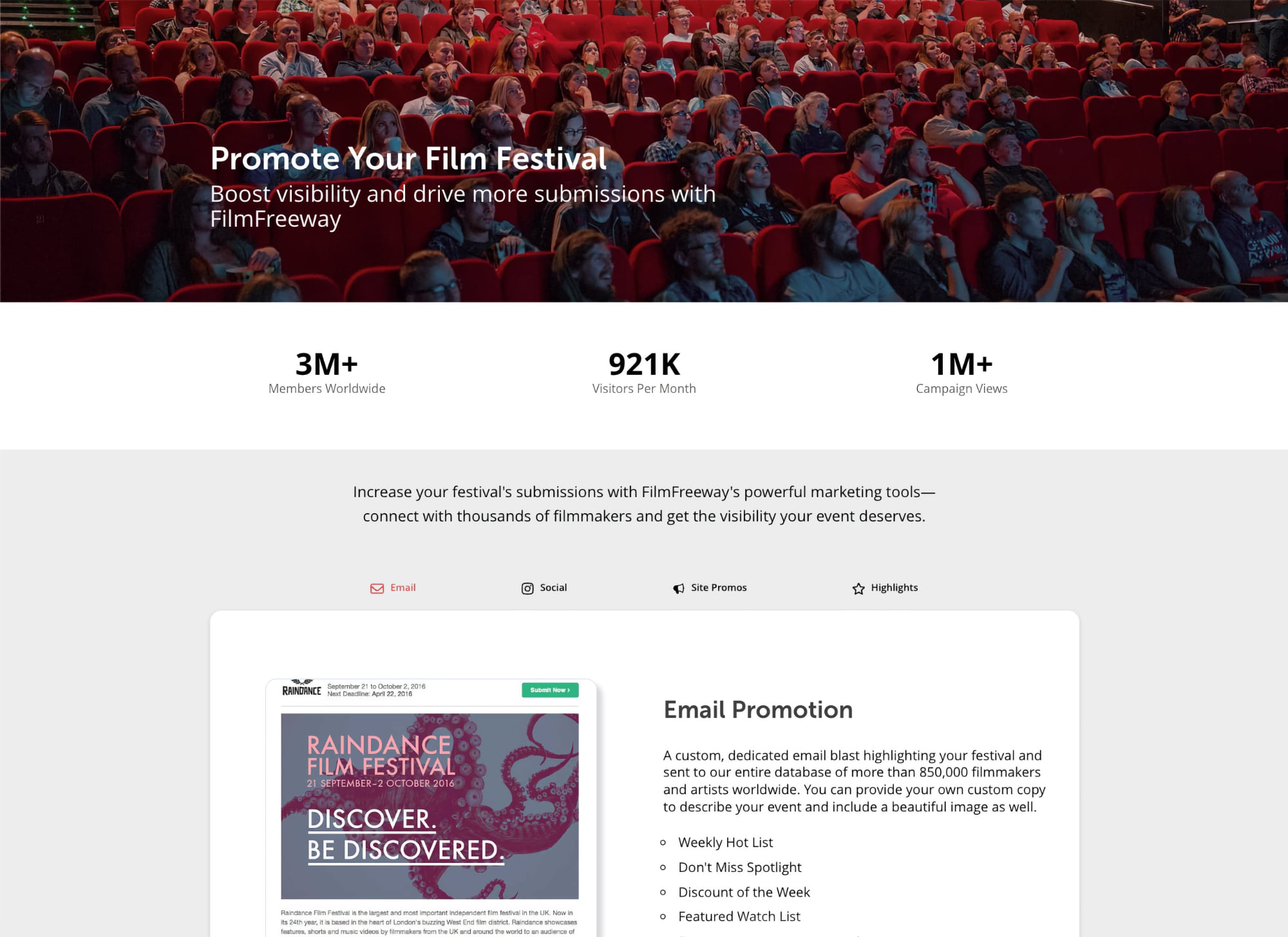
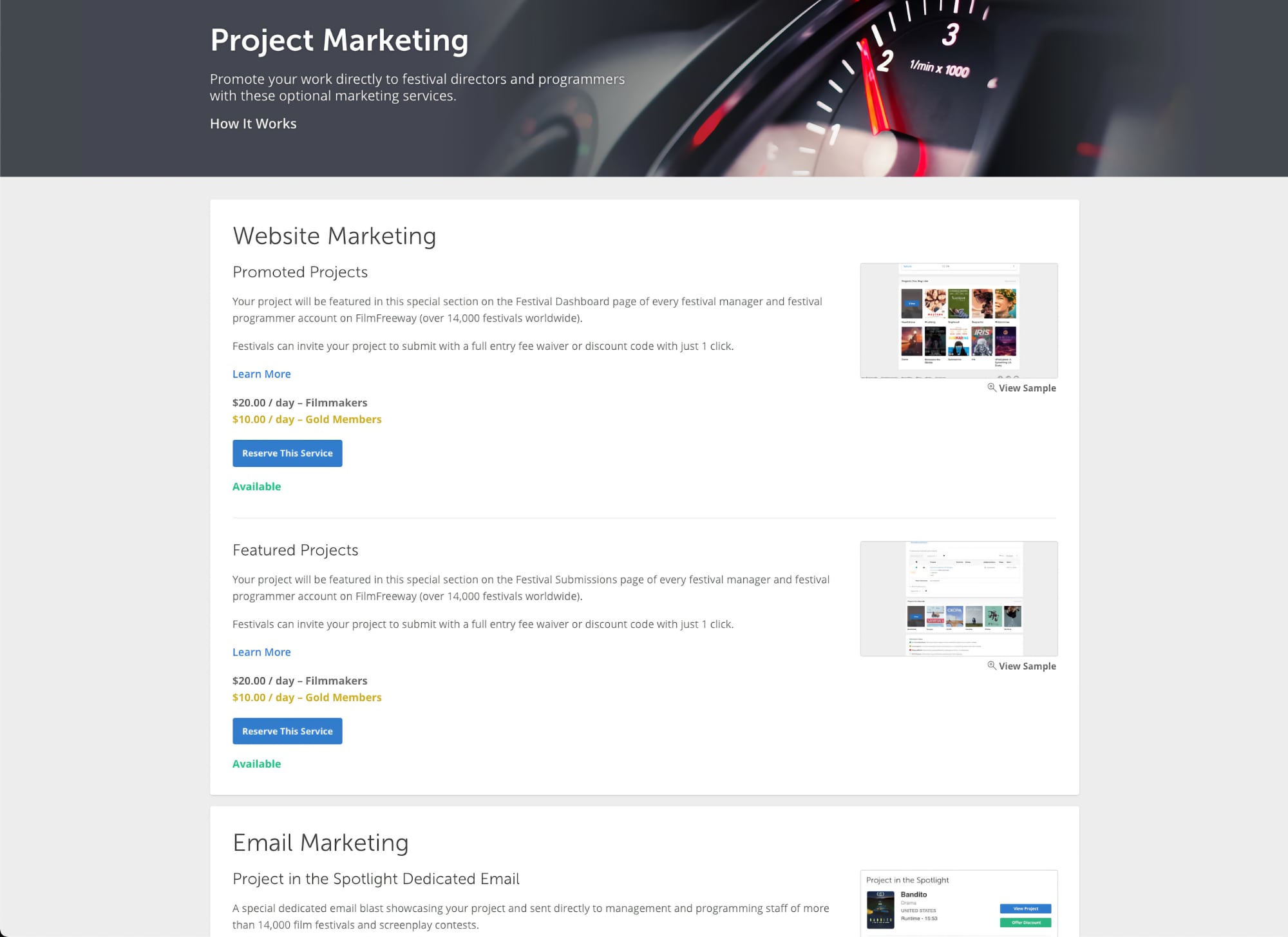
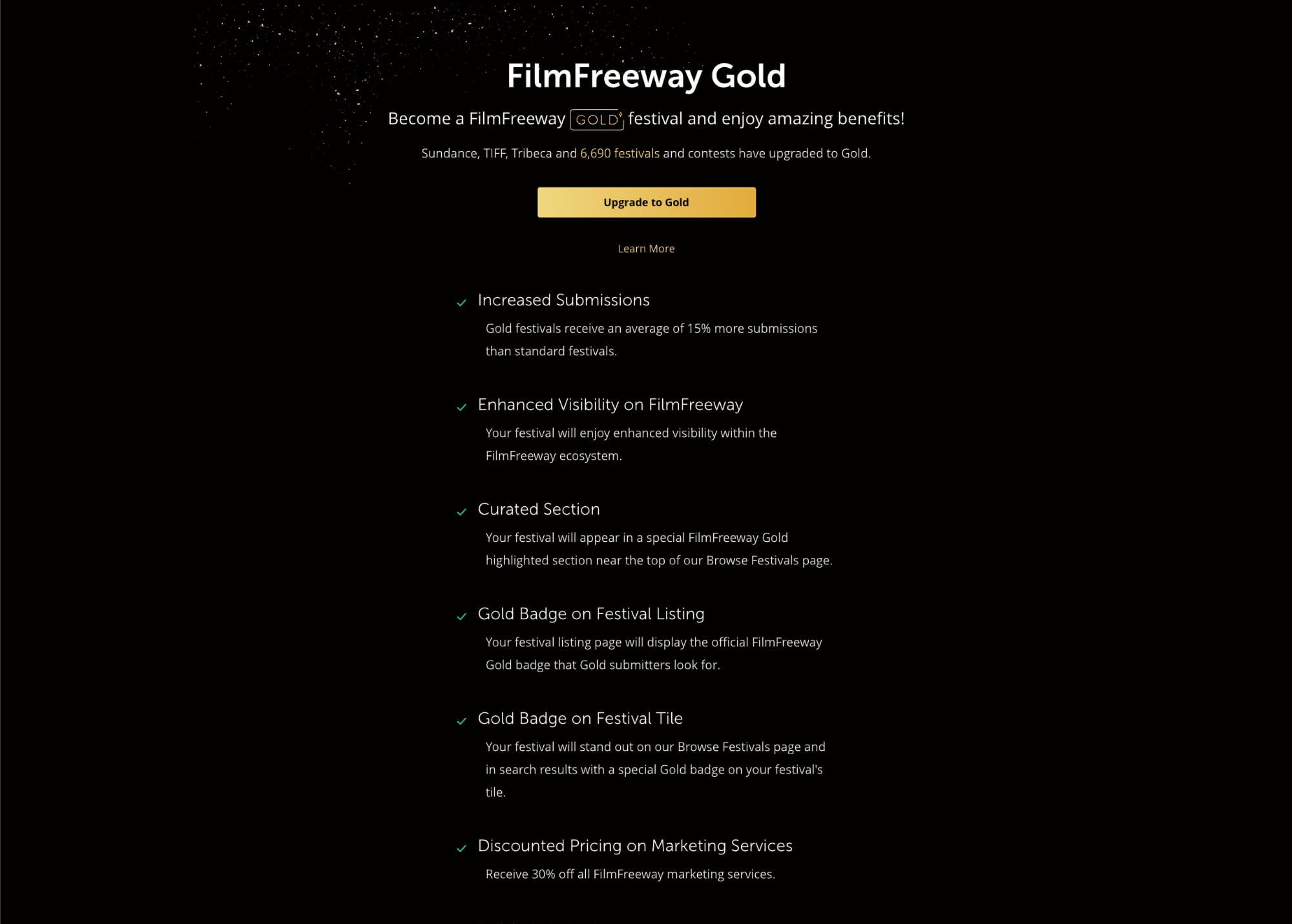
I can talk generally about it. You touched on the big three ways the business makes money. The first is through submissions. When you submit through FilmFreeway, we take a percentage of that submission fee when we pay out the festival. We facilitate all the transactions and submissions. We have a monthly process where festivals withdraw the money and we take a small cut. That is the bulk of our revenue. The other ways are Gold, where a filmmaker can sign up for reduced submission fees for certain festivals. If you submit a lot, you can save money with a monthly membership. We’re looking at ways to add more value to that—not just discounted fees, but how we can help you market your film to festivals and others. I’m excited to take FilmFreeway from just getting you to festivals, to helping new filmmakers in multiple ways. The third way is festival marketing, which is where I’m putting most of my focus right now. We have some tools for filmmaker marketing, but that needs revision.
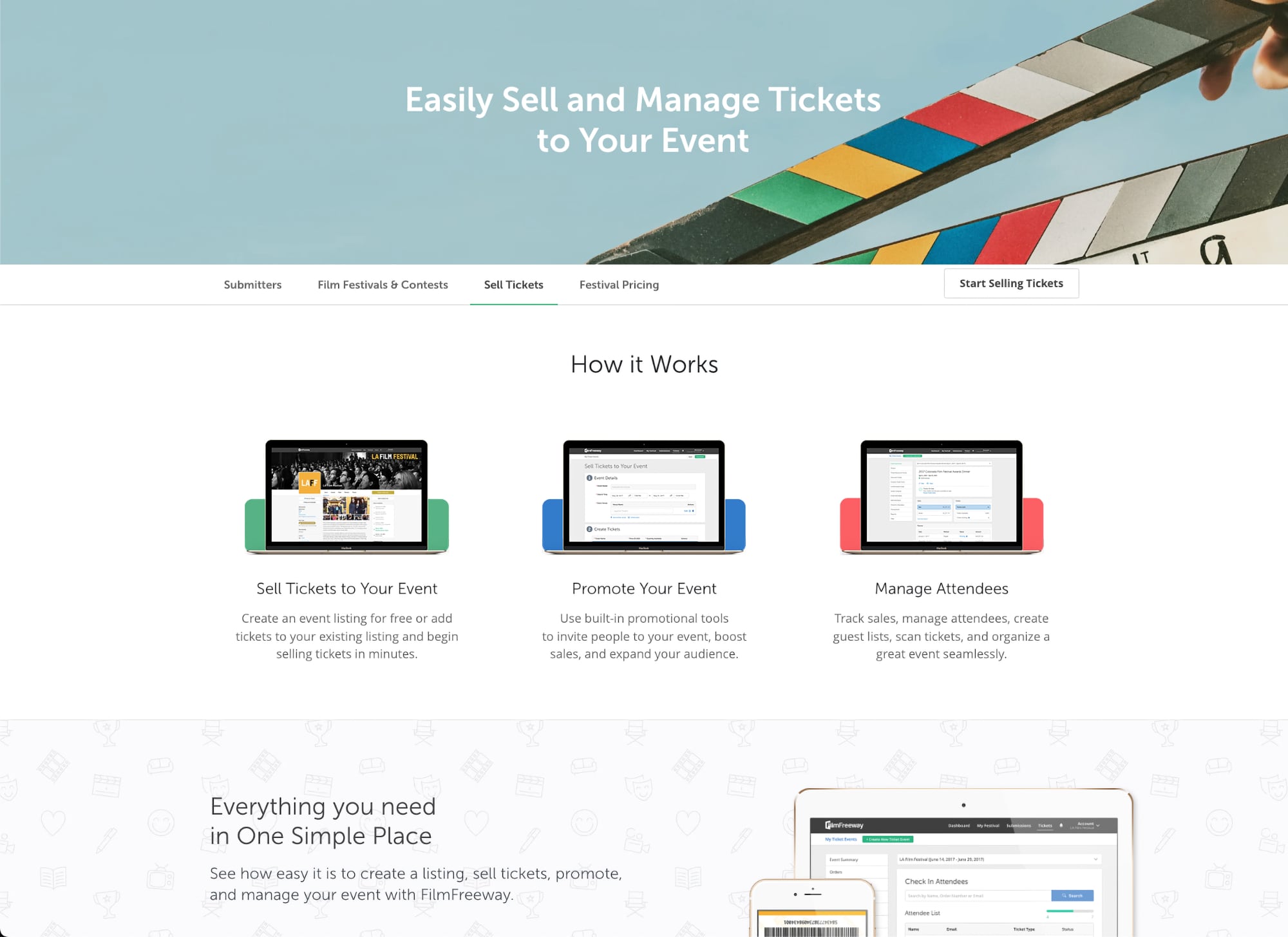
So, in order: the bulk of the money is from submissions, then Gold membership, then marketing. We’re really drilling on marketing right now because there’s a lot we can do better. When a festival pays us for marketing, I want to be able to tell them how many clicks, submissions, and movies they got thanks to that marketing. We don’t do that right now, which feels like a big gap. We’re tracking that data on the back end and working on how to show it to festivals. That’s generally how we make the bulk of our money. We have a ticketing product we need to make more investments in, and longer term, I’m thinking about other ways in the next couple of years to build new things to help.

How many festivals are there currently on FilmFreeway because even on your own site, the numbers vary?
It’s in the tens of thousands, and it depends on how you define an ‘active’ film festival. It depends on how you check the data. My general rule of thumb is, if a festival in the last year has had more than five submissions, I would consider it active. But also, some festivals don’t run in subsequent years. They may have moved their dates as well, which could mean they’re outside of that year. But the number is in the tens of thousands at this point.
When a festival pays us for marketing, I want to be able to tell them how many clicks, submissions, and movies they got thanks to that marketing.
On the marketing side, from the film festival perspective, there is a belief that without the marketing products, your festival gets lost. Can you clarify how that works? Many festivals feel they need to be members of Gold as a bare minimum because if they don’t, they won’t show up. They feel they have to pay to play. Is that something you’re aware of?
I hadn’t heard that feedback yet. That’s really valuable. I think getting filmmakers to the right festivals and not overwhelming them is one of the best investments we can make. The marketing tools are there, and we’re going to do a better job explaining what you get for using them. I hadn’t heard that festivals felt lost in the shuffle, but we have tens of thousands of festivals on the platform, so that’s understandable. We’re going to audit those [the marketing options] because I think it’s a little confusing. We probably want to do bundles or a getting-started guide and better video guides. The page is overwhelming right now. I hope we can make it better by guiding people to festivals, not just the ones that paid the most for marketing.
I think we have a very big, expansive marketplace of film festivals so we really have a gap where you’re a filmmaker in this location, this is what you want out of your film – let’s help recommend the right film festivals to you. That’s one of the biggest opportunities we should be doing, and we’re starting to work on. The marketing products will always be there, they work really well, but I think we can do a better job getting a niche film to a niche festival and pairing them together. That’s what I hope will be the answer to that problem where people feel like they have to buy the marketing, hopefully.

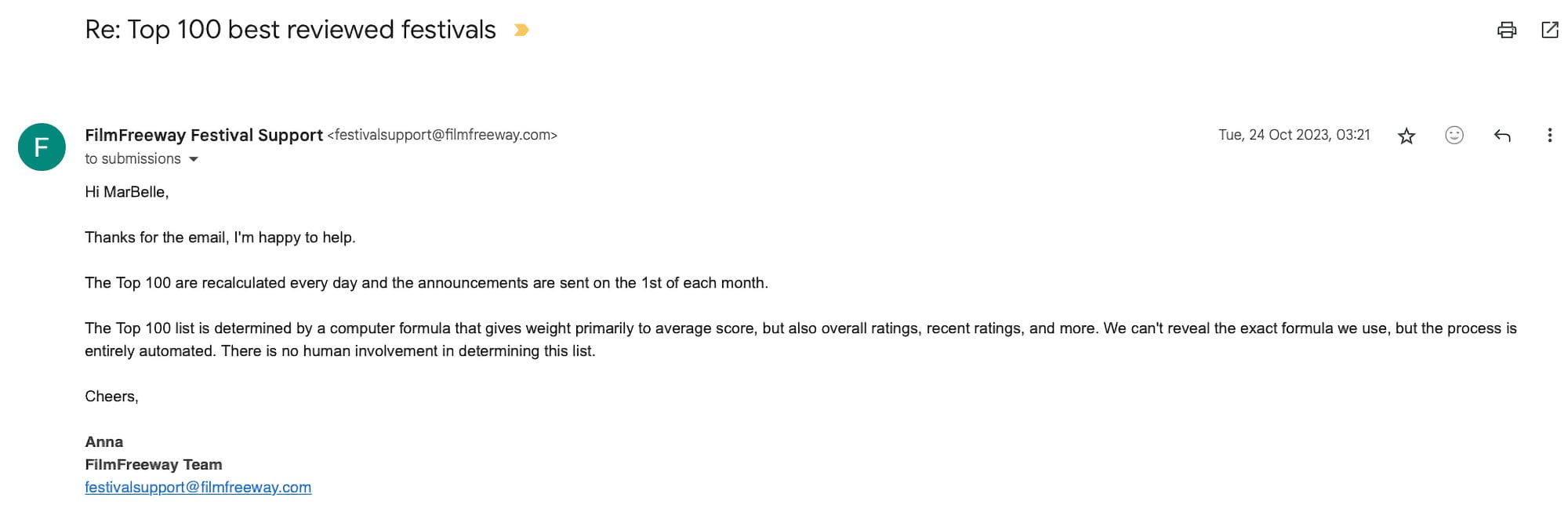
Related to that is the curated Top 100: Best Reviewed Festivals list, which is about as opaque a list as can be. Several people (including DN) have emailed support over the years asking how to get on that, noting that their festival has more reviews than some currently on the list. The answer has always been that it’s a ‘clever algorithm’ you don’t want to reveal because it will be gamed. On the flip side, festivals have been on the list for months and then dropped off without knowing why, which hits their submissions because a lot of filmmakers flock to that list. Can you tell us how the Top 100 list is compiled?
I do not know how the exact algorithm for the Best Reviewed list works. I will take a to-do right now to get you better information on that. I don’t like to say “I don’t know” in an interview, but that is one where I legitimately don’t want to speak too much about it. I’m sure it takes review data into account. I don’t know if it’s the volume, the exact star reviews, or the recency. I can dig in a little bit more and try to get you some data there. There probably is a grain of truth to not wanting to say how it works because it could get gamed. I’ve been in similar businesses where I’ve seen completely fake reviews game things. Obviously, there are ways to prevent that as well, too. Good reviews are one of the best indicators for filmmakers of a quality festival, as long as we’re sure they’re real. I do think that is an important list to understand how it works a little bit better.
*Updated 29/08/25: I wanted to follow up on the best reviewed festivals page. I looked at the code that makes it work and generally, this is how it works:
- It will only show published festivals that are currently open for entries.
- There’s a minimum number of reviews that are needed to appear over multiple years.
- The ranking in the top 100 is a mix of number of reviews, rating, and duration of the festivals.
Speaking of reviews, there’s also this idea that filmmakers may feel pressured to leave positive reviews and that any negative reviews get pushed down by positive ones. Is that something you’ve come across or discussed internally?
I have not. I’d have to check on the exact algorithm we use for what reviews are allowed. I know there are rules about who can review what festival. Previously, we did allow reviews if someone wasn’t accepted, and it went off the rails a bit. I often talk about our CX team and I just love their absolute level of compassion. It’s a vulnerable moment to put yourself and your film out there when someone says it’s not good enough. Rejection is hard. People pour their heart and soul into a movie. I had not heard about other reviews drowning out negative reviews. That happens in other businesses, but if we’re only allowing filmmakers who were accepted to review, that shouldn’t be the case because there’s no way to leave anonymous reviews. I think there are things in place to stop that.
Probably the most important concern for filmmakers and film festivals alike is the belief that FilmFreeway is full of scam festivals. What new ways of working are you implementing to go through your vast catalogue to remove fraudulent festivals from the platform?
There was a lot of discussion on this topic when I started. It’s the largest thing we’ve worked on as a team probably since I’ve been here. We put details in the Festival Focus newsletter but the biggest thing is that we put new requirements in place for first year film festivals. I define a scam as taking someone’s money and there was no event. That’s a scam. There are debates about what is a quality film festival versus what’s not a quality film festival. I think those are totally fair debates to have, but ultimately, I can’t make someone run a festival a certain way. However, we have zero tolerance for situations where someone takes money and doesn’t have an event. As soon as that happens, we pretty much know about it, and then they’re deactivated and booted from the platform for the most part, and we generally will restore filmmakers’ submission fees.
I define a scam as taking someone’s money and there was no event. That’s a scam.
The next question is—if there was any ever—how would they have gotten on the platform? So we’ve really invested in all of our trust procedures for new first season festivals. The biggest change was that if you’re a first season festival, you will not receive a payout until after your event. This was tricky because if you’re a new festival, you want to get off the ground and you need money. Historically, there was a way to get submission fees before your event, which helped new small festivals, but that is also a tremendous avenue for people to do bad things with if you think about it. You have the money, then why do you need to do the event?
Do you see that as prohibitive for brand new festivals, as pretty much all festivals run on zero margins?
It is a little bit. We wrestled with this. The reason we got okay with it is that this change is what all filmmakers wanted so they could trust festivals more. Legitimate film festivals wanted it too because they want to know that other festivals on FilmFreeway are legitimate, so users are more likely to submit and not second-guess themselves. That helps legitimate festivals. We can potentially make exceptions if it was a student-run festival or something very new. We can always talk about waiving it, but we really felt this change was necessary to give filmmakers and festivals more trust in the platform. That was the biggest change we made and it removes the incentive for scams because there’s no way to get money out if the festival didn’t happen. The money never leaves and we can refund. Previously, if there were ever situations like this, we were very clear about trying to communicate what happened.
The other change is that we brought on Entrust, an ID verification partner. For any festival now, regardless of accepting money, you need to upload an ID document and take a selfie. This third party compares them and deletes the data after six months. We can also do additional background checks if needed. Those two changes have cut down on any instances. We still have to work on the communication about it, but this is one of the most important things for me to solve on FilmFreeway. It was the first thing I started working on. I want filmmakers to trust anything they find on the platform and festivals to be confident they’re getting all the submissions they can get because users don’t second-guess the validity of their festival. We’ve made a lot of strides, but any feedback is still valuable. I want to be careful to still value and help new film festivals because this change could be detrimental to them, but it was something almost our whole user base wanted.
Does that mean you’ll be doing away with the $100 activation fee and the $50 relisting fee now that you have these more robust measures in place?
We’re keeping them as well. Another thing that can happen is that someone gets access to a festival that wasn’t going to run a subsequent season and could do something malicious. Verifying a credit card each season helps ensure the original account owner or someone related is still running the festival. It’s part of a fraud mechanism. If someone got access to a festival that decided not to run a new season, they could make a fake new season that looks legitimate. Putting the credit card step in there makes them put a name and a charge to it, making it easier to detect if it’s legitimate. That’s why it’s there for subsequent seasons.

But the result of a relisting fee for an established festival, which isn’t a scam, is that it’s just an additional fee they have to pay.
Yes. That’s a business rule that was put in place before I was here. We could look at it potentially, but it’s also a mechanism to ensure someone didn’t gain access to the account and is just going to run it to withdraw money. For second or third season festivals, we’ve waived the requirement to wait until after the event for payout. If someone got access to your festival and you didn’t want to run it next season, they could make a new season, get all the money, and immediately withdraw it. That’s a real risk. We only do the ID policy and verification for first season festivals. People can get access to festivals and make fake seasons; that’s happened previously. The credit card charge helps us determine it’s a real season.
Another concern for filmmakers, alongside fake or scam festivals, are awards mills. Festivals with 30-40 categories that encourage filmmakers to enter as many categories as possible, offering package deal discounts if you submit to multiple ones at once. Is that on your radar or do you see it as not problematic?
I think it’s up to someone who runs a festival how they want to run it, as long as they communicate clearly how the mechanisms and awards work. And it’s up to filmmakers if they want to submit to it. Ultimately, I don’t want to be the person who assigns an A – F grade to a film festival. I don’t think that’s fair to film festivals. I don’t think I understand everything they deal with. I don’t understand all the nuances. A festival might have a bad first season but then has a great subsequent season. Some filmmakers may want awards and that’s all they’re after. It’s up to them what festivals they apply to and what they get out of them. If they are actually giving out awards, depending on how they conduct themselves, I generally think it’s okay.
It’s up to someone who runs a festival how they want to run it, as long as they communicate clearly how the mechanisms and awards work. And it’s up to filmmakers if they want to submit.
It’s up to the filmmaker to do a little bit of research to determine if that festival is what they want for their film. It may or may not be. Some may want to get a little bit of feedback and get one award to help out with their PR cycle or things like that. If they are actually running the festival, presenting awards, I generally think it’s okay to be on the platform. We only list festivals with certain kinds of criteria publicly. I think that’s up to filmmakers and festivals to negotiate, to be honest with you.
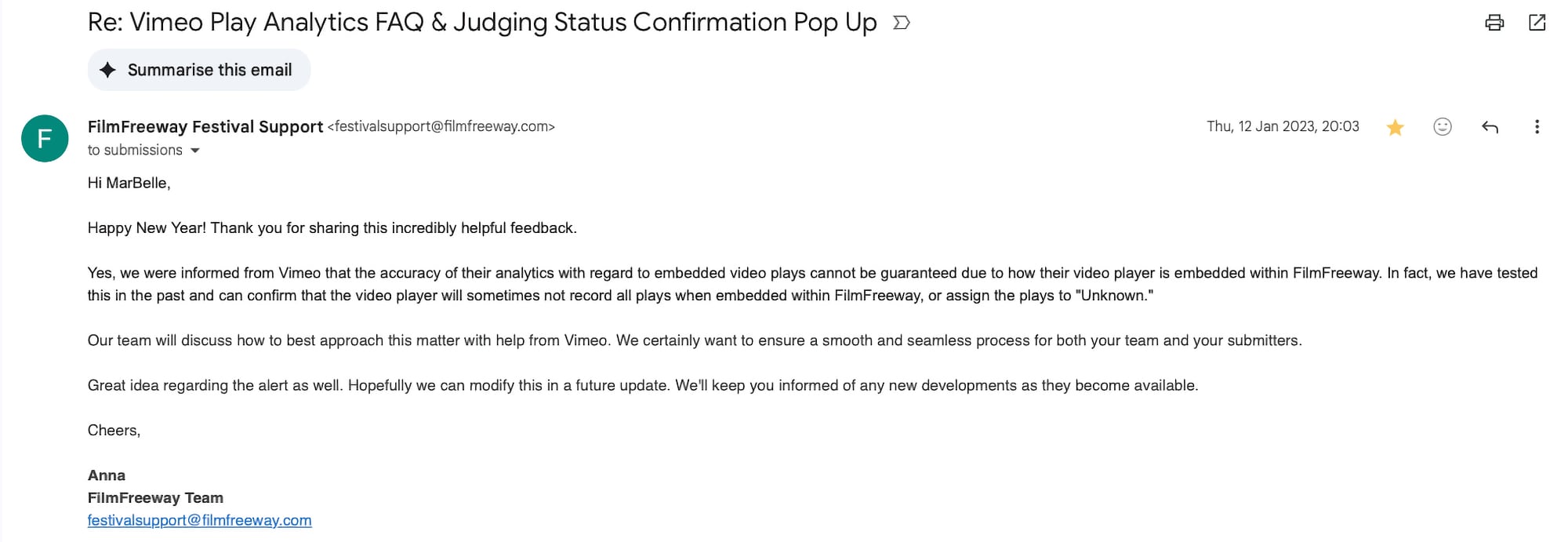
A recurring technical issue that leads to conflict between festivals and filmmakers is Vimeo analytics and the fact that Vimeo embeds on FilmFreeway don’t necessarily result in actual view counts. This throws fuel on the fire of filmmakers accusing legit festivals of being grifts that take their money without actually watching their films, which isn’t the case. Is this something you’re aware of? Is there a technical fix or a way to educate filmmakers?
Yeah, this has come up a little bit. I’m happy to run a platform to help filmmakers submit their films and for festivals to take submissions, assign them to judges, rate them, and communicate acceptances. Unfortunately, I can’t police what a programming or selection committee does for a film festival. There’s no way I can put monitoring tech on their computers. I don’t know if these are stats issues with Vimeo or if someone didn’t watch a video. There’s no way, technically or operationally, to police that. It’s up to the film festival’s programming committee how they run it and talk to their judges. I can’t get into the mechanics of how a festival runs their operation or tell them what to do. But I have heard that feedback before.
Katie over at Festival Formula wanted me to ask if there are any plans on the platform to highlight premiere requirements for various festivals front and centre, so filmmakers can clearly see those requirements to help them plan their festival strategies.
That’s a new one, but it’s one of probably 20 things where we can do a better job filtering film festivals. If I look at our page there with the grid up top, it’s overwhelming, especially as a new filmmaker. Even if you’re an experienced filmmaker, it’s probably still overwhelming. I didn’t have that feature in the bucket, but I know we need to do a much better job with filtering: these are all the festivals, this is how you filter, these are the ones more applicable to you. It’s definitely an area where we need to do a better job with the metadata we have about each festival and how we surface them to particular filmmakers as well. That’s one of the biggest things we can do to help both filmmakers and festivals because it is overwhelming to traverse all the festivals on the platform.
What are the key elements you’re focusing on for improvement that you can share?
The biggest thing we’re working on is festival marketing. We can do a better job with that. We’re working on a public-facing redesign as well to put a better foot forward. We just did a session on how to get new users to set up their project faster and find their best first film festival. That’s a big source of opportunity. There are a lot of fields in the project creation workflow; we don’t really need all of them right away. We want to get someone in the door, set up with a project, get excited, find the right festivals for them, and then, before they submit, say “You might want to put these details on your project”. Right now, it’s a big overwhelming wall of, add these 50 fields, then maybe look at festivals. I think that’s the wrong way to keep the excitement for a new signup. Someone signs up, they want to see what’s on the platform. It should be: let’s get you set up quickly, suggest some good festivals for you, get excited before you submit. You’re more likely to be accepted if you add these fields. We’re working on that right now.
We’re thinking about how to make Gold membership more valuable as well. What other features can we offer filmmakers? It’s mostly about marketing. So we’re thinking about other ways to help filmmakers market their projects beyond just festivals. I’m starting to think a lot on that. Also, some big in-house tech upgrades that will let us build features faster for all of our users.
I noticed in the General Manager job listing you applied for, it mentioned expanding into new verticals. Your predecessor had spoken about different services filmmakers need, like DCPs, which are expensive and tricky. Is that something you’re looking at? Are there any extra value-add-ons you’re exploring that would be accessible to your community?
Yes, definitely. I’ve had discussions about DCPs. We’re talking to a potential partner about that. A DCP is theater quality for the final showing, but for submissions, many smaller festivals don’t want to deal with DCPs initially; they just want judges to view films. But we are talking to a partner who does DCP encryption for industry partners about adding that as a value-add. It’s another sign of professionalism for a filmmaker. The more buttoned-up you are, the more professional you present yourself, the more likely you are to be successful. We’re looking into that. There are lots of other partners we’re chatting with about potential additions.
We’re thinking about how to make Gold membership more valuable as well. What other features can we offer filmmakers?
FilmFreeway can be about helping filmmakers get to festivals, but I think there’s a lot we can help with marketing. Can we easily let you make a mini-website to promote your project? You have your project page, but can we do a better job making that an actual small website with good SEO so when you’re the hot film at Sundance and people Google you, does your page show up quickly? Can they find how to get in touch? I think we can do a lot more there. You’re going to the festival, congratulations! Now, let’s set you up with other things to help market yourself during and after the festival. Filmmakers are passionate about their projects but might not be about marketing. We can step in and help with stuff they’re not as interested in so they can work more on movies. There’s a lot we can do: digital press kits, easy add-ons that are there when they need them. That’s the biggest thing I’m excited about building.
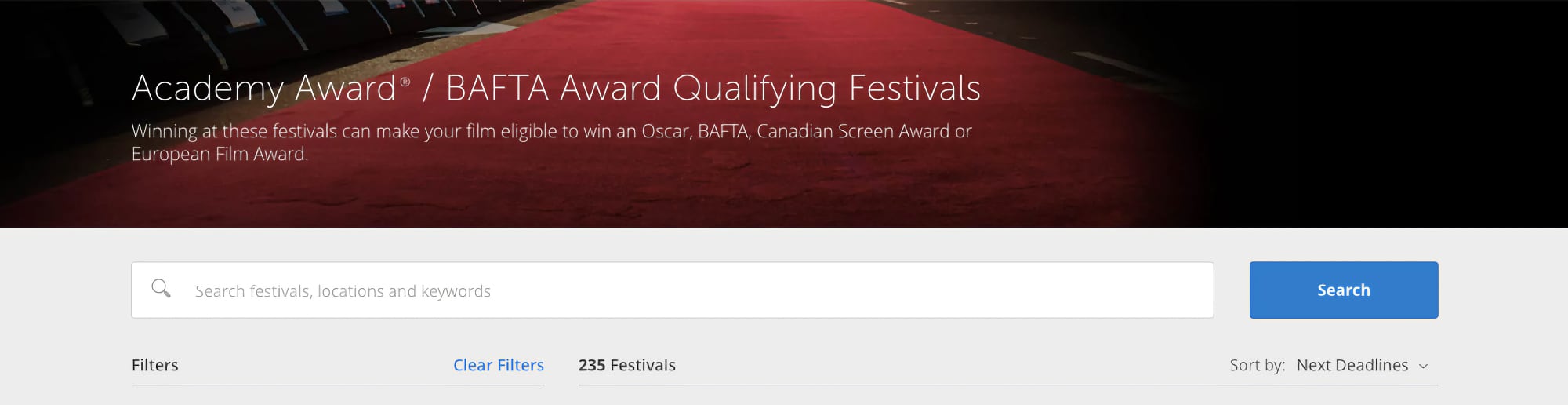
You currently have your Academy & BAFTA Award Qualifying Festivals list, are you actively working with other awards bodies like BIFA to expand those?
We’re always looking to expand those listings. Adding those badges and filters is a no-brainer. Those organizations promote film. Filmmakers want to know where they can best apply. They may be overwhelmed, but seeing a list of all BIFA festivals helps them figure it out. We usually have one of those we’re working on at all times. We generally will just say, we can add the badge to your listing. We talk to the partner organization and make a page filtering so they can list all their festivals in one place. We’ve done two or three since I’ve been here.
Is there any advice or insights you have from the data or FilmFreeway team on best practices for both filmmakers and festivals?
I’m still traversing that data; we have a lot of good data, but there’s always more to data, right? The two things I’ve noticed: the more complete the details about your project—do you have a trailer, the director credits, all your other credits in place—the more professional your listing looks, the more likely you are to be accepted. On the festival side, there’s no substitute for communication. Making time for anyone who emails with questions about the submission process or if their film is right. Nothing beats communication. For festivals, making time for anyone who spends money to submit, addressing their needs or questions. The communication piece from festivals goes a long way to helping them succeed.
And finally, is there anything you’d like to say to the existing and potential new members of the FilmFreeway community to get them excited about what’s to come and allay any concerns they have?
We have a lot to do for both filmmakers and festivals. I’m still new here. I can only use that excuse for a year, maybe, I feel like I have three more months, then I have to stop saying that. We’re a smallish team, but we’re really sensitive and take our responsibility to festivals and filmmakers seriously. I’m passionate about people pouring creativity into a film. Let’s make sure we get you to the right festivals and help navigate that process.
Similarly, festivals are there mostly out of passion. There’s some misperception that they’re making boatloads of money, but they’re passionate about film and helping new filmmakers. I want to be clear that we’re here and sensitive to both groups. I’m available to chat with folks as needed. Our customer service team is fantastic; they take the same responsibility I do. There are a lot of new things we can build to help both groups. We’re going to be listening, building, and I’ll try to communicate a lot more with filmmakers and festivals about what we’re up to. I’m excited to talk to everybody.
Matt, thank you so much for spending the time to speak to the film community.
Thank you, MarBelle, for the time and the tough questions. I appreciate it.