
Petticoats, pistols and lavish hats are just the surface of the Georgian world of Satisfaction from multi-DN alum director Bailey Tom Bailey’s delightfully playful venture into period filmmaking, telling the tale of an aristocratic duel fought between a society lady and her mentor over a trivial insult in 18th Century England. Writer Christopher Buckley adopts a revisionist lens, inspired by the hidden history of ‘Petticoat Duels’ – real duels fought between Georgian women – shining light on a ludicrous ritual of class, honour and social status. With razor-sharp wit, meticulous composition, and a thorny Baroque score, Bailey brilliantly transforms the stately displays of aristocracy into a tense, theatrical and fiercely feminine showdown, without losing sight of the comic absurdity at hand. The tonal balance on display is delightful, elevated further by exaggerated costume design, heightening the contrast between characters’ distinct personalities. Bailey returns to Directors Notes to discuss his integral storyboarding process, the foundational influence of his fine art background and scheduling around every film crew’s worst enemy: unpredictable weather.
What drew you to Christopher Buckley’s brilliant script?
Christopher Buckley (who is also an actor seen in Stranger Things: The First Shadow) and myself connected through Centerframe’s Get It Made competition. Chris’s focused 5-page script caught my attention with its spin on the conventional duel with bold characters, funny conflict (the hat) and wonderfully textured Georgian slang that I kept having to look up, but gave the world a strange, specific energy. It was great fun, and I saw a chance to create not only a comedy-drama but a thriller as well.
Thematically, we became interested in the way a rigid society had warped a close friendship into a rivalry.
I am fascinated by Satisfaction’s revisionist lens. How did the historical truth of petticoat duels shape the narrative?
Chris read about petticoat duels; rare but real instances throughout history when women fought one another in formal combat. Some instances include topless (so as to save their dresses) sword fights, which would have been even more transgressive but probably wouldn’t have gotten shown anywhere! Chris even found a satirical cartoon of two Georgian-era women duelling with pistols and the story unfolded from there. Thematically, we became interested in the way rigid society had warped a close friendship into a rivalry, so the arc of the story became about two women realising this absurd inhumanity and reconnecting with their compassion. Putting humanism before social structures is as relevant now as then.

The duel has real psychological tension. How did you approach directing their showdown?
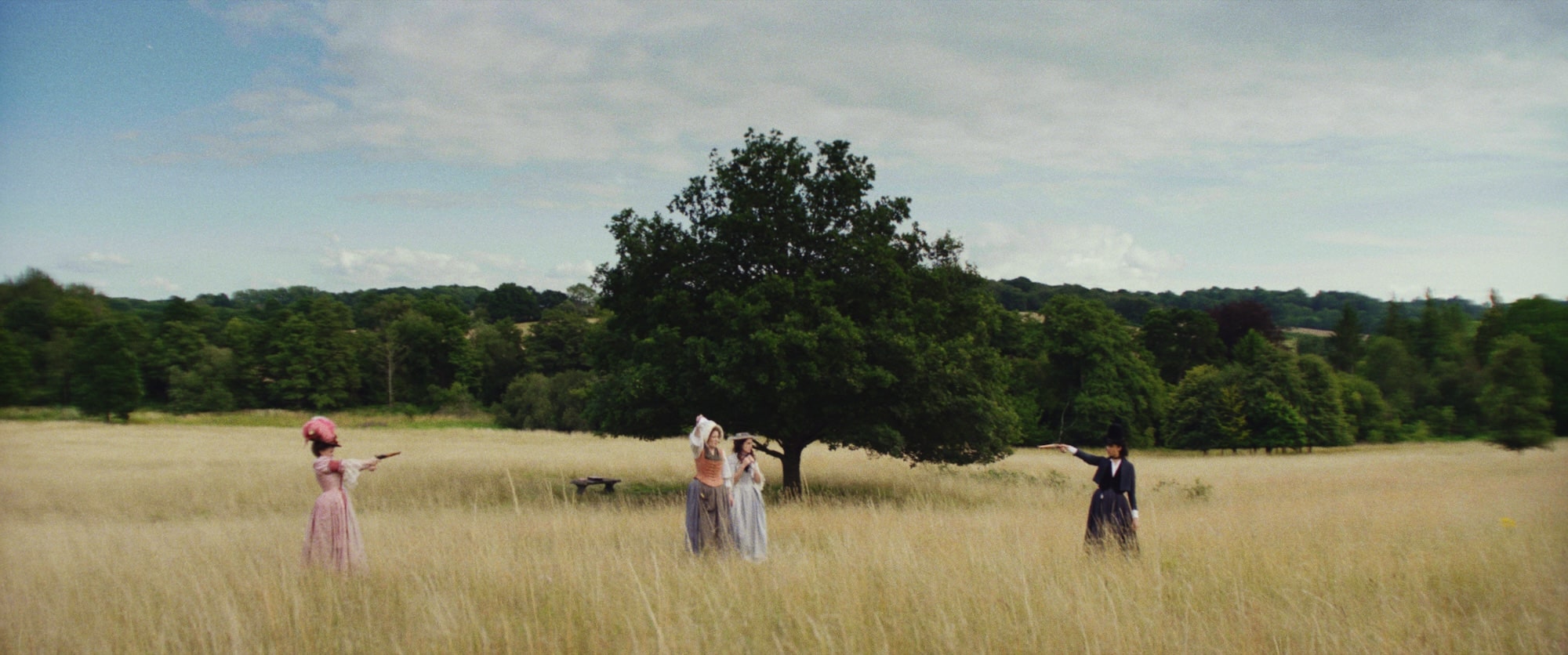
As the script evolved, I pushed for the duel itself to be expanded, adding an extra round with an injury to build the tension and make clear the absurdity of the manners of this ritual, where pride continued to overrule common sense even as the danger became more tangible. I wanted to lean into the duels’ comparability to a Western shootout and took cues from Budd Boetticher and Sergio Leone’s playful, near abstracted approach that stretched time, and moved the altercation into a psychological space, often with a surprising ending. Though I had to be careful not to tip over into parody, as often happens with this style.
Most Popular
Costume plays a large role in the drama. Could you tell us more about your collaboration with Molly Langford on that aspect of the film?
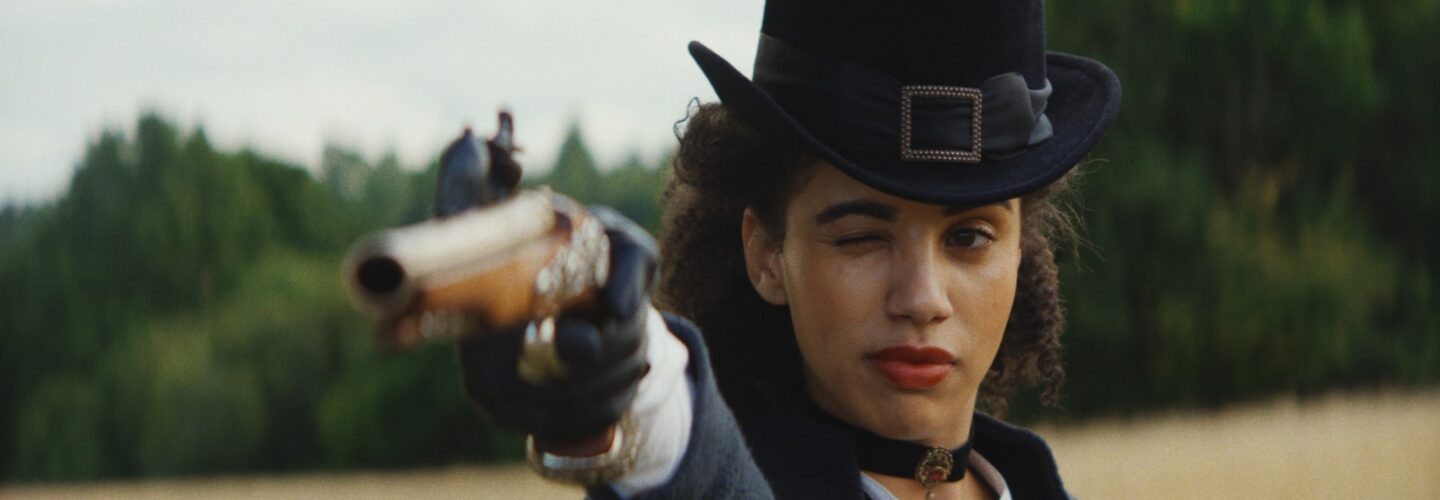
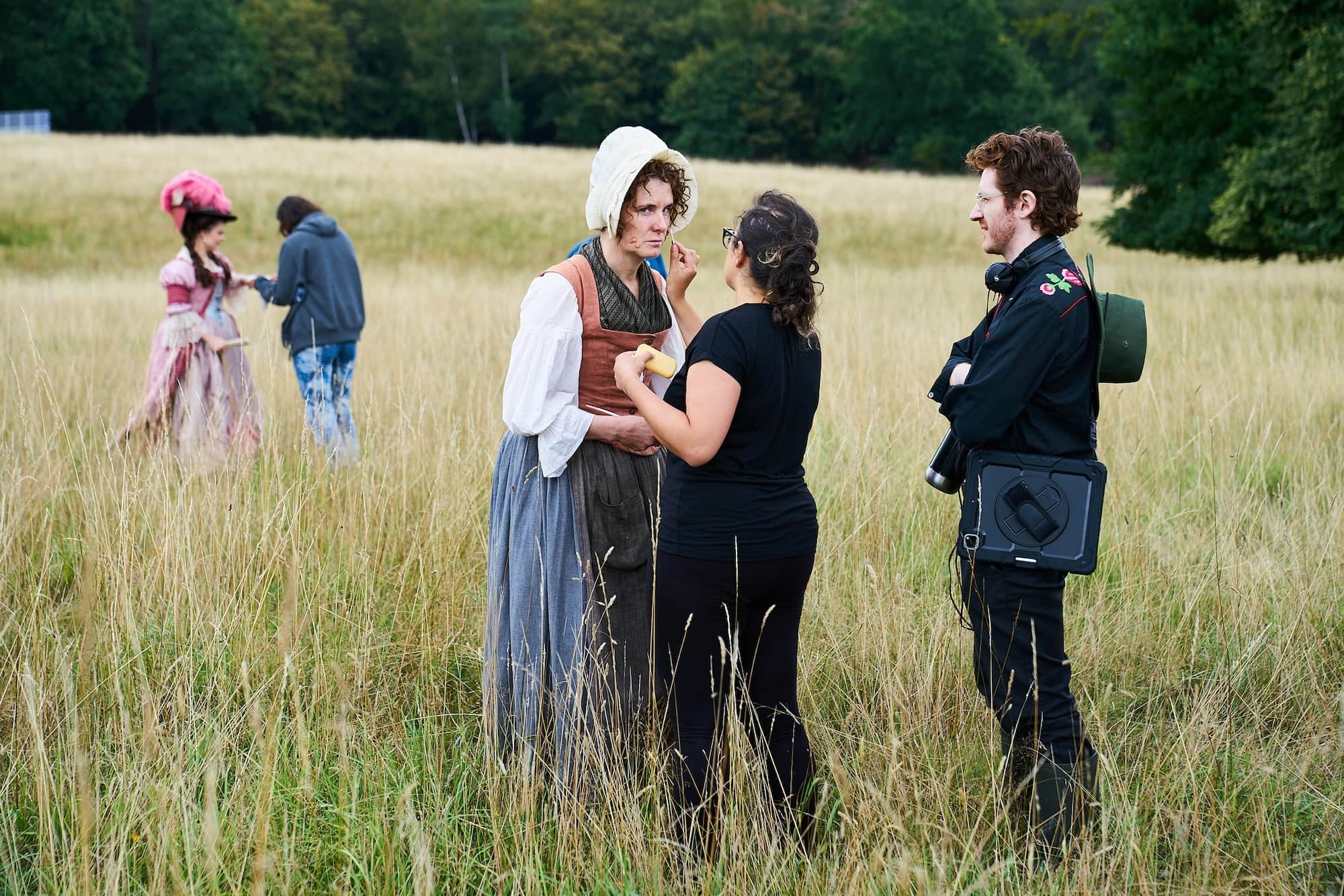
My main concern was to create bold, distinct characters, and create blocks of colour with each character that would set the colour palette for the film through the costumes, as there were few other means to control it. Molly Langford, our costume designer, who worked in the costume department for The King’s Man, The Nevers and Little Women, complemented and complicated my brief to keep things bold and simple in the best way possible, adding greater depth to the designs. She also latched onto hats as a central motif defining each character. Verity Elphinstone (Gwyneth Keyworth) became a big pink birthday cake. Belinda Allendale (Ellie Gallimore) was to be very grave and a little militant, all in black. Ann Scoley (Michele Moran) was earthy and almost a scullery maid. Olivia Kettwood (Mia Khan) was fragile, feminine and pastel blue, contrasting with Verity’s pink.


Your fantastic cast craft performances that balance heightened comedy with tense drama. What was your process for directing these performances like?
It started with casting, I was keen to have actors who could make big choices for bold characterisation without losing authenticity. I find actors who have done a lot of comedy great at this. Our casting director, Chloe Blake, who has worked extensively with the National Theatre, was a great collaborator with an overview of new and established British talent. She was very patient with me as we explored various options. We managed to land a great cast with BAFTA Cymru nominee Gwyneth Keyworth (Death Valley, Misfits, Alex Rider, Aaron Sorkin’s To Kill a Mockingbird) and Michelle Moran (The Witcher, Doctors) opposite new(er) comers Ellie Gallimore and Mia Khan.
I was keen to have actors who could make big choices for bold characterisation without losing authenticity, I find actors who have done a lot of comedy great at this.
In prep with the script, I tried to define the line of action and tonal shift from funny to brooding and perhaps even moving. When thinking about how to prevent the stylised language overriding the emotions of the story, I re-watched Sweet Smell of Success, a noir-drama that the director Alexander Mackendrick (a Scot making his first US film) said in his book On Filmmaking was a very ‘wordy’ script. But its writer, Clifford Odets (an influential New York playwright), told him, “Just do it fast”. I thought about that when dealing with the language of Satisfaction. They needed to just throw it away.
In calls, rehearsals and costume fittings, I briefed the cast on the kind of performance I wanted and discussed their characters’ objectives and any revealing business (minor actions, fidgets), so we had lots to play with. Then in rehearsals we got comfortable with the stylised text, tried to hone in on the emotions underneath and explore any questions. When working on her accent, I probably piled too much contextual history on Gwyneth, which she took patiently but eventually said, “Leave it to me”. On the day her accent was phenomenal. Everyone made bold choices on set. Michele was able to be funny just standing there, Ellie was more severe than she had been and Mia more hysterical than I had imagined. Moments between the rounds of the duel were fleshed out with moments of improvisation.



Your journey as an artist began in Fine Art. Do you feel your background in painting has shaped your approach as a director?
Definitely. Painting has, of course, taught me about colour and composition but it’s pretty hard to be a painter in the 21st century and not be influenced by 50 years of conceptually heavy art, so principally fine art affected the way that I think about things. It taught me to try to communicate and affect emotion by translating ideas into imagery, soaked with personal associations, filtered through a wide variety of reference points (yes, largely movies nowadays, but also painting, photography, music and culture) and a focus of theme.
One of the differences coming up through painting rather than through photography or theatre is that you’re creating the image from scratch and so every part of it is filtered through you and has your (sometimes literal) fingerprints on it. Everything in the artwork is a choice. I love that and I love to see the artist’s brushstrokes. This is why I’m always thrown when someone refers to anything camera or craft based as ‘technical’ or asks if I’m “more into style or content.” At their best, technique and effect are inseparable.
Everything in the artwork is a choice. I love that and I love to see the artists brushstrokes.
The cinematography is gorgeous and contributes so much to the film’s tension. How did you and Simon Stolland develop that visual language together?
We wanted the design and photography to be bright and colourful, contrasting with the violent actions being far too lightly undertaken. In terms of the overall look, I started with what I didn’t want. The original script described a beautiful park, but when I imagined bright period costume on green grass, for reasons I can’t completely articulate, it seemed too modern and clean. I felt it would look like we were playing dress up. So I thought about exterior images I did like: Andrew Wyeth’s paintings and Terence Malick’s Days of Heaven. Both looked wilder and had khaki fields whose colour receded more than green, creating a more balanced contrast with the pops of colour from the costumes.
Myself and regular DP Simon Stolland decided to shoot on the new Alexa 35, which was billed to have great colour rendition, and paired it with JDC Cooke Xtal Xpress anamorphic lenses, which are known to have a lot of odd aberrations and gave the image a bit of grounded texture, countering our stylised composition. The front half of the film was very wordy, but I’m always looking to convert words into action, so I focused on blocking to make the relationships felt not just talked about. I’m heavily influenced by the evocative but simple interaction of actors and space in films from the 1940s to the late 60s, when it went out of style. The duels were shot quite simply but the way we used them in the edit helped to move us into a psychological space. Borrowing heavily from Sergio Leone, we moved in closer and closer to the eyes, letting everything else disappear and held shots in the edit, while the music represented the unseen dimension of emotional and tension.


What does the storyboarding process look like for you, and how strictly do you stick to your storyboard on set?
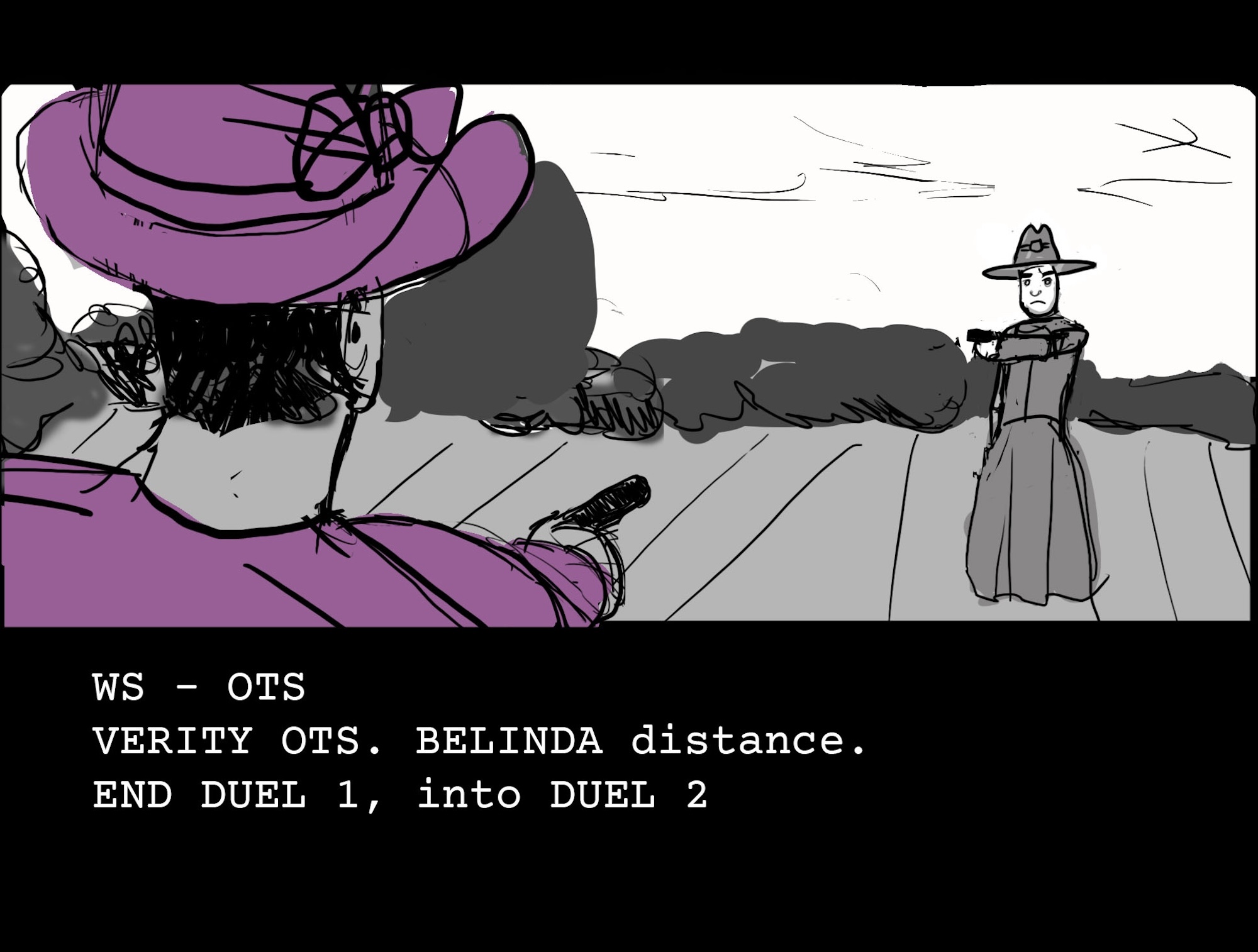
The storyboarding process for me is like another rewrite; it forces you to define your edit and shot choices in detail so you really have a plan. I discover things when drawing and need to re-draw often, but it’s better than scratching your head on set. They’re super helpful when scheduling and having conversations with HODs about how we’re going to do things. I start from the script, nailing down what’s in my head into a shot list. But a shotlist can be very abstract. People can interpret them all different ways and I don’t want to be reading description on set. I want a picture, which is more concrete to me, so that I can show it to the DP and say, “Like that.”
It’s also very easy to swing the camera onto the actor and everyone says “looks decent”, and when you want another angle they say, “you covered it already,” ignoring the fact that those different shots and angles mean something different. So you are pushed to just shoot coverage. With storyboarding, it forces you to consider the function and composition of each shot in a less stressful environment, and shows everyone there is a plan and reason for your shots.
The storyboarding process for me is like another rewrite, it forces you to define your edit and shot choices in detail so you really have a plan.
We stick fairly close to the storyboard but things do change, they don’t look right when you put a lens on it, or someone gets an idea, or the actor does something that means you can convey more in a single shot rather than cutting. But most often, things change because we run out of time. Regardless, it’s a great basis for the shoot and helps you conceptually understand what you need for the edit. Though I have to admit to dropping this process on some recent music video projects where it’s very performer-led and they often want it shot within two weeks so I don’t have time to prep as well.




Did shooting in such a stunning and elaborate, yet very open, location bring any challenges to the production process?
Yes, shooting outside all day in the UK was my greatest anxiety. We thought a lot about how to schedule the day to work with the direction of the sun, but we could only pray the English weather held out. As we approached the shoot, rain was forecast for our second day, our location panicked about us traipsing mud inside, but shifting everything didn’t feel realistic. So we crossed our fingers – and the gods laughed. It poured. Most of our second morning was washed out. Luckily, I had the help of my 1st AD Ben Keswick to manage this potential disaster and we shot longer on day one to hedge our bets, and on the second day we pivoted to covered areas for close-ups before managing to grab the remaining key shots during a brief dry window at the end of the day. Our very dedicated colourist, Myles Bevan of Studio RM, did an incredible job balancing out sunsets and overcast skies to give the film a consistent feel.
You’re now developing The Petticoat Duellists series. What can you tell us about the project, and what is exciting you most about expanding these characters?
Myself and Chris are having exciting conversations with commissioners as we develop a limited series based on the short called The Petticoat Duellists, which follows Belinda as a fallen woman who teams up with Ann to become duellists for hire, traversing between high and low Georgian society and fighting for women’s honour.