
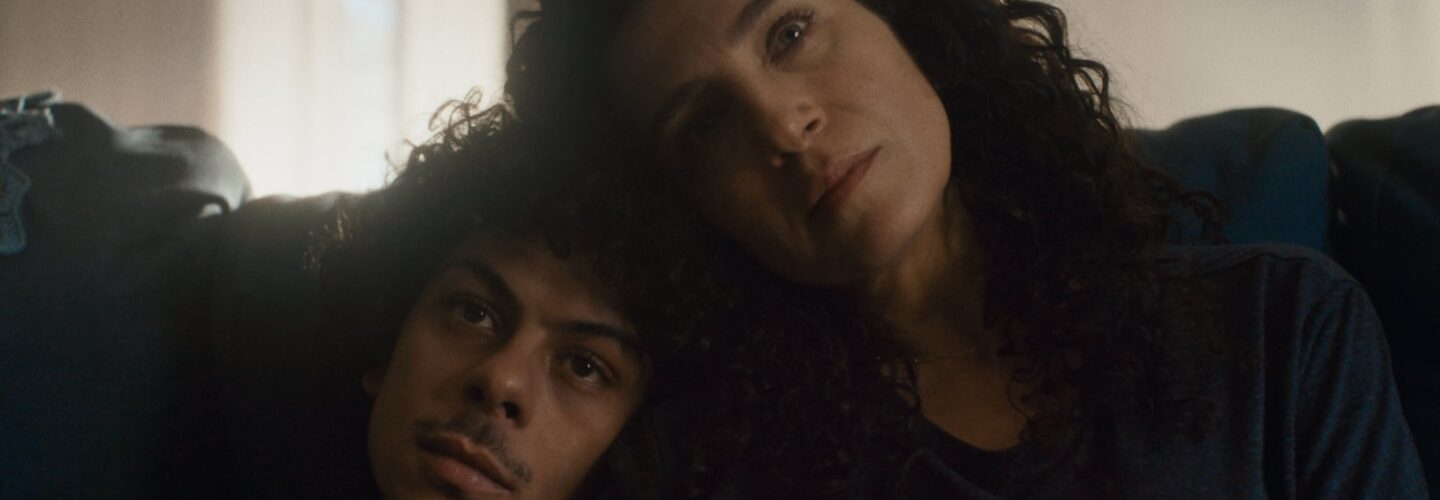

In Zain Duraie’s debut feature Sink, which I caught during this year’s BFI London Film Festival, love becomes suffocating. The Jordanian filmmaker constructs her thrilling psychological drama around sustained unease—moments stretched to breaking point, conversations that vibrate with barely contained threat. The film follows Nadia as she navigates her teenage son’s undiagnosed mental illness, but this isn’t simply a story of crisis; it is an examination of a mother’s devotion that even the foreboding spectre of escalating violence can erode. Working closely with DOP Farouk Laâridh, Duraie employs deliberate framing to trap her audience in Nadia’s psychological state. Constrained angles and static wide shots create a visual language of denial—corridors that narrow, spaces that refuse release. When physicality erupts, it shatters the carefully maintained calm with visceral force. This is tension built through restraint, through what remains unspoken until there is no space to hide. Sink also represents a meaningful departure for Jordanian cinema. Duraie resists crafting the kind of film international funders might expect from the region, instead pursuing something both interior and universal. Her insistence on telling this personal, psychologically complex story positions her as a distinctive voice refusing to conform to prescribed narratives. As Sink continues on its festival journey, we bring you my conversation with Duraie, recorded at LFF, where I speak to the writer/director about creating knife-edge tension through claustrophobic framing, employing a constrained aspect ratio as a direct expression of psychological fracture, and relying on gut feeling to find the film’s slow-burn rhythm in the editing room.
[The following interview is also available to watch at the end of this article.]
I would love to know how you knew you were ready to dive into Sink and make your debut feature.
I think it was a calling; it’s a very personal story, and I felt the need to recount what was burning inside of me. I wanted to make it a feature, and I have a lot to say. So it’s just an instinct. It’s like when you’re ready to have a kid.
There are concurrent strands of deep thematic exploration in the film but at the heart, it is about a mother and her son. Your actors, Clara Khoury and Mohammad Nizar, delivered such spectacular performances.
Clara is a very special actress. She is quite well known and obviously visually stunning. I was so impressed by the way she was interested in the script, in the character, and by her bravery in performing this crazy, unpredictable mother. She was willing to do anything; her role is very physical in the film, and she embraced all of those moments. For Mohammad, playing Basil, my producer suggested him to me. We went for a coffee and just had a conversation; I could feel his talent just from him talking. I didn’t audition him; he just got the role. Then we were preparing for three years.
That’s a long lead time.
I was giving him the story bit by bit over the years. He’s a very hardworking actor; he does his homework so well. He was reading a lot of books, doing a lot of research, and was very curious. I was talking to him about the story and telling him about some scenes that I’d been writing. Then, eight months before the shoot, I finally gave him the final script. He was really shocked when he read the story and then started doing even more inner work on Basil’s physicality, working on the emotional beats and his physical gestures.

The film’s tension is palpable, often hanging on a knife-edge of physicality. Was sustaining that a key intention from the start?
For me, the tension in the film rides on the question of “When is this going to explode?” That was very much my intention. I’ve been going on about this for two days, but I love Charlotte Wells. After watching Aftersun, when I was still in the process of writing, I broke down. That is what I wanted. It was the subtlety and nuance that I wanted. I was crazy enough to say that I wanted to make the Aftersun of the Middle East! Both films are very personal stories; we have so much in common in terms of what we want to share with the world. When you have something so personal, it becomes a shared pain with the world. This is what I wanted to do; it’s a very universal story and it could connect with anyone, anywhere.
I wanted to show her denial through those angles, through those wides, through those corridors.
The film’s visual language is so deliberate, particularly the framing. Can you talk about your collaboration with your DOP and the visual approach to the mother’s psychological state?
First of all, shout out to my amazing DOP, Farouk Laâridh. He’s super-talented and I was lucky to have him. I always wanted my focus to be less is more. I didn’t want to show much and didn’t want to be so traditional in the filmmaking. Because we’re in the headspace of the mother, I wanted to show her denial through those angles, through those wides, through those corridors. I wanted that to intensify when the aspect ratio opens in the film. I wanted to build that through claustrophobic angles because it’s all about building these angles of denial. I was so focused on her psychological state.
Most Popular
I have to ask about the recurring motif of water and its importance to the narrative.
Sink—we’re sinking into the water. The title in Arabic means drowning. I wanted to show the psychological state of Nadia sinking into her son’s illness, using the water as a method of cinematic symbolism, my kind of cinematic language. I wanted to use the pool. We open with the pool shot; we can see it is part of his routine so it becomes a very significant place psychologically for both of them. I wanted to have the camera dropping in and out of the water; it’s all in her head.

At the same time, the pool offers us moments of relief from the tension that we are almost choking on. I’d love to know more about building the pace.
My editor, Abdallah Sada, is just brilliant. He is so smart and was almost my other half in this film. We were together for three months in the editing room. Between us, we found the heartbeat and the pace together, but we doubted everything. We were constantly going back and asking each other what would work, working with our gut feeling. We dropped the script and didn’t work chronologically.
I personally don’t like editing to the script, I think that the script is a phase that ends after the shooting. Then, when you’re in the editing room, you’re rewriting, and you’ve got to be as radical as possible and solve the puzzle. So we did play around; we shuffled a couple of things, but we found the pace. We knew it was going to be a slow burner leading up to a crescendo. It was going to be the type of film that picked up on its own and I just had to believe that. The first 30 minutes are just slices of life and then it blows up.
I personally don’t like editing to the script, I think that the script is a phase that ends after the shooting.

I feel there are so many different paths you could have taken us down, but you chose to end on a positive note.
That was very important to me because I wanted to show all patients with mental illness that there is hope at the end of the day. That was my personal experience: when you have so much love, there’s hope. Even if things are going to be hard, this mom holds his hand at the end and she says, “I’m with you.” The dialogue is so restrained in the film, but that look she gives him at the end was it for me. I just knew that this was what I wanted to end on. I never intended to propose any grand solutions; I didn’t want the kind of Xavier Dolan ending. I wanted this to be subtle.
Artists are not social workers; we’re also humans who are going through these complex emotions and we’re always trying to find the emotion rather than a solution—that is my kind of cinema. I wanted to end with this strong emotional beat and just leave you there. For me, that is more important than giving you the solution.

I really want to return to how you crafted that pervasive, palpable tension.
The performances were the biggest priority; we were rehearsing all the time. We never really talked about this tension because between them, it was always love. Clara, who played the mother, told me she would become afraid of him and that things were gonna get bad later. When I was building this tension, I always wanted to see how far I could go. I wanted to see how long I could stretch this mother’s denial, and the longer I stretched it, the more interesting the film became. I wanted to play on that psychological tension between them. There’s so much love and complexity, and it’s not just black or white; it’s not just one string or another. I think I was trying to play on a lot of strings.
Where we were really able to build the tension was in the editing room. People underestimate editing, but when you’re editing a picture, length is a big question. If I go a bit longer, then maybe the tension isn’t as strong, but if we’re short on the scene, then things start to build up.
It was very challenging to find the rhythm for the film. Even in the script phase, when I sat with my editor and we went through the whole sequence in the garden, I was asking him if there was something missing, what he thought about the tempo, and if I should cut anything. But he just told me to “shoot everything. The tempo is there; we will find it in the editing room.” It’s the magic of cinema.
We had a lot of challenges financially from the West because my film is not the typical film that they would expect from Jordan.
Given that mental health can still be a taboo subject, what has the reception been like, particularly in Jordan, where I imagine you met with a lot of resistance?
It was very challenging because the only person who believed in my vision at the beginning was my producer. He’s a first-time producer, but he’s very smart and very capable in his own way. He knew that we were going to make this film. We had a lot of challenges financially from the West because my film is not the typical film that they would expect from Jordan. It annoyed me because I hate that there’s a certain image that they expect from us. I didn’t want to make a film to please the funders. I wanted to make this film for me. It was just a love letter that I wanted to write for myself.
I wanted to take that risk and my producer took it with me. I was surrounded by such positive team members, we agreed to shoot this with whatever budget we had. My producer managed to finance the whole film on his own from the region. We didn’t have the support of France or the UK. We had no sales, no distribution, nobody to push this project. We made it on our own to TIFF and then to LFF with nobody fighting for us or pushing for us, and now we’re in talks with an important sales company.

It would become very boring if people just made the films they were expected to.
I wanted to do something relatable, universal, and tackle multiple themes. It’s about mental health, but it’s a love letter to motherhood. And it’s a love letter to the people suffering from mental illness—don’t forget you are human. After screenings, a lot of people have come up to me and spoken about how they resonated with the film. At TIFF, a woman came up to me and told us she was schizophrenic. She wanted to say thank you for humanising us. Thank you for not stereotyping us like they always do; we’re not always the bad people. That moved me. We were crying.
When you do something that gives you purpose, that brings you back to your purpose, it’s no longer about the success, the spotlight, the awards, or the money. You come back to the ground to remind yourself: this is why I make films. You go back to your purpose, your authentic self, and you ask, “Why did I choose to be a filmmaker?”
With Sink continuing to do well, what are you working on next?
I still need to actually sit down and write, but I’ve been concentrating on a new project about maternal instinct, very different to Sink. It’s about a woman who declares to her family that she doesn’t want to have kids and things start falling apart.