
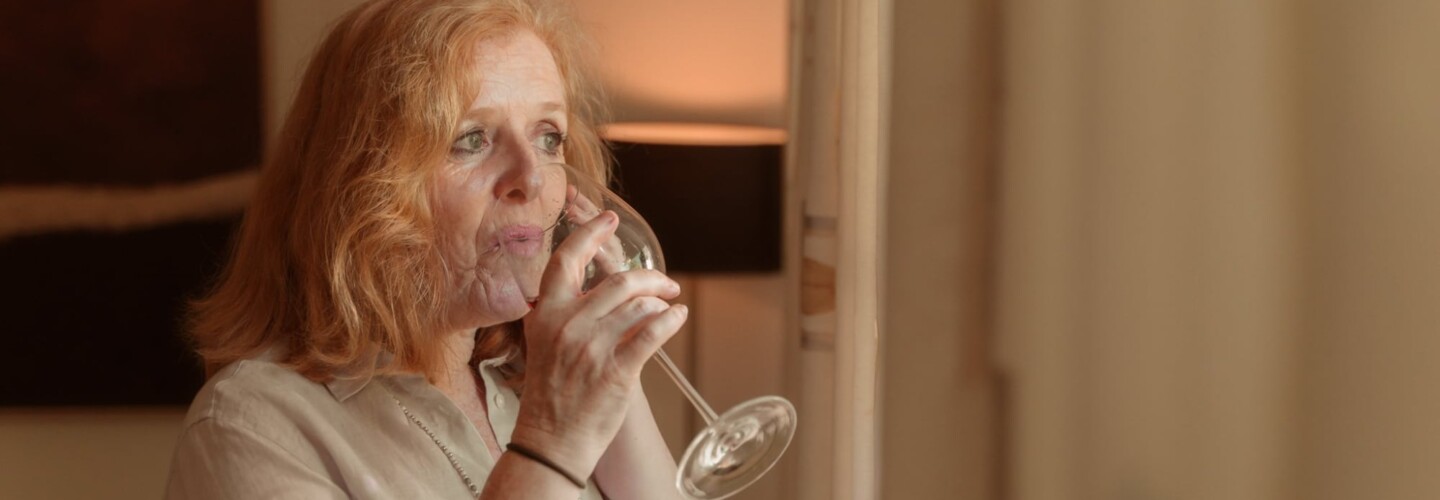

It is a truth as old as storytelling itself: as women age, the spotlight grows smaller, and the stories told about them become fewer. But Still Life, directed by Nick Richardson, goes against the grain by centring on Eloise, a middle-aged woman navigating the messy transition of redefining herself. Told almost entirely through a single-sided phone conversation, the quietly powerful drama captures a pivotal moment – the feeling of losing a part of yourself when the life you built starts to unravel – without ever reducing its protagonist to an outdated stereotype. Still Life is a rare gem in the short-form landscape, where narratives about women over 35 are scarce, and even rarer are those that treat their subjects with such unsentimental empathy. To accompany today’s premiere, I caught up with Richardson to explore his personal connection to his lead character Eloise, the creative choices that shaped Still Life’s minimalist yet deeply moving framework, and how the film honours the real women who inspired its story.
What inspired you to tell this particular story from the perspective of a woman like Eloise?
Eloise is a composite of a handful of women, mostly friends of my mother, who I grew up with. They were women who would come over for Friday drinks with Mum. I would listen to them chat, gossip, tell meandering anecdotes about their kids (often filled with pride) and their husbands (often filled with disappointment). They were all women born in the 1960s, perhaps the last generation to be brought up to believe that the definition of a successful life for them was a house in the suburbs with kids and a mortgage.
As I got older, I started to see couples I never imagined would separate break apart, and the women – it’s the women who seemed to stay in my parents’ lives – try to figure out how to live when the only way they knew how to be was taken away from them. When your entire identity is bundled up with this suburban ideal of marriage and children, who are you when that’s taken away? That question is something I really wanted to interrogate and it’s not something I’ve seen many films try to grapple with, especially short films. I’m also a sucker for a character study where the protagonist is thorny and difficult and not inherently likable. That, combined with the love I have for the women I grew up with, is where Eloise was born.
When your entire identity is bundled up with this suburban ideal of marriage and children, who are you when that’s taken away?

Eloise originated from a longer script. What was it about that character that made you want to give her a standalone piece?
I think the Eloise of that film, A Success Story (which is still unmade), is a very different character from the Eloise of Still Life. A Success Story was this 25-page ensemble film about an outsider going to an anniversary party and being the only person who can really see the lingering sadness in all the performed celebration. Eloise was one of the guests at the party. She was this brassy, high camp, chain-smoking divorcee who had come out the other side of her divorce living her best life, going on Tinder dates, and living freely in a way she couldn’t when she was married.
Most Popular
When it became clear that procuring the budget we would need for A Success Story was highly, highly unlikely (although I would still love to make it one day!), I decided to pivot to something smaller scale. I just really loved this character and I wanted to spend more time with her. Who was she when she was married? What was the process of divorce like for her? How long did it take for this transformation to happen? As I started to get deeper and deeper into Still Life, it became clear that this Eloise was different. I’m not necessarily sure that the Eloise was Still Life would turn into the brassy, high-camp Eloise of A Success Story. Draft after draft, I stripped a lot of the camp out. It didn’t feel right. And when Di Adams came on board, she made Eloise her own and grounded her in a way that I think made the film and the character infinitely stronger.

Why did you cast Di Adams in the role of Eloise, and what did she bring to the character that made her performance stand out?
We were pursuing a few different actors for this – it’s such an actor’s piece, there’s really no room to move if you don’t get the performance right, and I think a lot of the people we approached were intimidated by that a bit. It’s such a difficult thing to carry what is essentially a monologue and Di really relished the challenge and embraced it. She does a lot of theatre and I think the longer takes suited her acting style. When we approached her agent, they pretty much got back to us straight away and she was very keen to be involved, which I think is a good sign she was the right person.
When Di Adams came on board, she made Eloise her own and grounded her in a way that I think made the film and the character infinitely stronger.
She came with a lot of insight into menopause and the experience of being a woman in her 50s – something I haven’t and won’t ever experience – and I think that was a big part of why she wanted to do it. Menopause is this major life change nobody talks about, and I can’t speak on her behalf, but I think she was keen to bring something of her own experience to that conversation. We adapted some of the dialogue around her so it fit her natural speech patterns. In other hands, Eloise could have become a caricature, but Di really grounded her in something real. She was a delight to work with, so down to earth and experienced, and I can’t speak highly enough of her.


With such a minimalist setup, what were the biggest creative or technical challenges you faced?
Making this film was basically like going to blocking school. I hadn’t worked with a Steadicam before as a director and it was something Boris Vymenets, our cinematographer, really pushed. I knew when the cuts would be – I wanted to use edits like punctuation marks that take us from one part of the story to the next – and I knew when I wanted Eloise moving and when I wanted her stationary. But getting the pacing right, moving her around, and moving the camera around her on the day was a really interesting challenge. There was a bit of a dance between me, Di, Boris and Julius Koivistoinen, our Steadicam operator. There were lines here or there that we cut out on the day for pacing and moments where it was like, “Oh, we’ve trapped her into a corner. How do we get from the door for this line to sitting over here for this line?” It was a real team effort and it’s a credit to the amazing team we had on this film that we were able to work it out and it came together so well.
Getting the pacing right, moving her around, and moving the camera around her on the day was a really interesting challenge.
Still Life uses, to great effect, a constantly shifting aspect ratio which progressively widens as we learn more of Eloise’s story. What underpinned that decision?
This sounds incredibly lame and trite when you have to put it into words, but the thinking was we start the film only seeing a small slice of this woman, and by the end of it, we see her more fully. As the screen expands, we get a more complete view of who she is. I also wanted to play with the idea of the still life as this static thing. You can’t distil a life into an image. If the frame is constantly moving, it challenges this idea. Life may change, but you have to keep on moving.


How did you work with your cinematographer and production designer to reflect the emotional state of Eloise and the symbolism of the home being packed up around her?
I knew fairly early on I wanted an autumnal colour palette and I think we were all on the same page about using that to create this sense of melancholy, of seasonal decay, of transition from one stage of life to another. Once we found the location, everything really fell into place from there. The house had this natural orange in the floorboards, which did a lot of heavy lifting. We were able to push that in the lighting and, eventually, the grade. And on set, Laura James (our production designer) brought these little accents of red and beige in throws and cushions that made the place feel like Eloise would live there but also made the world feel complete and self-contained.
What do you think audiences from different generations, especially younger viewers, might take away from it?
I don’t know what younger viewers might take away from Still Life. It’s always a surprise the films that have struck an emotional chord with me and sometimes it’s never entirely clear why they do. When I first saw the film Summertime, it hit me in this deep place emotionally, like this film was made just for me. I totally understood everything that Katharine Hepburn felt in that movie. Which, on the surface, makes no sense. I am not a single woman in her 40s living in the 1950s. In fact, I was 22 at the time and yet I totally ‘got’ it.
I hope that younger viewers can find some empathy with Eloise and recognise something of themselves in her. Maybe they will feel for her what I felt for Katharine Hepburn when I first saw Summertime? This film came from a place of love. I just hope it can be received in the same spirit.

Do you see Still Life as a part of a wider conversation about underrepresented life stages and transitions in film, television and media?
Absolutely. There is a real lack of stories about women between the ages of 35 and 60, especially in the short film world. There are countless ‘coming of age’ shorts about teenagers or people in their early 20s, which makes sense. Short films are mostly made by younger people who want to make films that reflect their experiences, as they should. But the result of that is a real lack of shorts about people over the age of 30. And that is when people are at their most interesting! That’s when all the living happens! You don’t stop coming of age when you turn 30.
You don’t stop coming of age when you turn 30.
What stories are you excited to tell next, and will they continue to explore similar emotional landscapes or move in a new direction?
I love a melodrama – films like All That Heaven Allows, Brief Encounter. It’s a mode of storytelling I really enjoy and I don’t think it has reached its fullest potential. I am currently writing a feature that lives in that world a bit and it does feel like it occupies a similar emotional space to this film. It’s a story I’m very excited about and I can’t wait to share it with the world. I’m not sure where to from there. It could be something similar or something entirely different. I can’t wait to find out.