
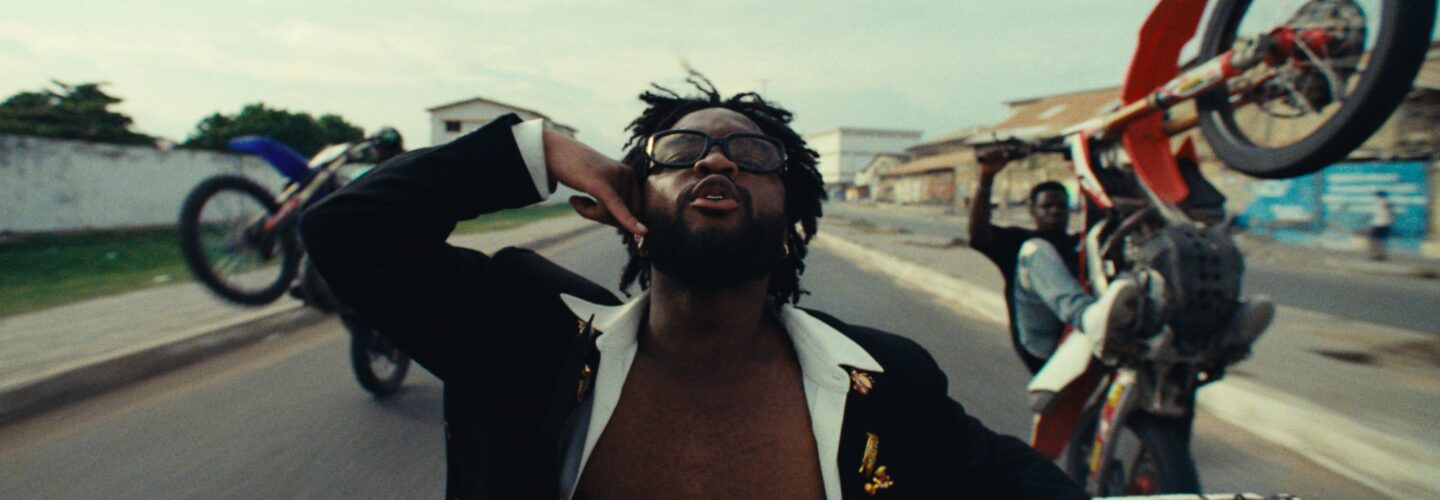

When Genesis Owusu, an artist last featured on the pages of DN with music video The Fall, reunited with director Isaac Brown for their second collaboration, the destination was never in question. The shoot for Stampede marked the Ghanaian-Australian artist Owusu’s first return to Ghana in eleven years because Accra offered something no studio backlot could replicate—a living subculture of motorcycle riders whose community spirit sat at the very heart of what Stampede needed to say. Brown spent weeks in research before writing a frame: Ghanaian cinema, independence history, and a VICE documentary about the country’s daredevil bike riders, which would prove central to what the film became. When the crew arrived, those same riders became the shoot itself, recces done on the backs of the bikes, the community cast rather than costumed. The result holds two registers in productive tension: the raw, responsive energy of the motorcycle sequences and more symbolic, graphic vignettes running alongside. At blue hour on a tidal beach, a Steadicam rigged to a quad bike chased Owusu on horseback against a stormy sky, tightly planned, rapidly executed, and pushed into something altogether more mythic in the grade. We speak to Brown about unifying his two distinct visual registers, the choreography behind that blue-hour beach sequence, and what it means to document a real community rather than dress one.
I’d love to dig into those bandages coming off at the start of the film. What was the thinking behind that image, and what did you want it to signal before the stampede began?
The bandages already had a history in Genesis Owusu’s visual world, so what interested me for this film was the act of removing them. It felt like a threshold moment, one state ending and another beginning. For me, it was about unmasking, shedding what came before and letting something more direct come forward. There’s vulnerability in that, but there’s defiance in it too.
Talk to us about the research you went into on Ghana’s history, cinema, street life and subcultures before writing the treatment. Were there particular filmmakers, visual traditions or anything else that directly shaped what ended up on screen?
Before writing the treatment, I spent time trying to get a proper feel for Ghana. I watched films, short docs, music videos, and read quite a lot about the country’s history. I thought it was important to understand that context, particularly around Ghana’s independence and what that sense of self-determination meant culturally. I was never trying to reference any of that in a literal way. It was more about wanting to understand the place properly before building anything around it.
I didn’t want to impose a story on Ghana from the outside. I wanted to find something real that already existed there and build from that.
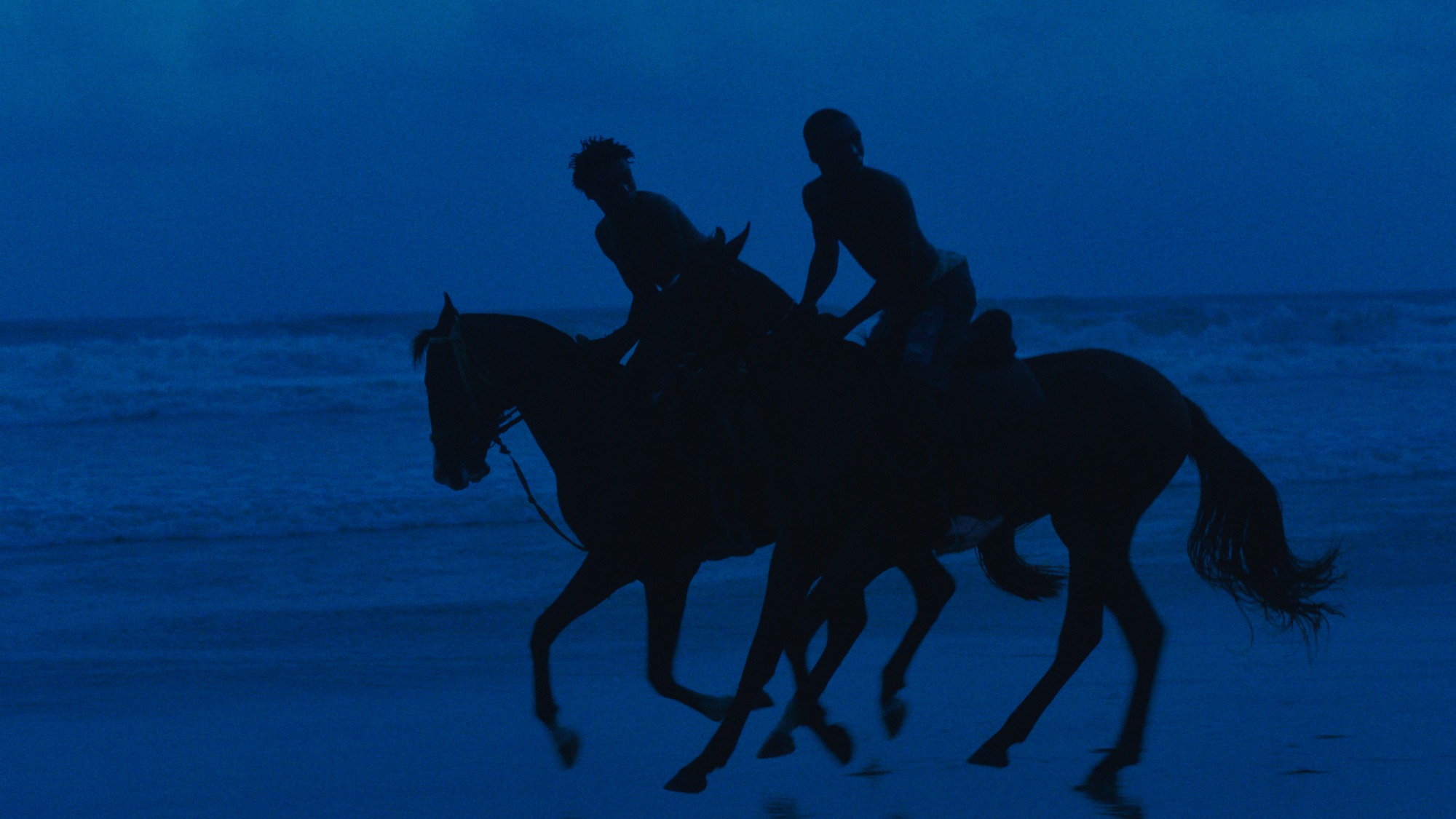
One of the first Ghanaian films I watched was The Burial of Kojo. I was also watching a lot of short documentaries and online material around street life and youth subcultures. One thing I came across early was a VICE documentary called The Daredevil Bikeriders in Ghana, which became a big reference point for me. After that, I found a lot more of the bike life on social media, which gave me a better sense of how big that world was and the community around it. You can definitely feel that influence on the bike material in Stampede. What I responded to was the energy of it, the freedom of it, and the sense of community around those riders. That was the main thing for me. I didn’t want to impose a story on Ghana from the outside. I wanted to find something real that already existed there and build from that. We did our recces on the back of the bikes of the same guys you see in the film, so the research gave me a way in, but the film really came to life through collaboration once we got there.


How did you hold that tonal coherence of the video between the doc chaos and staged vignettes as you managed a very involved two-day shoot?
I think it was really about giving those two modes different jobs. With the bike stuff, we wanted it to feel like you were inside the world, almost part of the stampede itself. That meant being looser and more responsive with how we shot it. The vignettes were doing something different. They were more graphic, symbolic and a little mythic, more like flashes of an internal world running alongside the real one. So I never really saw it as two separate languages. They were just two different expressions of the same energy. There were also a few images that helped bridge those worlds. The backwards-looking truck shot is one of them. It has a more formal, composed quality to it, but it still carries the movement and danger of the riders around him. That kind of image helped the whole thing feel unified.
Most Popular
There are shots where Genesis appears to be holding or is in a very close physical relationship with the camera, creating a low upward angle as he moves through houses. What story were these angles telling?
That shot was really about proximity. We had the camera rigged to the back of a motorbike, with Genesis sitting backwards on it, and I liked that it let us move physically through those spaces and pick up all the texture of the world around him, the clotheslines, the density of it all. It puts you right inside that environment rather than observing it from a distance. The low angle gives Genesis a certain power, but what I really like is that he’s facing back toward camera while the bike is moving forward. There’s a confidence to that, and a slight defiance too. It makes the shot feel very assertive.



Once you add horses, a Steadicam and a quad bike into that kind of window, it becomes a pretty challenging thing to pull off.
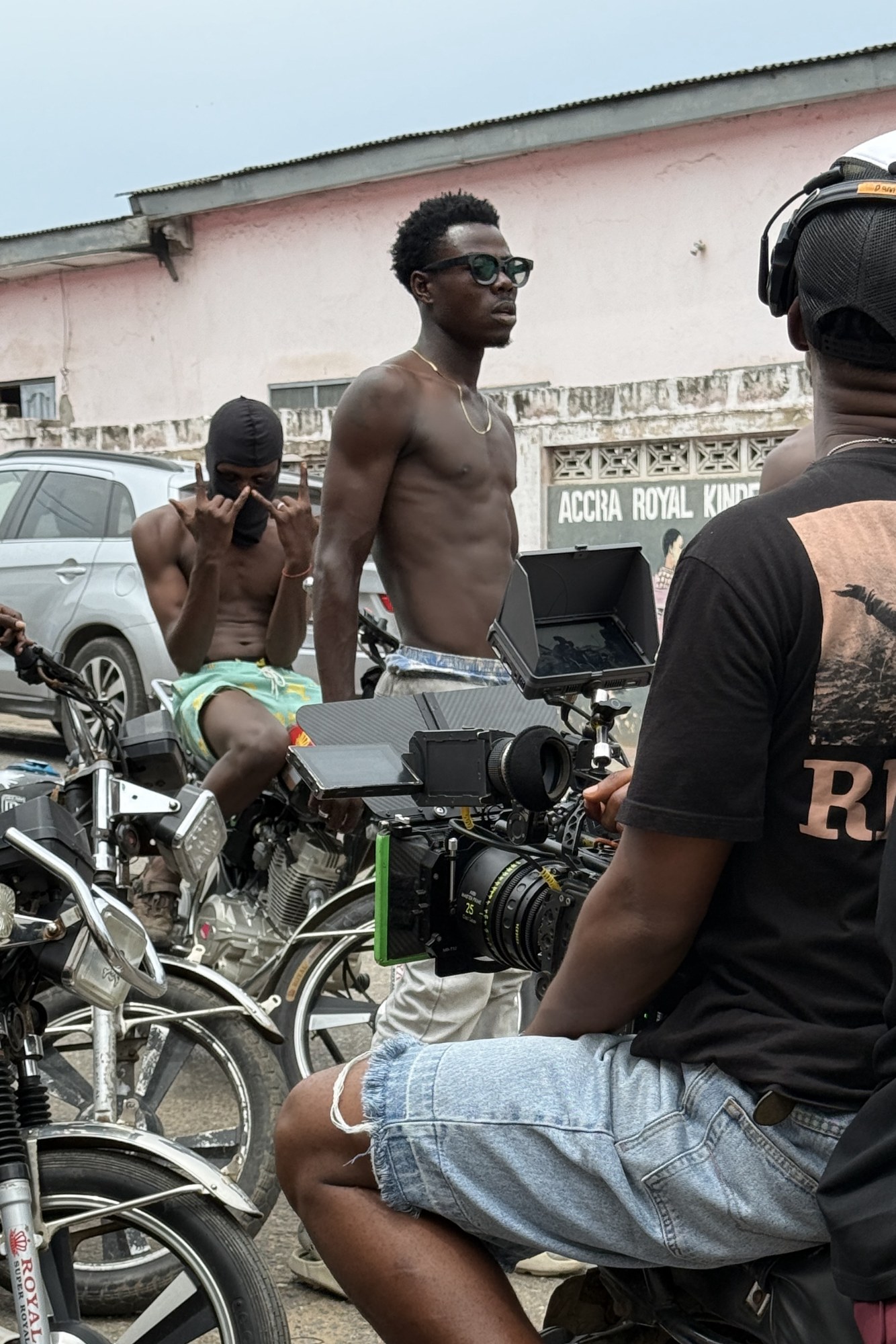
The beach horse riding sequences are some of the most visually stunning images. Blue hour lasts minutes, you’re working with horses, and you’ve got a Steadicam rigged to a quad bike. How did you plan and time that, and how much of what made those frames so beautiful was designed versus the sky just doing something miraculous?
That sequence was planned pretty tightly. We knew the beach stuff was going to give us a very small window because we were dealing with both the light and the tides, and both were moving fast. We had to be really clear about timing. We had scouted it properly and worked out the window as closely as we could, because at a certain point, you lose both the wet sand and the light. So in that sense it was very designed. But once you add horses, a Steadicam and a quad bike into that kind of window, it becomes a pretty challenging thing to pull off.
The final look was heavily crafted as well. It was shot after sunset, but the sky didn’t look that dramatic on its own. Daniel Attoh’s cinematography gave us such a strong base to work from, and Ferg Rotherham did a fantastic job in the grade, pushing it into something much more magical. So it was a combination of careful planning and a lot of shaping afterwards.


Stampede cuts between street life, the beach, and Genesis as a performer, while still holding a narrative thread together. How much of your edit was essentially built on set?
A lot of it was built on set. We weren’t just running the whole song in every location and hoping to find it later. We were shooting in sections and making pretty clear decisions about what each part needed to hold. We shot a lot of really exciting material, and Ian Wallace is a brilliant editor. The first cut we showed Kofi and the team didn’t change much, which I think speaks to how much of the structure was already there.
Kofi’s performance is really strong, especially to camera. But we also had all this incredible footage of horses and bikes. A big part of the early editing was managing that tension: you don’t want to cut away from him, but there’s all this other compelling stuff you want to see. That dynamic actually helped us find the rhythm pretty quickly.
Music videos have always had the capacity to document contemporary life in ways that outlast the single—the bikes, the horses, the street subcultures in Accra feel genuinely recorded here rather than dressed. Is that something you and Genesis worked on consciously, the idea that the video is doing a kind of cultural preservation alongside everything else?
That’s not something we consciously set out to do, but I think it’s a really lovely way to look at it. We were focused on finding genuine community and real energy rather than dressing things up. We spent time with the bike riders, we cast real people from Jamestown, and we weren’t imposing something onto the place. So if that creates a kind of document of contemporary Accra, I think that’s a byproduct of trying to be honest about where we were shooting and who we were working with.


What’s a short film(s) that’s stayed with you and why?
Two that have stayed with me are Thunder Road by Jim Cummings and Spider by Nash Edgerton. Thunder Road does a wonderful job balancing the tone. It’s funny and painful and deeply human all at once. I’m always really drawn to work that can hold comedy and sadness in the same moment, and that film does it so well.
Spider is obviously a very different kind of short, but I loved that film growing up. It’s such a simple idea, but the execution is so precise, and the escalation is kind of perfect. It just keeps building in this really clean, brutal, funny way. That definitely stayed with me.
Your short Help! Everything Is Fine is currently on the Australian festival circuit and will also be hitting the pages of DN later this year. How does the experience of making that sit alongside high-octane music videos like Stampede, and where does your head go next?
In some ways they’re flexing pretty different muscles. Help! Everything Is Fine is much more contained and performance-led, and it really lives or dies on tone and behaviour. Stampede is working on a much bigger canvas and leaning more into movement, image and collective energy. But to me they still feel connected. They’re both interested in tension, tonal shifts, and that moment when something bigger starts to take over.
I like moving between those forms because they sharpen different parts of me. The short reminded me how much I love performance and narrative pressure. Stampede reminded me how exciting it is to build a world through image and momentum. Where my head goes next is really towards bringing those things closer together.