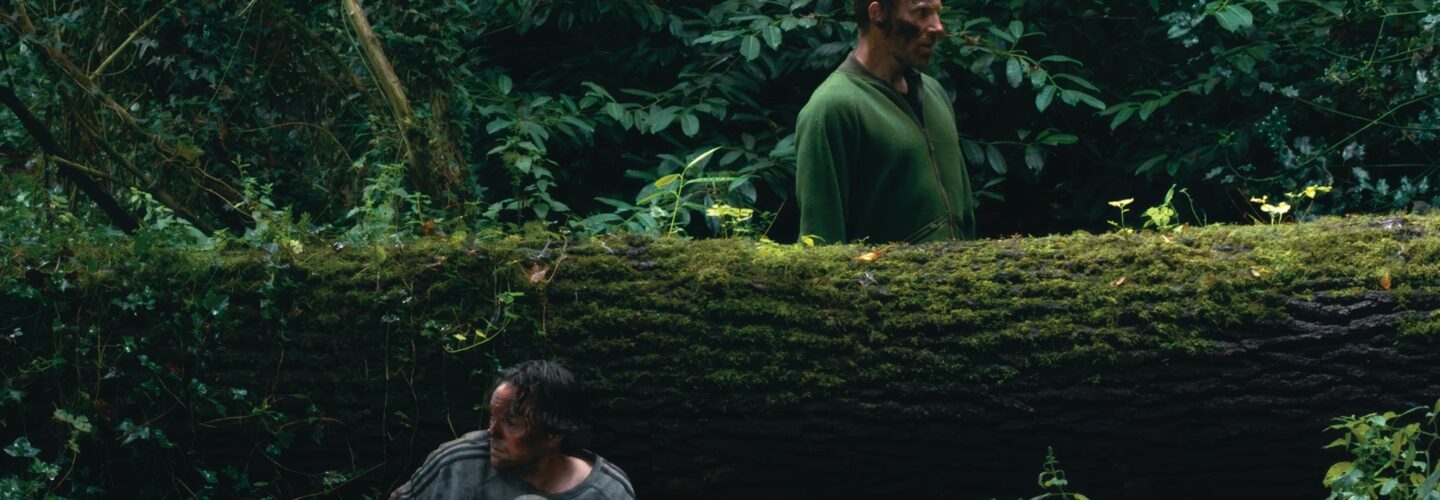

Geoff Barrow and John Minton’s Game is a masterclass in resourceful, independent filmmaking born from a close-knit creative trust and a defiant pushing beyond your comfort zone attitude. Stepping away as the drummer of three-piece Beak> into the dual roles of writer and producer, the Portishead and Invada Records co-founder pursued his desire to dive deeper into film, and alongside longtime collaborator, director and editor Minton, embarked on a journey to create a self-funded claustrophobic survival thriller as the debut feature of Invada Films. The result is a tense, two-hander set in 1993, which plunges Marc Bessant’s ageing raver, David, into a fight for survival after a car crash leaves him trapped upside down in his vehicle deep in the woods, injured and seeking help from a mysterious poacher, menacingly played by Jason Williamson of Sleaford Mods. With a commitment to visceral authenticity from the outset, the filmmakers detail the immense practical and physical challenges of filming their lead actor suspended upside down for large portions of the shoot. This introduction to their process reveals a project built on the empowering trust between friends, a problem-solving mentality, and the unwavering belief that if you have a camera and a story, you can—and should—make your film. As Game embarks on its Q&A tour, closely followed by a fully independent UK cinema release – grab tickets here – we speak to Barrow and Minton about forging their own path, the gruelling realities of shooting inverted, and why sometimes the simplest ideas involve the most complicated obstacles.
[The full interview is available to watch at the end of this article.]
Welcome to Directors Notes, John and Geoff. As we’re doing this interview very early, the majority of people aren’t going to know anything about the film at all so I don’t mess it up and spoil anything could I get you to tell us a little bit about Game?
Geoff Barrow: Yeah. It’s a two-hander thriller, I would say, set in 1993, based around the tail end of rave culture in the UK. I suppose it’s a survival/thriller/comedy in places, and it’s Invada Films’ first film. I run a company called Invada Records, and we mainly release soundtracks and bands on vinyl, things like Stranger Things and lots of interesting electronic and scores, working with lots of different artists, we sign people as well. And yeah, this is our first feature that’s in cinemas over November and December.
I think the first that I heard about this project was as a longtime fan of Beak> when you announced that you were leaving the band. Was that because you wanted to dive more into the film world, stepping back from that side of your work in music?
GB: It was two things really. I started to get a bit ill when I was touring, suffering from exhaustion. I think my days of live touring have finished. That also went with the idea of actually working, not just on scores, but developing films, producing films and writing them. They went hand in hand, one led to the other.
And John, I believe your relationship with Geoff goes back 22 years or something and began with a music video for Gonga?
John Minton: Yeah, it’s from the start of Invada Records in the UK. That’s how we met basically through the process of making that video and we got on from the off. I remember meeting Geoff soon after that in a pub, chatting and thinking that we work in a similar way. That remains true 22 years later.
I know that you’re an editor by trade and was pleased to notice that you edited Esther May Campbell’s BAFTA-winning short September, which I interviewed her about way back in 2009.
JM: That was my first narrative; Esther literally persuaded me to do it. It coincided with the first Portishead tour after the Third album so it was a strange old time. I remember cutting it on a cracked version of Avid in my old studio, which was polluted by the spray shop next door, and it kept crashing. I delivered the edit and then went on tour with Portishead. September was a real indicator of how you can develop every step of the way, and that remains true today. Esther’s a really interesting filmmaker, on that project she basically developed her own language so wrote the film through subtitles.

This is a first project for Invada Films, but it’s also a first for both of you. This is your feature directorial debut. John and Geoff, your writing and producing debut. Why this project and story?
GB: Basically, Marc Bessant, the main character in the film who’s trying to survive his situation, and I went to school together, and Marc was in an early iteration of Portishead when we were first developing and going through vocalists, so we’ve worked closely together. The other thing with Marc is that he’s a graphic designer and has done loads of album covers, so all the work that you see on Game is actually done by Marc. The way that we work is really close-knit, we’re all there for each other. We haven’t got the budget to farm stuff out. When you’ve got that trust between a group of people you know, it’s really empowering. I suppose that’s why it ended up with this story as well. We haven’t got much money. We can’t have a huge cast.
Marc and I were talking for a long time about doing a theatre production of J.G. Ballard’s Concrete Island, that’s where this idea came from. It’s about a guy who spins off the road and turns his car upside down and but it was based in 1973 off one of the roads in London – a very different setup. I was thinking, let’s do a theatre production of Concrete Island on a motorway roundabout in Bristol. That didn’t happen, and it developed into this idea instead.
The way that we work is really close knit, we’re all there for each other. We haven’t got the budget to farm out stuff. When you’ve got that trust between a group of people you know, it’s really empowering.
JM: I think that’s the connection. We’ve got this close-knit group of creative people, and we all meet up and collaborate on projects. We were looking around, going: Well, we’ve got the skills, we want to step out of our comfort zones, be tested and do new things, and everyone likes film. We can spin stories, we can edit, we can deliver things, why not do our own? That’s how it started.
GB: It’s a ‘can do, will do’ attitude to it. We don’t know everything there is to know about films. We’ve not seen every cool film that has ever existed, but we would be doing this anyway. We’re not expecting the world to love it. Invada has always been the opposite of those rules that are set up by industry, which say you can’t do this unless you’ve got that. If you’ve got a computer and if you’ve got a camera, you can record music, you can shoot something. You don’t need to be the most technically proficient—but John is—you can make films and you can make music, and we’ve got a supportive group of people around us to do that.
Luckily enough, Invada Records had done alright for a couple of years. I said to Redg Weeks, my partner, “Have we got any money?” and he was like, “Yeah, we’ve done all right”, and I’m like, “Well…” So there was money there, and we just thought, right, we’ve got this amount of money to make a feature. It ended up being £150 grand but basically it could have been £80 grand and we would have still made it.

How did you settle on the ultimate length of the film?
JM: We started with the story idea, then we had a script around 60 pages long, or maybe the first iteration was 45, 50 pages. Then it grew, and then there was a point where Geoff was like, “No, we need to be feature length. We’re making a feature. We’re not going to make a long, short film. If we’re going to do it, let’s do it properly.” And so, we then had to make our script longer and push it towards 70 pages, 74 or something in the end. So we developed it and had to make sure that we put ourselves in the feature length bracket so we appealed to festivals and stuff.
It was interesting having this story and seeing how far it can actually sustain itself, because it is designed to be efficient, shot in very few locations with very few characters and actually not much dialogue and not much actually happening. That was our challenge. There was this balancing act as director and being part of the writing phase. In theory, if it’s a 74 page script, you’re making a 74 minute film, and we knew we wanted to make it longer. And so my challenge was to know that I can have extended sequences, and that was part of what we wanted to create, this sense of tension and anxiety, especially in the first half of the film. So yeah, I knew I could push it further. We had a really long two-hour edit in the assembly.
If we can’t do what we want now, when we’re funding it with no people telling us what to do, when can we make our own film?
GB: You were literally in with Marc in real time! We spoke to a few people who watched early versions, and they were going, “Oh, the beginning is far too long.” But for us, we want people to feel like he’s in it. It’s supposed to be painful. He’s in a car upside down. And if you make it short, you end up basically making an episode of Casualty. People do go, “Not much of much happens at the beginning”, but that’s what’s supposed to happen. Look, if we can’t do what we want now, when we’re funding it with no people telling us what to do, when can we make our own film?

For me, that really placed me in that claustrophobic space, trapped there with him. It also had me searching around the car, going: “How would I get out of it? What would I try?
JM: That tells me we’ve done our job in a sense. If you’re with him, you want him to escape, and you’re helping him for yourself, that was the aim. That part of the film took the majority of our time at every step of the way. Finding the car, the dog, training, all of that in pre-production. The shoot itself was all about those scenes in the car. And actually, it took three-quarters of the time for that first third of the film – the rest of it just flowed after that. I think the effort paid off because if we couldn’t tell that story effectively, then you wouldn’t get to the release and the reward later on, where it starts flowing.
It took three quarters of the time for that first third of the film, the rest of it just flowed after that.
I’m curious about how you seeded the car with things he could use that would be practical to him, and how much back and forth there was settling on that?
GB: Yeah, we did a lot of that, mainly in the pub, so it was all right. Marc would send a note on WhatsApp, going, “I’m worried about the pen”. There was a lot of that. We went through a lot of possible things.
JM: Yeah, that was another whole thing, the upside-down thing. That span our heads out a lot, thinking upside down.
Most Popular
I read you had a model car that you were using to help orient yourself.
JM: Yeah, I’ve got it on the shelf over there.
GB: I think early on, John’s brain melted a bit. I mean, we didn’t know Marc would actually work in the car upside down until we were on set with Marc upside down in the car.
Did you ever consider faking it in a studio at all, or were you always going to do it for real?
GB: It had to be for real.
JM: We had talked about it, but I think we could only do it in real places. Once we’d committed to doing it outside, we knew we wanted it to be real, but every step of the way, we considered it. Everything had a thought process. With the car, we didn’t really have the budget or time to do a test. I looked into it. It was calculated risks all the time, and we never really knew until Marc got in the car, but we’d figured it out. We were confident, but we didn’t fully know how he would be. What we discovered when Marc was upside down in the car was that the car (a Golf) was quite small. His neck was crushed, and his way of moving and getting in the car was quite restricted, which helped in a sense, but it was a new discovery the day before we were shooting so we just had to roll with it.

Marc was always committed from the off that this should be a struggle, he was fully committed to it.
How did you secure him in the inverted position in the car and what were the production limitations of accommodating that?
JM: I’d already done some research into how it would be possible, and our very experienced stunt coordinator, Glenn Marks, then confirmed that’s how you do it. You drill two holes in the car, you literally have a trapeze bar across his pelvis, you tie it off and that keeps him in the car. So Glenn knew about the ins and the outs and what’s possible. Safety was paramount. But Marc was always committed from the off that this should be a struggle, he was fully committed to it. What Glenn brought on board was training, preparation and getting used to it, such as an inversion table and whatnot.
GB: Marc is a committed person, there’s no half measures. He’s done a lot of theatre and he’s a fit guy who takes care of himself. I think you needed to be that strong and know your body that well. We really lucked out that our best mate was this guy, and was really into it.
JM: Even then, he pushed himself too far on that first night, and so we learned from him that he could push himself further than was necessary. Glenn was on board to coach him through that and we then restricted the amount of time he was in. I think in the end it was 25 minutes and I was getting 15 minutes of shooting time out of it. He pushed himself to an hour and it was just too much. It had to be sustainable because we had the rest of the shoot in front of us. We had to think about that. We couldn’t have him breaking down. It’s all about recovery time as well. You have to have a certain amount of time outside the car to reset and get ready for your next session. So that was challenging. The simple idea actually involved a lot of complications and a lot of obstacles along the way. We like problem solving and we just went for it ultimately.
Was it two weeks that you were shooting for? Where was your location?
JM: In the woods, we shot for two weeks. We had a single location for the first two blocks of five days, so ten days with weekends off. Then we moved into multiple locations in the third week. Into the fourth week, it was a bit more external stuff, green screen and picking up shots in the later part of the film.
GB: We really lucked out. We found this place called Nature’s Spectacular in Bristol near Chew Valley Lake. It’s a campsite, with some yurts that people stay in, and it’s got this huge yurt, for weddings, so it’s got lots of space, a kitchen, a dance floor and a bar. It worked out to be this amazing place that we could move into. It also had a tiny little bit of wood attached to it that we were shooting in. Because it’s a campsite and it was off season, the really lovely guy, Luke, who runs it, just said, “Give me this amount of money and you can have it”, and that covered everything. We could make food, the camera crew and the actors would stay there, we really lucked out with this place.


Going back to the time restrictions of Marc in the car, how did that practicality affect the way that you were shooting, as in, during the rest periods, were you able to shoot other elements or did you just have to pause and wait?
JM: We just picked up what we could. There wasn’t a load of stuff we could do, but there was some stuff like point of view shots looking down away from the car. There was a limited amount we could do whilst Marc was out of the car, but we just picked up details of the car – lights, bits and bobs, stuff that was on my shot list, or we would be feeding the crew. It didn’t feel like we ever stopped.
We had a really experienced first AD, Kim Heron, who was fantastic. She basically held our hands throughout, and we managed to never miss a thing. We made every day. That was one of the successes for me and Ross James (DOP) in particular. We were confident we could work quickly and we could compromise. We would listen, and we would still get what we needed, but we wouldn’t get too sucked into stuff. We’re used to that in the way we work anyway, through music or touring. It’s like, “Okay, just make it. Let’s do it. That’s a good one. Don’t sweat it. Just get it done”, without sacrificing quality or creativity.
The simple idea actually involved a lot of complications and a lot of obstacles along the way. We like problem solving and we just went for it ultimately.
Could you tell us a bit about how you used your B-cam, the Sony A7s as a kind of ‘dash camera’ to be able to cut from your main camera (Sony FX9) to that inside of the car perspective?
JM: We always had a B camera so we could shoot from two angles, and so I could cut between them. We had the opening scene of the whole film laid out and it was obviously split up in the script. Pretty much what you see in the film is not far away from what the script was. There are these almost checkpoints – Marc has to wake up. He has to be comatose almost, like he’s knocked out. Then he has to wake slowly, and then he has to figure out his surroundings before he reaches for something – everything had to take time and we had to tell that through certain angles.
Our windscreen disappeared when the car was put upside down, which was actually a godsend in the end. And when I was storyboarding, I always had a point of view of Marc, head on with his face and so that camera became the dash cam view. You can’t operate from there, but I’m quite used to mounting cameras and just letting them be auto or search. We wanted some artistic viewpoint that wasn’t curated, that had a bit of randomness to it.
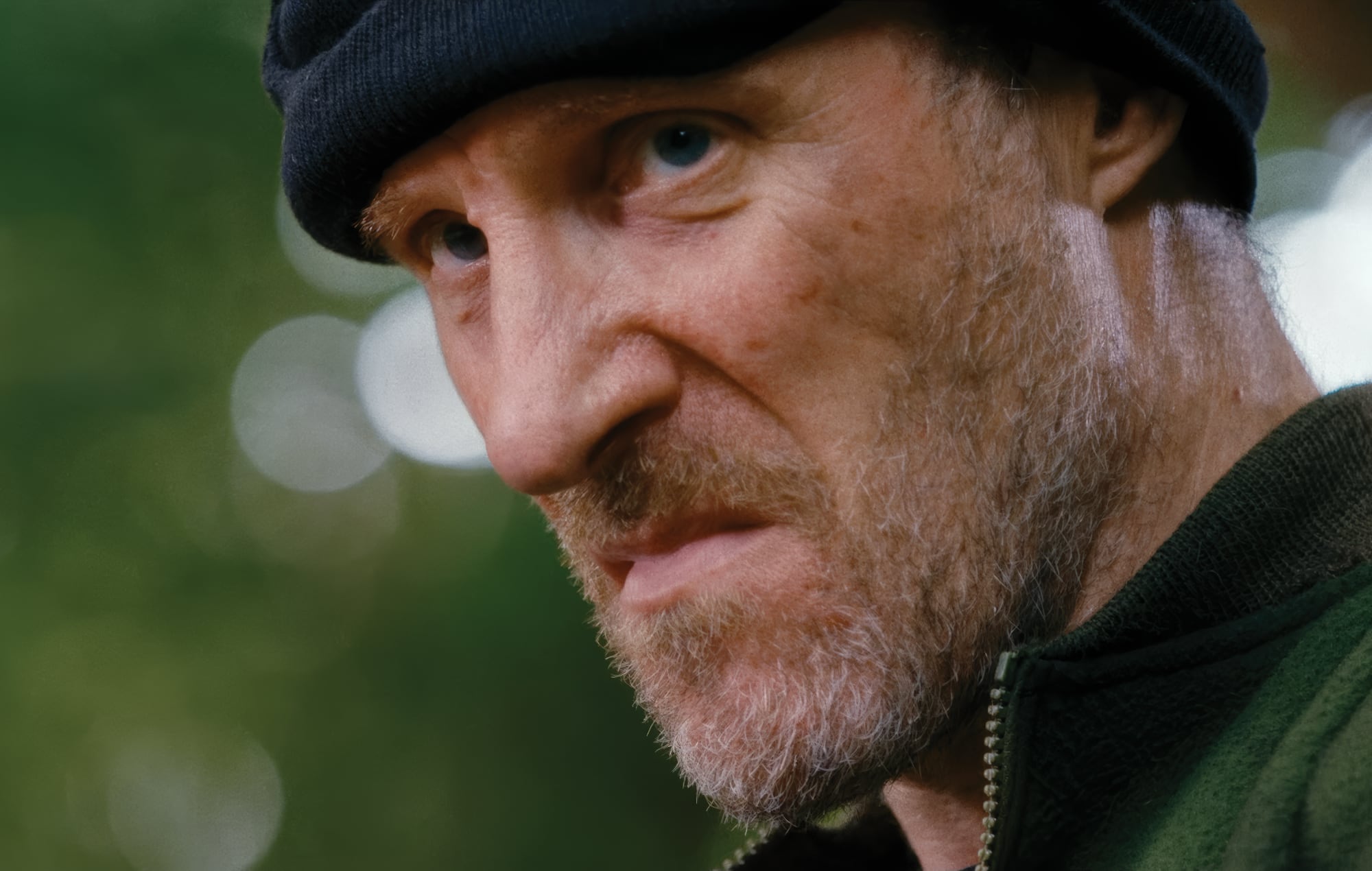
We’ve mentioned Marc Bessant a lot, and rightly so, but opposite him as a terrifying force is Jason Williamson of Sleaford Mods. How did you come to cast him opposite Marc?
GB: Well, to cut a long story short, when Sleaford’s first started playing gigs, they played the Exchange in Bristol, and so I’d met them and then on social media, you just have a laugh or whatever. Then Invada released Tiswas on 12-inch, we went to radio with it, and it was their first proper radio, then we just became mates. Then, when the script developed, there was this poacher, and it was like, “Well, it’s Jason”.
JM: Jason’s always had an ambition for acting as well. It’s kind of what he wanted to do, wasn’t it, in his life?
GB: Yeah, so he was in a short film and then I introduced him to Cillian Murphy, I think I could be wrong here, but basically, he ended up as this mad, drunken priest in the last episode of Peaky Blinders. Then he was in an ITV drama. It was like the same thing with Marc, with no doubt about his commitment. If he felt like he could play this role, well then, Jason, it’s yours. I just think it’s you.
JM: We were writing it with him in mind, weren’t we?
GB: Yeah. I’m not saying that the Poacher is Jason in real life because he’s really not. He’s not a psychopath. There are very nuanced differences between Sleaford Mods and the Poacher. People will go, “Oh, that’s Jason”, because he’s such a strong character, but it’s very different. A lot of the poaching and drug stuff, there’s a mate of mine called Leo, who I grew up with in Portishead, he’s been involved in the drugs trade and he’s also been a poacher, so we did lots of interviews with him and found stuff out. Jason himself knew poachers from where he grew up, so he spoke to them about the way they saw the countryside and stuff. But yeah, he was like, “I’m on board”, and we didn’t really have to talk about it again.

I feel he really nails that antipathy the Poacher has towards Marc’s character and the way that it bubbles along. Then there’s the chilling line: “No one can come looking for me though – I’ve done nothing!”.
GB: Yeah. So, we had one read-through in the room before. We got on set, and obviously, we’d done a load of stuff with Marc already. Then Jason turned up on the second week, they started acting together, and the dialogue was awful. The dialogue just didn’t work! I take the blame for that. There was stuff that was written that just didn’t work, and as soon as I saw it on camera, I had a gut feeling. A good amount of stuff remained, but that night we had to go off and rewrite it. It was too theatrical. It was too political. Whatever it was, it just didn’t work. There had to be more of a real basic communication. The dialogue was too grand, it was too telling, and I was like, “Fuck, we’ve got to rewrite this whilst they’re on set, and we’ve got no time.” So me, John, Rob (Williams) and Marc rewrote it.
JM: We shot extra stuff because we had a fear that it was too much, but actually, a lot of the rewriting really happened in the edit. We cut up and reordered stuff and therefore had to fix issues where suddenly Jason had his balaclava still on, but he’s still talking, and I had to edit around it and make it work. But, from my experience of when stuff doesn’t work, because you haven’t quite nailed it in the writing or you’ve shot an idea that hasn’t quite panned out, those limitations are what makes it because you’re fighting against something and you’re solving the problem. We got there in the end. It’s weird now to think back to that shoot because all of that dialogue was shot in one day. Ultimately, we didn’t have long with Jason or left in the woods so we had to really just nail it.
I wanted to ask about the music, which is great the whole way through, and my favourite scene plays out to this fabulously demented reworking of a classical piece. But fitting with our earlier discussion about the first section of Game, apart from the bits that we see at the rave, there isn’t very much music.
GB: A choice really early on for me, which I stood with all the way through, was that there wasn’t gonna be a score in the traditional sense. I thought it would ruin it. I tried a couple of things, and it ruined it. We talked about it constantly, didn’t we?
JM: Every Monday night at football – no score, no temp music, no nothing.
GB: Because of the financial aspect of the film, you add music, even if it’s tones, that can very easily make something look a lot cheaper than it actually is. A lot of people make that mistake of overscoring low-budget films, and in my experience, it cheapens the film even more. Even though I’m a film composer by trade now, I suppose, I just wanted the music to be real.
A choice really early on for me, which I stood with all the way through, was that there wasn’t gonna be a score in the traditional sense.
For the rave stuff, there’s a guy called Jamie Paton, who we play football with, and we found out he was a dance music producer who’s the same age as us. I said, “Can you write some tunes from the raves in the 90s?” and he was like, “Yeah, I’d love to do that.” So he wrote a load of tunes and then we edited them and I worked on the sound design a lot, trying to make sure that they sounded real in the rave. I was really scared about this whole thing that it was going to look like an episode of Casualty, where they’d go to a rave, the music’s quite soft and you can hear everyone talk. So [in Game] when the girl speaks outside the rave, you can’t really hear what she’s saying and that’s purposely because you can’t. We wanted to not break that wall, to make it as realistic as we could.
The end scene that you’re talking about it’s Ravel’s Boléro. What it is for me is that, without giving too much away, Torvill and Dean were an ice skating pair who won in the 1984 Olympics, and it really reminds me of a certain time that would have been in the Poacher’s life and his past. So it’s what he’s hearing, like a terrible rave version of it. We knew we had this specific scene that we needed to score, but it’s quite long and the scene is quite slow so we needed a piece of music that would propel itself. That would grow, have chord changes. Thank God we found this because it really works.

JM: It was interesting from my point of view with the sound design and the music, I didn’t want Geoff to be in a position where we had temp music and that was putting a plaster over things. We used this whole experience to support each other’s journey as well. It was challenging. I’ve learned a lot about not using temp because a part of putting temp music on any narrative is that it fixes shit. You settle back and go, “Oh, that sequence works now I’ve got a tone running through it.” It’s tense, it’s telling me to feel this. When you’ve got nothing and you have to build tension through images, that flips around my career because I’ve always cut images to music in general, or I’ve made visuals to a live show, or the sound has always been there first. Even when I started making moving image, I always created soundtracks first and then cut images to them. Whereas the film is the flip of that, the images are what come first.
When we started perfecting the sound design with George Ramsden and then Martin Pavey later on in the final mix, we were taking sound away and letting the visual be the trigger and the guiding principles. That’s what happened with the music as well – the film demanded the music to be in certain sequences. Apart from having rave music at the rave and then the Boléro sequence having its moment, all the other pieces are that the story demands it and so we brought it in. It was never planned. We gave it space and then it asked for it, and we delivered what it needed.
From my point of view with the sound design and the music, I didn’t want Geoff to be in a position where we had temp music and that was putting a plaster over things.
GB: In the film, there’s not any kind of tension tones or booms or on cuts, which I find that a lot of people use at low-budget to enhance almost the ‘professionalism’ of the film. I think it’s awful. People who know film at a certain level will watch that and go, “It’s stock. It’s just stock stuff”. It’s very much used in television. I’m not putting down television because there’s great television, but there also is a load of awful television. If you close your eyes and listen to the sound design and score of terrible television, that’s the thing you want to be farthest away from if you’re trying to make a low-budget indie. That’s my personal opinion, anyway. You have to strip everything back to start to really see what you’ve got and to see that you feel tension without this sub base thing rolling under, telling you to feel tension.
JM: It reminds me of Portishead live shows as well – the quiet and then the loud. If you looked at the waveform, it has that dynamic shift as well in the film. We found that out in the final mix with Martin. He was like, “This is the quietest film I’ve ever mixed… and then it’s really loud”. It’s an experience in that sense. If something’s quiet, you have to listen and you tune into it. It’s like you’re leaning in and then you’re hit with something hard. Then it has a greater impact on you, like going into a rave tent, it physically affects you because you’re being bombarded with physical feeling from the sound waves.

So Game premiered at the Mayhem Film Festival last month, and you’re on a Q&A tour with the film before its full UK cinema release on the 21st November.
GB: It’s been interesting because we’re running this pretty much the same as Invada Records – it’s fully, truly independent. We haven’t got a distributor. We haven’t got a marketing budget. We’re holding off going to to streamers and pay per view yet because we want to create a vibe about it, like you would do a record or a band, and see people digging it so that we can make some noise that someone might come along and go, “Here’s a little bit of money, we’ll buy that for Europe”.
We’ve decided to go that route. We’re working with a brilliant guy called Colin Burch from Verve Pictures and he’s independently putting us into cinemas. The only way that we can promote it really is word of mouth and Instagram, everything else is pretty much gone. We’ve got a press person who we’re paying so in that sense, that’s our marketing budget. We know how hard it is to sell stuff because we know it through music.
At the moment, film is really tough, especially for British independent stuff, because you’re going against A24 $50 million films that are still considered as indies, which is preposterous, but it’s true. If you want to get into an Everyman or wherever, then you’ve got to fight a title like Eddington – how can we do that? Obviously, independent cinemas are really supportive, and they want to get people in there because they need the audience, so they have to book those films. And everyone wants to watch those films anyway, because they’re brilliant. So yes, it’s an interesting period for us to see what will happen, and see if we’ll ever make the money back, ultimately. But yeah, I feel for all the independent film people out there.
What’s going to be next for both of you and Invada? Are there any hints you can drop about what’s going to come next?
GB: A lot hinges on what happens with Game, not like that’s going to make or break it. We’re all working on stuff outside of Invada. I’ve written stuff and have been trying to get a film that’s in the £3 million mark off the ground since before Game happened, so I’m still working on that which is a very different thing. It’s something that’s actually based in Africa. I’m also in the middle of writing a stoner whodunit based in LA.
JM: Personally, I feel like I’ve reached a plateau, like I’ve climbed this mountain of making this feature. There’s nothing in my diary. Normally, there’d be a tour in the spring and I’d be pulling my hair out about all the stuff. A lot of projects in my life overlap. I’m normally doing eight things over the course of one year. We’re still going through this process of delivering the film and that was the idea from the beginning, we’re doing the whole process. It’s not like I’ve directed this thing, I’ve edited it, and now I’m off. You guys promote it. We are still figuring out promotion. We’re still feeding Instagram and figuring it out and now promoting it and talking to you guys, and that ain’t gonna stop, is it? So for the first time in many, many years, it’s like, what is next? I’ve got a couple of mates talking to me about documentaries, and there’s a producer who wants me to be involved in something else, and Esther’s got a film in development that we’re hoping to work on. One phone call and you’re busy!
Get tickets for Game’s Q&A tour and keep an eye out for local listings when it officially opens in UK cinemas on the 21st November. Stay up to date with Game and future projects by following them on Instagram: @mintonfilm | @barrow_geoff | Invada Films | Invada Records