
“Always leave them wanting more”. It’s a phrase most people are familiar with, and one that comes particularly into play when talking about short films. There’s a very fine line between tickling a viewer’s curiosity and leaving them unsatisfied with too little context and too many questions. The Parish, written and directed by Matt R. Smith, is a gripping example of the former. It sucks you in with a mysterious sense of foreboding right from the off, thick with Lynchian influences that Smith discusses in this Directors Notes premiere for his unsettling short film. It’s moody, sinister, dangerous even, with a magnetic soundscape that will leave you ready to hear a pin drop by the end – and continue thinking about what you’ve just watched until long after. While its influences are clear, it’s Smith’s unique voice and his self-shooting approach to filmmaking that ensure it’s very much a stand-alone piece of work that will leave you wanting more from the man himself, as well as the story he spins here.
After years of making artist films, you eventually moved into narrative with Bugbear and the BFI-backed New Atlantis. What was the inspiration for The Parish and how did your experience on the previous two shorts inform this one?
Initially, it was just about trying out a way of working that I wanted to carry forward with narrative films, something much closer to how I approach my artist work, and to honestly just go and make some work with great people. We’d been endlessly waiting for funding outcomes, and it can be really demoralising. Then I was lucky to meet Alexander Cobb, who plays Joe, and it came together in a really natural way.
A direct influence was that I kept coming back to ‘that’ diner scene in Mulholland Drive and was interested in using it as a sort of starting point. I had this idea of someone describing a dream, and you sort of can’t avoid Lynch when you do that, especially in the form I was interested in exploring. That scene is one of those that just completely oozes dread, and I was interested in using that as something to riff on and learn from, rather than replicate – almost like sketching from an artwork and then letting it go somewhere else or jamming around your favourite song. Lynch’s passing as we were finishing the film gave that influence a completely new weight. It really felt like we lost something big with him going. Suddenly, The Parish, which started as a nod, slowly became – for me at least – a way of saying thank you to him. To a completely unique artist who entirely shaped how I think about making work.
That said, it was important to me that the film ended up feeling very much from my world, and very British. The character of Joe wasn’t fully formed at the beginning, he really came out of meeting Alex and spending time with him, and realising how incredibly talented he is. So much of the script, especially the way Joe speaks, came from talking with Al.

As for coming off Bugbear and New Atlantis, the biggest thing I took forward was how important it is to have space to experiment and dream. Like I say, I was fed up with waiting for funding decisions and feeling stuck in that cycle where you don’t feel like a filmmaker anymore, just someone filling in applications and making pitch decks. Once we had access to the scout hut, it became this really relaxed space where we could play and explore ideas. That too informed the script. It’s just down the road from me, and I love it. It’s unmistakably British: proper on the surface, but decaying just underneath, like something out of a J.G. Ballard novel. The script was shaped around that space and the cast, allowing the building itself to become a third character alongside them.
One thing that definitely carried over was developing the sound world before shooting, at least in sketch form. That started on the previous films, but on The Parish we pushed it further, recording sounds from the building and the surrounding area, especially the church bells nearby, which became a fundamental part of the score.
Most Popular
You’ve been very self-sufficient when it comes to your filmmaking up to now, taking on many of the production roles yourself. How has that way of working evolved for you as the scale of your projects increase?
Taking on multiple roles isn’t really about necessity for me – it’s because I genuinely love the process, and it is how I have always worked since Art School. I feel most connected to a film when I’m involved in shooting and sound, and I can’t really edit without making the sound design. I usually start building the sound world before we shoot, and then the images grow out of that. The edit and the sound develop together, it’s very organic, and it’s just how I work. And that extends not just to me – Rhian, my producer (and wife), also acted as Production Designer, and our two boys are the kids at the beginning of the film… it’s a bit of a family affair!
I feel most connected to a film when I’m involved in shooting and sound, and I can’t really edit without making the sound design.
At the same time, I’m much more aware now of where collaboration is essential. It was great working with Joby Newsom as camera operator on certain sequences, where I really needed to step back. And bringing Pär Carlsson in for the final mix was hugely important, as that’s the stage where I need distance and subjectivity. He did an amazing job of elevating the film. Going forward, I’d like to do the same with grading. I enjoy it, but a colourist on a calibrated setup brings something you just can’t fully achieve on your own. That said, working with actors is where I feel most present. There were moments during The Parish where it genuinely felt like I was eavesdropping on something very private, and that’s a really special feeling – especially for something you have written.


Actor Alexander Cobb became very organically involved with the project. Can you tell us about that, the addition of co-star Sam Parks, and the collaborative process with both?
I met Alexander Cobb completely by chance. He was cutting my hair for my wedding! We got chatting, realised we both worked in film, and before we’d finished we determined we should do something together. Later, when I looked at his work properly, his reel, I was blown away, and the character of Joe really grew out of that and wanting to build something around him. For me, working with actors is as much about getting on with someone as it is about their talent, and I really connected with Alex straight away. Sam Parks came in as the counterpoint to Joe. I’d worked with him years earlier, and he has such a strong presence on screen physically and emotionally, he can say so much just with a glance. As soon as the therapist character existed, Sam was the obvious choice.
The shoot itself was intense – essentially a day and a half compressed into one – but both Alex and Sam were incredibly generous and up for it. Especially for Sam at the end, who had to stand in his pants by himself for quite some time. It was cold, physically demanding, and very hands-on. He was an absolute legend that evening.


When Joe is recounting his dream, there is a wonderful shift in perspective between him telling Blake and telling us directly. Can you provide some insight into directing this scene, both in terms of performance and camera moves?
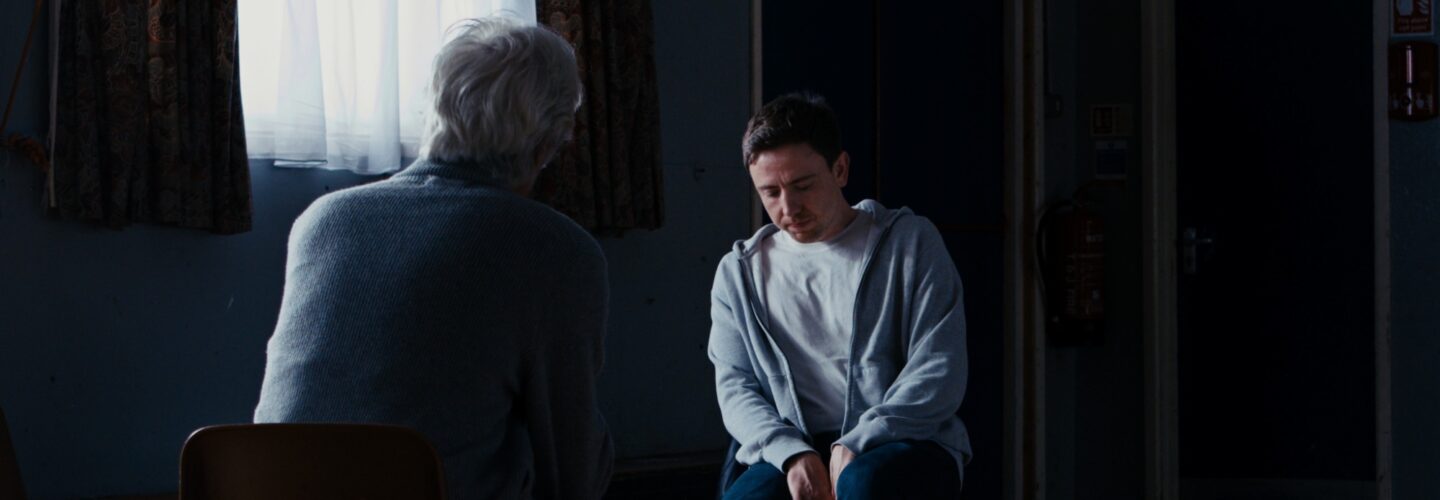
That long push-in was always central to the film. Really early on, I wanted to try that out, and it became quite locked in my brain. The idea was to start wide, let the audience settle into the space, and then slowly shift perspective until you’re seeing the conversation from Blake’s point of view. It was hard to do, though, as we didn’t have a dolly or track, so we improvised, shooting it with Joby in a wheelchair, holding the camera on a gimbal, while I pulled focus at a very shallow depth of field. It was technically difficult, aside from the fact that we didn’t really have the right kit, but we got it on the second take. We’d rehearsed a lot earlier in the day, and I had got back up coverage just in case we hadn’t pulled it off, but because we had been through it so much, Alex knew exactly where to land the emotional beats and he did it in a completely embodied, natural way – he is so good. During that take, it genuinely felt like I was witnessing something private, which is exactly what I wanted.
The idea was to start wide, let the audience settle into the space, and then slowly shift perspective until you’re seeing the conversation from Blake’s point of view.
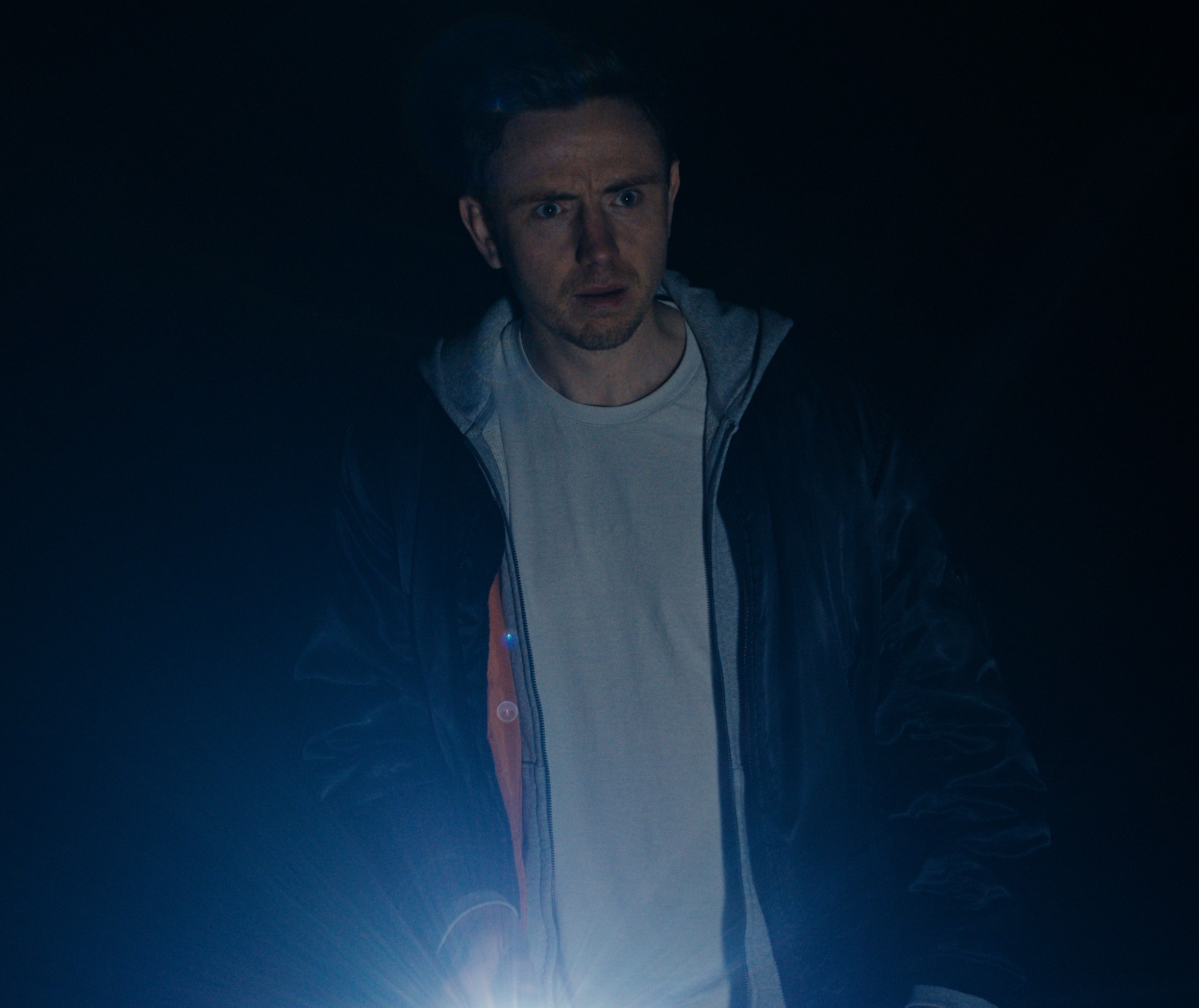
The shoot itself was deliberately simple. There were five of us on set, lighting was kept minimal and largely single-source, and camera movement was restrained. Principal photography was shot on a Blackmagic 6K with vintage Nikon photographic lenses, with additional material shot later by me on a RED Komodo. While the shoot set up was simple, the main shoot day was hard. We had a lot to get through: interiors and exteriors, night work in nearby lanes, and then back to the scout hut for the final sequence. Because we shot in late May, sundown was very late. Once we’d finished the main scene, we stopped, ate homemade pasta on the scout hut lawn, and waited for darkness to arrive. We then headed to the lanes and shot the driving scenes pretty much in one go.
Editing the film yourself, what was post-production like for you crafting the story in terms of having no distance from the material you captured on the shoot?
Editing is where the film really comes together for me. I usually assemble a rough cut with sketched sound design very soon after shooting, so we had the bones of The Parish within a couple of weeks. From there, it’s about refining detail and building the sound world, which takes time – and in this case, a long time. The problem with making a film by yourself is that you have no hard deadlines and work, and life slowed it up a lot. There was, of course, no budget to allocate time, so I worked on it when I could – evenings and weekends.
In terms of distance from the edit, it can be difficult, especially because we shot a lot of coverage as insurance for that central tracking shot. That meant there were a lot of possible versions, which slowed things down as well. Ironically, the very first cut – largely built around those tracking shots – is very close to the final film. I’m increasingly interested in working with more restrictions, which is partly why I’m drawn to celluloid. Fewer takes, fewer options. But for me, the film is really made in the edit, that’s where I feel most at home.
The problem with making a film by yourself is that you have no hard deadlines and work, and life slowed it up a lot.

There is an undeniable atmosphere throughout The Parish, built mainly by Joe’s storytelling at the start and then the soundscape in the final act. Were there any particular inspirations or references that informed this tone?
David Lynch is an obvious influence, particularly in terms of sound and his work with Alan Splet, but it’s less about direct references and more about approach. I’m fascinated by how sound, especially frequency, can immediately create a sense of unease.
We recorded sounds from the scout hut and the surrounding area, sampled them, manipulated cassette tape, and built the score almost entirely from those materials, including the local church bells (the main score is basically sampled Parish Bells). Long-time collaborator Alex Hyland and I then spent time jamming with that material, recording sessions onto tape and feeding it back into the sound design. This is a process we have done since school, and it’s something that is absolutely essential to how I make work. It’s a process of exploration more than imitation, recognising when something feels right rather than aiming for a specific reference. The end-credit track is Alex’s music under his alter ego EKSU, and I love how it closes the film.
When it came to final mixing, I worked with sound designer Pär Carlsson, whose technical precision and sensitivity to the sound world really lifted the film and brought a new level of clarity to the final mix.


I was fascinated by the otherworldly mushrooms in the story but also the design and making of those props – particularly in the dead crow at the end of the credits. Can you talk us through both their meaning and construction?
The mushrooms went through a few iterations. We initially worked with artist Joseph Arm on prosthetics, but for the macro tracking shot, we ended up using real mushrooms. Rhian and I then dyed and painted them with acrylic, and then arranged them in the earth we’d dug up ourselves. I shot them with a probe lens in my little studio. The bird at the end is actually a pheasant, which we filled with mushrooms and filmed in the woods. The mushrooms were always about hinting at something larger – ideas of interconnectedness, hidden systems beneath the surface, and how fragile our sense of reality is. They suggest there’s another layer to what’s happening, beyond what we’re explicitly shown. The end-credit sequence is intentionally a bit frustrating, like a short-film version of a post-credit scene, hinting at a bigger story without explaining it.
The mushrooms were always about hinting at something larger – ideas of interconnectedness, hidden systems beneath the surface, and how fragile our sense of reality is.

With The Parish now released into the world, what’s next for you?
I’ve recently been learning 16mm filming and hand processing, and I’m developing a new short on celluloid. Alongside that, we’re planning another longer short in similar territory to The Parish, while developing two feature projects that are close to being written. The aim is to make a longer short this year and move towards shooting a feature as soon as possible, so if anyone reading wants to connect and help finance a film, get in touch! Bet you haven’t heard that before…
And finally, what’s a favourite short film you’ve seen, new or old, that you’d recommend to the DN community and why?
An Untitled Film made in 1964 by David Gladwell is one that I always come back to. It feels incredibly modern and just creates the most amazing atmosphere without dialogue. The cinematography is stunning too. The Black Tower by John Smith also had a huge impact on me when I was at art college. I recently had the pleasure of speaking with John, and his work continues to resonate deeply. He’s a great guy and artist and I thoroughly recommend checking out his work.