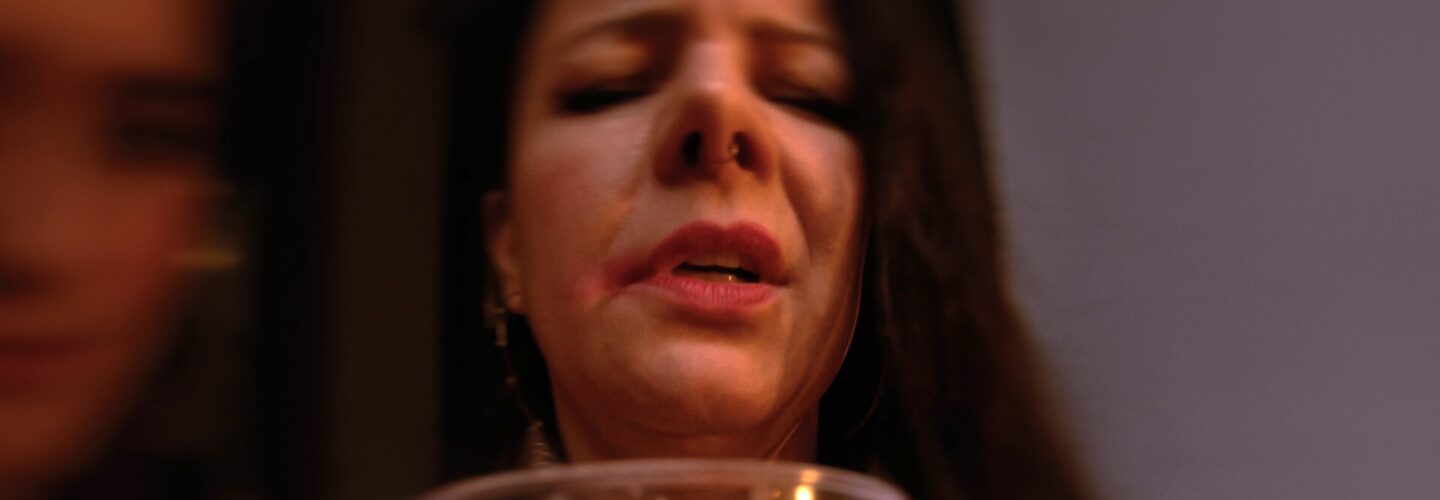
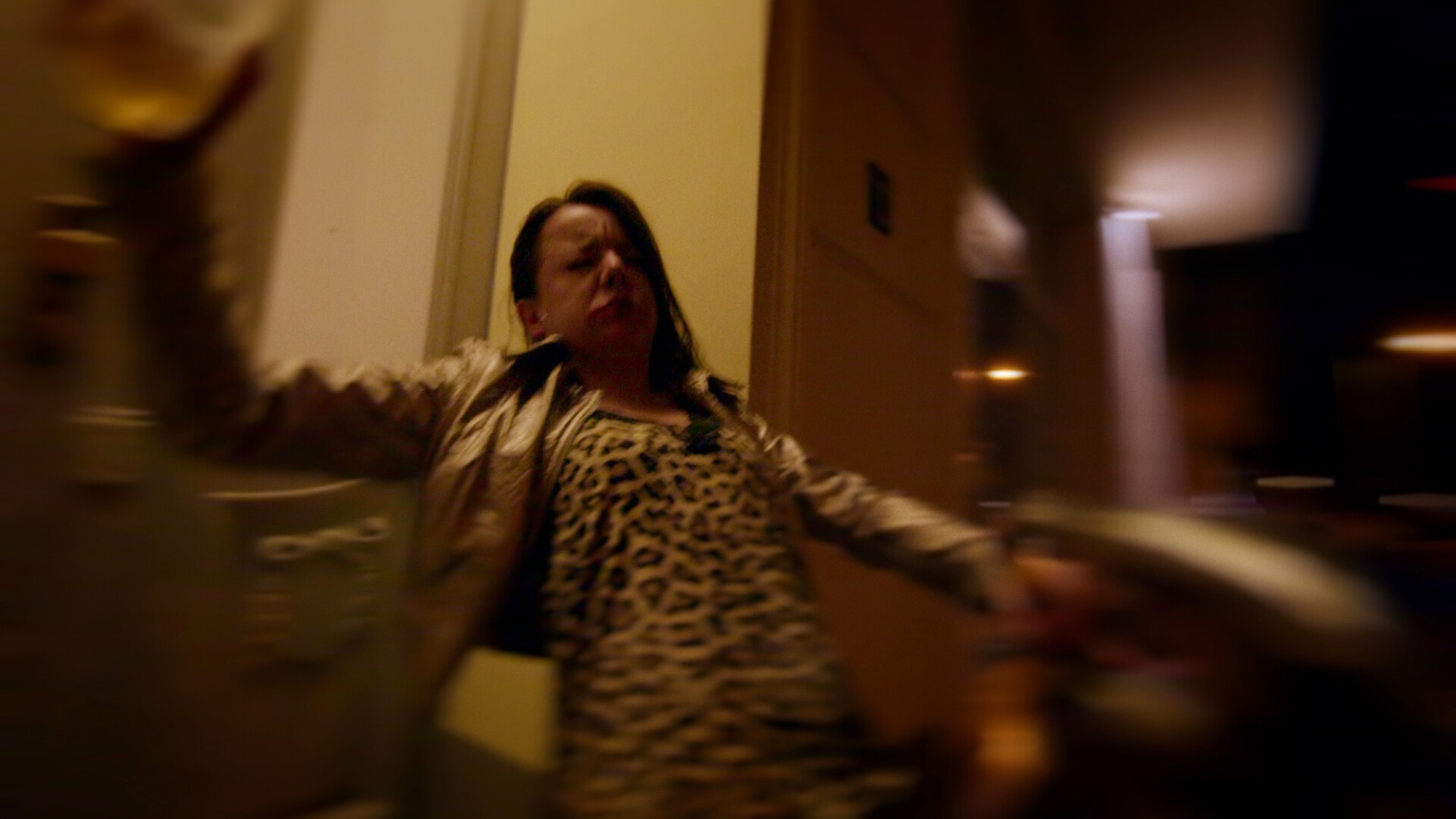
Buzzed, merry, legless, smashed – there are countless ways to describe being drunk, but capturing any one of those states convincingly on screen is no easy task. Conventional depictions of inebriation tend to rely on slurred speech, uncontrollable hiccups and characters stumbling into furniture, but do these familiar tropes ever really convey the alcohol-fuelled perspective, or have they simply become lazy cinematic shorthand? With his perfectly titled short Don’t Puke, director Daniel Chisholm sets out to offer something more authentic, following a wasted woman on her increasingly disorientating journey home to her trusty sofa.
Opening with an epilepsy warning that also contains a tongue-in-cheek disclaimer about the film’s potential to induce vomiting, Don’t Puke makes its intentions clear from the outset and delivers on them over the following seven minutes. Disorientating, hilarious and at times painfully accurate, Chisholm elevates a relatively simple premise through an inventive and immersive production that puts us firmly inside his protagonist’s drunken perspective. Naturally, it left us with plenty of questions. Eager to dive into those, the writer/director/editor/producer joins us to discuss the challenges of recreating a drunken night out — spinning rooms, cold chips and all.
Hey Daniel, thanks for joining us on Directors Notes. We’re excited to talk about your wonderfully titled short film, Don’t Puke. The film seems intent on capturing an unusually hyper-accurate depiction of what it feels like to be drunk. What inspired you to explore that experience on screen and what did you find interesting about trying to recreate it for an audience?
I’ve often watched depictions of inebriation on screen and been a bit disappointed. They often did a token attempt at depicting what it feels like to be drunk (usually with a Snorricam), but never quite went far enough for my personal taste. I wanted to go the extra mile and take the concept to its logical conclusion – how close could I possibly get on screen to what it feels like to be drunk? What are the symptoms, and how can I best translate those into something that is filmable? The goal was to make the audience feel like they’ve had the most drunk night of their lives, but hopefully without the hangover.
Authenticity seems to have been a key aim throughout the production. What did your pre-production process look like and how did you work out the details that would make the experience feel genuinely drunk rather than simply like a cinematic depiction of drunkenness?
My first step was to think back to my own (way too many) experiences with alcohol and how it made me feel. The plan was to really figure out what was happening in detail and to be as faithful to that as possible in the film. Two feelings seemed essential to me: The dizziness that makes it hard to walk or focus on things, and the feeling of the world spinning around when lying down and closing one’s eyes.
If that’s what my eyes are doing, why not just do the same with the image on screen?
Thinking back to the dizziness I felt, I realised that my eyes constantly seemed to be flicking from right to left, again, and again, and again. Apparently, this is called “nystagmus” and people can experience it horizontally or vertically. I personally am of the horizontal persuasion. So, I figured, if that’s what my eyes are doing, why not just do the same with the image on screen? I tried moving the camera in that manner (repeatedly panning it from right to left) and cutting out the pan back (from left to right) to make the movement seem like it was always going in the same direction. Unfortunately, that led to big continuity issues when filming dialogue, because it required me to cut so much out. Instead, I ended up doing it in post, by slightly cropping the image and then keyframing it repeatedly from one direction to the other.
The world turning effect took a bit more work, though I knew that I wanted to transport the idea by having the camera spin around Charlie (the protagonist), because that is what I myself visualised when I was lying on my bed, trying desperately to distract myself from the need to puke: I visualised the room spinning around me, then the house, then the whole world, and then the galaxy. I did lots of tests to see how I could achieve something like this, and after lots of trial and error, I broke that sequence into multiple stages, each of which has its own technical solution, including techniques like photogrammetry, gaussian splatting and 3D modelling, using mostly Blender and After Effects. More about those later.
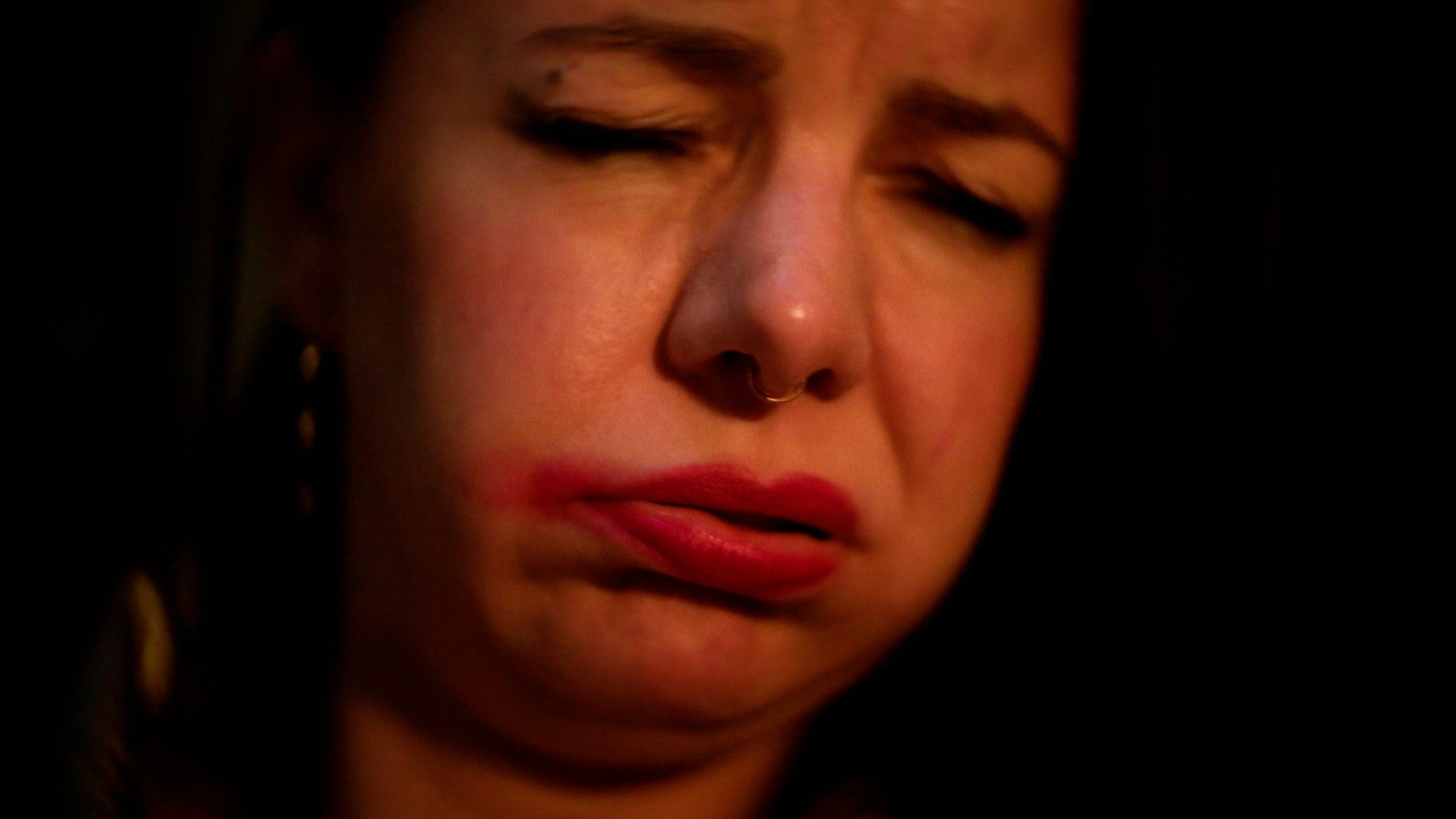
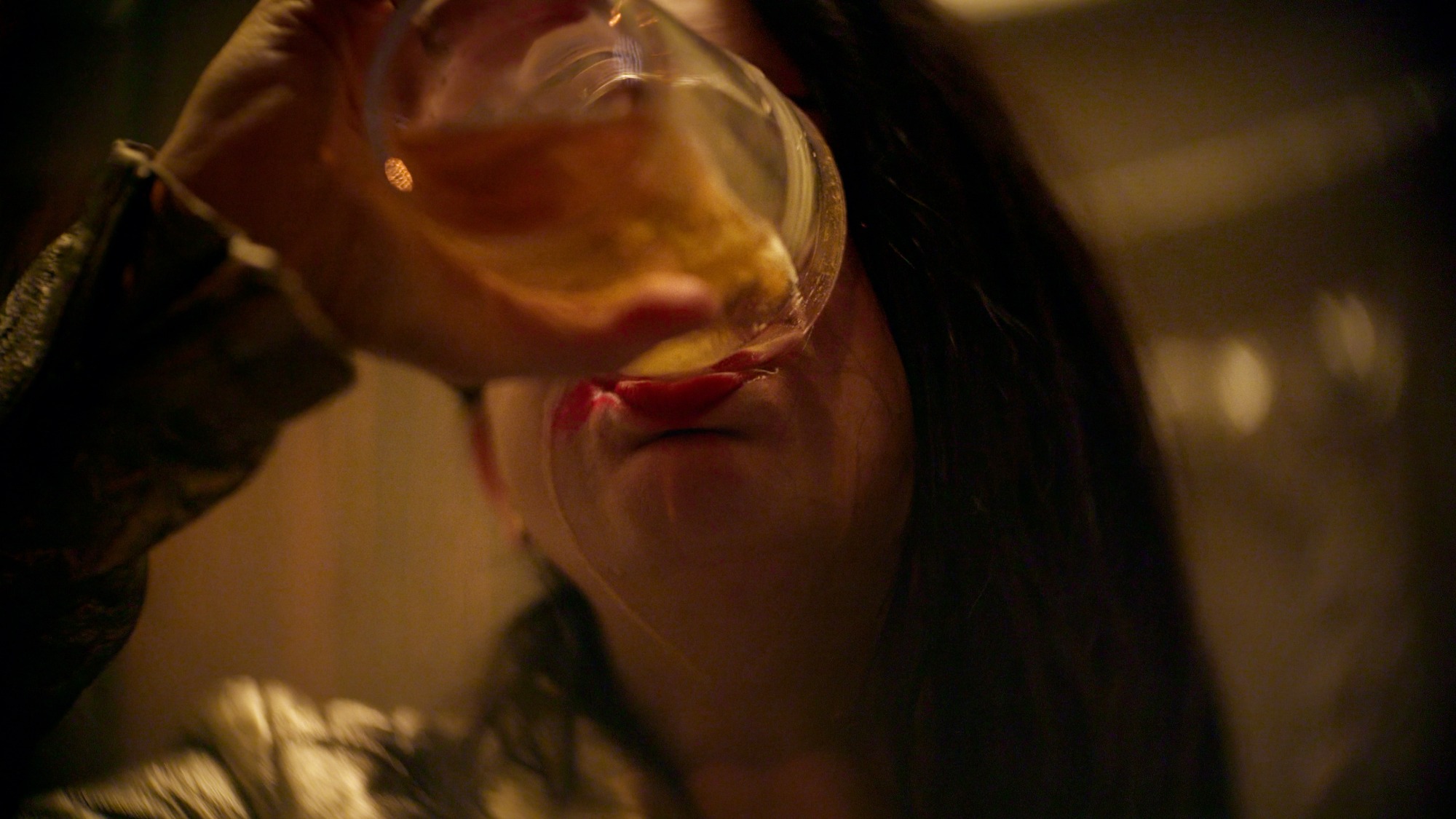
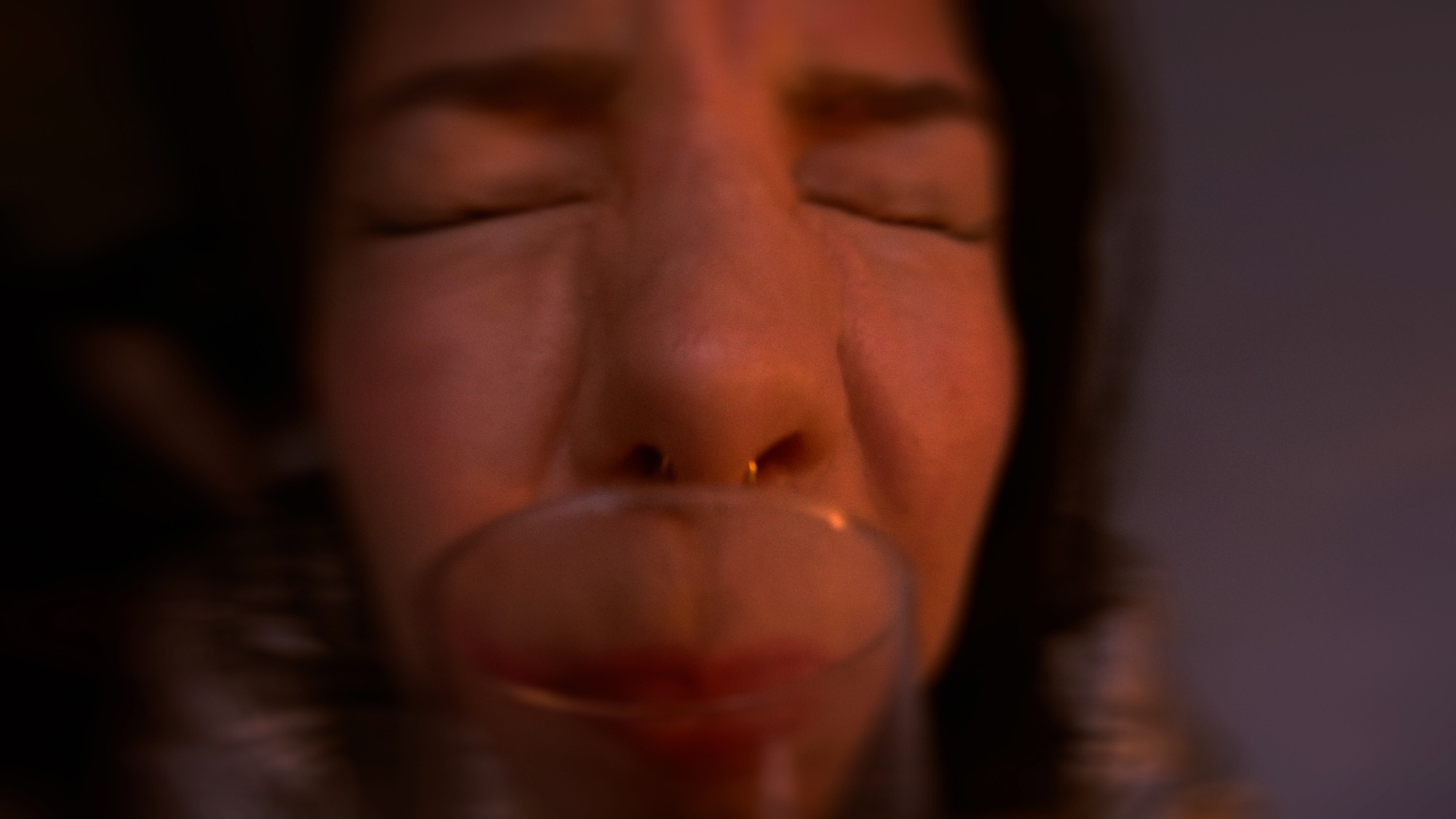
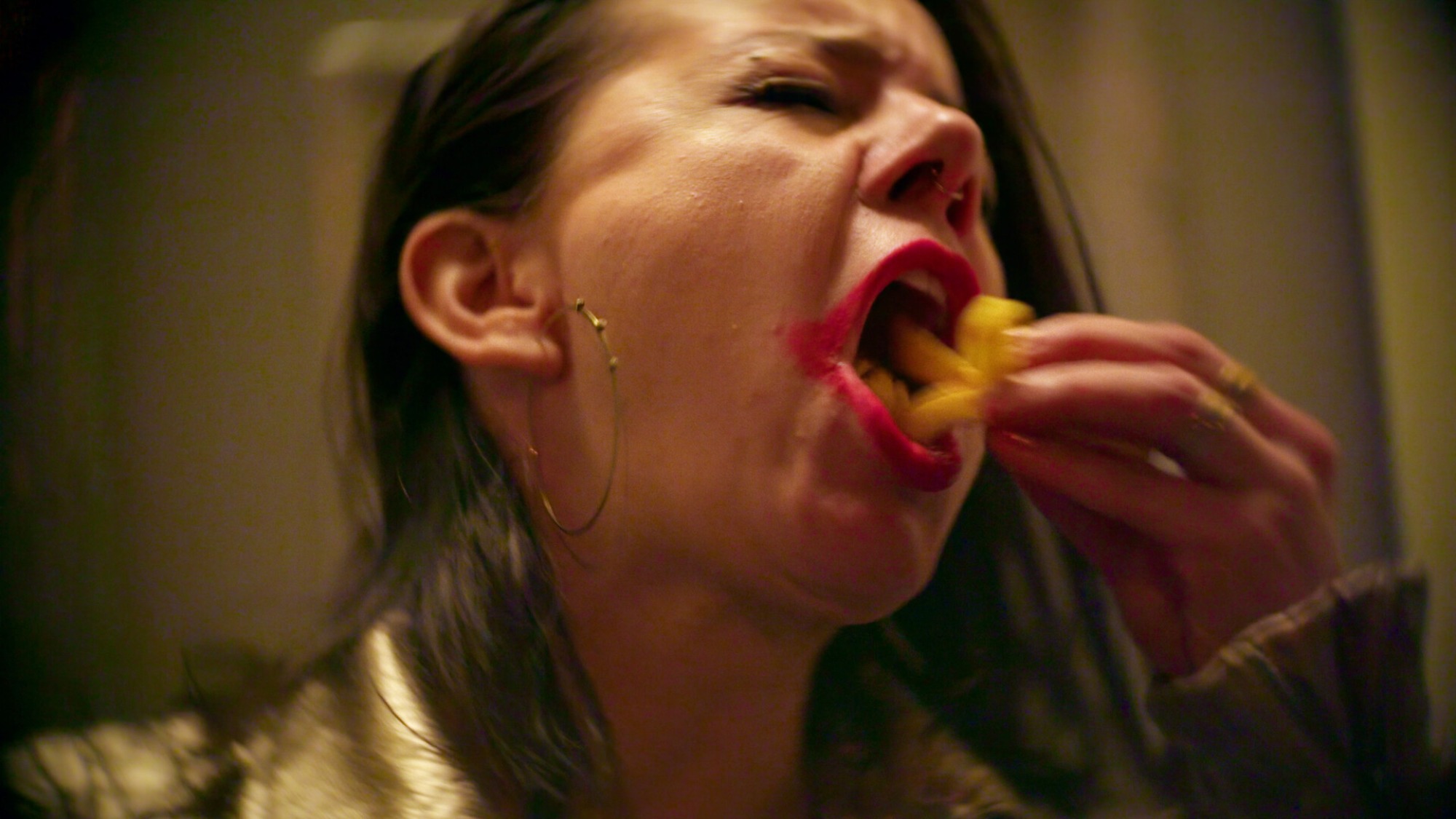
Janka would ceremoniously have a single shot of vodka, just to get in the headspace.
A lot of the film’s authenticity comes through Janka Horakova’s performance. How did you work with her to get into that inebriated headspace and were there particular aspects of the character’s physicality or behaviour that you wanted her to focus on?
Janka Horakova was an absolute godsend! When I auditioned her, I immediately knew that she would play the part. She is a consummate professional, so she had prepared thoroughly, and it showed in her performance. Her energy was incredible! It really looked like she was trying hard to stay upright, trying hard to enunciate her words, but instead, she was staggering and slurring like someone who’s downed the better part of a vodka bottle. To be completely honest, there was very little ‘directing’ I needed to do at all – she just turned up and nailed it. I’m incredibly lucky she decided that she wanted to play the part, because without her, I’m not sure it would have worked at all – she totally carries it.
Most Popular
We were a fairly dry set (until wrap-time anyway). The temptation would of course have been to go full method, but Janka heroically resisted. At the beginning of each shooting day however, Janka would ceremoniously have a single shot of vodka, just to get in the headspace, while of course still staying totally in control. I think it also helped that the atmosphere on set was really good – people were having fun and that allowed the party-vibe to take hold, which was particularly important for the first scene, where Charlie (played by Horakova) begins her journey after escaping from her pushy friend Alex (played by Claire Uicker) and the crazy birthday party they’re at.
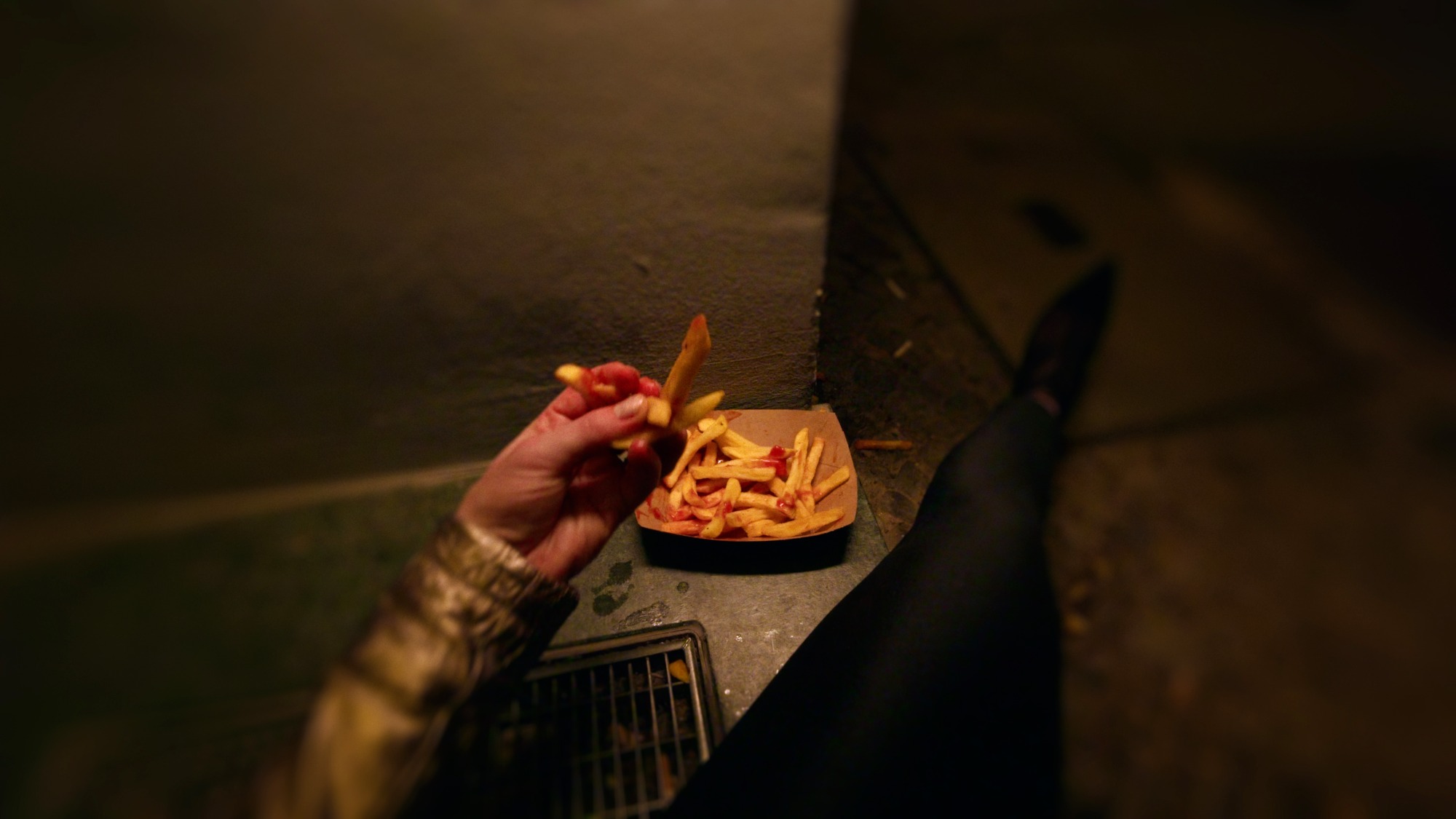
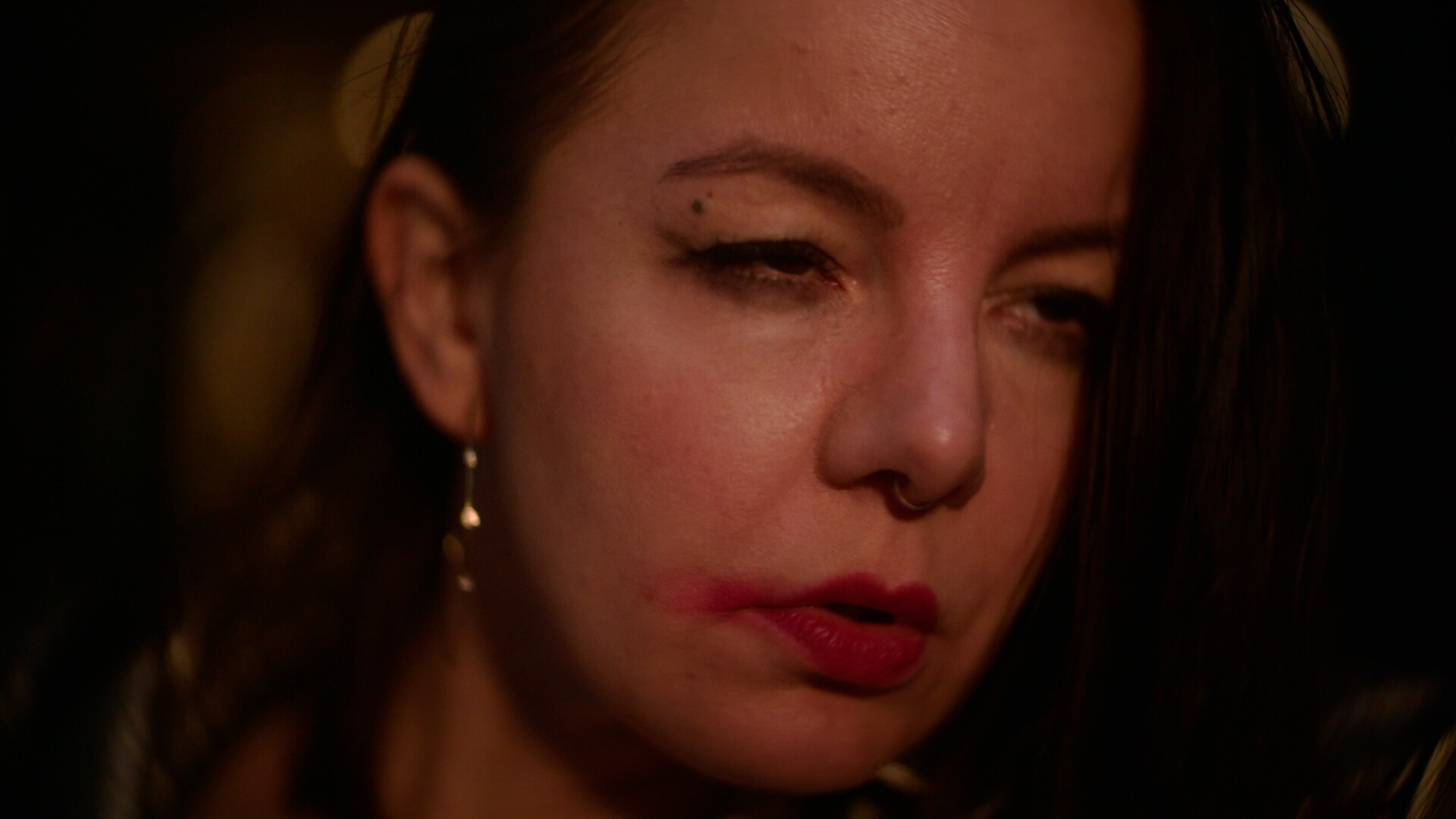
The film constantly shifts our perspective between first-person shots and the close-up camera that follows Janka. How did you decide which moments should be experienced from her subjective perspective and which should place us outside of her?
My initial instinct was to go full subjective perspective throughout the whole film, meaning I wanted the audience to experience each scene as Charlie, the protagonist, through her view of the world. Of course, that doesn’t mean literally seeing everything through her eyes in a point-of-view shot, but rather we shot almost the entire film using a mix of POVs and close-ups on Janka, to put us in her headspace and still show us her emotions.
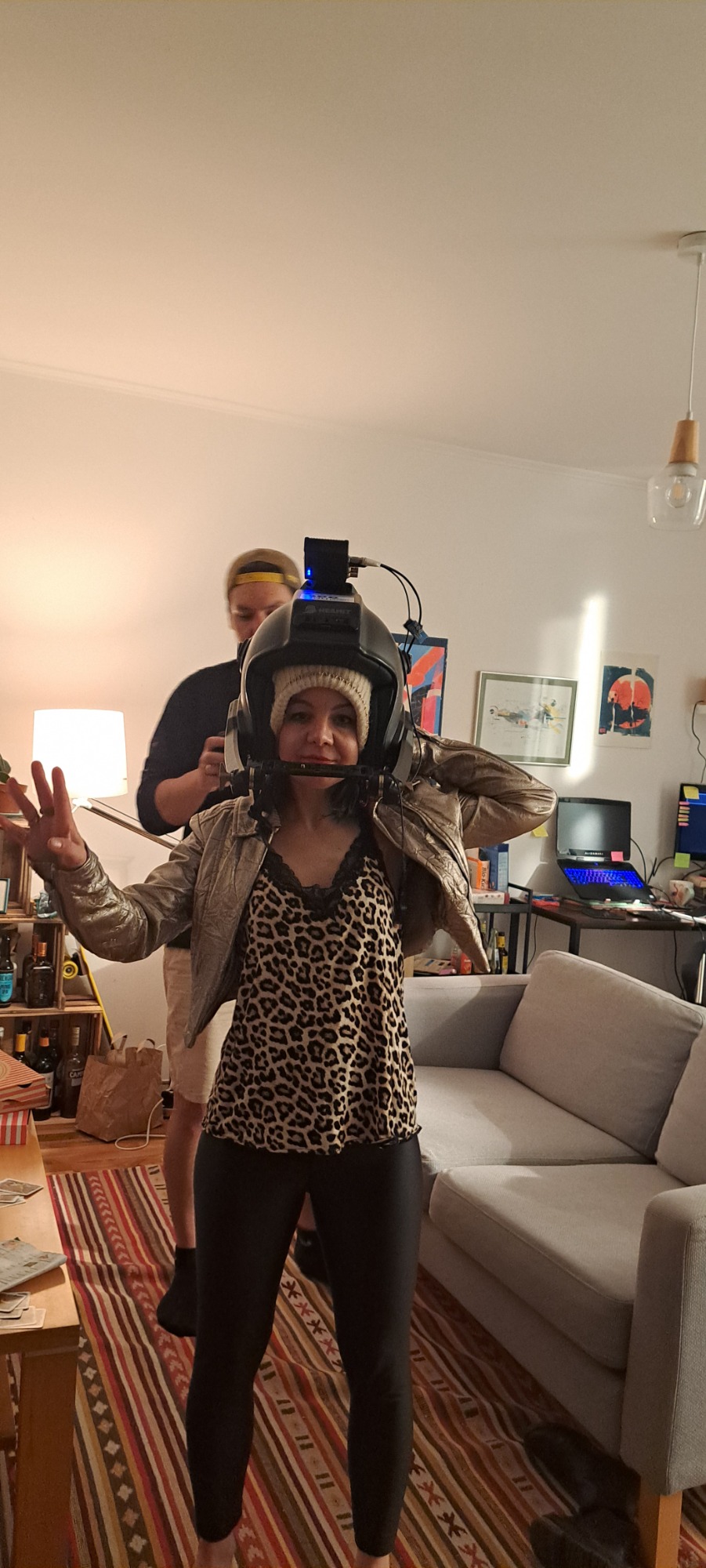
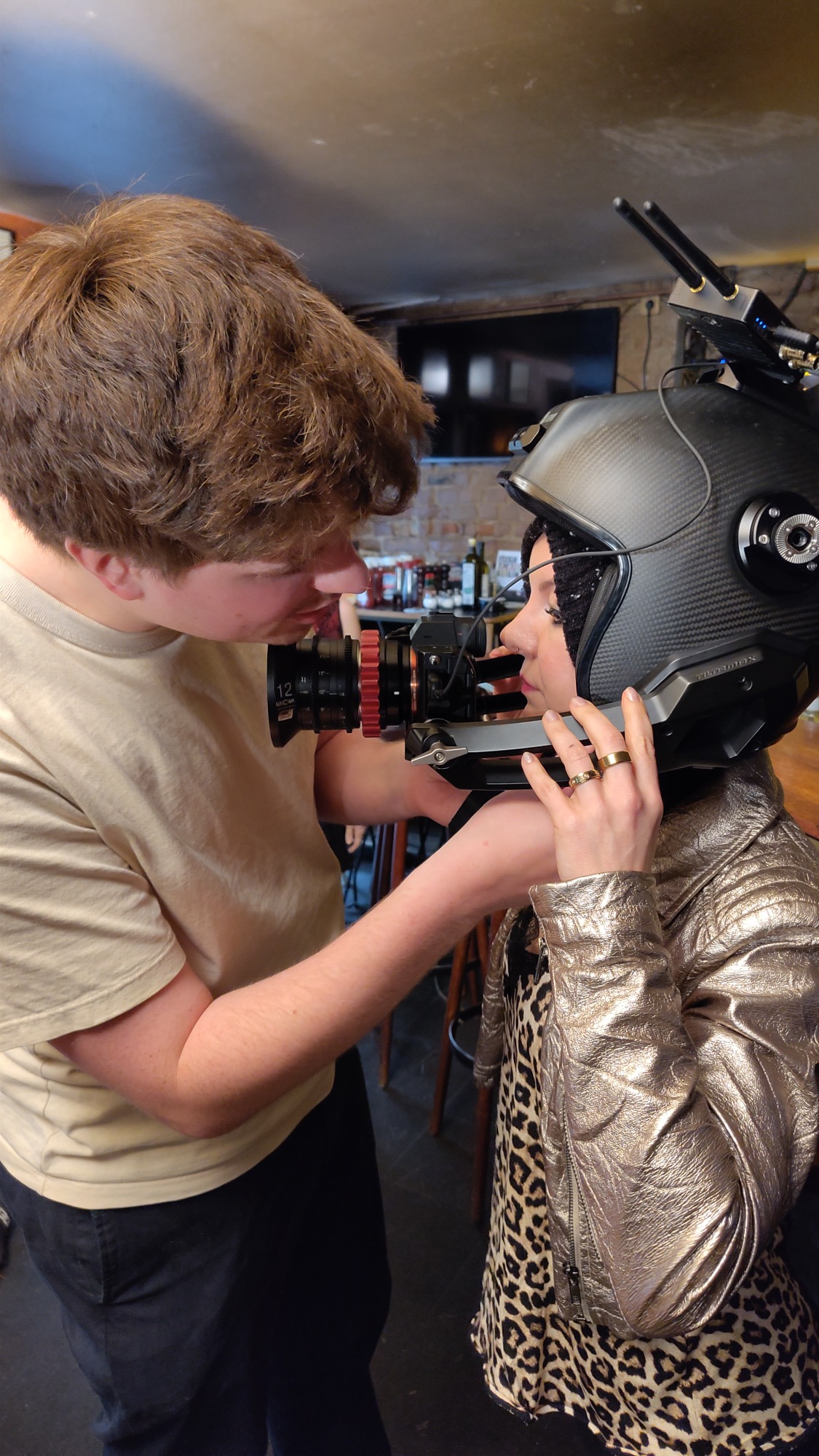
The close-ups were shot on an old, adapted projector lens that Dillon Ritchie, our DoP, got from our mutual friend Shane Kang, who graciously lent it to us. This lens is ultra-soft and has some beautiful distortions around the edges. Together with the chaotic hand-held action and the constant focus shifting, I think this gets close to the blurry, fuzzy, dizzy feeling that can kick in when properly sozzled.
It almost feels like security camera footage and gives us a good look at what Janka looks like from the outside.
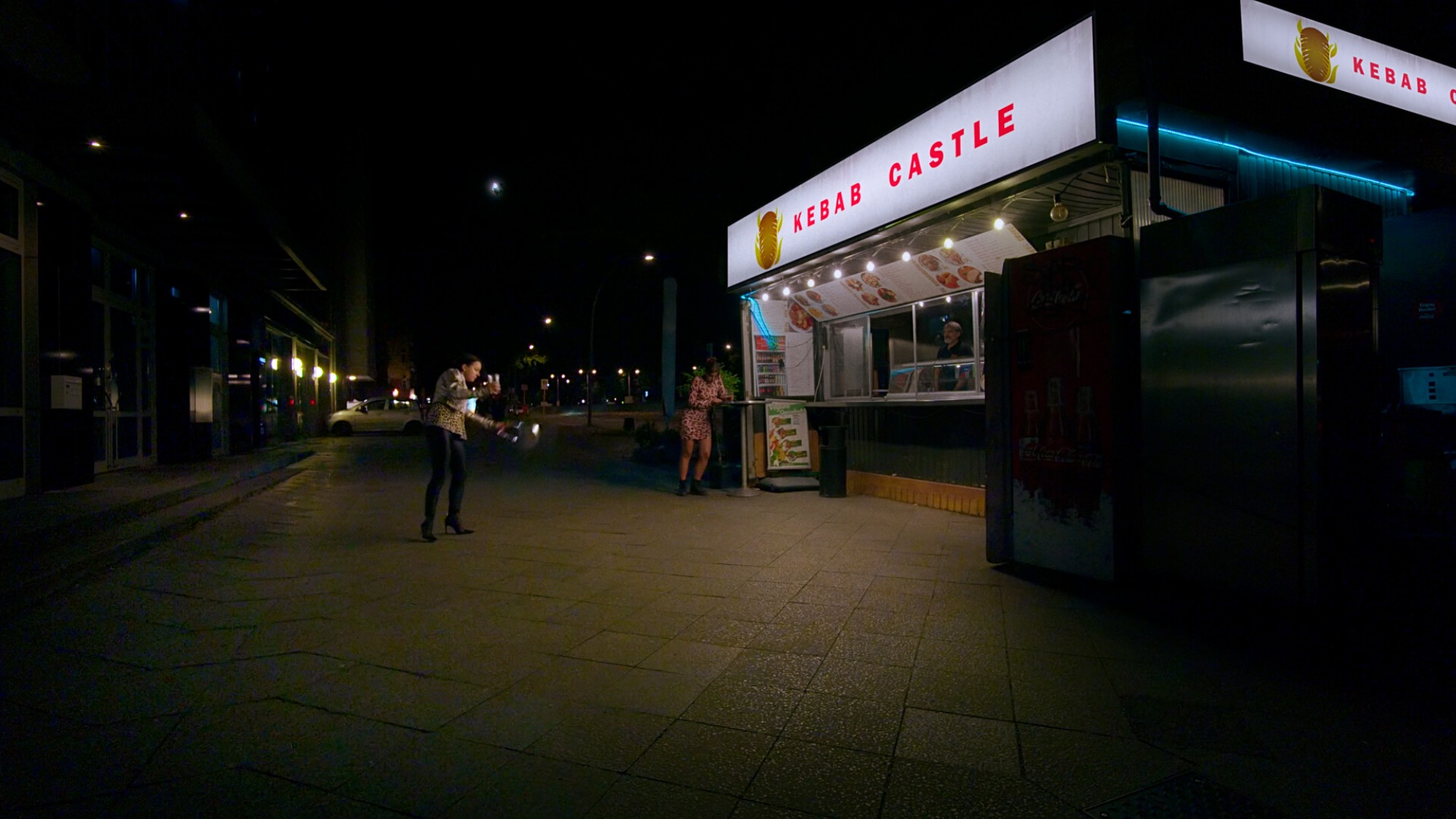
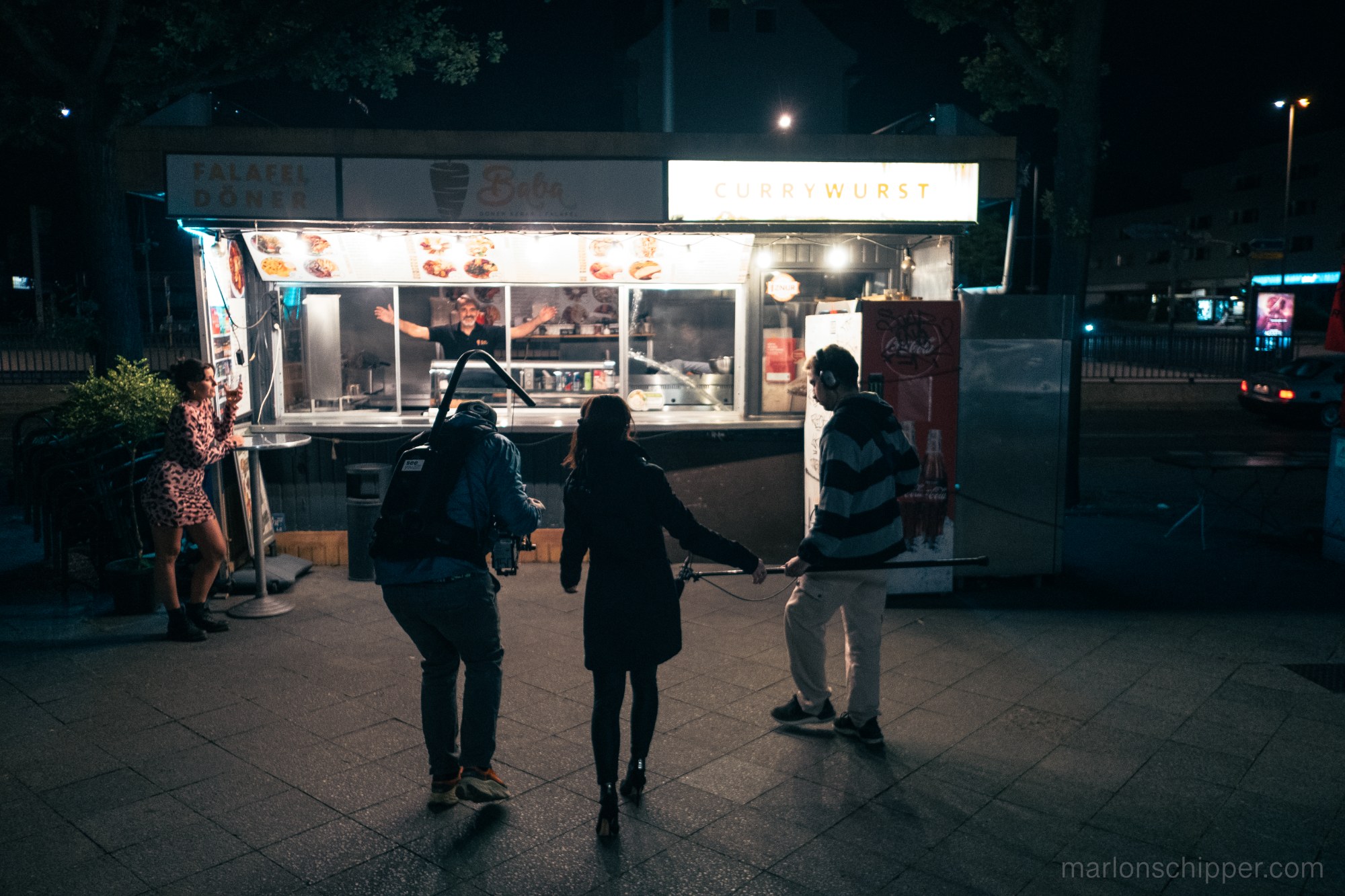
We didn’t stick with the subjective perspective through the whole film however – there are two scenes where we break out into an objective, observational perspective, meaning we see Charlie from the outside, as an onlooker, a spectator: The first is at the kebab shop, the second is when she arrives home. Dillon came up with the idea for the perspective break during our early conversations about the film, and I think juxtaposing what Charlie looks like from the outside with what she feels on the inside adds some lovely humour.
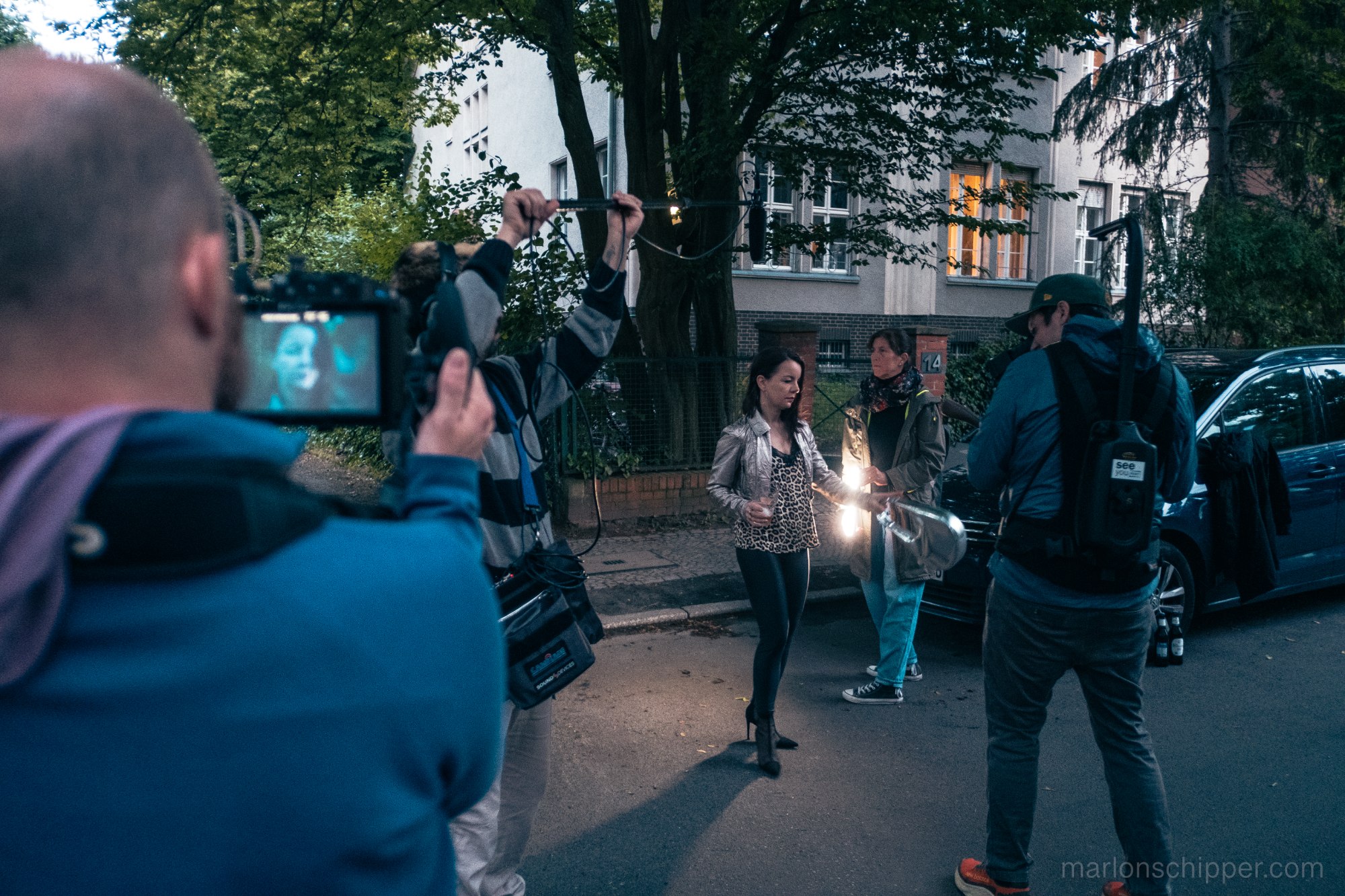
To really emphasise the perspective shift, the objective, observational shots are the only ones in the entire film that are wide shots, and they are shot with a locked-off camera, and a clean lens and a deep depth of field. It almost feels like security camera footage and gives us a good look at what Janka looks like from the outside. She’s pretty funny to look at as she staggers around completely legless.
With that in mind, were you more interested in showing the audience what drunkenness looks like from the outside, or trying to make them experience what it feels like from the inside?
Definitely the latter. I wanted to avoid making a film about drunk people as some kind of social statement. When making a film about something that has as many downsides as alcohol, I think it’s easy to end up with a simplistic message, like “alcohol is bad”. I was hoping to avoid that by focusing purely on the experience itself rather than the consequences. After all, I think the feeling of being completely smashed is something that many of us can identify with. I wanted to connect with that experience and make people go: “Ah yeah, I recognise that. That’s pretty accurate. And a bit funny when I can experience it at arm’s length and without the fear of waking up to realise I did something really stupid last night” (that’s how I usually felt after getting plastered, at least).
So yeah, entertainment was definitely a lot higher on my list of priorities than education. I suppose that for anyone who has never had the doubtful pleasure of being totally shitfaced, after watching this film, I hope you might have a better idea of what it feels like to be hammered. Maybe that’ll help some kids make a more informed choice.
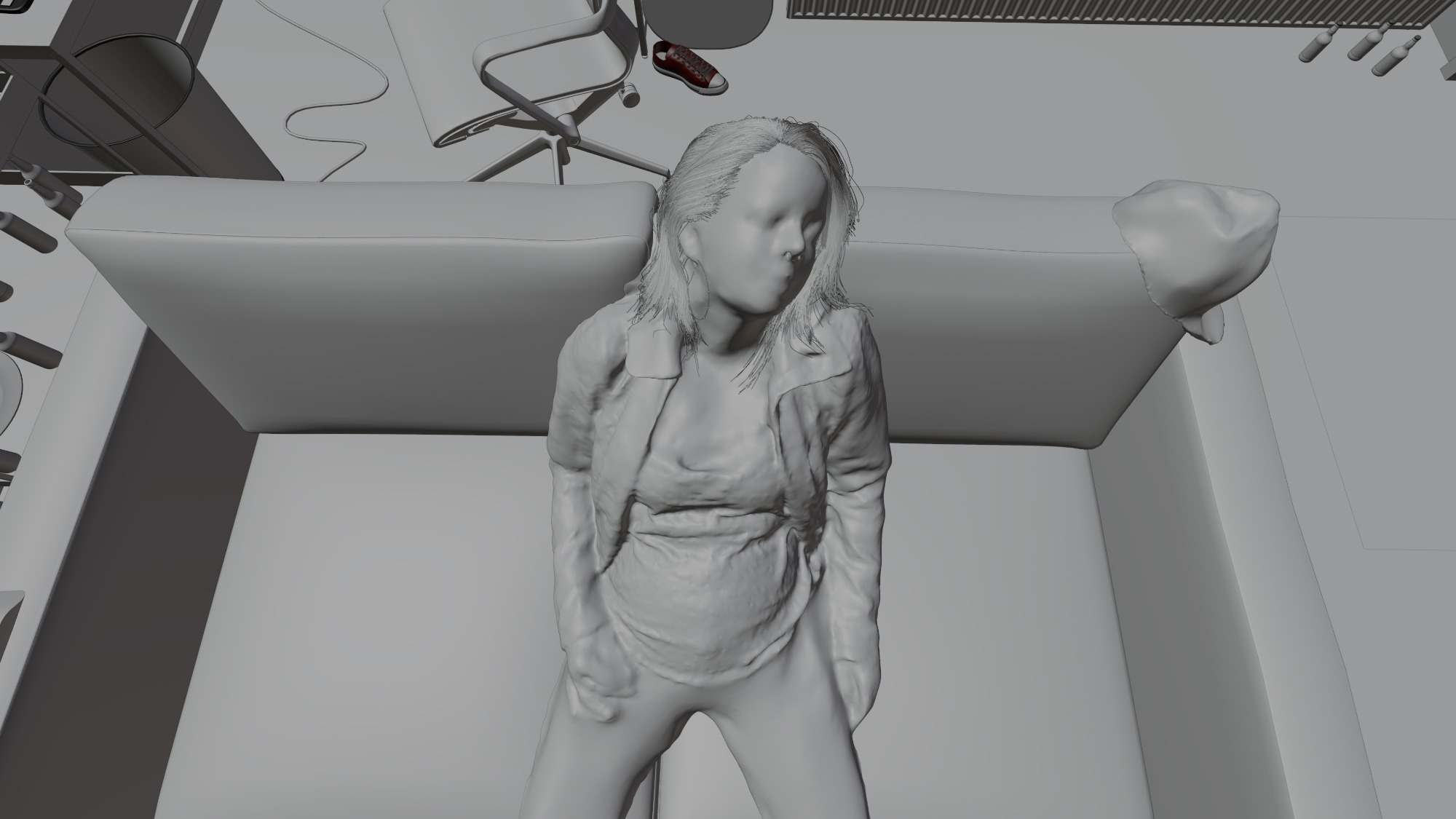
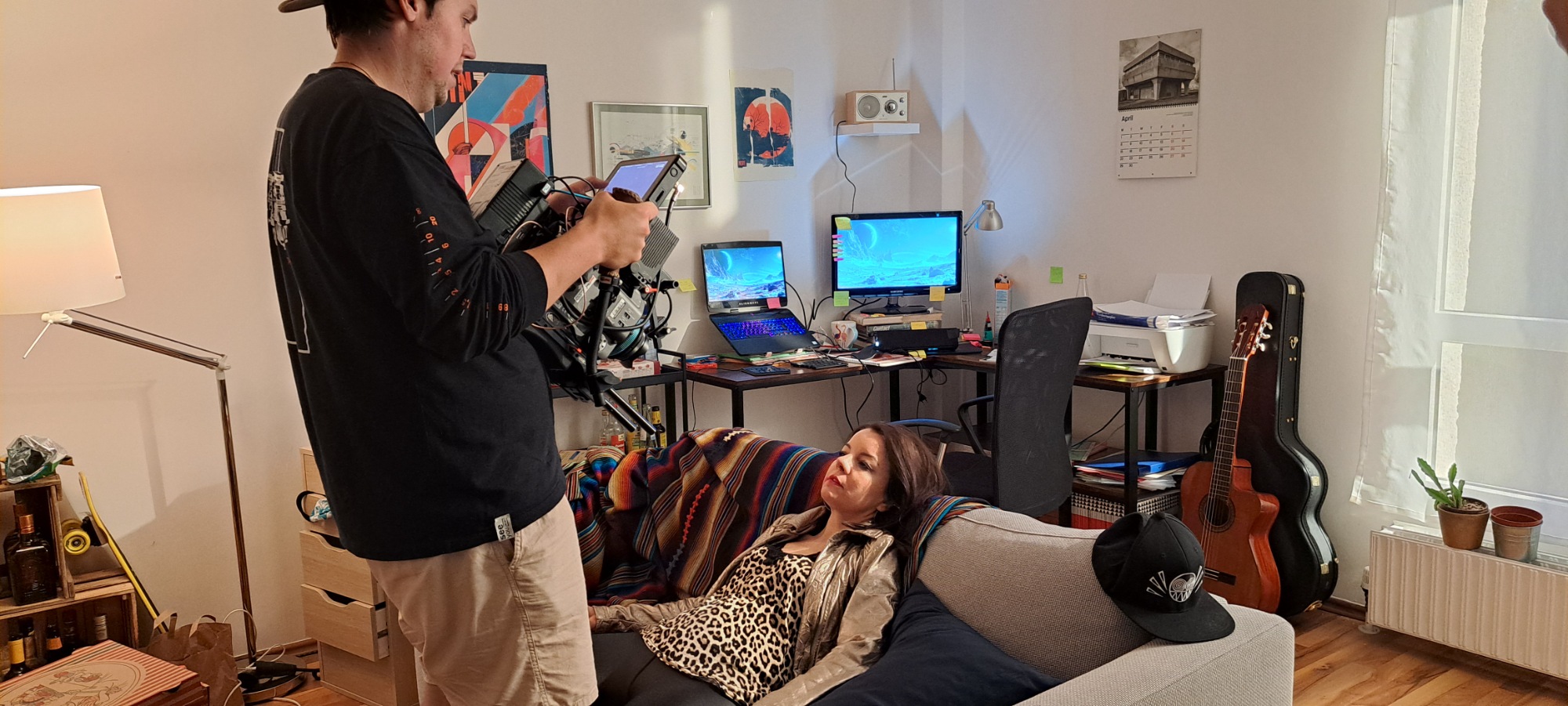
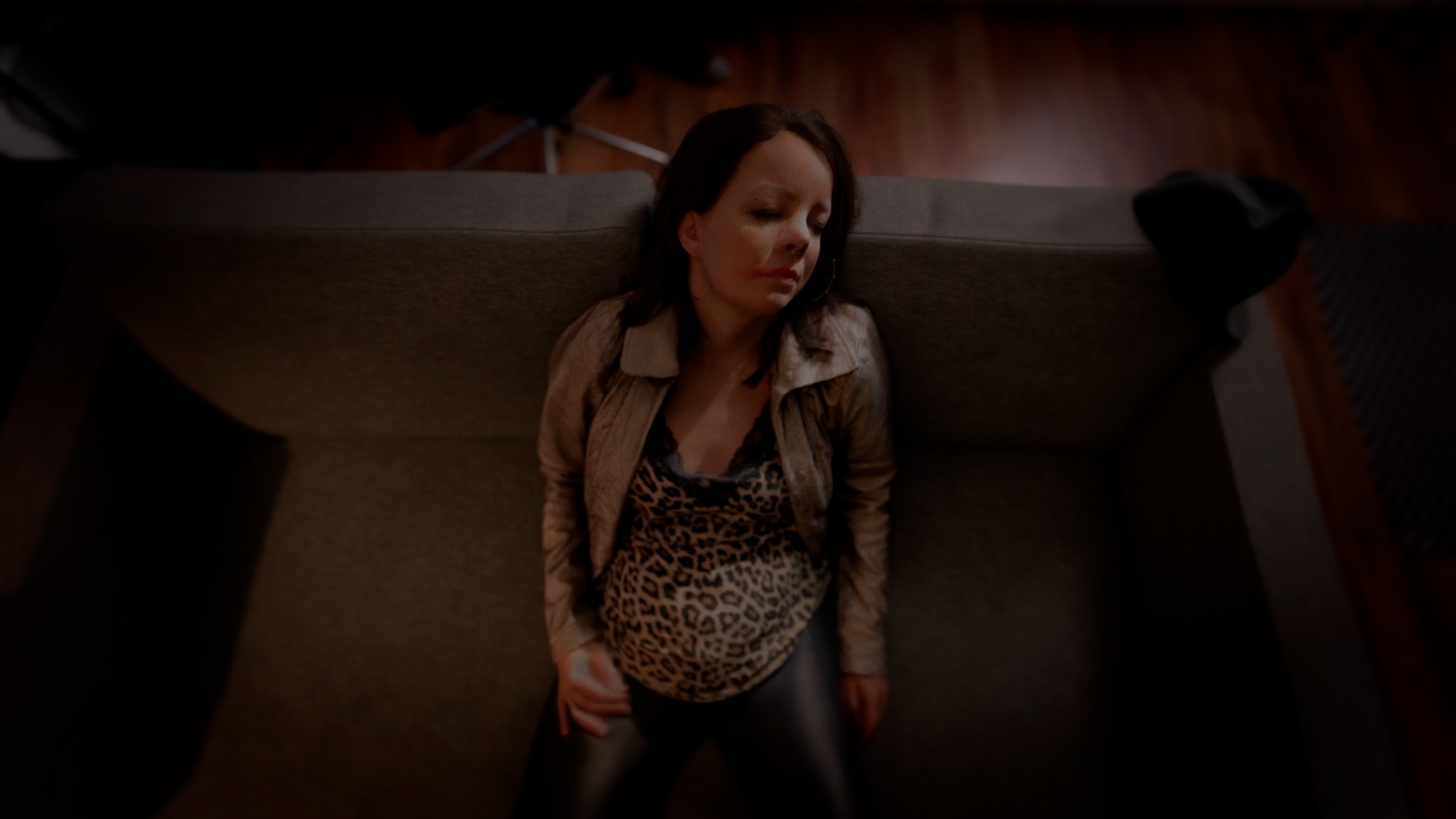
There’s a particularly striking sequence where your protagonist slumps onto the sofa and we experience that familiar spinning-room sensation as the camera orbits around her, before pulling back beyond the building. How did you conceive and execute that sequence?
This moment in Charlie’s journey was inspired by (too) many sloshed nights lying in bed, feeling the world spin around me. On occasions when it was bearable, I would visualise the world spinning around me. My addled mind found it entertaining to depict myself in the room, the whole house spinning, then taking it further out to the whole world spinning, with me perched atop it, and then the whole galaxy. That was fun, until I desperately needed to puke. Which I did. And this is, of course, exactly what I tried to replicate in the film.
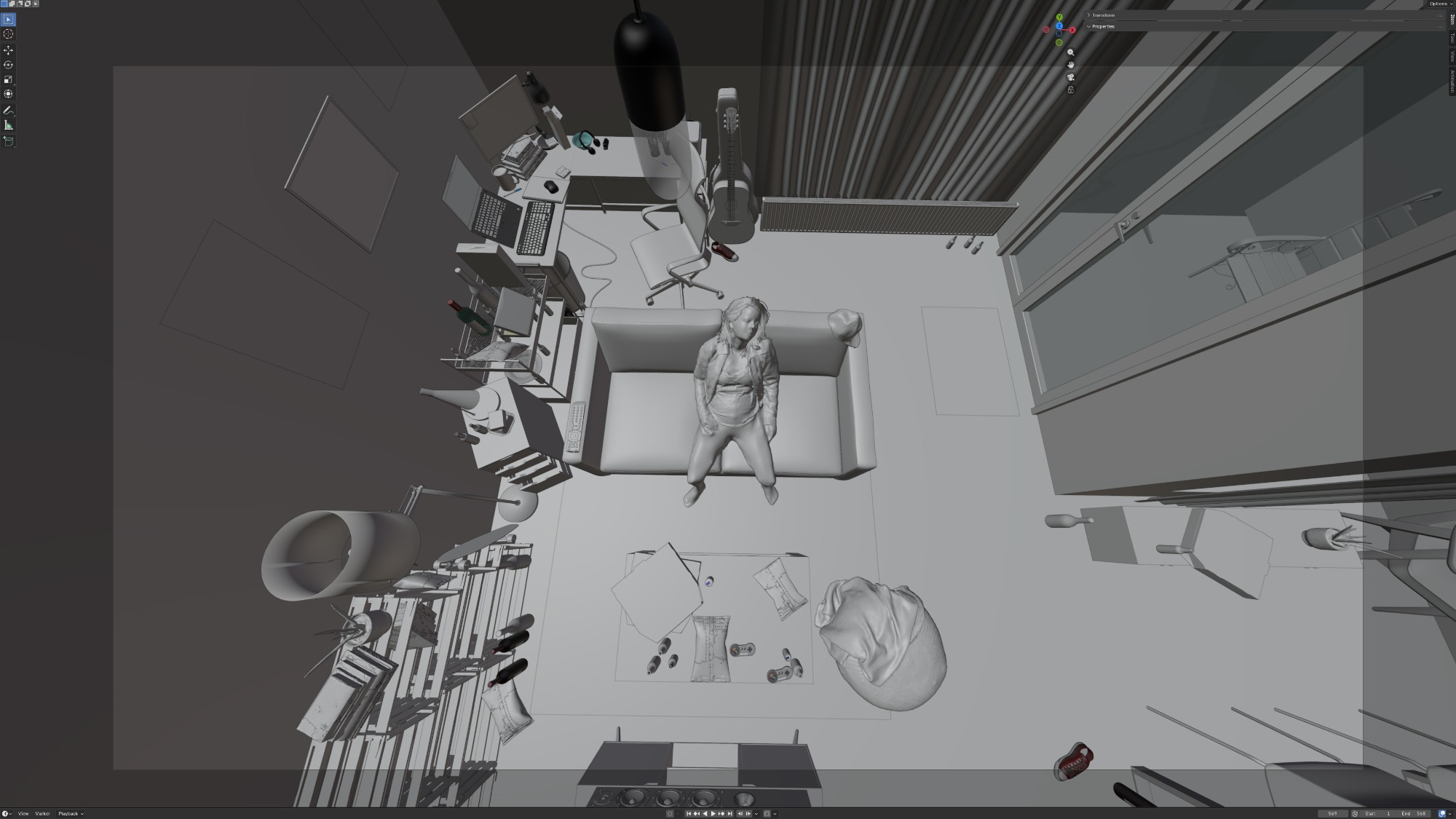
At first, I thought about ways to achieve this practically (at least the first step of showing the movement around Charlie on the sofa), but I quickly realised that this would be pretty much impossible to do on the budget I had available. I’d never even heard of a rig that would spin around a fixed point, so I gave up trying to come up with one myself. Instead, I looked into ways to do this digitally.
I’d only dabbled in Blender up until this point, and I knew there was no way in hell I would be able to sculpt a photorealistic Janka myself, but just around this time, I’d seen something online about relatively new techniques to capture photorealism for 3D, called photogrammetry and gaussian splatting. I did some more research and started experimenting with some free solutions that I found online. After lots of trial and error, I decided that a mix of both would probably work best.
The thing that gave it away initially was the hair, which came out looking flat and unrealistic. So, I learned how to create a hair system in Blender and replaced her hair.
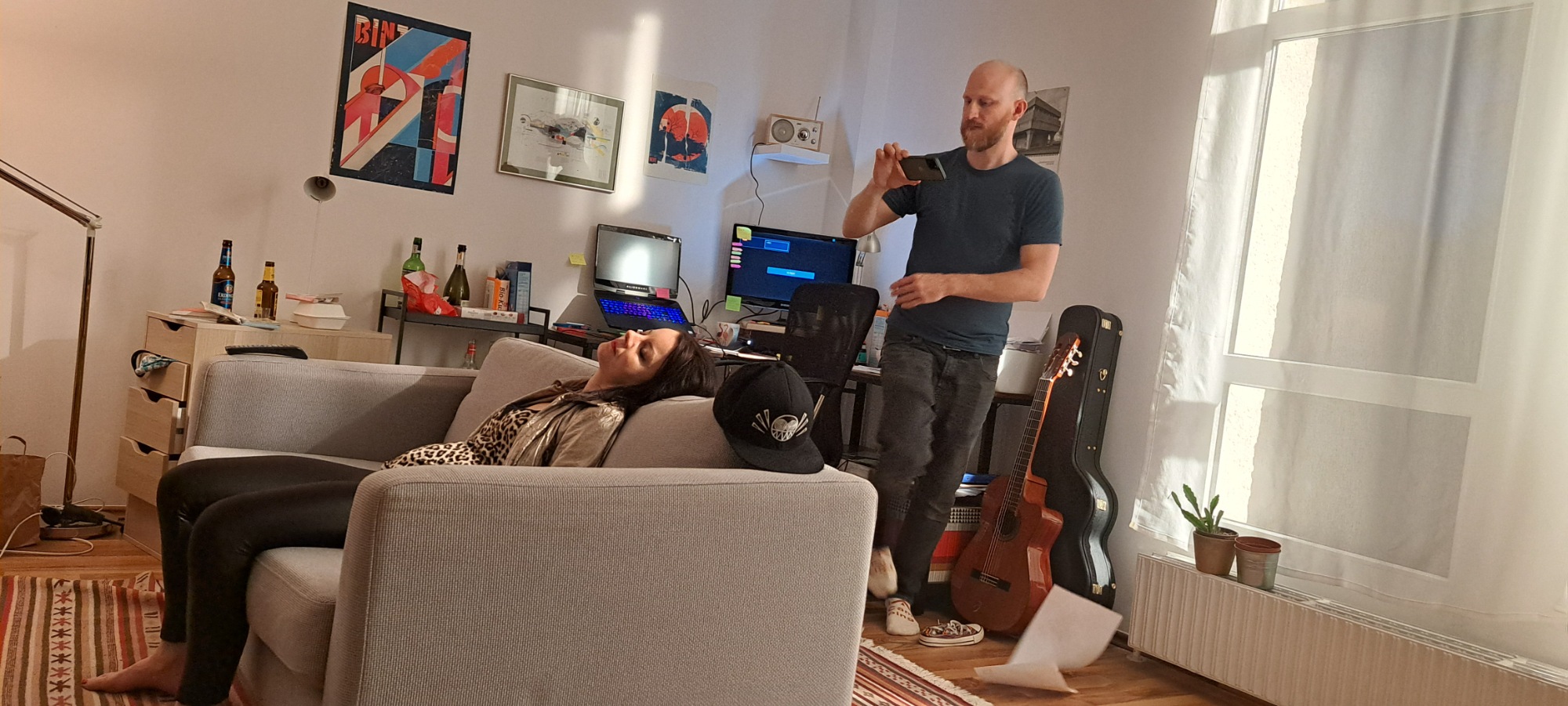
For the shot on the sofa, I took lots of footage of Janka sitting there, then fed those into Polycam, which at the time was still new and had a lot of free options. This gave me a 3D model of Janka and the room. When trying to capture the entire room, the quality was really low, so I used that mostly as a reference to rebuild the room in Blender using assets I downloaded online from various sources, like Sketchfab – where there are tons and tons of community-created assets, many of which are on a Creative Commons license and free to use. For those bits of furniture that I couldn’t find a good match, I modelled them myself in Blender.
For the model of Janka, a detailed photogrammetry scan gave me enough quality to feel like I might get away with it. The thing that gave it away initially was the hair, which came out looking flat and unrealistic. So, I learned how to create a hair system in Blender and replaced her hair. Once I had the room and Janka assembled, it was just a question of animating a camera around her.
For the house shot, I decided to go for a gaussian splat, which is a 3D point cloud that can create stunningly photorealistic environments. I was lucky enough that my friend Marvin Borchers, who is a drone operator, agreed to help me out. We did a flight around my parents’ house, taking footage of it from all angles. I then fed this into PostShot, which is software that creates a gaussian splat out of pictures or video. Once that was done, I could animate a virtual camera around the point-cloud house, and the result is what you see in the film. It’s not perfect, because PostShot was still in Beta at the time, and my graphics card isn’t exactly top-end, but the shot moves fast, so I hope I got away with that bit of jankiness.
The shots of the Earth and the Galaxy spinning, I both animated in After Effects, which is more my comfort zone. The legendary Video Copilot has a great free plugin called Orb, and a brilliant tutorial to go along with it, that makes creating a semi-realistic Earth in After Effects a breeze – I’d recommend that to anyone doing something similar.
For me personally, I found some visual parallels with music videos such as The Prodigy’s Smack My Bitch Up and Pulp’s Do You Remember the First Time? when watching Don’t Puke. What were the visual influences that shaped the way you approached your film?
Funny you should mention music videos – I absolutely love music videos, and I approach projects where I know the music is going to play a large role, like in Don’t Puke, a bit like editing a music video at times. Paul Child, the composer, is a longtime friend and collaborator of mine, and he was on board well before the shoot began. We tossed ideas back and forth for what the music would need, and once the film was ready, I primarily let the music dictate the rhythm of the edit rather than vice versa.
Wow, I just checked out the video to Do You Remember the First Time? by Pulp, and they really did the same spinning effect, but they did it practically! I’d not seen this one before – that’s amazing! Now I really want to know how they did it! 😀 Smack my Bitch Up is of course a legendary video and I’m honoured that you would be reminded of it while watching Don’t Puke!
To be honest, I didn’t really have any direct references in mind while coming up with the visuals for Don’t Puke (apart from what I could remember of my personal experiences). I thought about Fear and Loathing in Las Vegas as a film that goes to similar lengths to depict substance abuse, but it was more of a spiritual reference than a direct one. Of course, I’m not creating my work in a vacuum – there are definitely influences from other filmmakers that have found their way into my work, but I think they’re mostly on a subconscious level a lot of the time. Some of the filmmakers whose visual style has impressed me in the past are Luc Besson, Chris Cunningham, Gaspar Noé and Hayao Miyazaki. Charlie Kaufman’s unique approach to subjective perspectives has also deeply impressed me and got me thinking about how to reflect some of those concepts in my own work.
The film also has a wonderfully repetitive quality to its editing, which seems to mirror the cyclical nature of being drunk. Was that repetition something you planned from the script, or was it something you discovered during the edit?
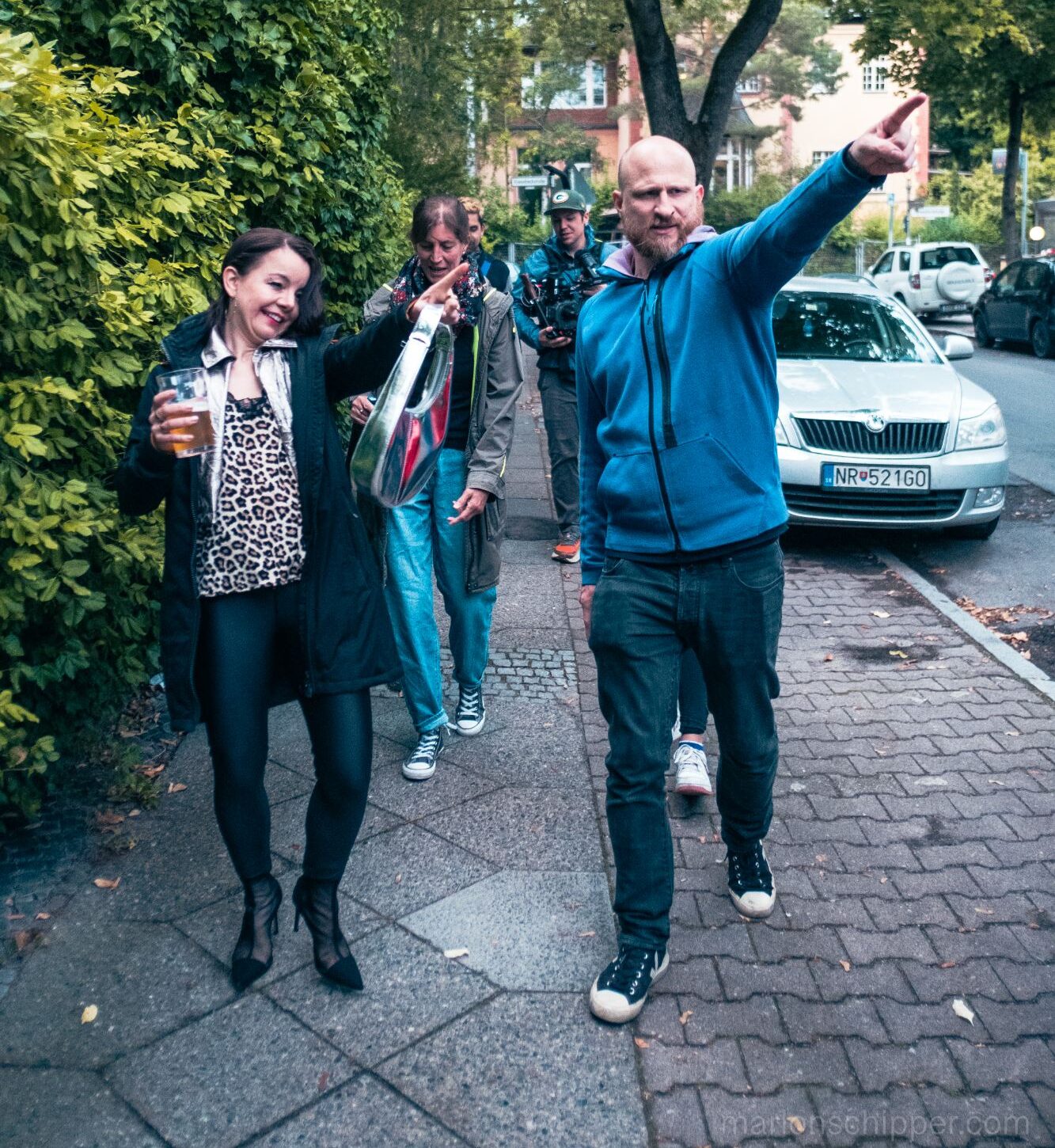
Yeah, the repetition was definitely baked in from the start, but the detailed execution was then often found in the edit. I knew from the get-go that I wanted the process of getting from A to B, the ‘shoe leather’, which is usually the first thing to be left out in films because it’s usually repetitive and boring, to feature prominently here. In my experience, getting anywhere when your legs aren’t working properly is a lot more interesting than it normally would be. So, I tried to use the recurring walking scenes to pull us into Charlie’s state of being, to make us walk in her shoes for a little while, so to speak.
Charlie needed to almost puke a few times, so that the climax would really land.
I also knew I was going to use a lot of repetitive jump-cuts, both to add to the chaos and the lack of orientation, but also to give myself the freedom to mash loads of different takes together, finding the moments with the right kinetic energy and the best performance. The drinking of beverages and the nauseating result thereof was something I didn’t want to leave at just a one-off either. After all, the pay-off at the end needed a set-up: Charlie needed to almost puke a few times, so that the climax would really land. And what better way to make someone want to puke than by forcing them to drink something they’d rather not?
More generally, how did you approach finding the rhythm of the film in post-production? Was there a point where you felt you’d finally found the right pace for the audience to experience the night alongside your protagonist?
It took a few re-edits to get the right pacing and length, that’s for sure. Though I frequently freelance as an editor, I usually try to avoid editing my own films. I feel that it is usually easier to get a good result if the editor has a healthy distance from the material, which I, as a director, almost never do. But this time, I decided to do it myself anyway, because of the highly specific nature of the visual language. If I had saddled someone else with the edit of this film, I probably would have ended up micro-managing the poor sod, which wouldn’t have been fun for either of us.
At some point I guess perfect becomes the enemy of good.
As a result, however, I did indeed find it difficult to get the necessary distance from the material, and I needed lots of detailed feedback from my friends and family to find the right length for the piece. I even killed a whole scene because it felt unnecessary and like one repetition too many. In hindsight, I think the chips eating scene still could probably be a little shorter, but I guess one can keep tweaking forever. At some point, I guess perfect becomes the enemy of good.
What’s next in your filmmaking journey? Are there any upcoming projects you’re working on that you’re excited to share with our audience?
Heh, yeah, I’m always working on something. My biggest project is an arthouse, contained, near-future sci-fi feature that I’m writing, and which I am very excited about. In parallel I’m also developing a short film with Dillon Ritchie (the DoP on Don’t Puke) which he’s written. It’s a dark, off-kilter comedy about a son-in-law connecting with his wife’s dad while on a hunting trip. It’s a really fun story, and we’re hoping to shoot in spring next year.
I’m also developing another short film I’ve written, which is a fictionalised engagement with my own post-colonial guilt. Both my parents grew up in Africa (Zimbabwe and Mozambique), and I have lived in South Africa and Kenya. The inequality I experienced while growing up there was staggering, and it left a deep impression on me. I’m trying to work that experience into a story about a character who has to deal with a similar past, while being thrust into a situation in which he must decide between paying a hefty price in order to atone for his guilt, or ignoring it and pretending it doesn’t matter.
And then I’m also developing a fun vertical drama together with Janka Horakova called Das Revier (German for Hunting Territory and Police station – we love double-meanings, us Germans). It’s a bit of a piss-take on German procedural police shows (of which there are about a billion – it’s the most popular format over here). We’re just having a bit of fun with that, and hopefully the first episodes will be dropping in the not-too-distant future.
And finally, this is a question we ask all our featured filmmakers: what’s one short film by another filmmaker that you’d recommend to the Directors Notes audience, and why?
One of my favourite short films of all time is Soft by Simon Ellis. I watched this back in 2008 or 2009, and it still is one of my favourites. The film hits like a truck. I really admire the emotional punch that it delivers. For me, the sign of a really good film is when I feel properly shaken about after watching it. When it really makes me feel something. It could be any emotion really. As long as I feel my insides twisting and turning, that means the film is connecting with me. And Soft most definitely did that.