
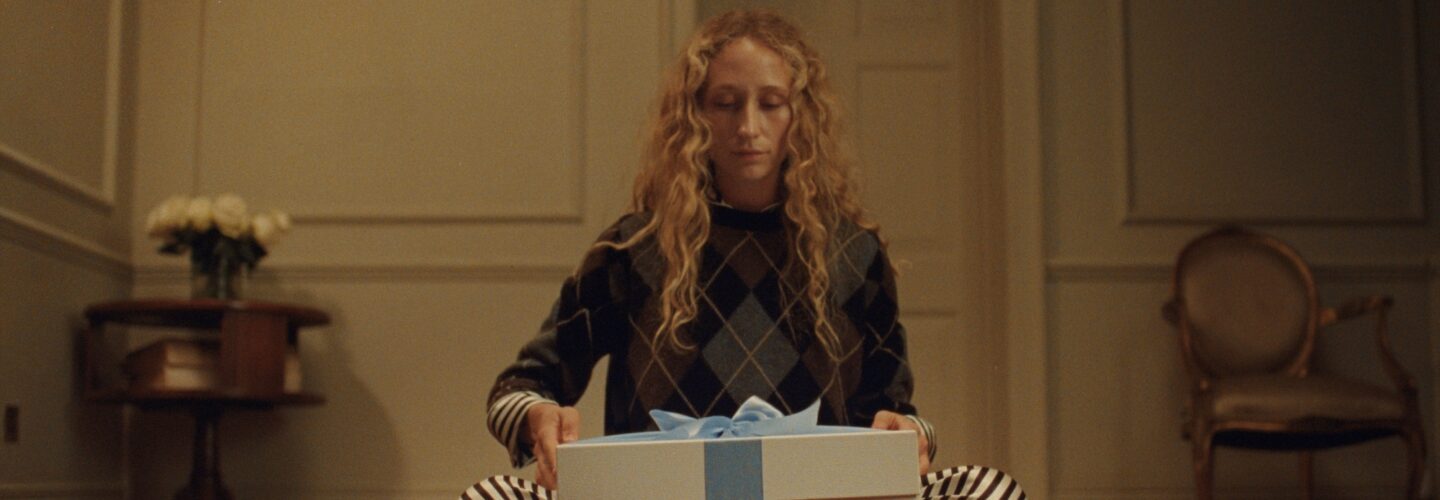

Festive films, regardless of form, can all too often mistake volume for impact—more sparkle, more sentiment, more of everything. French-British director François Larpin’s three-part film for knitwear brand &Daughter delights with a much more pared-back principle guided by absurdist restraint, lush visuals and the quiet confidence of an original idea executed with finesse. A Festive Tale presents a gloriously odd but on the nose premise: a woman prepares for Christmas while a sheep appears, inexplicably, in her home. There’s no explanation offered, no punchline delivered—just the quietly surreal image of wool’s origins wandering through elegant interiors while our protagonist remains utterly unfazed. Split into social media-compatible mini episodes, each of the three films was limited to just three camera angles, their unhurried pacing allowing the absurdity to breathe the trilogy strips festive signifiers to their essence. The result is Christmas advertising that refuses to perform like Christmas advertising, finding its distinction in the confidence to do less, beautifully. With the holiday season firmly upon us, get into the spirit by watching A Festive Tale followed by our conversation with Larpin about the practical wisdom of shooting animatics to lock his minimal shot list, building a character backstory that transformed goofy into commanding, and how directing commercials through his production company Voodoo Pictures is sharpening the craft for his debut feature.
Was there immediate synergy between you and &Daughter for this great quirky concept?
With my team at Voodoo, we immediately thought of a film featuring a sheep and a young woman. The idea came from a picture from the French artist François-Xavier Lalanne featuring sculptures of sheep in a living room. I loved the simplicity of the concept, its absurdity and softness. I wrote short scenes around this idea. The team at &Daughter immediately bought into it. We quickly realised that we had the same film in mind.
I love the trilogy format.
Social media is a numbers game. It felt key to deliver a couple of short assets rather than one longer film. I wanted to make a series of short abstract scenes evolving around one action rather than a longer story leaning on the narrative side. In order to get the timing right I shot several animatics during the pre prod. Editing these test videos helped me to narrow down the action to one key action per film.
The slow pacing enhances the absurdity of the action and minimising the number of camera angles also permitted us to craft every shot.


You’ve limited each film to just three camera angles—what drew you to working within that constraint?
In order to enhance the absurd tone of the films, I chose to limit the number of camera angles per episode. Each film has a maximum of three camera angles. This setup is inspired by the work of Roy Andersson, whose vignettes rarely use more than two camera angles. The slow pacing enhances the absurdity of the action and minimising the number of camera angles also permitted us to craft every shot while achieving to shoot three videos in a day.
Most Popular
As mentioned, in order to fine-tune the shot list, I shot animatics with my team. I realised that the less we cut, the more abstract the films would feel. Minimising the number of cuts also enabled me to have the time to craft each shot as I intended. With Jake Hunter, the DOP, we felt that instead of being functional, the framing had to reinforce the absurdity of the scenes. On set, the blocking evolved marginally. We got rid of a few actions which felt unnecessary in order to focus on the essence of each scene.


What specifically were you looking for in your location, and how did the architecture and interiors of the final location inform your visual approach and the three-angle strategy?
I pictured our hero, Alice, as a romantic bohemian living in a Georgian house. We started looking for houses that felt lived in and elegant. Houses with character and a patina. We scouted houses which are often used for Christmas commercials. They didn’t work. The rooms felt too cramped, too busy or too dark. It made me realise that the location had to be a blank canvas. The main focus had to be the talent and the product and the action. The location had to set the tone without becoming a distraction or limiting the action. As we couldn’t afford to change the furniture, we had to find a location that worked as it is.
Reston Lodge in Richmond felt perfect as it had the bones and the soul we were after. It allowed us to shoot every scene as we intended. We presented two options of houses to the client in order to give them an option. They agreed with my recommendation and understood that we had to avoid the more traditional options.


The absurdist tone seems to emerge from the contrast between the utterly mundane domestic Christmas preparations and the completely inexplicable presence of a sheep, enhanced by actor Elfie Reigate’s fabulous deadpan reaction.
We gave Elfie a backstory. We invented a character of a busy and powerful woman stuck on business calls while she prepares for Christmas. Initially the scenes felt more goofy and her character more clumsy but making her powerful felt more interesting, less expected and more modern. I liked the contrast between her aloofness and her authority.
We were after a more poetic, more stripped-back, less commercial approach.

The film feels distinctly festive yet remarkably restrained–there’s a lush, classical Christmas quality without any of the usual commercial trappings.
The client and I agreed that although the films were set during the Christmas period, they shouldn’t feel like traditional Xmas ads. We were after a more poetic, more stripped-back, less commercial approach. Every department made sure that the films felt Christmassy without becoming a caricature. We focused on one key element per film: the snow, the tree and the boxes. The goal wasn’t to create a realistic environment but to build a world around the character we conceived.
Can you break down what celluloid specifically brought to this project that digital couldn’t have achieved?
I knew shooting in 35mm would create a feeling which would be impossible to produce digitally. There is a magic to celluloid that digital can’t replicate. I waived my fee so that we could afford the stock and development. The crew also made huge efforts to accommodate the budget and the ambition of the project. I’m forever grateful. On set, shooting on celluloid brings a solemnity to the take. I feel it also pushes every department to give their best. Everyone is sharp, focused. We never did more than three takes per shot.

The festive advertising space is saturated. How did you approach creating something genuinely distinctive that would cut through the noise of traditional Christmas campaigns?
The client and I were on the same page from the start. We had the same film in mind. Finding the right tone was important as it was the first time the client released a film focused campaign. The DNA of the brand is elegant, authentic with a twist of quickness. Buffy Reid, the creative director of the brand, and I agreed that the films had to be faithful to these values. We have the same taste and she trusted us to accomplish what we pitched. I’m very grateful for that relationship.
Some of my favourite directors (Glazer, Fincher, Scott…) mastered the craft of commercials before moving to feature films. I’m very inspired by their approach.
You’re currently developing your first feature film. How do you see your practice evolving between commercial work and personal filmmaking?
I feel that the most challenging aspect of directing is to hang on to an ambition despite the constraints of production. From conception to the last steps of post-production, the idea can easily get lost. By directing commercials, promos and shorts, I aim at learning the craft as much as I can before I’m on the set of my first feature film. I also love experimenting with tools and formats. Some of my favourite directors (Glazer, Fincher, Scott…) mastered the craft of commercials before moving to feature films. I’m very inspired by their approach. The challenge now is to manage my time in order to make sure that I prioritise the development of my feature film while allowing time to direct commercials. I also run Voodoo Pictures, the production company I founded in 2020. There is a lot to do. It’s exciting.