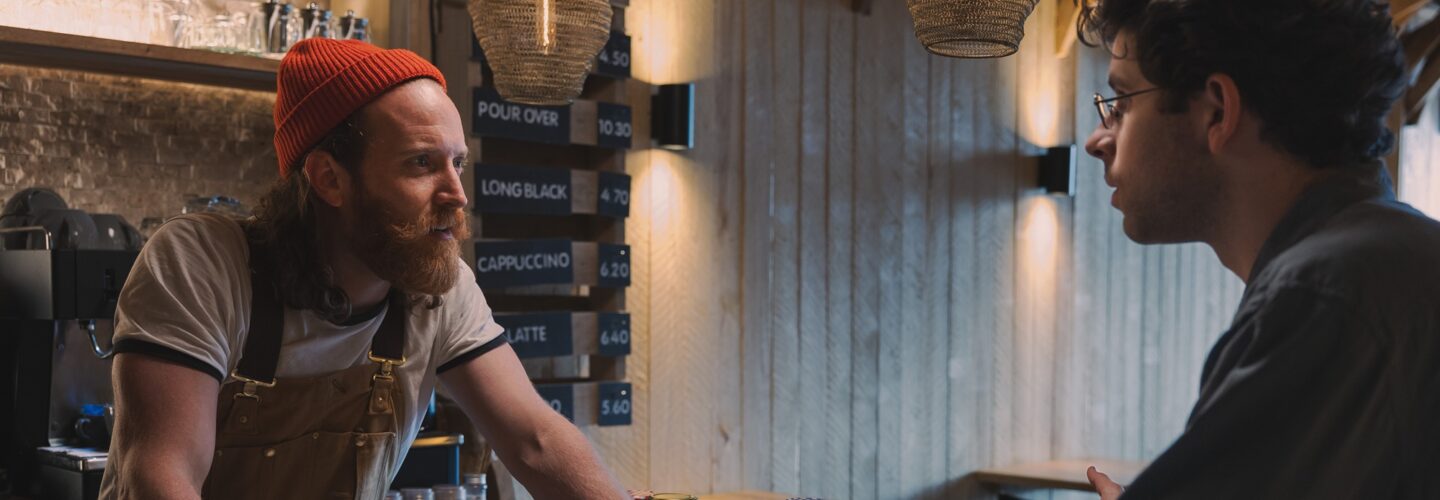
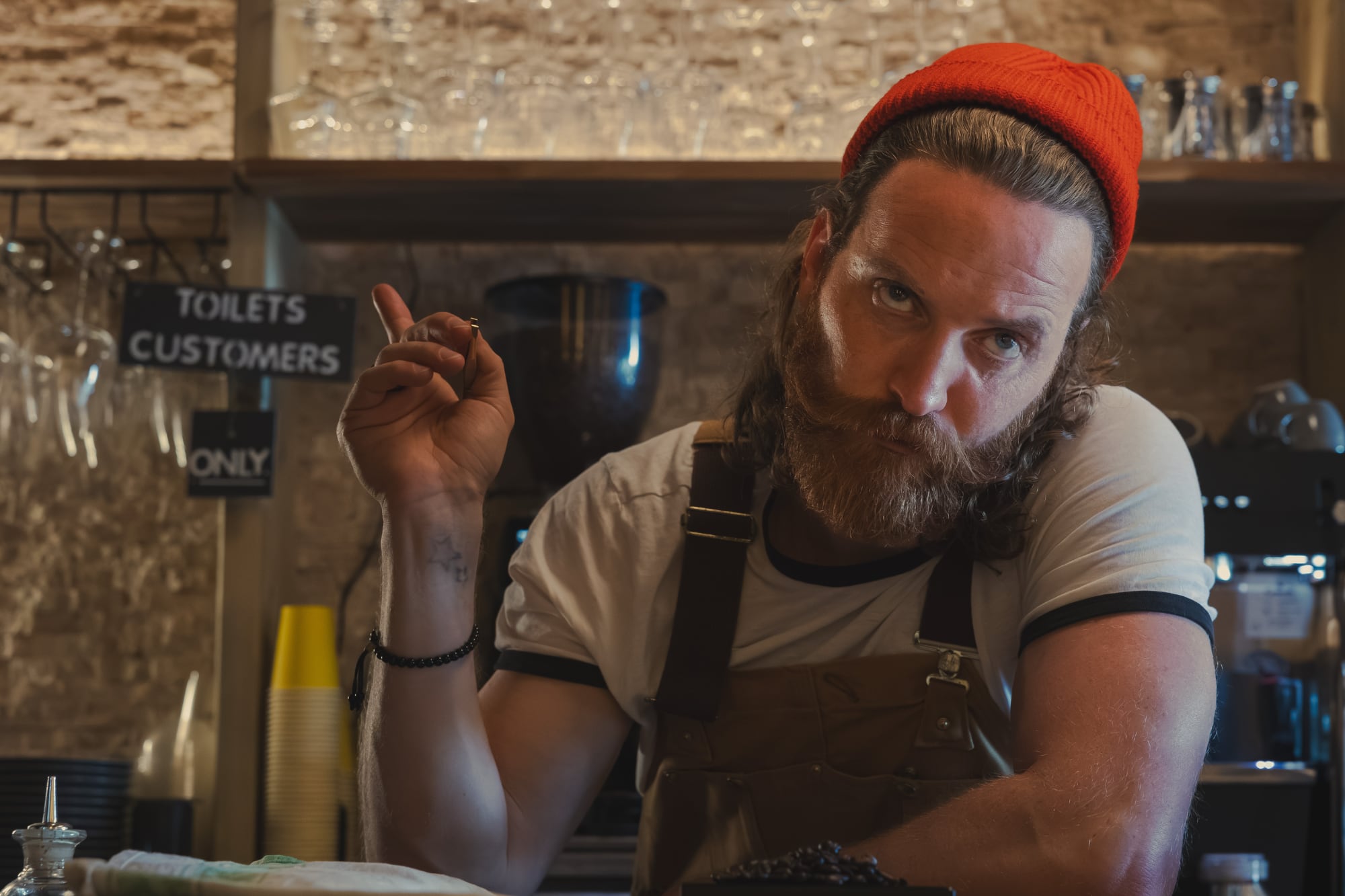
The wonderful thing about film is its power to unify audiences across the world. To take a slice of the human condition and serve it up as a story of shared experience to which we can all relate. And if there’s one thing all people have in common, it’s that at some point in our lives we’ve all really, really, ‘really’ needed a wee. I’m talking tap-dancing, bladder-busting, tear-jerking desperation. Now imagine that feeling, and then being denied access to the only public toilet available by a snooty, overly self-important barista telling you it’s for customers only. Alex Barnes-Auld’s Long Black takes that idea and runs with it to the extreme—a superbly crafted comedy short that takes a relatively simple idea but executes it with precision, care and creativity. Making its online premiere with us here at Directors Notes after delighting audiences on the festival circuit, Barnes-Auld tells us about how classic Spaghetti Western-style tropes inspired the visual language of the film, the old-school practical effects employed to hilarious ends, and how he and his team made the most of their self-funded budget.
Long Black features a very relatable first half before things escalate dramatically in the second. I understand Albert’s desperate situation is one with which you have some experience and inspired the story?
Yes, the story was inspired by a real event. I was heading into Brighton to meet Toby Martin, the DP of Long Black, to discuss working together on another project. On my way to the meeting, I developed the need to pee but naturally assumed I’d find a bathroom easily. It was early morning, so really only cafes were open. I went into a few cafes and was met with stuffy baristas telling me they didn’t have a bathroom, or they were for customers only. I ran from café to café, getting rejected at every turn. As the situation was becoming quite dire, I slowly began to realise that I ‘might’ actually piss my pants. Thankfully, one extremely kind shop-owner let me use their bathroom. But that whole situation got me thinking, “What if I ran into the exact wrong person? What would have happened? How would that play out? And if my dignity was stripped away, how would I take revenge?”.
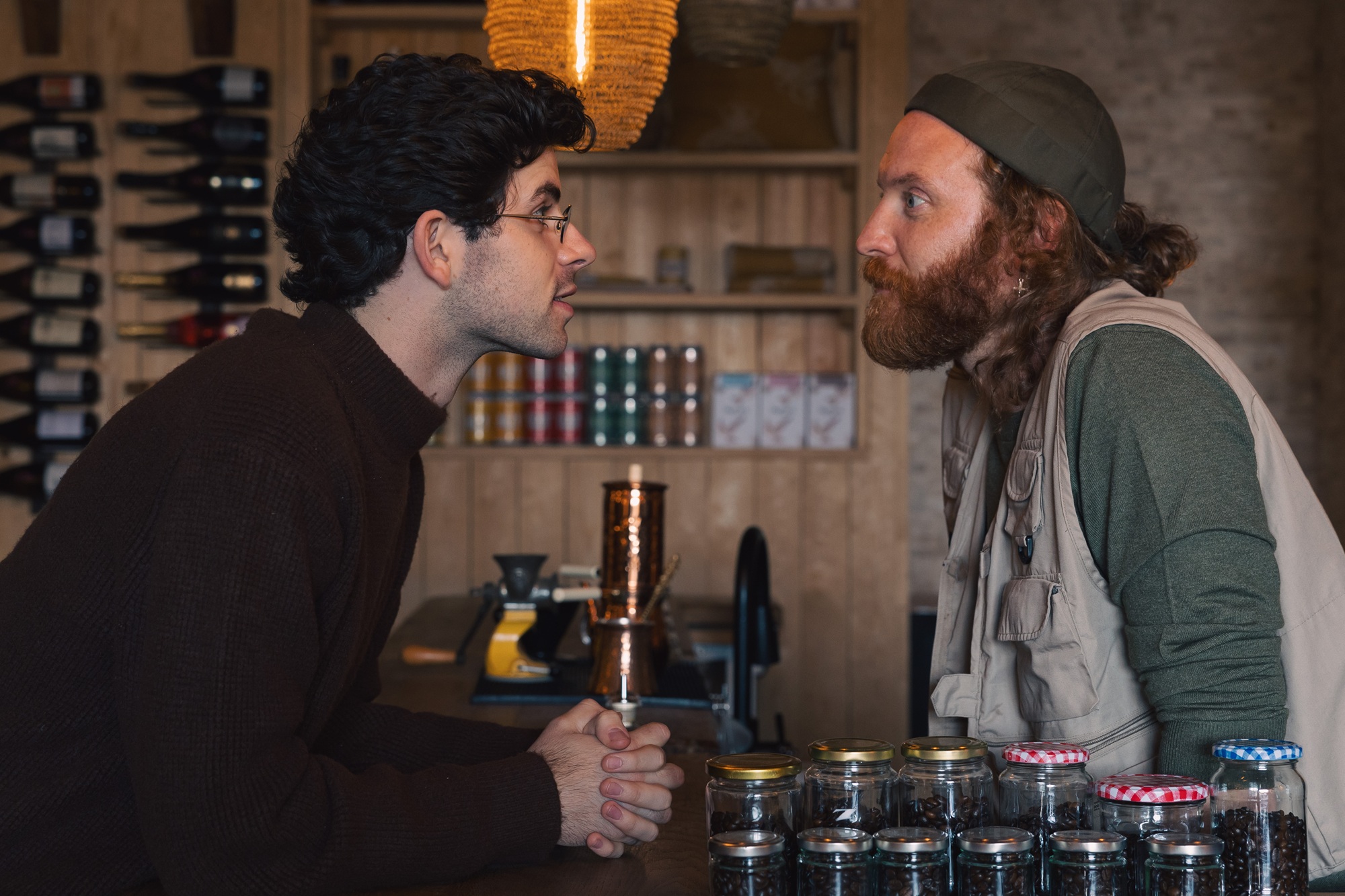
The adversarial chemistry between actors Tom Rainn and Maxwell James Clements is superb. Can you tell us about your casting and rehearsal process?
Tom and Maxwell got on like a house on fire from the get-go. Tom actually reached out to me out of the blue asking to work together sometime in the future. It was just perfect timing really. When I looked through his work, I initially thought he would be a good fit for Mike, the Barista, but he asked me if he could try out for both roles. His tape for Albert was perfect. He understood the sort of overly polite, pushed too far kind of person we were going for. Maxwell was a later addition to the cast. We initially cast a different actor, but they dropped out a few weeks before shooting for personal reasons. We went into full panic mode, but then by chance, Toby met Maxwell and set up an introduction. We met up for coffee and he was just perfect. Maxwell is an incredibly funny guy in his own right, and his excitement over the project was a clear sign he was the right man for the job.
They bounced off each other’s energy perfectly and we were able to find their characters and their dynamic really quickly.
During rehearsals, I asked both of them to come in with some ideas on where they want to take the characters. I didn’t want to impart my thoughts too early, because they might bring someone I didn’t expect. We went through the script a few times, and it led to some fantastic ideas. They bounced off each other’s energy perfectly and we were able to find their characters and their dynamic really quickly. I was there more to guide them in a certain direction, they produced the fireworks.


In a world of CGI, these days after seeing a special/practical effect one question I rarely ask myself is, “How did they do that?” However, I think I speak for everyone when I ask how did you get Tom to pee his pants?
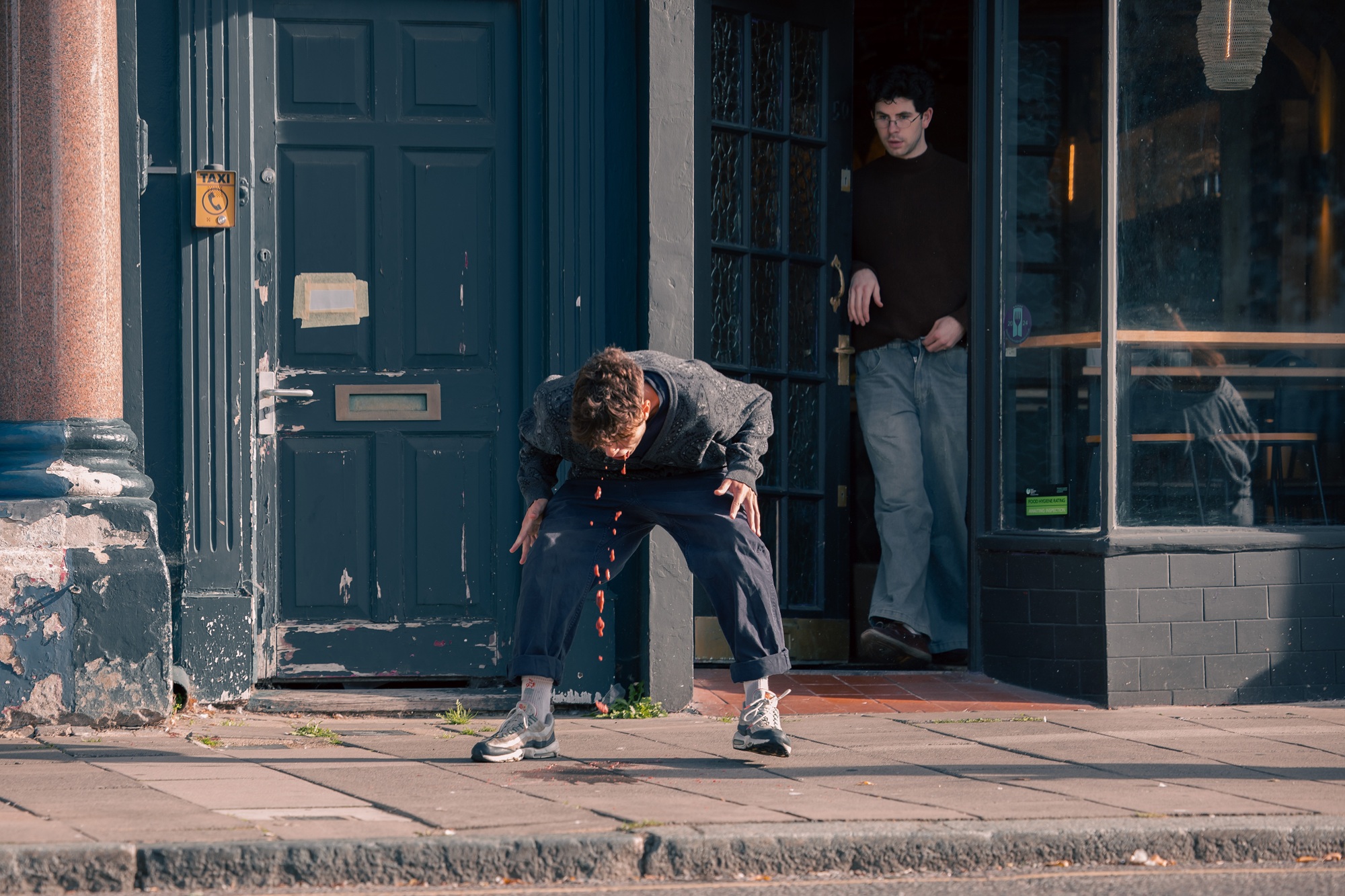
The question I get asked most after people watch! Myself and DP Toby, spent a day or two trying to figure out how we would do this. Water balloon in his pocket? Water bottle in the trousers? Actually wee himself? We eventually had a brainwave and decided we would make something ourselves. We went to the pet store and bought some thin rubber tubing used to clean fish tanks and epoxied that tube to a fairy liquid bottle. We got about five pairs of crap trousers, making sure we got light brown to show the stain as clearly as possible. We then cut a small hole in the pocket of Tom’s trousers and fed the tube through, hiding it from view under the rubbish bags. I operated the camera while Toby squeezed the bottle. We did it about three times I think, but the shot we used in the film was the first one.
Most Popular
You mentioned previously that you and Toby came up with a bunch of visual references and language for the film. Can you tell us what some of those references were and how they were applied to Long Black?
When I wrote the script, the main reference I had in mind was The Dollars Trilogy. I always saw it as an absurd British western. For instance, the scene when Tom (Albert) returns to the café is this low Dutch-angled shot of him silhouetted at the door, which was supposed to be emulating a cowboy entering a saloon. The intense staring that Tom does after he approaches the counter was influenced by the opening scene of Butch Cassidy and the Sundance Kid, when Robert Redford is playing cards and gets accused of cheating. I wanted there to be a clear difference in power from the first day compared to the second, with Tom being framed weaker and more uncertain in the beginning, and coming back much more asserted and powerful.

The main reference I had in mind was The Dollars Trilogy. I always saw it as an absurd British western.
Another reference for us was the underrated Martin Scorsese film After Hours, which influenced how we framed some of the awkward conversations. That film is rife with uncomfortable situations and was a great lexicon for awkwardness. Fleabag was a strong reference in terms of performance. Phoebe Waller-Bridge’s unfiltered nature and cutting dialogue was definitely an influence on Long Black. Fleabag was unashamed to go to the filthy places and I just loved that. Edgar Wright also had a strong influence. Hot Fuzz was one of my favourite films growing up, and I’ve always been in awe of his command over his films. How he manages to balance the cinematography, acting, sound, and editing to create such a frenetic package.
What did you shoot Long Black on and how did you dial in the look you wanted for the film?
We shot the film on an Arri Mini with Angenieux Zooms. The EZ-2 set, I believe. We chose to shoot on zooms for flexibility and speed. It sped up our process immensely, allowing more time for experimentation. Angenieux glass has a fantastic texture to it, and that character added to the story. Zooms not being as sharp as primes was also a desired effect; we wanted to avoid a modern, crispy feeling. We used some polarising filters to reduce reflections, and occasionally some weak diffusion to soften the image.
Our colourist, Marieta Farfarova, did an absolutely stunning job bringing out the best in our shots. She created a cohesive palette for our world, linking the interiors with the exteriors masterfully. We wanted to capture characteristics of Kodak 2383 colour positive, adding subtractive saturation to the skin tones and pushing elements of blue into the shadows.


The film was entirely self-funded and shot in just a day and a half. How important/intense was your pre-production process for the shoot, and what was the timeframe end-to-end for Long Black?
We were aware of the sparsity of the funding landscape and so decided, “Fuck it” we will self-fund. I happened to have a retainer contract for some filming work at the time, and basically funnelled as much as I could from that into the film. Claire Nilles, our producer, put together maximal and minimal budgets, and we ended up landing somewhere in between. Our meticulous pre-production was fundamental to getting together the talented crew. Having a clear mission, a treatment, and a concise/actionable plan gave people the confidence to work on this project. Without the sacrifices made by everyone on this cast and crew, this film would never have been made. I cannot thank them enough.
Claire held this project together. Having someone in your corner who can support you in times of crisis, believe in the project when you start to doubt, and push you over the line in the final hours is an invaluable resource. The entire production process took about nine months, with about five months of pre-production, one and a bit’s days shooting, and then four months of post-production. As I mentioned earlier, about four weeks out from shooting we had a cast member drop out, and then our main location went silent, and the Council tried to ask us for £2,500 for a shooting permit. We were able to rise above all of those problems and come out the other side with better than ever.
Claire Nilles: Our pre-production was extremely thorough. Since we had a super limited budget, it was important to plan out as much as could in advance since we didn’t have much leeway. The major challenge was finding a date that would work for all of us. All of the cast and crew came on for free, so we needed to find a time that worked with everyone’s schedule as well as the location. We didn’t know until the very last minute if we could pull it off or not. Dates were moved around a lot due to actors pulling out, locations pulling out, councils asking for ridiculous permit prices, but we managed to make it work. It was about flexibility, problem solving, and being proactive. Things are going to go wrong, it’s about how you react to that. Without the intense planning, rehearsals with the actors, detailed storyboarding from Alex, we couldn’t have pulled it off. We also had the perfect crew who were able to work so efficiently in such a tight timeframe.
It was about flexibility, problem solving, and being proactive. Things are going to go wrong, it’s about how you react to that.
The comic timing in the edit is equally as great as in the performances. You created in-depth storyboards ahead of filming, how important was that for you in the edit and did you still find any unplanned moments of magic?
With comedy, editing can be the make-or-break element, and I didn’t want to wait until after shooting to find out if our ideas didn’t work. Or worst of all, that it wasn’t funny. Comedy is such a subjective genre, meaning you have to test things to make sure they are actually funny. We did this in pre-production by doing a ‘pre-edit’ using storyboards and voice over. Obsessive planning has always been essential to how I work, regardless of my role in a film. It’s the only way I know to curb my anxiety when it comes to the actual shoot days. I truly believe that the more prepared you are, the luckier you become. While we had a clear plan of what we were doing, we were always open to happy accidents. For instance, the penultimate shot through the legs was something we found on the day! It was never planned but somehow, it just happened.
The score plays such an important part in both enhancing the humour and complementing the visual references you were going for. What was the process like of honing in on that with composer George Bloomfield?
George was a star to work with. He really understood what we were going for and had the perfect skills to make it happen. We started by discussing key references I had in mind for the score. I’m a massive fan of Lalo Schifrin, specifically his scores for Bullitt and Dirty Harry. While I was editing, I used music from Bullitt as our placeholder music. George totally understood the vibe, and his skills as a multi-instrumentalist made the process flexible and speedy. He ended up turning out this amazing 60’s style jazz composition jammed full of style, populated with stand-up bass, flute, jazz guitar, saxophone and piano. He recorded every instrument live, giving the score such texture and life. It genuinely took the project to the next level.
My favourite part of the score is the ethereal singing in the alleyway. I fucking love that part, it always makes me crack up.
For the first half of the film in the café, I wanted the music to be sort of broken, reflecting Albert’s situation. George created this cacophony of instruments that replicated Albert’s internal battle. We wanted the music to be a part of this world, reacting to what was happening between the characters, but we were conscious of it not becoming too ‘Mickey Mouse’. The solution was that George would add music or sounds to sections where he felt it would work, and then send me the stems so I could turn them on or off in the edit. My favourite part of the score is the ethereal singing in the alleyway. I fucking love that part, it always makes me crack up. The beautiful vocals contrast brilliantly with what we are being forced to watch.
With Long Black now out in the world for audiences to enjoy, what’s next for you?
The main joy of Long Black has been watching it with audiences. Every time people have different reactions, finding humour or horror in it. It’s a fabulous feeling that the film is out because it is no longer ours, it’s the audience’s. At the end of the day, we wanted to make a film that would surprise and delight, something we would want to see. Sharing a laugh feels more needed than ever, and I hope our silly project connects with people.
I’m now in the midst of writing a new project at the moment. This new script is more in the realm of drama/thriller as I wanted to have a stab at a different genre, to show we aren’t one trick ponies. It’s shaping up to be a sort of mix between The Death of Stalin and Slow Horses. I want to impart some of the style from Long Black into this new script: embracing outlandish ideas, unpredictable reactions, and putting characters in horrendous situations. Once the new script is done, hopefully we can scrounge up some funding! I’ve recently moved to New York, so I’ve been trying to establish a new network here, but for now, the plan is still to shoot short films in the UK.
And finally, what’s a favourite short film you’ve seen, new or old, that you’d recommend to the DN community and why?
There are two I’d love to shout out! One I saw that is still on the festival circuit is called Guille 28 by Miguel Alcalde de la Fuente. It’s a superb short! The reason I’m so enamoured by it is simply due to its restraint. There are about five shots in it total? Miguel is masterful in his framing choices, dialogue, and blocking, showing precise decision-making and giving the audience a high level of respect to put things together. Not to mention, the performances from the two lead actors are phenomenal.
The second is an older short but has influenced my work since I saw it. It is called The Procedure by Calvin Lee Reeder. When you initially watch it, you are taken aback by its absurdness, but the true nature of it that stuck with me so much is how it gets you thinking afterwards. How could that character explain what just happened? Would anyone believe him? Who was it all for? I think it’s a brilliant film, really out there, and I love it.