
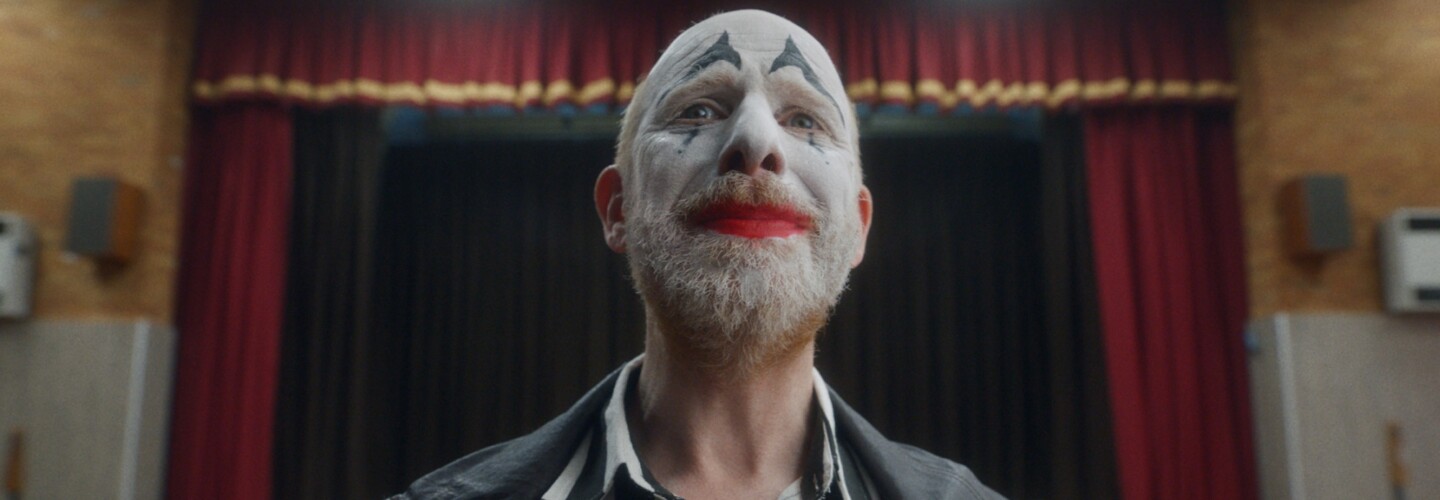

We all remember the miner strikes and some of the classic films that cover that topic, but what about the ‘Mimer Strikes’? James Nicholas Green’s debut narrative short, Victory To The Mimers, is a clever, quick-witted personal ode to the old classics that look at the struggles of England’s working-class and the families affected by a right-wing government hell-bent on tearing apart their communities and implementing brutal funding cuts. Co-written by and starring comedian/actor Steve Furst, Victory To The Mimers focuses on two estranged brothers played by Furst and Lee Ingleby – one a mimer passing on the artform,s rich and proud history to his daughter, and the other who fell out of love with the movement – as they overcome individual differences in order to empower themselves and their fellow mimers. Green harnesses the power of family, love and solidarity to capture the iconic themes of political films with a deftly absurd comedic tone, whilst simultaneously adding unique cinematic techniques to not only accompany this atmosphere, but add an entirely fresh take on it all. Victory To The Mimers is jam-packed with symbolic costumes, aesthetics and themes, and we invited Green to joins us for a discussion about his journey as a TVC and music video creator turned short film director, dealing with social issues within his work, and most importantly, the art behind choreographing the film’s beautiful and elegant miming sequence.
Your film grew out of a project shared with you by Steve Furst, who co-wrote and stars in Victory To The Mimers. Could you share with us how the script evolved and headed towards production? What drove your passion for this specific project?
I was instantly drawn to the project after reading Steve’s early draft, then titled The Mimers. I was already eager to move beyond music videos and TVCs into narrative work, especially comedy, and this felt like the perfect opportunity. Once Steve gave me the green light to expand it, I jumped in. At the time, I was juggling full-time work and the mental gymnastics of the pandemic, so the rewrite became a slow burn. It took around two years before I felt the script was truly ready, though I still didn’t know if it would ever make it to production. Fortunately, I reconnected with producer Kabir Malik, who I’d known from my TV days. He immediately got the tone, aligned with the message, and shared the drive to make more shorts, so we teamed up and pushed it into production.
The idea of “form follows function” stuck with me, and I’ve always aimed to create work that has something to say, not just creating something for the sake of on-trend aesthetics.
You’ve mentioned that your previous work also dealt with social issues. What is the creative process for you as a director to take a relevant social problem and develop a story full of comedy and satire?
My design degree often felt more like a crash course in advertising, and paired with years of writing quick-turnaround TV promos at MTV, it really honed my ability to make complex ideas feel accessible, usually with irreverent humour, quick wit or visual gags doing the heavy lifting. The idea of “form follows function” stuck with me, and I’ve always aimed to create work that has something to say, not just creating something for the sake of on-trend aesthetics. When I tackle social issues, I lean into satire and tongue-in-cheek humour, even if that means being a little on-the-nose to make the point land. I’m not an Oxford-trained writer with family contacts; I was state-schooled, from a council house in a regional town, raised on a mix of comedy across TV and film. That upbringing gave me a taste for humour with broad appeal, and I’ve always believed that even the silliest stories could say something meaningful.

How did you adjust to creating this as your debut short film?
A few of my early music videos were essentially silent films; ambitious, multi-location shoots with layered narratives and performance-led storytelling, all on tight budgets. At MTV, I also wrote and directed TVCs that often felt like short-form comedy sketches. That mix of DIY filmmaking and structured broadcast experience gave me solid training in resourcefulness, cross-department collaboration, visual storytelling and comic timing. Looking back, I’m glad I waited so long to make my first short. I feel I came to it with more experience, a stronger creative voice, and a clearer sense of what I wanted to say.
In pre-production, I was lucky to be able to pause freelance work and fully commit to the project. I’m meticulous by nature and have always taken “fail to prepare, prepare to fail” to heart. With such a specific visual language and a high volume of setups, I storyboarded every shot and mapped out blocking in advance. It meant we could solve problems early, leave room for new ideas on set, and let the performances breathe.
Most Popular
Victory To The Mimers is an ode to classic British mining strike films. It touches on the same themes but takes an entirely different approach. Was this an instant amendment for you? How did the twist develop?
The parallels with the Strikes became clear to me early on, and I knew I wanted to lean into those references in a way that felt affectionate rather than heavy-handed or pastiche. There’s something unmistakably warm and quintessentially British about films like Billy Elliot and Brassed Off, and I hoped that by playfully nodding to their tone and style, our film might subtly tap into that legacy, allowing the political twist to land in a more natural, even subconscious way. I also didn’t want the film to feel overly modern. I’ve always been drawn to more nostalgic visual styles, and this project felt like the perfect opportunity to explore that in a way that supported the story first and foremost.


The cast’s ‘play it straight’ performances really makes the comedy effective throughout.
When it came to performances, my aim was to play everything completely straight. The premise is already quite absurd, so it felt much funnier to ground it in sincerity, to have characters who take their world entirely seriously. The comedy hits harder when no one in the film is in on the joke. I never wanted things to feel over-the-top or deliberately ‘silly’. In this universe, being a ‘Mimer’ is a legitimate trade, an art form they’ve spent decades fighting to preserve. For them, every gesture, every tiny detail, carries meaning. Even something as ridiculous as miming a horse ride in the Grand National is performed with full conviction.
Deepening the family dynamics made the story feel more personal and grounded. It gave emotional weight to an otherwise surreal premise.
In regards to the actual plot of the film, there are strong family dynamics underpinning the political satire – between the father and daughter, and brother to brother – was this there from the beginning or did these develop through subsequent story revisions?
The original script featured the two estranged brothers, but I was keen to expand on their relationship, particularly the reasons behind their falling out and the circumstances that bring them back together. Harriet, Ernie’s daughter, was a new addition. I wanted to introduce a younger voice and offer a different perspective on the strike. She represents generational friction and what it means for a child to be expected to follow in their parents’ footsteps without question. Deepening the family dynamics made the story feel more personal and grounded. It gave emotional weight to an otherwise surreal premise and, I hope, helped raise the stakes in a way that audiences can connect with the film.


I think aesthetically that Victory To The Mimers works so well. You’ve nailed replicating working class England, but at the same time created a delightfully absurd fictional version. What were some of the creative choices you made to achieve this?
The visual style grew from my influences and my preference for gritty, lived-in imagery. Something more retro than polished. Coming from a working-class background, I’ve always felt disconnected from portrayals that fetishize working-class life. Too often, it’s reduced to shallow, clichéd tropes. I wanted to show a humble lifestyle honestly, without pity or negativity. The cinematography played a key role in shaping the film’s surreal world. I aimed for visuals that felt slightly uncanny, recognisable but subtly off. Static frames, planimetric angles, and symmetry combined with our stylised art direction and costumes to create a grounded yet surreal atmosphere.
Locations were also crucial. I avoided sleek, modern spaces in favour of real, familiar settings like the family’s mid-century bungalow, the community hall, and the 1970s coach the Mimers use. Finding locations that fit the vision and worked practically was a challenge, but those constraints ultimately reinforced the authenticity we were going for.
I aimed for visuals that felt slightly uncanny, recognisable but subtly off. Static frames, planimetric angles, and symmetry combined with our stylised art direction and costumes to create a grounded yet surreal atmosphere.


We’ve briefly discussed how the mimers theme and theatrical nature of your short transcends the storyline. How did you integrate these concepts into the visual aspects of the film?
Traditional depictions of Pierrot and mimes often use a classic palette of white, black, and red. We tried to incorporate these colours throughout the film, whether in set dressing, props, costumes, or background details. I wanted the world to feel tangible despite its surreal premise, and the art department played a big part in this. We added subtle Easter eggs, like mime props, family photos, fake posters, awards, and certificates, to hint at the characters’ histories and the world they live in. Theatre also influenced our decision to shoot in a 4:3 aspect ratio. It emphasised the uncanny tone and framed the action as though it were unfolding on a stage, especially with the static shots. The aspect ratio was also a quiet nod to the silent film era, which shares some similarities with the mime tradition.
The two brothers’ final miming routine is an impressive climax to the film and a cathartic resolution of their relationship. Could you talk us through the process of developing the choreography and working with your actors to achieve it?
This sequence was a lot of fun to work on! While the final performance was always scripted, I wasn’t sure how we’d pull it off until later in the process. Fortunately, we brought on mime consultant Richard Knight, whose expertise helped bring it to life. We held a workshop with our lead actors, Steve Furst and Lee Ingleby, where they received basic mime training and we shaped the routine together. The challenge was balancing the brothers’ bond and the humour of the narrative while ensuring the movements felt achievable, authentic, and emotionally resonant.
Steve and Lee already knew each other, which worked to our advantage. Their energy and physicality allowed us to improvise on the day, whilst their natural chemistry shaped the action, adding much-needed spontaneity to the performance. We deliberately shot this scene towards the end, which allowed the emotional stakes to feel fully earned, also giving us a fun, heartfelt way to close out the story and the shoot.


The challenge was balancing the brothers’ bond and the humour of the narrative while ensuring the movements felt achievable, authentic, and emotionally resonant.
We would love to hear about any upcoming projects you have in the works.
I’ve written another short film, which is ready to go; it’s just a matter of figuring out the funding (classic). It’s a dark comedy about a desperate understudy who dreams of replacing an insufferable lead actor. The plot unfolds as a ridiculously silly revenge story, loosely riffing on Macbeth in a playful, meta way. If anyone wants to collaborate, particularly producers, I’d love to chat! I also just completed a feature film screenplay, a comedy thriller, which I’m really excited about. I’m awaiting industry feedback and plan to re-draft it before sending it to producers with the aim of directing it eventually.
Next up, I’m working on a Christmas comedy feature, a rom-com, and a few comedy sketches and TV sitcom pilots. Lots of ideas in the works, I’m just giving them the time they need to grow. My goal over the next year is to secure representation, whether it’s an agent, manager, or rep, for both directing and writing. I feel ready to elevate my work to the next level and build long-term industry relationships to bring these projects to life.