
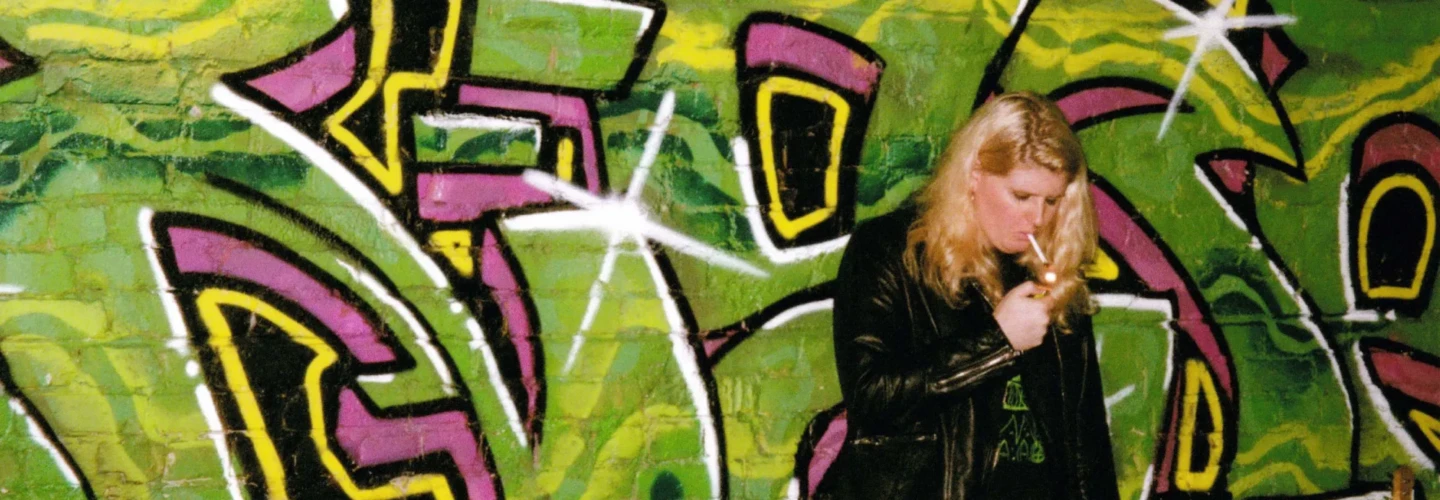

In her sprawling and personal 275 minute epic, Castration Movie i: Traps, writer/director Louise Weard explores powerlessness and gender struggle through two chapters, telling the distinct tales of Turner, a production assistant in a failing relationship and Michaela, a trans woman navigating sex work alongside her trans friend group. Shot on her parents’ Hi8 Camcorder, the film occupies a space nostalgic yet painfully cutting. Acerbic, vulnerable conversations about detransitioning, sex work and 4chan will be painfully familiar to many trans audiences, yet are filmed with the DIY charm of underground, mumblecore cinema. It would be easy to associate extended sequences of unsimulated sex, venomous behaviour and excessive drug use with cynicism, but what makes Castration Movie i: Traps so profound is the presence of a tender heart beneath its delightfully anarchic surface.
The cast, led by Weard herself alongside musician Aoife Josie Clements and fellow filmmakers Vera Drew and Alice Maio Mackay, depict deeply troubled characters, delving into the ugly depths of trans identity and community rarely seen in mainstream media. The film has been celebrated by trans communities and wider audiences alike. Despite its specificity – loosely drawn from personal experience – there is a frank universality present: our identities may be unique, but deep down we are all flawed, messed-up people. There’s a lasting sense of community to the film, no matter how acidic or toxic friendship may be, queer communities will pack into grungy DJ sets and care for each other in the aftermath of surgery and trauma. Castration Movie i: Traps is quintessential proof that the daring spirit of independent cinema is far from dead. Ahead of screening as part of the Prince Charles Cinema’s Bleak Week, Weard joins DN to discuss independent distribution, collaborating with friends and what we can expect from part two.
Castration Movie i: Traps wasn’t always a four and a half hour epic, it began as a 90 minute feature. Could you tell us about the origins of this project and its evolution?
It was coming up on ten years since the last short film I directed and I realized it was time to finally make my feature length debut. I conceived Castration Movie as a straightforward narrative with a brisk running time as a means of ensuring I would get the project finished in a reasonable period of time, but after the first few weekends of shooting I realized my directing process was going to result in a much longer film than I anticipated. Once I had that epiphany, I went back into my notes to add more layers to the story and the narrative has stayed pretty consistent since that point. It was always destined to be an epic and I never write anything short, so I genuinely think I was just fooling myself when I set out to make a more standard 90 minute debut.
What drew you to the Hi8 camcorder format?
I hate how modern cinema looks so I decided I wanted to take the most ascetic approach to aesthetic form possible. Having in my possession the family Hi-8 camcorder from my childhood unlocked this idea of trying to take a juvenile sensibility to the camerawork. If I’m not excited by what’s going on in modern cinema, then why not try to put myself back in my childhood state of picking up a camera for the first time and see what new form comes out of that? I think Castration Movie feels timeless despite being shot on a format so linked to a specific decade in a way that even a movie shot on a modern iPhone already feels too linked to its time and place. The Hi-8 is also just so easy to shoot on, since it’s a consumer camcorder.
If I’m not excited by what’s going on in modern cinema, then why not try to put myself back in my childhood state of picking up a camera for the first time and see what new form comes out of that?

I heard that on set you often passed the camcorder to the least experienced camera operator in the room. Can you tell us more about that decision and what kind of atmosphere it created on set?
Yeah, in any scene I’m acting in I would pick my camera operator by seeing who was the most uncomfortable to hold the camera, like see who had this worry of screwing it up since they didn’t trust their abilities or had never filmed anything with a camcorder before. I would put the camera in that person’s hands and say that there was no wrong way to shoot it, to just follow their instincts. We ended up with some really cool shots thanks to that, where certain operators would lose focus on the action in the scene and look out the window or zoom in on some small detail, or walk across the room away from the dialogue. It really adds this level of realism to the movie because it feels like a home movie sometimes, whereas most filmmakers are trying so hard to ensure their films look nothing like a home movie.
I would pick my camera operator by seeing who was the most uncomfortable to hold the camera, like see who had this worry of screwing it up since they didn’t trust their abilities or had never filmed anything with a camcorder before.
Your work often features long takes. Why do you think you are drawn to this stylistic approach, and how did you navigate directing and performing in such sequences?
I love actors and I feel that the long take allows for performances to grow and live so much better than you get by killing the momentum and spontaneity of a scene with too much coverage. With this movie I wanted to take a more collaborative approach to the performances, where I only focus on directing and don’t share a script with the actors. Instead, I attune my working with each performer based on their needs, which can sometimes include pages of detailed backstories or even something as minimal as finding the character through nothing but a costume fitting where the character comes to life by just choosing which pants they wear. Then on set we spend some time where I aurally dictate the scene to the actors and we use that as an opportunity to add any other ideas that collectively excite us before we settle on a fully formed scene to shoot. We only do one take of every scene so that we can bottle that spontaneity and I think that’s really what makes Castration Movie so effortless to watch.
Most Popular
The soundtrack is absolutely brilliant, much of it made by co-star and co-producer Aoife Josie Clements (Ravine Angel). Could you tell us a little more about the importance of music to Castration Movie, and what it was like working with Aoife?
I do all of the sound design on my work so the soundscape and music is always at the forefront of what I’m thinking about as a director. I wanted to be as minimal with music as possible on this project so what I did was give Aoife and the other musical artists free rein to send me whatever they were working on, with the idea being that I could pick out the track that fit best in a scene. Other times I commissioned artists with just a loose set of notes on what happened in the scene and the tone I was looking for. It’s all very curated, like I seek out who I want to collaborate with musically and then trust them to do their thing.
In the case of Aoife’s album Castration Songs it was me giving her a vibe and sense of the story and her watching dailies and then responding to what was going on in our real lives and putting that all into the music to create something beautiful. She made so much music for the movie so I really was just spoiled for choice on what I could use, it all being so good. Working with Aoife as an actress who has that musical talent is the best part because I could turn Castration Movie into a musical once the emotions got too strong to communicate any other way. This project just wouldn’t be what it is without her contribution.

One of the film’s most dazzling feats is its remarkable tonal control. Michaela and Adeline’s story, in particular, ventures into dark terrain, touching on topics I never thought I’d see on screen whilst also being one of the funniest films I’ve seen in years. Was it challenging to balance such tones or did they develop organically?
I think I’m the most talented director of my generation, so no it wasn’t difficult at all. It’s all about strong communication. I knew in my head exactly what I wanted this movie to be and then I communicated that with the actors and they pulled it off to a remarkable degree. I’m really lucky to have found such talented collaborators, as without all of these actors being so good it just wouldn’t have worked. It’s all them and I’m a hack, to be honest.
We only do one take of every scene so that we can bottle that spontaneity and I think that’s really what makes Castration Movie so effortless to watch.
There is such a communal feeling developing in the landscape of trans filmmaking right now. Castration Movie sees you collaborating with Vera Drew and Alice Maio Mackay, both outstanding trans filmmakers in their own right. How did this sense of artistic community influence the film’s development?
I really wanted to make sure that there was a community of all of the cool emerging filmmakers working today and it just so happens that many of them are also trans. I wasn’t specifically thinking of Castration Movie as a trans cultural object but wanted to do with the modern indie film landscape the same thing we saw with the 90s Sundance alumni and in 2010s mumblecore where all of these filmmakers were collaborating and sometimes lifting each other up. I just like making movies with my friends and so it was important to me that I made sure everyone I knew had a part in Castration Movie.

I understand much of Castration Movie draws from personal experiences. How has such a vulnerable approach felt throughout production, and how do you feel now this story is out in the world?
I like to obfuscate how much of the movie is real. It’s all real but also none of it is. I think it’s important to be vulnerable and sincere while making the art but talking about it after it’s done it’s fun not to be too serious about it. It’s nice that audiences find my traumas so funny.
The film has had wonderfully DIY distribution, playing in film festivals, club basements and being featured in the Prince Charles Cinema’s upcoming Bleak Week, but also being available for digital download. Could you talk about your unconventional and inspiring approach to distributing the film?
I felt it was important to just get the movie out there and make sure that anyone who might want to see it was able to do so easily. I have long felt that by the time a new release comes out I’ve already lost interest in it from when I initially heard of it, so I thought it would be cool to experiment with letting people see a movie with ease immediately after they hear about it the first time. The in-person screenings started months after the digital release because suddenly there was a demand for them, with people showing up to these screenings regardless of venue. It’s definitely a successful experiment in how a modern cult film comes into existence, but I doubt it could be repeated to this degree.

Given the film’s unflinching portrayal of trans experiences, simultaneously specific and yet so universal, how have audiences both within and outside of the trans community responded to the film? Have any reactions particularly resonated with you?
I think what’s most exciting to me is that I get messages from viewers in Ukraine or Hong Kong saying that the trans friends group in this is just like theirs. It’s also good when people from outside of the community see it and have that same feeling of empathy, like the movie is really at its core about these universal feelings and I wanted to use all of these disparate characters to drive that message across. I think that having made a work that has trans people being messy and oh so remarkably human has really lifted the ceiling on what trans filmmakers can feel comfortable doing going forward. I like negative attention so I wasn’t scared to make something that seemed to court controversy so clearly on its surface with its subject matter, and to have been celebrated for it was definitely noticed by other filmmakers who feel a lot of relief to get freakier in their own work now.
I am the first audience member so it really is all about trying to impress myself with everything we do.
This is only part one of the anthology, what can we expect to see from part two?
The movie goes increasingly harder as it goes on. Part 2 opens with a chapter that goes into pure John Waters hysterical gonzo mode, which balances against even more bottomless despair. With every chapter I try to surprise myself and do things that don’t always feel right, that make me uncomfortable. I am the first audience member so it really is all about trying to impress myself with everything we do. Prepare to sit there watching it for a very long time.
Finally, what advice would you give to young queer filmmakers?
Go just be a filmmaker and don’t worry about what expectations that ‘queer’ label might place on you. Figure out what about your voice is unique and highlight that most of all. Make movies for yourself and you will be surprised by the audience you might find.