
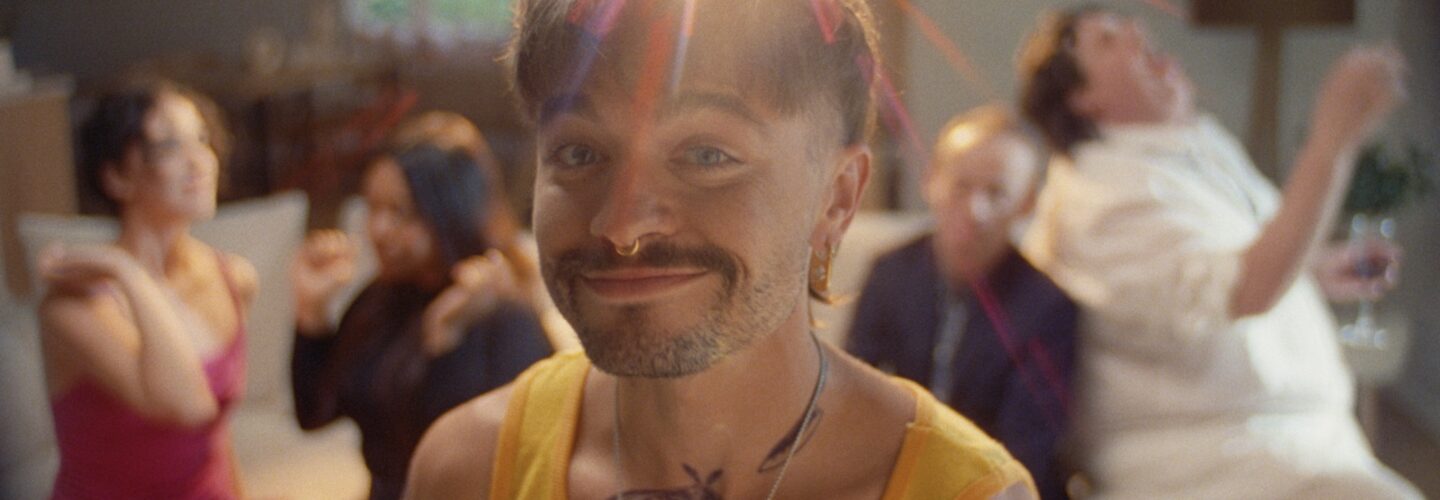

Gas Station Sushi from writer/director Chad Corhan is a masterclass in controlled chaos, weaving together the filmmaker’s vision of ultimate discomfort into a tightly crafted comedic nightmare. Corhan took his contemplation of the most horrifically awkward scenario imaginable and transformed it into a surreal tapestry of anxiety and absurdism. Notably, Corhan’s meticulous pre-production planning stands in fascinating contrast to the film’s chaotic energy – every moment was line-scripted and shot-listed before cameras rolled, a necessity given the project’s ambitious scope of multiple characters, practical effects and 35mm film stock all demanding precise coordination. Gas Station Sushi is a film that rides the razor’s edge between overwhelming and entertaining, delivering laughs while maintaining a surprisingly effective, genuine emotional weight. As this quirky delight premieres with DN Corhan explains how the intensive same room writing sessions became the engine driving the film’s breakneck pacing, and his non-negotiable that they used practical effects over digital.
Gas Station Sushi is almost a tapestry of a myriad of worst nightmares.
The initial concept of the film came to me when I was imagining what the most horribly uncomfortable situation a character could go through at an intimate drug weekend with a bunch of people they barely know. It just hit me as a taboo subject that, surprisingly, many people I spoke to in their late 20s and early 30s had experienced, which made me want to make a movie about it. I felt that writing this wacky slapstick fish-out-of-water story centered on a woman having a pregnancy scare would really do this drug weekend concept justice.
I wanted the movie to move at a clip, almost making the audience have to catch up with it as it unfolded which is really attributed to our writing sessions.
I didn’t want to go through a traditional casting process to find an actress to fill that role. I needed to build this thing from the ground up with a collaborator who could see the humor in the story and could embody the character. Asking my co-writer and star of the film Sydney Adams to work on this project with me was really the impetus to make this movie a reality. I gave her my short, non-fleshed-out elevator pitch of the film and then we went to work on writing it in earnest. We only worked on the script together in the same room, which really made us get the flow and the dialogue right. I wanted the movie to move at a clip, almost making the audience have to catch up with it as it unfolded, which is really attributed to our writing sessions. Our north star while writing was that the movie had to ride the line of being completely overwhelming but entertaining the entire time in order to work.

How closely do you attribute the rapid-fire dialogue and pacing we experience to the proximity you and Sydney had during the writing?
When writing the script, Sydney and I really just spent the most time trying to get all these characters to talk to each other freely on the page. Having your writing partner in the room to bounce ideas off of and see what sticks and what doesn’t when you read back through your work was a huge part of the process. It all gave a lot of immediacy to the writing process for me personally.
Most Popular
It’s immediately delightfully absurd with that amazing montage in the toilet. Why was this the perfect way to bring us into your world?
It sounds stupid, but I think honestly the toilet thing really came from thinking, “How can we make sure you are paying attention in the first 30 seconds of this movie?” It came pretty late in the writing process I remember, I think I pitched it to Sydney passingly and she was like “wait…”. After we committed to that, we just went all in on that opening existential bathroom moment and then that dictated a lot more of the surreal elements you see in the rest of the film.

The film is built off of non-verbal reactions from Hannah and we see the entire film from her perspective.
Each person in this is simultaneously odious yet amazing. How did you hone in on how many extra characters to envelop around Hannah?
I always wanted to have Hannah surrounded by people in this movie and make it more than a single-layered relationship-centred film between two characters. Sydney and I wanted to fill up Mark’s house with people to see the different levels of this controlled crisis Hannah was going through in comparison to everyone around her. The film is built off of non-verbal reactions from Hannah and we see the entire film from her perspective, so having a decent-sized group of characters at the party surrounding her was important. All the characters were honestly just so fun to write and develop, it was easy to keep adding more moments with them throughout the time at Mark’s house.
I wanted to be surrounded by great comedic talent on set. I wanted every actor I cast to have a distinct voice and not just hit the mark and say the line (they could do that too of course, they’re pros). Before I began writing with Sydney, I serendipitously ran into Jacob Wysocki at a friend’s backyard BBQ. We remained friendly over the next year or so and then I coincidentally got asked to be a film loader on a film he was acting in. I was able to watch him work from the sidelines on that film, which really made me start visualizing him in the role of Mark in my movie.
Then I was introduced to Andrew Yackel by one of my producers and editor on the film, Andrew Gibson. After that meeting, I knew Yackel could play this f-boy boyfriend Sydney and I concocted. He also insisted on wearing the dinner plate-sized pupil contacts you see Thigh Tat wearing in the film, which were incredibly thick and uncomfortable, so I knew he was the right choice for the role. I rounded out the cast with Joseph Schwartz, [whose comedic acting was the joyful centre of Taylor Thompson’s People Person], Jamie Loftus, and Asha Michelle Wilson, who all really resonated with the script and understood the assignment. Truly, every person in this movie is an immense ball of talent that I was so lucky to work with.


There is a lot going on at any given moment.
In any film I make, but especially Gas Station Sushi, I try to be really cognizant of coverage. I categorically hate that word, but knew when making a comedy where every take can be a different performance, it was important to have an idea of how the film would be edited before the cameras rolled. I line-scripted and shot listed the entire film with DOP Arlene Muller before production and shared our work with my AD, Cutter White, and editor, Andrew Gibson. We were able to make a game plan of how to economically cover this thing and really visualize the edit in pre-production. So on set, I always had a good sense of when to move on from a set up and when to let the actors play with it a bit. I did not have the luxury of ‘finding the scene in the edit’. I had to make sure it worked on the day on set or we were destined for failure.
It was important to have an idea of how the film would be edited before the cameras rolled.


How did that organisation translate on set?
There were so many moving parts in our production that it was really critical to have a solid sense of the blocking and flow of the scenes before we got to set. Obviously, we were working with this incredibly funny cast that was going to give you some new piece of gold on almost every take, so you wanted to leave some breathing room in the scene work but then we had all these gags and physical comedy bits to account for as well. Then you throw in shooting on 35mm into this equation as well and the time it takes to light for film. Our movie essentially plays out in real time, so we have scenes that happen at every hour of the day going into night. It was a hard schedule to balance. My AD Cutter White really understood my shot list and line script and was able to shift things accordingly to make our days if we got behind. What’s that saying? Everyone has a plan until they get punched in the mouth. I think that might be applicable to our film.
I just wanted to make something based on a hyperspecific thing that I thought was funny but also play for a broad audience and have some weight to it.
Tell us all about your vision and how you captured cinematic widescreen comedy.
I think I’m preaching to the choir here, but I just think there are so few great modern cinematic comedies being made anymore. I think I just wanted to make something based on a hyperspecific thing that I thought was funny but also play for a broad audience and have some weight to it. I was thinking about films like Election, Punch Drunk Love and Albert Brooks’ Modern Romance a lot while making this film. I just wanted the film to be a visual ride while still making you laugh a lot.


The practical effects are brilliant. How did working with these tangible elements influence your visual storytelling compared to potential VFX alternatives?
On the practical effects side, I asked my good friend Tayler Nicholson to design the film for me. Tayler is a wizard when it comes to DIY practical effects so when I said, “The movie opens with the lead actor’s belly expanding and exploding like a gender reveal cannon”, she already had like a million ideas of how to pull it off. Tayler also built multiple sets for the film and helped me fill the frame with a warm but stylized pallet. She really took every gag in the script as a challenge of how to achieve it practically. From the belly explosion to thigh Tat falling off the roof and then of course the possum finale, we did it all practically. There are obviously a lot of little VFX shots scattered throughout the film as well (created by great friend and VFX sup Mitchell Harris) but we wanted the film to feel as tangible as possible and lean into the practical effects.

I want to know more about the pallet and tapping into the bohochic vibe and what that does to the tone of the film?
I think anytime you pick a location with white walls, your DP immediately loves you (sorry Arlene!) But we really wanted to lean into this fake airiness that was Mark’s house. Mark is obviously a big form over function character and is incredibly performative, so having this pure and bohemian feel for both his home and his wardrobe was really important. It also contrasted his drug-fueled freakout that happens later in the film. Then for the rest of the party members we all wanted to have their own individual feel, most of them had small pops of color that were indicative of the party atmosphere. Our costume designer Lauren Teebor was so incredible at making sure everyone felt like they were in the same movie but also felt true to the character. We really just tried to make everything at Mark’s house feel clean with a fine grain and then everything outside of Mark’s house feel a little more dirty, grainy and sun soaked.
What’s next?
Sydney and I have written a feature version of Gas Station Sushi since completing the short and we would love to make that as our next project. I also have a couple other shorts and a coming-of-age road trip feature I’m developing as well. While making shorts is so fun, I’d love to focus my energy on directing a feature as my next project.