
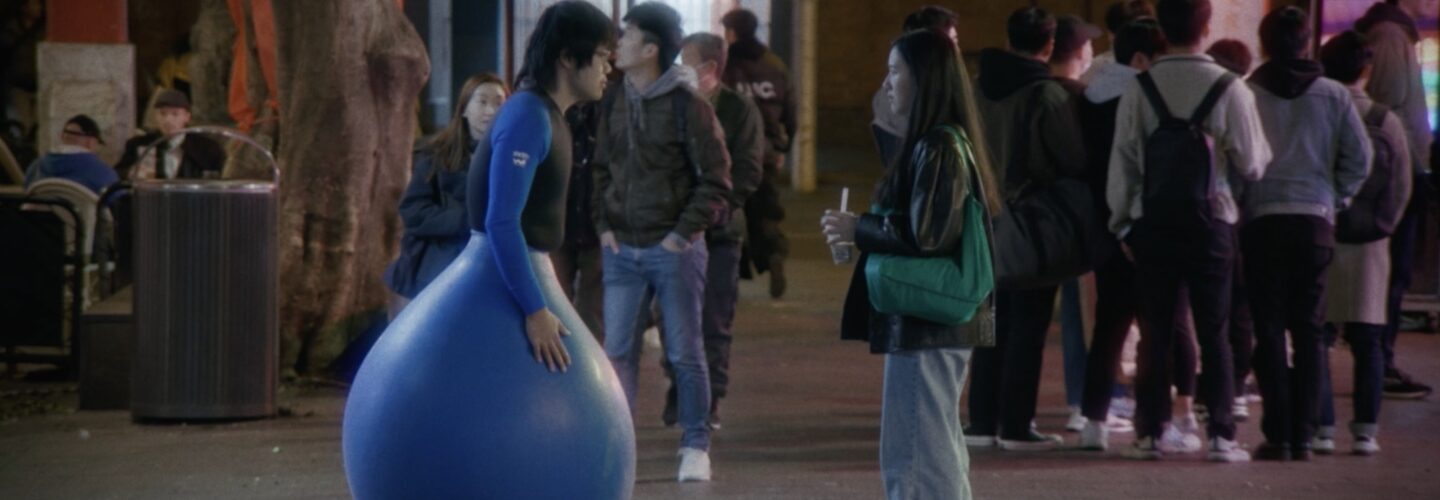

In the lexicon of migrant cinema, the narrative is often one of hardship, a sombre ledger of loss and struggle. David Ma’s Sydney Film Festival winning short The Dancing Girl and The Balloon Man quietly but firmly challenges this, proposing an alternative vocabulary built on whimsy, wonder, and the quiet rebellion of personal desire. The film is built on a fusion of seemingly opposing forces: the gritty, observational texture of documentary and the luminous, yearning heart of a fairy tale. This is not a film about escaping a mundane reality, but rather one that uncovers the magic latent within it. Ma’s approach is one of intimate observation. The camera, often stationed at a distance with long lenses, doesn’t intrude but patiently witnesses, capturing the authentic rhythm of Sydney’s Chinatown as a lived-in workspace, not a postcard. This aesthetic choice grounds the film in a tangible reality, making its magical leaps feel earned rather than escapist. The profound beauty found in the mundane—the precise fold of a dumpling, the hypnotic glow of a dancing video game—is not romanticised but presented as the very texture of the characters’ lives. These moments are the quiet battlegrounds where the central tension plays out and we bear witness to an age-old fight between the push and pull between the communal duty of selfless subservience and the aching, personal need for expression. Ma crafts a deeply resonant portrait of immigrant life that acknowledges precarity while fiercely celebrating the courage to imagine something more. With The Dancing Girl and The Balloon Man bouncing onto DN’s pages today, Ma joins us for a chat about the impossibility of objective storytelling, redefining the immigrant narrative from hardship to hope and whimsy, and navigating the insider/outsider perspective on autobiographical filmmaking.
I hear the balloon man is inspired by a real performer.
I met Vincent, the real balloon man, at the start of 2020, a couple of months before the pandemic would subsume the world. When I saw him performing on the streets of Sydney’s Chinatown, I was entranced. Vincent is not a charismatic performer but he still evokes joy and wonder in the way he dances with and inside the balloon. I knew I wanted to make a film about him. At the time, I was shooting and editing documentaries and news stories for one of Australia’s government broadcasters. I was slowly falling in love with the documentary form, especially the observational style of Frederick Wiseman. The stationary camera, the long lenses, the breadth of life that you could explore with very little money but compensated through time and patience. I was also following a fresh breakup and revisiting my favourite romance films.
For us children of the eastern diaspora, Wong Kar-Wai casts a long shadow, and as I rewatched Chungking Express and In the Mood for Love, I was discovering the works of Hou Hsiao-Hsien and Tsai Ming-liang. Along with a pervasive feeling of yearning in their films, these guys are also unified by their horniness. To round out this diet, I was also watching a lot of John Cassavetes for the first time. Who needs wides when you can just shoot 20 closeups?

Did you consider casting Vincent in the film?
He was originally from Taiwan. When I met him, he was 39. He lived the life of a true vagabond, travelling performer. He was not only a balloon man. He could perform magic, make balloon animals, and in his downtime he would go 4WD offroading and free diving. He would travel to Melbourne, Adelaide, or Brisbane on a whim if business was slow in Sydney. The thing that drew me to him was this lust for life and joy that I rarely saw explored in films about migrants. It’s really hard building a new life in this country but I know many migrants, like my parents and aunts and uncles, came to Australia with a sense of hope and wonder. Vincent emanated this when he performed.
The thing that drew me to him was this lust for life and joy that I rarely saw explored in films about migrants.
I wanted Vincent to be in the film, he was often impossible to track down. The man didn’t want to be tethered to a place. I wanted him to be in the film but it was too great a risk. Instead, I turned to my close collaborator Johnathan Lo, one of the co-founders, along with our producer Georgia Noe, of our film collective, Floating Leaf Pictures. John is a great writer and director, but he was once a comedian, and I knew he could play this like Jim Carrey doing Eternal Sunshine of the Spotless Mind.
Most Popular
Why the decision to move away from documentary and to fold his essence into a scripted narrative?
I think a filmmaker can’t help but impose their perspective onto a real life subject, even if it’s a documentary. The impossibility of objectivity, etc. When I first saw Vincent’s performance, my immediate instinct was to make a documentary about him, maybe in an observational style. But after that first performance, I didn’t see him again for 6 months, and in that time, whilst rewatching some of my most beloved films, I realised that deep down I had a really romanticised view of his life. I still don’t know if it resonates with the truth of how he saw himself, but that was how I wanted to tell this story. This would have happened even if I had made a documentary instead.
The other driving instinct was the monotonous and dreary representation of the immigrant experience I kept seeing. A lot of that touches on truth, the immigrant experience can be punishing, but I know my mum and dad and my aunts and my uncles experienced a lot more. On their lunch breaks during a 12-hour shift, they found time to flirt, to buy a gift for the girl who worked the checkout counter at the local grocer, to spend their fortnight’s pay slip on a new shirt before going on their first date. That was the feeling I was trying to get at in the film, and hopefully it exists somewhere in between the objective truth and the emotional truth.

I really engaged with your central exploration of women.
The women that I grew up around, the women who raised me, were the other impetus behind this film. My mother used to work at a Chinatown supermarket. I spent my school holidays there, by my mum’s side as she worked the checkout, a job she had not dreamt for herself but one she undertook every day with no resentment. Her employers were kind people, and became a second family to us. Then there was my cousin Ada. A couple of decades younger than my mother, Ada was employed by my aunty at their steamed bun shop in the suburbs. She couldn’t hold down this job nor the other casual jobs she picked up. I think it was difficult for her to do something mundane.
The contrast between my mother and my cousin is what inspired the central tension of the film, the push and pull between one’s Chinese upbringing of selfless subservience, and the personal desire to pursue one’s dreams. Both of these women spent their early years in Sydney living in financial precarity, in a foreign country where they did not speak the language, and only knew a handful of people. They are part of a long lineage of migrant women who have lived through the same circumstances.
This is where the character of Mei comes from, a young woman working a monotonous job, living in a cramped apartment with her aunt, wiling away any spare hours with a dancing video game. She has little in the way of career or romantic prospects. The ying to Mei’s yang, the missing half that might make her whole, is the Balloon Man, an immigrant who seemed to be untethered to his upbringing, performing on the street not only to scrape by but because it’s the only job he can do. I mean, imagine him working in an office. In the film, Mei meets the Balloon Man. In a fleeting moment, they see in each other a kindred spirit. This romance then takes a turn into a fairy tale, stealing moments from the folk horrors of Pu Songling, but ultimately there is no neat, happy ever after. I wanted to make a film that portrayed the mundaneness shared by so many immigrants. They are not the typical heroes we see on our screens; they are simply living and getting by, experiencing joy and hardship in equal measure.
The ying to Mei’s yang, the missing half that might make her whole, is the Balloon Man, an immigrant who seemed to be untethered to his upbringing, performing on the street not only to scrape by but because it’s the only job he can do.
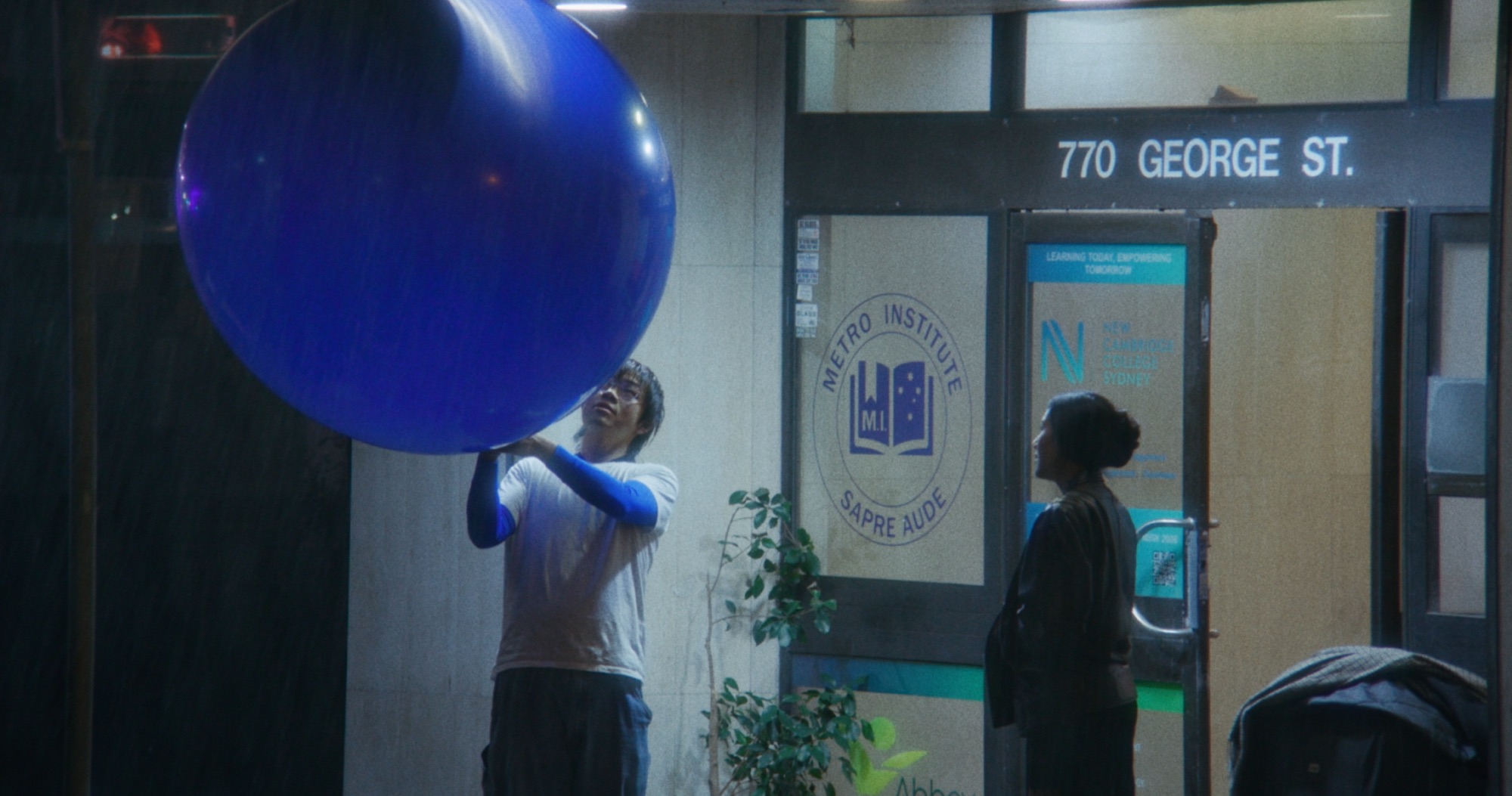
The Balloon Man represents a radically different approach to migrant life: untethered, artistic, and public. How does his character specifically challenge Mei’s worldview of subservience?
He’s both a love interest but he’s living life in a way that she can’t, and maybe never can, but hopefully in meeting him it opens up new paths in her life. As you’ve pointed out, the Balloon Man’s living in a way that’s the polar opposite to Mei. But I think what touches her more than his lifestyle is his approach to life. He makes the most out of his work, and he is courageous in his pursuits, whether it’s his performance or when he develops a crush on a girl who passes by. It’s this courage that I think will be most transformative for Mei.
Can you talk about that creative tension of adopting an observational style, which seems directly at odds with the film’s ultimate, magical fairy tale turn?
It definitely seems at odds, but that was exactly why I was drawn to that style. I wanted all the fairy tale/folk tale elements to feel like they were happening in the real world. These characters appear like all the immigrants you’d see day to day, but within them there is a deep well of feelings, and the magical realist moments are an expression of this.


How did you and DP Jack McAvoy design shots to feel both voyeuristic and intimate, especially in the crowded public spaces of Chinatown?
The doco style cinematography was key to how we developed the film, even though we didn’t always adhere to this style. I didn’t want those heightened moments to feel cloying, and I really didn’t want to reach for a grandeur that we couldn’t achieve. It was both a tonal and budgetary decision. We ended up shooting in the winter of 2022, over 7 days and nights. From the onset I wanted to shoot in an observational documentary style with unobtrusive long lenses. Like I mentioned above, I had been making a lot of docos for the last 2 years and I wanted to create the feeling as though this story was happening in the real world and we just so happened to have cameras there to capture it. I wanted to shoot scenes in the middle of the city and capture pedestrian reactions and movement in the frame without them being spooked by a camera.
From the onset I wanted to shoot in an observational documentary style with unobtrusive long lenses.
The long lens also helped us stay far away from the action and allowed pedestrians and real life to seep into our scenes. We shot on our DP, Jack McAvoy’s Canon C300 Mark III, cropping the sensor to super 16mm with the goal of emulating super 16mm in post. This was both an aesthetic choice and a practical one to get us even tighter closeups. We used a couple of old Super 16mm zooms—a Canon 8-64mm and an Angenieux 11.5-138mm—along with a series of Zeiss Distagons for the really low light scenes.

The film finds profound beauty in mundane parts of life – working a checkout, making dumplings, playing a dancing game. How did you approach shooting these sequences to elevate them into poignant moments rather than establishing shots?
Thank you! The cast and crew deserve all the credit for investing the time and care into those scenes. Robyn Liu and John, our leads, understood what we were trying to make, and they gave those moments as much love as the lengthier dialogue scenes. Laura Murray, our production designer, created spaces that spoke to each scene. Jack, our cinematographer, and Nico Nalbandian, our gaffer, composed these beautiful, tender frames for those moments. Those moments all ended up being much shorter in the final film, compared to how they were shot. I think that really helped as well, cutting them down, making them more focused.
I really want to dig into the shooting of that truly evocative moment of them in the balloon—both from the inside and outside—and editing this together to feel so otherworldly yet grounded.
Once again, all credit goes to the crew. Laura painted one of those walking on water giant balloons and we found a cheap warehouse space to shoot in. We put the balloon in a portable Kmart pool and hosed it down to create a rain effect. The actors and Jack were the only ones inside, and I don’t envy them. It was a sauna in there. With the exteriors, it was just some simple puppetry with alternating friends, who were willing to get rained on, standing to the side of the balloon. I think the earlier moments of fantasy in the film helped keep the scene tonally consistent and hopefully not too ridiculous.


The actors and Jack were the only ones inside, and I don’t envy them. It was a sauna in there.
As a Chinese-Australian filmmaker, you possess a unique perspective—both an insider’s understanding and an artist’s observational distance. How did you consciously frame Chinatown to avoid an exoticised or tourist gaze, and instead capture its authentic rhythm as a lived-in, working community?
I mean, I hope it feels lived-in! I think a lot of it comes from getting access to the community and those locations because I grew up there and I can speak the language. The actors, especially the older actors, brought that realism too. Yuxin ‘Peter’ Jia, the singer, and Julianna Zhuang, the aunt, are both first time actors and there’s a quality that they bring to the scenes that we could not have achieved with anyone else. I do think my gaze still exists somewhere in between an insider and an outsider. Yes, I spent my childhood in Chinatown, and I still spend a lot of time there to this day, but that’s completely different to someone who’s worked there for 30 years, as many of the locals have. I don’t know what kind of film they would make but it would be very different to mine.
I’d love to know what you are looking to focus on next.
I’m currently developing a feature. It’s a spy movie but still tonally in the same world as this short. I think they call it a low gear thriller in the industry. I’m co-writing it with my friend, Andrew Pham, who’s a brilliant writer/director and devout Buddhist.