
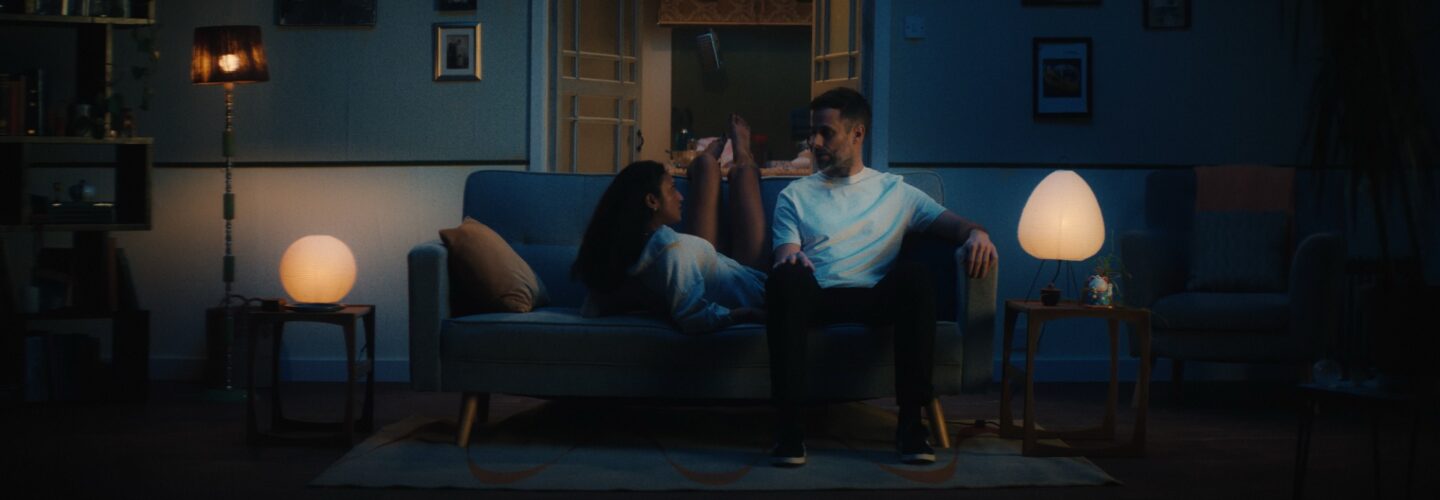

As we hurtle further into a frightening future of artificiality and commercialisation, the need for dystopian fables has never been so vital. Writer/Director Pardeep Sahota’s sci-fi short OK/NOTOK arrives at the perfect time as both a warning and a mirror, a daunting diorama of a society in which the most human experience, love, has been commercialised. A static camera, fixed in a lush wide, captures compelling central performances from Bairavi Manoharan and Jay Taylor as a couple unravelling under the pressure of incessant advertisements, walking a fine line between charming humour and eerie artificiality. Though the frame may be locked, intricate sound design builds an expansive world beyond the apartment’s walls, hinting at an Orwellian nightmare ruled by omnipotent machinery just out of frame. Likewise, the film’s lighting work paints the apartment like a canvas, at times nocturnal and eerie, others warm and homely, ensuring a lack of expressive angles does not limit the narrative’s rich emotional palette, but instead enhances it. OK/NOTOK stands out amongst a vast history of dystopian sci-fi through its intelligent class-conscious perspective, grounding Loretta’s longing for intimacy in economic struggle and suggesting that technology is less an inherent evil and more a vessel for oppressive capitalism. As his darkly satirical short premieres on DN, Sahota joins us to discuss using a locked-off camera to mirror emotional confinement, exploring the commodification of love from a working-class perspective, and shooting twenty-six scenes in just two days.
With a rise in AI usage, this feels like a vital narrative for our times. How did the story come to you, and could you tell us a little more about your class-conscious approach to this sci-fi world?
I’m not sure how much thinking went into it; it was more instinctual. I have a keen interest in science and what’s going on in the world. And I have my smartphone feeding me an endless scroll of fear and obscure film recommendations every time I look at it. Just thinking about our increasing reliance on everything tech to get by, the commodification of every single aspect of our lives—that’s a thread that runs through it and was present in the initial spark. The class-conscious aspect of the story stems from my perspective; I come from a working-class background, so that just felt like the only natural way to approach this story for me.
I realised I had seen other films tackle aspects of this subject matter but not from the working-class perspective that I was seeing it from.
Writing this film was the fastest I’ve written anything. I was avoiding writing another short film that I got stuck with, so I decided to clean the bathroom. A sure-fire sign I was experiencing a block. As I was cleaning the bath, OK/NOTOK as an entirely new idea just came to me. The relationship, the arc of it, the length of time we spend with them, the way the film slowly opens up to you as a series of revelations, the dark humour running through it and even the single-shot designing principle. It felt like, in a lightning bolt, the film told me what it was going to be, and my job was to write that down as quick as possible before the idea left. I wrote the whole thing that day and did revisions the next day. And it was done (aside from tweaking elements, it stayed pretty much the same). It was only after it was written, I was able to step back and analyse why the story came so fully formed and felt right to me. I realised I had seen other films tackle aspects of this subject matter but not from the working-class perspective that I was seeing it from, so that felt like an exciting spin that I could add to the conversation. The story felt born out of everything I had been consuming about the near future. And that spewed out onto the page, filtered through the prism of my cynical (yet still optimistic) worldview with a healthy dose of my sense of humour running through it.

OK/NOTOK is very much a two-hander, so casting is of utmost importance. How did you find them and then approach directing your actors to strike the right tone between artificiality and emotional truth?
As this film was a single shot, I had the challenge of holding every scene in a single take, without the luxury of cutting in for a close-up for emotional emphasis. So, I needed actors who had the skillset to reach out to the audience whilst in a wide shot. Our amazing producer Luke Grech brought in Stevee Davis as a casting director, who has a fantastic eye for talent and matching them up to the right material. I had already seen Bairavi Manoharan in a terrific short film called Ratthum (Blood) by Vathana Suganya Suppiah. Her performance in that film showed me she had what I was looking for, it was rich, layered and emotionally compelling. When I met her, she had a great sense of humour and really got the script, which made it really easy. It was also important to me that Loretta was played by a South Asian actor. I think there’s a tendency in our industry where South Asian (and any minority actor, for that matter) can get offered roles where their cultural background is a function of the plot but not so much if it’s not. Once I offered Bairavi the script, this was one of the first things she pointed out to me that she loved and from there, I knew she was going to be great.
Stevee found Jay Taylor, and his reel was great. The moment I started chatting to him, I knew he was right for the part. He has a natural disarming charisma to him that I felt was essential to Zane. Jay is also incredibly sharp; he instantly got all the nuances I wanted to bring to Zane. For this film, I wanted to approach sci-fi a little differently. I kept calling it science fiction Mike Leigh in the pre-production period, as I wanted it to feel so lo-fi that the sci-fi elements creep up on you. What is holding your attention for the first half of the film is the performances and unconventional nature of the relationship. This was something we developed with the performance of Zane. He starts the film at his baseline, not quite getting her but slowly he learns and adapts to her acerbic sense of humour. Once he gets the hang of how to make her laugh and reflecting Loretta’s humour back at her, she finds him funny and starts to bring her guard down. There is a subtle manipulation going on (whether intentional or unintentional on his part is for you to decide), but he’s always learning and adapting to become a better partner for her whilst he’s discovering himself. And it works. It’s better to have your paying customer, a happy customer after all… finding that balance was something we discovered in rehearsal and kept pulling at that thread as the shoot went on.
Most Popular
Beyond that flood of bath cleaning inspiration, what made you want to stick with the decision to shoot the entire film from one locked-off camera position?
It came out as an expression of Loretta’s character. I wanted the film to feel very subjective to her experiences. She feels trapped in her situation, so it felt right rooting the camera in one position to express that. Along with the static camera, I wanted the sound design to feel very chaotic and intrusive when her mental health is fraying in the first half of the film. At the beginning, the world outside is fraught with social unrest, bordering on collapse. The protestors chanting “I have a dream, humans over machines”, give you an indication of what they are angry about; however, Loretta is lucky enough to still be able to work remotely. She feels intimidated by that wider world, so she stays inside. We find her at the start of the film with her upstairs neighbours having very loud sex, her isolation is compounded by this feeling of loneliness and drives her to buy a MetaSpaien.
I wanted the film to feel very subjective to her experiences. She feels trapped in her situation, so it felt right rooting the camera in one position to express that.
As the film develops and she starts to develop feelings for him, her TV and Zane are attuned to her behaviour and keep offering her antidepressants with extreme side effects. So whilst the camera stays rooted, the sound design outside starts to mirror her internal state. Is she falling in love? Or has she listened to the advertising and started using the antidepressants? Or both? I stretch this to as far as it will go, so by the time she says the final line, “How was your day?” she’s reached a place where she’s moved from immediately distrustful to being openly vulnerable right from the very start of the relationship. If the film continued for another second the camera would move, but we cut to the credits. I had played around with the idea of showing this earlier in the pre-production process but ultimately decided against it. It’s a short story and the moment we leave her is the moment she makes a real change internally. I felt it was neater to keep it that way.


Did the locked-off camera set ups bring any challenges to the production?
Haha! Yes, they certainly came up for quite a few departments. Aside from Lorine Plagnol (Exec Producer), Linda Wu (DOP) was the next person to sign onto the project. I remember pitching the film as “I’m going to tie one storytelling hand behind your back, because we won’t move the camera”, and she loved that challenge, to tell a story focusing mainly on control of light. But what started off as a cool idea from writer Pardeep increasingly became a knot in the stomach for director Pardeep. The fear that someone would accidentally knock the camera at any point kept me up at night. Almost every scene in the film plays as a static oner. And most films, to some extent, lean on the magic of editing, but my bright idea took a lot of that away. We either got it in camera or we didn’t. It was a tightrope walk and I took away the safety net.
I never thought I would need to do a storyboard for a single-shot movie… and I ended up doing one for every scene.
The actors don’t get the luxury of a close-up so writer Pardeep ended up being a bit of a menace. But that just meant the film was telling us to cast the film correctly and be really methodical in pre-production. So that’s how we approached it. I never thought I would need to do a storyboard for a single-shot movie… and I ended up doing one for every scene. It was really helpful. Every department could refer to it in the midst of the shoot to get their bearings on what exactly was going on, which can be difficult when every set up looks quite similar and you’re not shooting everything in order. The script had to be tight as a drum going in and everyone had to bring it. And I’m proud to say, everyone really did rise to the challenge. It was beautiful to watch it all come together. The anxiety leading up to the shoot gave way to a real sense of achievement once it was shot. Because I knew we got the pieces, it was time now to see if they all worked together in the edit.
How did you structure the shoot to ensure you made the most of your limited production time?
We had a 2 day shoot at Kennington Film Studios with a day for set build and pre-light. Within that time frame, we had to shoot 26 scenes, which was intimidating going in. But put simply, it was down to a lot of planning in pre-production and it helps having an incredible team who are all pulling in the same direction. We couldn’t shoot everything in scene order due to certain logistics with the lighting setups. But between Linda Wu (DOP), Dan Pachalski (1st AD), and me, we were able to come up with something that worked for the production team and the actors, so they could explore the characters through an emotional arc that was as smooth as possible.
On a short film, you don’t get a lot of time together; we only had a few hours one evening to rehearse prior to the shoot. I wanted to keep a lot of moments fresh for when we were rolling. So we used that time to improvise around the scenes or to block any physical action. In terms of structure, all the later big dialogue and emotional scenes were saved for the second day so they could build on that connection. It all ended up working out nicely.


I was in awe of the film’s editing! What was the post-production process like? Was it difficult working without traditional coverage?
Thank you for saying, we worked hard on it. The single-shot nature of the film meant that a lot of editorial work had been thought through in pre-production planning. Thinking very carefully about the edits in and out of scenes. So the first assembly came together very quickly as there wasn’t traditional coverage, as you say. Which meant that all that planning had paid off. Sound began to play a big part, even when it was just temp sound laid in for the edit. I had written the film thinking about the sound and how characters interact with elements you can’t see, to give the audience a sense of a wider world. As soon as Amanda Reines (editor) put some temp sounds in, the scenes had a real drive and became something that we could continue refining.
Despite trying to keep that script as tight as possible, Amanda was great and still able to trim about a minute out of the shot footage to make it feel tight. We also found some nice moments to let the film breathe. One of my favourite little moments in the film is towards the end. The scene where the shot is quiet, aside from some shouting outside and a fly inside, we just sit with the scene for a moment. Despite all our planning, that small scene wasn’t in the script. It was something we found as we were shooting and decided to quickly get on the day between setups.
The lighting throughout is utterly gorgeous and really helps convey time and emotion.
Working with Linda was a dream collaboration. It’s what I love about filmmaking, if you surround yourself with people who are more talented than you, the end result will be beyond what you dreamt of in the first place. She was the second onto the project and she was a champion of the script from the beginning. She was bursting with ideas and we shared references from film and photography and developed our own visual language for OK/NOTOK together from there.
Being a one-shot movie we were hyper aware that very quickly the image could become wallpaper to the audiences eyes.
In pre-production, with the help of my storyboards, we went through every scene and nailed down the time of day and year each scene was set in, even what the weather was like outside. That really helped us tell Loretta’s story through mood and colour, which then went on to inform her costume choices. After finding a look for everything, we then came together on references for each of these looks for every single scene. Anything we could do to give each set-up its own character and help tell Loretta’s story. Being a one-shot movie we were hyper aware that very quickly the image could become wallpaper to the audience’s eyes. So we wanted each scene to have a freshness, its own unique flavour to spice it up. OK/NOTOK was only going to use one lens fixed throughout, so Linda did a lot of testing before we ultimately settled on a vintage anamorphic Panavision C-Series 50 – 95 zoom lens. That brought an organic character to the image that felt alive and tactile, which really helped bring Loretta’s world to life.

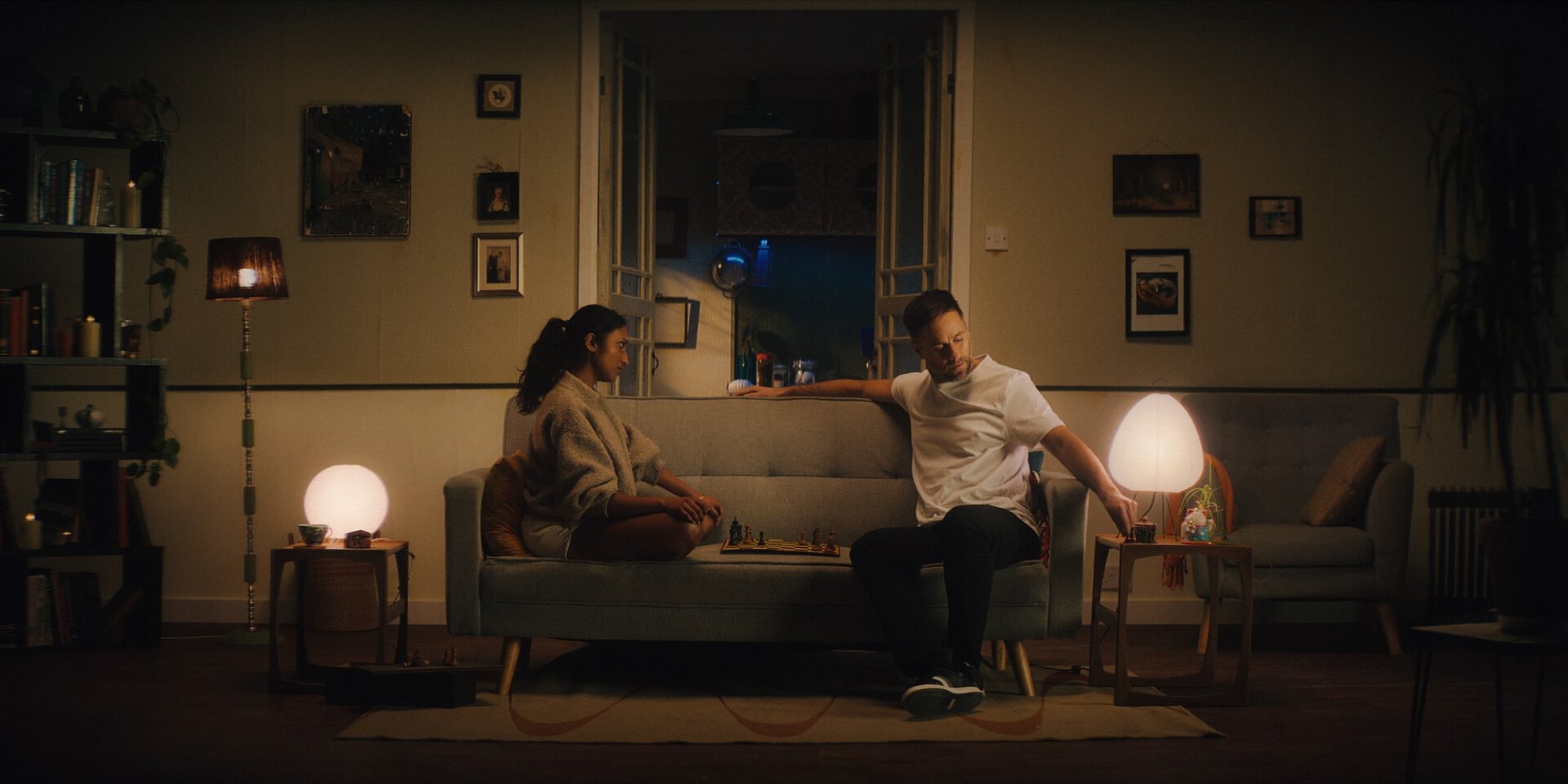
Due to the limited camera movement, the sound design really plays an important role in building the world.
I’ve worked with Edwin Matthews for many years on commercials and other short projects so we’ve built up a very strong shorthand. We were passing ideas back and forth at the script stage, which helped inform some interactive sound elements that made it into the final script before we shot. Once in post, Edwin was able to create such a layered and textured world outside the frame that when combined with Linda’s lighting and Elle Mikkola’s production design in the frame, it all came to life. We wanted to tell Loretta’s journey subjectively through sound. So, her interior life is heightened and represented through the sound design and the music.
When you’re not giving yourself close-ups, we felt we needed to use other methods to pull the audience in. A great example of this was the saxophone-playing neighbour. Initially, the idea was to have the neighbour upstairs, learning an instrument like a saxophone… but badly. They are starting out, so it’s loud, erratic and ugly. Another neighbour even swears at them to stop (that voice is Edwin’s too). As we move through the scenes and time progresses, so does the saxophone playing. It’s more polished – they’re improving. It was here where Ed had the brilliant idea of matching the saxophone tune to the music on the soundtrack and then bleeding them together, so the saxophone then hands off to the music track when Loretta is really starting to fall in love with Zane.
The outside world, which would start off as loud and piercing, becomes this sweet theme on the soundtrack that carries us through. It’s a small detail we went to, and I think that most people when watching don’t necessarily register it consciously. But your brain does, and you start to feel that transition along with Loretta as she falls in love. It was another great moment where I had an idea but when you have an incredible team around you, it’s enhanced to something greater than your initial vision.
Earlier, you described the film as “science fiction Mike Leigh”. How did Mike Leigh influence your directorial process, and did any other filmmakers influence your practice?
I used science fiction Mike Leigh as a line to describe to the cast and crew where the film sits tonally. A lo-fi sci-fi story of a relationship that has dark comedy running throughout. Now Mike Leigh hasn’t made THAT movie specifically, but I thought it was a neat shorthand that this was a grounded story about flawed people in a relationship trying to make sense of their world, which just so happens to have a dystopian sci-fi component bolted to it. In terms of other filmmakers, the films of Paul Verhoeven were my touchstones. Particularly, his tone of humour and socio-cultural critique that he has running through his films like Robocop and Starship Troopers. Jonathan Glazer’s Under the Skin was a good reference point for OK/NOTOK. He made an alien abduction film but stripped it down to its essentials, which was something I really responded to. OK/NOTOK even has some minor references peppered in from David Lean all the way to Yasujiro Ozu. It’s my hyped up version of doing Ozu’s transcendental style of cinema.
OK/NOTOK is transcendental style cinema on class A’s. I’ve also gotten a lot of comparisons to Black Mirror and that is a huge compliment; it’s an incredible series. I wasn’t using it as a direct reference but it has no doubt been absorbed by my psyche via osmosis. A few months after we premiered, we saw there were a lot of similarities with their Common People episode in this latest season on the theme of the commodification of relationships and surreptitious adverts. We premiered in November 2024, and they released that episode in April 2025. So, it felt like we got to have an Armageddon/Deep Impact moment in that we share some commonalities. A lot of people who watch the film bring it up and I feel honoured that people even put this film in the same sentence alongside the work of the talented and brilliant Charlie Brooker. Our antennas must have tuned into the same wavelength on this subject.

I’m fascinated by how themes of connection and technology collide in your narrative. What do you hope audiences will take away from your exploration of these themes?
I hope the film provokes a discussion and some connection about the issues in the film. The loneliness epidemic is already here and people are falling in love with ChatGPT so it’s already knocking on our door. But what the audience should take away should be in their hands. I wanted to make a film that would reward you the more you leaned in and thought about it. It’s deceptively simple on the surface and if that’s all you want to take from it, that’s great. But also, if you want to read more into it, explore the subtle manipulations taking place, we had put that in there too, so there is more depth. I’m a big fan of films that ask questions and provoke discussion.
We had our London Premiere at Picturehouse Create. After the screening, two students came up to speak to me about the film and they asked me to settle a bet—on their way out, one said it was a horror movie, and the other said it was a comedy. Which was it? I said, “That’s perfect. This type of discussion is exactly what I was looking for. You don’t need me to adjudicate.” It was the best feeling, I knew at that point the film really worked as I intended.
OK/NOTOK has been smashing the festival circuit, what can we expect to see from you next?
The film festival circuit is positively buzzing with lots of great work at the moment and so it means a great deal that we’re considered a part of that conversation. Being a totally self-funded indie production brings its own unique set of challenges, so any spotlight we can get on the film we really appreciate. Next up, I want to do another short film. I have three different scripts that are ready to go and I’m looking for different routes for funding. All three are dark comedies that deal with genre. I’m also working on a feature that is in early development with the BFI. So, looking forward to the future… even if it might be a bit murky out there.