
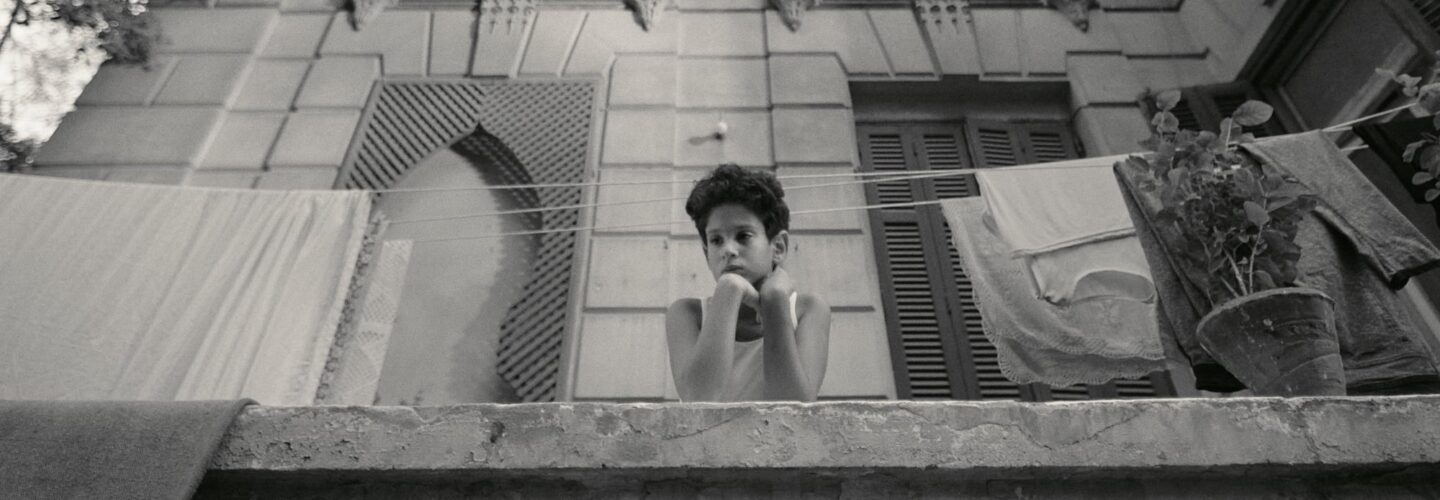

Dawn Every Day (فجر كل يوم) from Egyptian filmmaker Amir Youssef crafts an achingly intimate portrait of childhood loss set against the invisible weight of geopolitical upheaval. A dedication to his father and an excavation of mid-century Cairo, the film follows 8-year-old Nabil through his final day with his best friend in 1950s Heliopolis, as forces beyond his comprehension begin to tear their world apart. Rather than depicting the era’s political turbulence directly, Youssef keeps us locked at eye level with his young protagonist, transforming adult chaos into a child’s bewildering first encounter with grief and separation. What emerges is a film of remarkable technical precision and emotional restraint—a monochromatic fever dream shot employing wide lenses to render the adult world as vast and alienating. Youssef constructs a sensory time capsule built from family archives, abandoned apartments, and year-long conversations with his father, resulting in a narrative that breathes with lived specificity yet speaks to universal ruptures—how children bear the scars of conflicts they cannot name, how memory distorts into high-contrast shadows and light. With Dawn Every Day premiering on DN today, we share our conversation with Youssef in which we explore the meticulous craft behind this deceptively simple story, how the writer/director translated family memory into cinema, and the eerie synchronicity of filming a story about historical separation as the war in Gaza erupted—a reminder that the cycles of loss the film mourns have never truly ended.
Dawn Every Day is deeply personal—it’s dedicated to your father. Can you tell us about the initial spark that led you to tell his story?
This film is dedicated to my father, Nabil, and is inspired by his childhood in the 1950s, as he was growing up in the vibrant neighborhood of Heliopolis in Cairo, the same neighborhood that I also grew up in. The idea developed over time through many conversations with him, and I became certain that I wanted to revisit the past to create something that could bring me closer to his inner child. I’ve known him as an adult all my life, and I felt that through this film I would be able to visit this 8-year-old boy who was still learning about the world and its ways.
When I began to write the script, I soon found myself reliving a complicated time and place. It became apparent to me that I’ve come across remnants of a first friendship, forever lost against the backdrop of geopolitical chaos that children can never understand nor relate to. It is a film about a specific moment in a child’s life as he copes with his first loss.
It felt that this personal story is a universal one that many children live in today’s world, as social disruptions and politics separate us.
As a director who strives to tell the stories of unheard voices. How did you find it telling the story of your own father?
The difficult part was accepting my own vulnerability as I was exploring a story that is deeply personal, but soon enough, it grew into a very fulfilling journey. All my life, I’ve known my father as an adult, and making this film allowed me to know him as a child. A perception that allowed me to revisit a time and place that is far and distant, yet relevant to our world today. It felt that this personal story is a universal one that many children live in today’s world, as social disruptions and politics separate us. And so, I approached it from the point of view of a child coping with his first loss in a brutal world that he doesn’t understand.

In what ways did you mould your memories—beautiful and complicated—into the final film?
My inspirations came from many long conversations with my father, before I started digging up old photos and family archives that he and other family members kept. Later on, my exploration took a more physical state. I visited my father’s old apartment, and the abandoned spaces that he grew up in, and I walked through rooms filled with old furniture that was kept in storage, imagining how it all was. In a way, it was an immersive experience that helped me really understand the sensibilities of the time, and my approach was not to replicate the past but rather capture its very unique feeling.
To authentically recreate the past, I needed to delve deeper into my family archives. I visited my grandparents’ house where my father grew up. It’s a place that hasn’t been occupied for decades and I began to decipher everything I came across. Initially, I wanted to film there but it was not practical, and we had to find a similar place in Cairo that had a similar aura.
Most Popular
To add to your authentic tapestry, how did you work to lay out the aesthetic groundwork?
My producer Norah El Khateeb introduced me to two very talented friends that I teamed up with Asem Ali (production design) and Nashwa Maatouk (costume design), and we began to build the world from the inside-out with two guiding rules in mind—everything we see is in black & white, and everything we build is going to be through Nabil’s perspective. We began to analyze each character and their backstories, including some background actors to bring life to every detail. As Nashwa began sketching wardrobe designs, we used some archival photos for inspiration, and most of the wardrobe we see on screen is custom tailored by Nashwa and her team.
We began to build the world from the inside-out with two guiding rules in mind—everything we see is in black & white, and everything we build is going to be through Nabil’s perspective.
We took the same approach for production design. I worked with Asem on creating a world that feels like it is a slice of life that these characters belong to. The space had to be integral to every moment in the film. One of the most challenging things Asem had to endure was creating a cooling device (Sarabentina) that predated the use of fridges, and we had to build one for the film. Another challenge was using the same apartment and dressing it up as if it were two separate apartments. Asem’s set was built in a way where we were thinking about light and the space that the characters would occupy.


What did your monochromatic palette allow you to express thematically about memory and a child’s perspective?
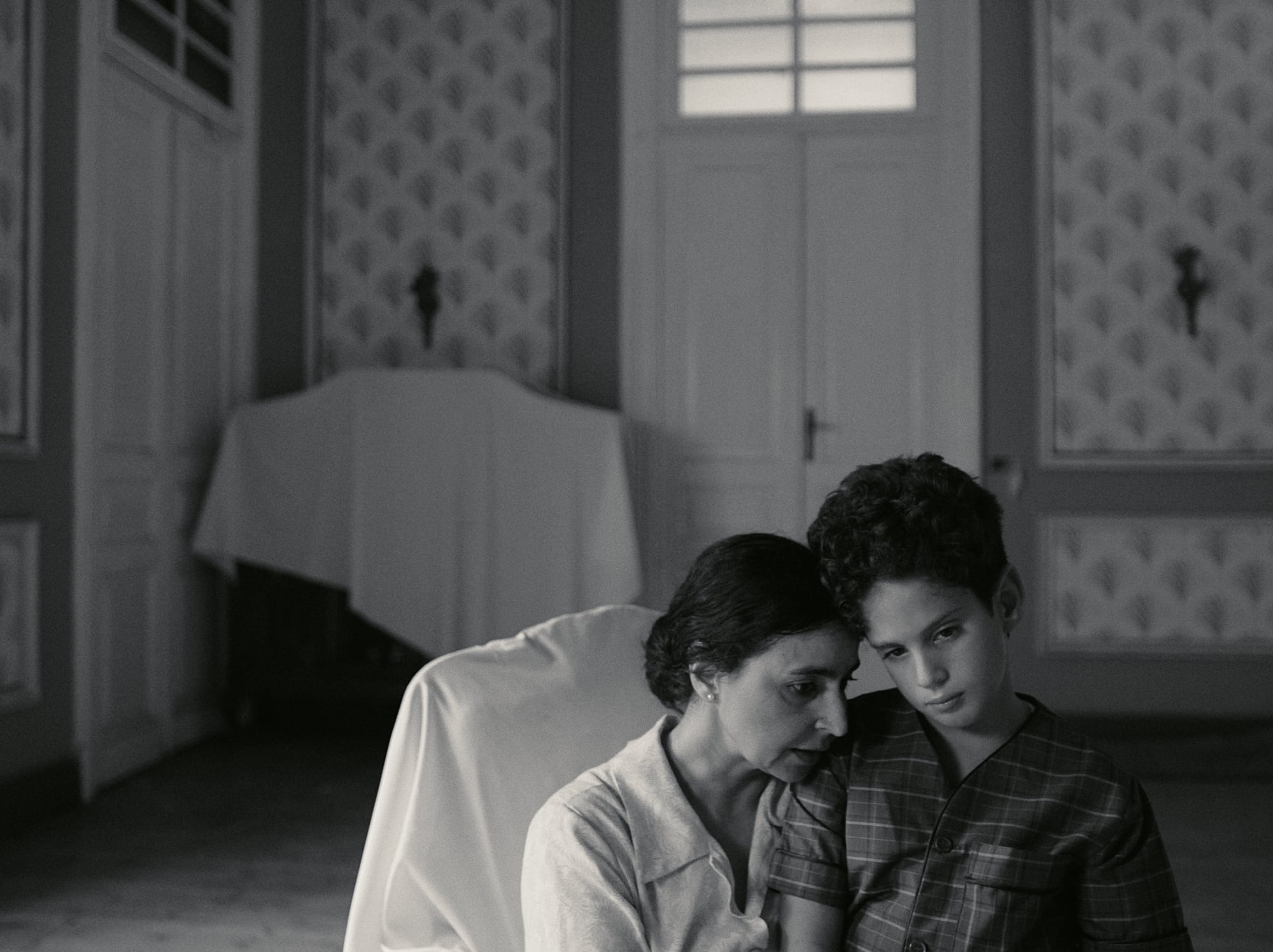
Filming in black & white was a very early idea since the first draft of the script. For many Egyptians, our connection with mid-century Egypt is through old black & white photos and films. Particularly in the 1950s, when Egyptian cinema was at its peak. Movies from that era are still revisited and are relevant today. It is a palette that evokes a longing for the past and is a direct gateway to mid-century Heliopolis, Cairo.
We worked with Arri to configure the Alexa 35 sensor (ALEV 4) to create imagery that is very much similar to 35mm Kodak 5222 and Kodak Tri-X film stock. We imported textures into the camera to enrich the imagery with grain, halation and texture levels that are familiar to film. Additionally, Evan imported a custom LUT that he created that replicates the exposure levels of B&W film stock.
The high contrast of shadows and highlights throughout the film evokes a duality—the feeling of a child’s first loss despite his naïve attempt to prevent it, and his coping with a politically changing world that he cannot understand. Towards the end of the film, contrast levels become natural, evoking the feeling of winter season—a manifestation of Nabil’s perspective as he longs for his best friend. Despite coping, and despite the passage of time.


I’d love to know more about your almost dizzying at times camera work and more information on the distinct cinematic language that places us in Nabil’s perspective.
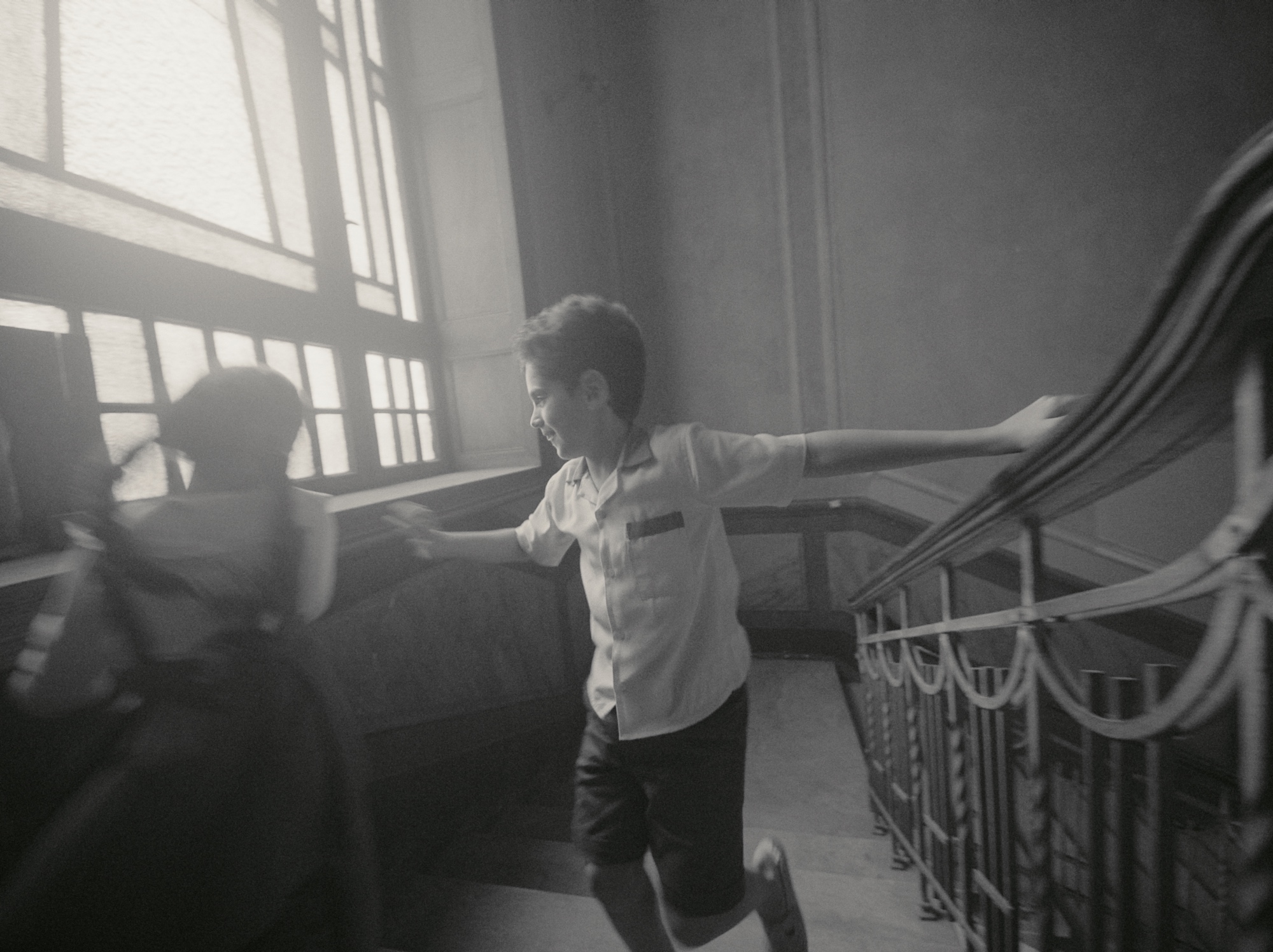
There are a number of key decisions made to convey the visual language of the film. Very early on, we settled on shooting on wide lenses ranging from 8mm to 20mm. It was a natural choice to capture a grand world from a child’s perspective. In our extreme wide sequences, we used the UltraPrime 8R (8mm) in moments where the children felt extremely free and the world felt wide open. Particularly, the stairway and party scenes, when the children were dreaming of an escape. For that reason, in these moments, we also shifted the visual language from complete stillness to free hand-held movement.
He breaks the fourth wall and pulls us into his reality—he is empowered to see us, the adults, who imposed a polarized world.
In the remainder of acts one and two, we used Master Primes (12mm-16mm), which was our basis for the film. In act three we used 20mm Master Primes as Nabil’s perspective shifts. The world becomes tighter as Nabil finally sees the adult world for what it is, and we lean back into complete stillness. In terms of blocking and camera angles, it was essential to be at Nabil’s height and his line of sight most of the time. Through acts one and two he drifts away from his family and from the world as his attention is completely focused on his best friend Mireille. In act three his mother is no longer just an adult figure in the background; she finally moves into his space, as she caresses him and tries to help him process the concept of loss and the concept of a volatile world that imposes its will no matter how hard he tries. As our camera angle gets closer to them, she anchors him in her faith which keeps her going in a way; she lifts him up from the ground. In the very final shot, the camera pushes in on Nabil. He breaks the fourth wall and pulls us into his reality—he is empowered to see us, the adults, who imposed a polarized world.


Could you map out your blocking and camera angles in a bit more detail for us?
This film is my 3rd collaboration with my DP and friend Evan Weidenkeller, who knows me very well and from the very beginning, he understood the unique visual language of our story that captures the perspective of an eight-year-old boy in mid-century Egypt. We created a preliminary shot list, which was a good first step to start visualizing the script, but given the fact that Evan was located in LA and I was on location in Cairo much earlier, he proposed to me that we’d use a Lidar application to scan the space. With time as production logistics evolved, we had to find a new filming location when Evan arrived in Cairo, and so we leaned further into this 3D model idea for storyboarding and Evan scanned the space using a Lidar application (Polycam) and imported the 3D model that was created into Previs Pro.
We created a storyboard that considers detailed lighting, camera setup, lens specs and blocking intentions. We almost created all the shooting conditions in advance. This was very helpful in conveying complex ideas to the crew in a simplified way, and really helped us stay efficient and precise with our intentions, which was key to our low budget production.
How did you approach directing the children, especially for such emotionally complex material?
When the time came to film Dawn Every Day, I showed up with the intention of letting go of any preconceived ideas I had in mind as the camera rolls. It was mainly because I wanted to find an element of freedom in the decisions I make, just like the children whom this story is about. It was my first time directing children, and it was important for me to allow them to enjoy this experience. I decided to create a parallel world for Selim Moustafa and Cleopatra Snefro outside of the script that could really help them portray the same emotions and inner world of Nabil and Mireille, through drawing their imagination to familiar situations that are less complex. We also set up the shot-list to follow the same energy levels the characters would have in each scene and it all felt natural as it came together. And ultimately, most of the film’s final cut came within a precise proximity of the initial intentions that were planned in preproduction.


A cyclic propagation of pain, loss and separation was felt on and off our production set.
The film touches on themes that feel painfully relevant today. How do you view the relationship between this historical story and the tumult of the present?
On another personal level, this journey reminded me that we are not remotely detached from our past. The traumas that haunt us will always impact our lives, no matter how far they are. Through this story that takes place during a complicated and difficult moment in Egypt’s history, we never really see the external events happening at that time, as this story is told from the point of view of 8-year-old Nabil, a child who has no capacity to understand social dynamics or regional politics. And even though many viewers of this film are not from Cairo and are not from an age group that lived in the 1950s, we can all relate to how today’s seismic political events and social movements tend to separate us rather than connect us. Coincidentally, when we started filming this project, the war in Gaza erupted. A cyclic propagation of pain, loss and separation was felt on and off our production set, echoing decades of hardship in the Middle East.
What’s next on the agenda? Any new projects on their way?
It’s exciting times for me! I’m finally developing my first narrative feature film titled Three Myths, which takes place in modern-day Egypt. It follows a young Egyptian man who wakes up from a coma 9 months after surviving a near-death incident, and his only clue to his past is a blurred image of a woman with the street name Hatshepsut, in Akhmim, the forgotten city of Egypt. The film is produced by Norah Elkhateeb (Cats Films) and we’re planning on shooting Fall of 2027.