
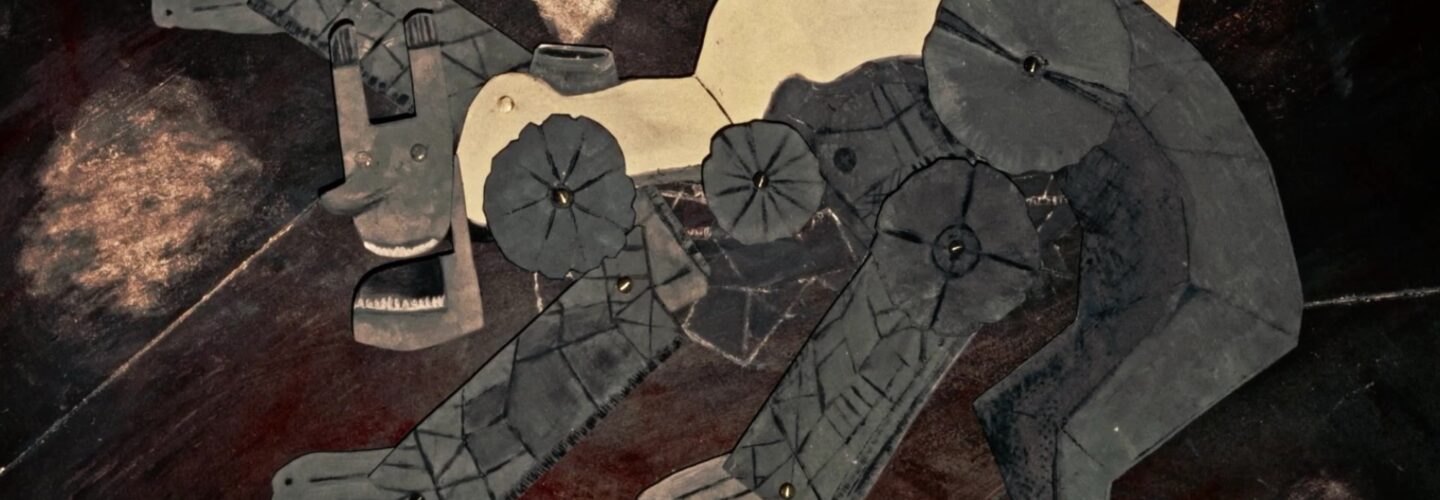

There’s a long lineage of documentary filmmakers who have turned their cameras toward injustice with unflinching clarity, and Ruben Gagliardini’s Macchina Continua stands firmly within this tradition, wielding documentary form as both witness and weapon against the devastating machinery of global financialisation. Produced with the support of the Italian Ministry of Culture, what distinguishes the 20-minute short is its intimate scale matched against its global implications. By chronicling the threatened closure of Fabriano’s historic paper mill—an institution whose roots reach back to the 13th century—Gagliardini reveals how international investment funds can dismantle centuries of cultural heritage with cynical detachment. Yet this isn’t merely an exposé of bad corporate practice; it’s a love letter to a disappearing way of life, told by someone who refuses to let his hometown vanish quietly. Gagliardini’s commitment to regional storytelling feels increasingly vital in an era of homogenised globalisation. By centring workers’ voices—those rarely afforded space in discussions of their own livelihoods—he performs an act of radical preservation, keeping alive not just stories but the dignity of the people who inhabit them.
His partnership with Local Bizzarro—a production company who pioneer a decentralised production model and head up the festival and creative retreat Conero Film + ADV—reinforces this ethos: art rooted in its territory, made by and for those who remain. The film’s formal ingenuity matches its moral clarity. Denied access to the factory floor, Gagliardini transforms constraint into creativity, conjuring the doomed F3 machine through hand-drawn paper animation—a chimera that audiences root for as fervently as the workers themselves. This marriage of archival footage, worker testimony, and imagined machinery creates a piece that doesn’t just document but captures the slow grind of institutional collapse with remarkable emotional precision. Macchina Continua proves that the most important stories often begin at home. With the short still finding audiences through festivals we caught up with Gagliardini for a second time—after editor in chief MarBelle spoke to the writer/director on stage following his hometown premiere at Conero Film + ADV—to talk about the documentarian’s responsibility to step outside of their comfort zone to fully absorb workers’ struggles, balancing academic analysis with emotional storytelling, and the striking emptiness that follows moments of protest in his region.
This story is from your birthplace, Fabriano. How did your personal connection to the land and its people change your directorial approach compared to your previous films?
In my previous documentary about wildfires, Fuochi, unpredictability was a constant presence. You basically never knew where or when the next disaster would break out. I never imagined I would experience that same sense of uncertainty and fragility in my own hometown, in the Marche region, in Fabriano, a small city of thirty thousand people, where life usually flows quietly and peacefully.
For me, Macchina Continua became an opportunity to rediscover what home really means. It was through the workers’ eyes that I began to see this new reality and to understand the effects of financial globalization. We’re used to hearing CEOs, politicians, and business boys speak; far less space is given to the workers whose physical labor sustains local (and therefore global) economies. Our goal was exactly this: to stand beside them and give them a voice, as an act of solidarity and resistance.
To gather these voices, you have to step outside your comfort zone of course, go into the streets, and live alongside people long enough to absorb their struggles. I believe this, too, is part of a documentarian’s responsibility. Filming in the city where I grew up certainly influenced me: I already knew most of the locations, and some of the workers were parents of friends or people my age. But I don’t feel this compromised my objectivity. A documentarian always has to balance their emotional connection to the story with their critical judgment. What we did was give shape to a real sentiment. One that I, living in that territory, shared deeply.
How did you come to be working with Local Bizzarro and how did a shared set of beliefs and morality shape the production?
My collaboration with Local Bizzarro began long before Macchina Continua. I first met Mattia Fiumani, the producer and founder, back in 2023. His artistic background struck me immediately: after years spent abroad, he chose to return to his hometown in the Marche region to build a cinematic hub for young people living in the area. Our first collaboration was a short documentary of mine, Portrait of a Broken Family, an investigation into young people from the Marche who had chosen to leave the region, and those, like Mattia, who had chosen to stay. That project also gave me the chance to interview part of the Local Bizzarro crew and discuss with them some of the ethical principles we share about filmmaking.
A documentarian always has to balance their emotional connection to the story with their critical judgment. What we did was give shape to a real sentiment.
For both of us, it was essential to place the territory at the center of our visions and to imagine a kind of zero-kilometer cinema that could highlight not only artistic qualities but also the humanity of those who work behind the camera. Those values created a perfect synergy throughout the production of Macchina Continua, and we’re carrying them forward in the distribution phase as well, involving artists and professionals from the region.
Most Popular
The film balances the intimate, grounded struggle of the workers with the abstract, academic analysis of financialisation from Alessandro Volpi. Was there a risk of the economic explanation feeling detached, and how did you use filmmaking to keep it emotionally engaged?
Including researcher Alessandro Volpi in the documentary sparked many discussions during production and post-production, because at first I wasn’t convinced by the academic tone of his contribution. Initially, I imagined the film developing almost entirely through the emotional flow of the workers’ experiences. But I eventually realized that what was happening in our territory was part of a much larger system, and that the workers’ struggle would gain even greater meaning if framed within a global context.
I’m grateful to Local Bizzarro, my co-writer Antonio Casagrande, and to Margherita Montali, Sara Mei, Jan Devetak, and everyone in the crew who encouraged me to include and elevate Volpi’s intervention. For me, this was yet another directorial ‘constraint’ to confront, but, like the animation work, it became an opportunity to experiment with archival material and glitch-based visual language.

What was your strategy for weaving these historical glimpses of your archival material into the present-day?
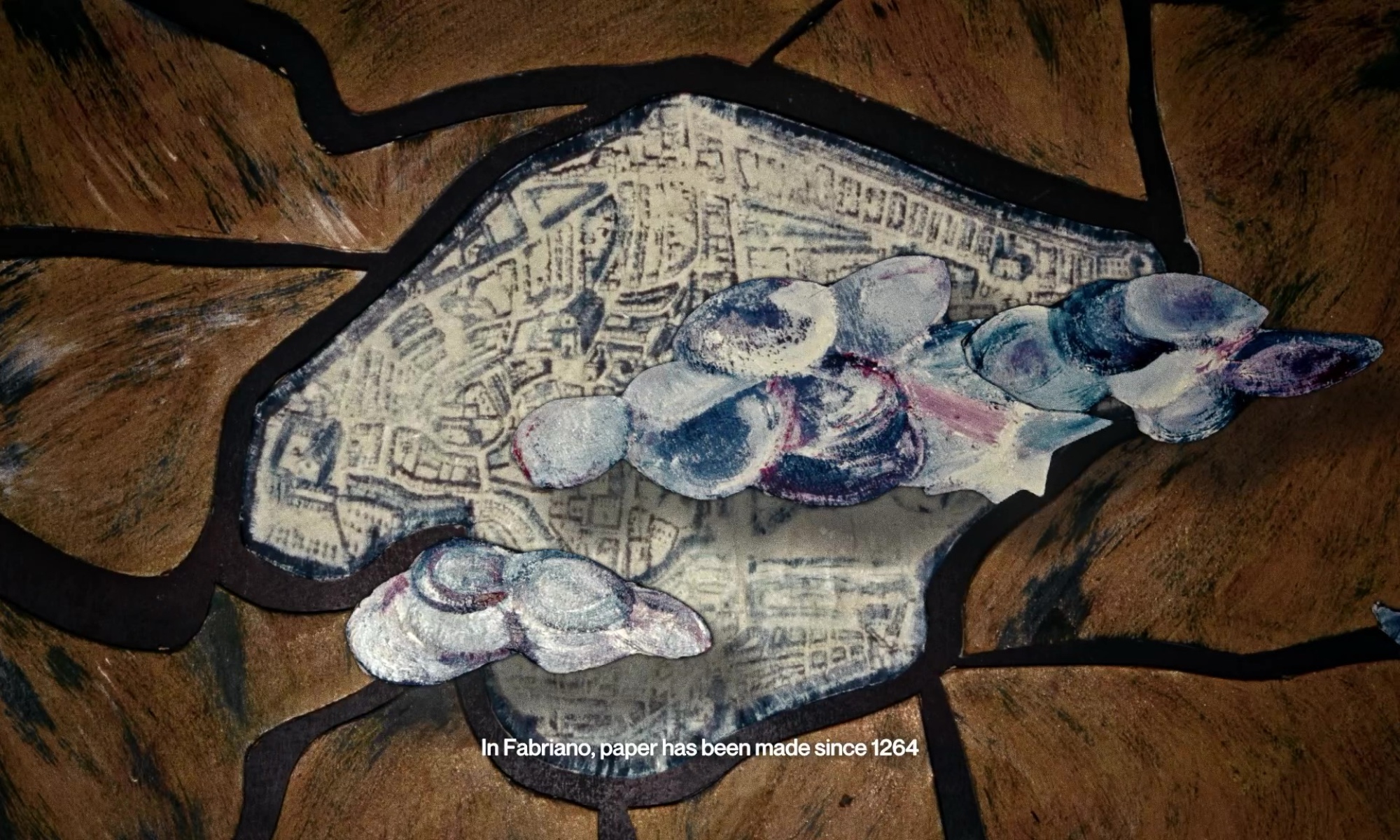
Almost all of the archival material comes from Achille Corrieri, an elderly documentarian from Fabriano who, over his long career, recorded the city extensively on VHS. As I dug through his archives (between one coffee and the next), I realized how perfect that material was for contextualizing the city and highlighting the deeper roots of our region’s crisis. At the start of production, I wasn’t sure whether to draw from the paper mill’s own audiovisual and photographic archives. But when institutional relations broke down, that option disappeared, and we were forced to evoke paper solely through animation, sound, and the workers’ testimonies.
I eventually realized that what was happening in our territory was part of a much larger system, and that the workers’ struggle would gain even greater meaning if framed within a global context.
How did not being able to access the factory catalyse the idea to use animation?
Local Bizzarro and I had a series of formal exchanges with the company at the center of the dispute, because early in production we hoped to include footage of the F3 continuous machine: the one that had been shut down. Our request was denied, of course, and that led to the idea of filling this gap through the expressive medium that feels most natural to me: animation. In this way, we transformed the F3 machine into a kind of chimera the audience could root for and empathize with.



How did you decide on the animation’s style—its texture, colour palette, and movement—to ensure it felt organically connected to the live-action footage and the theme of handmade paper?
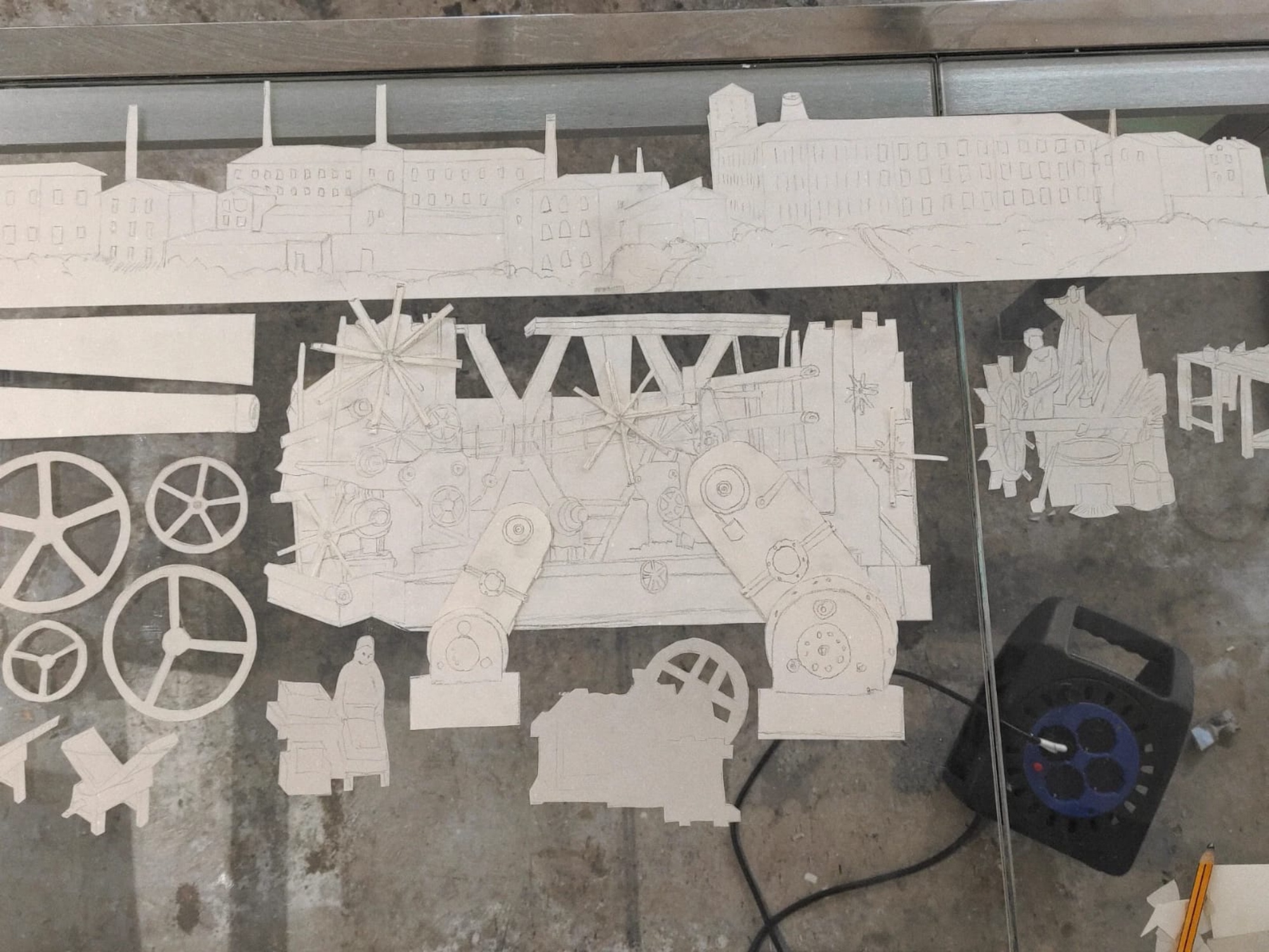
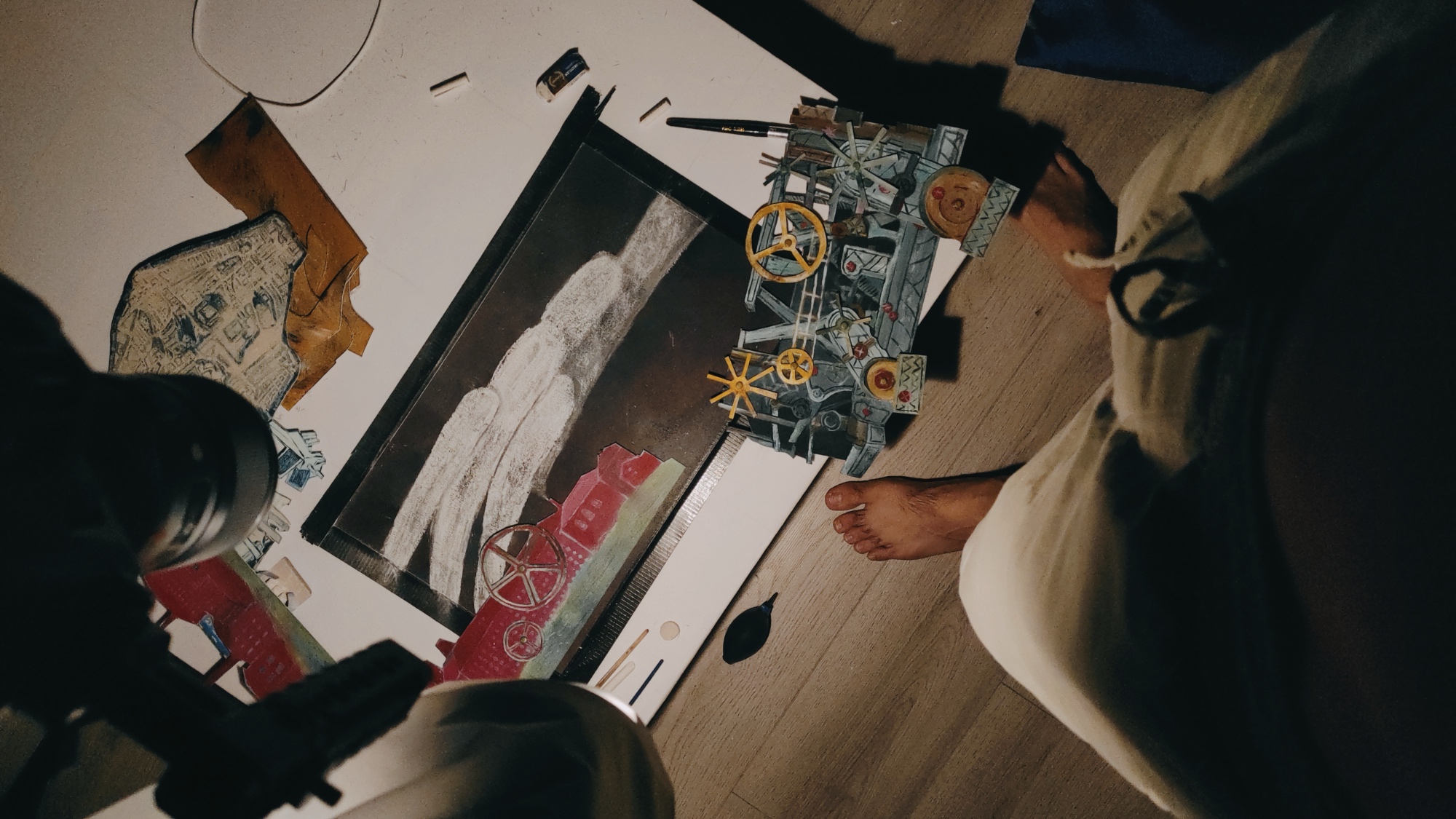
The theme of paper guided every stage of the animation’s design and execution. At first, I wanted to work exclusively with traditional hand-drawn animation on paper, but then I integrated cut-out techniques, which allowed me to emphasize the materiality and thickness of the paper even more. For the visual design, I drew inspiration from old books about Fabriano’s paper mills that I found in the library, as well as medieval illustrations of the earliest paper-making machines I remembered from childhood.
Even then, I didn’t want a didactic aesthetic. I tried to make each subject feel as alive and human as possible, to underscore the connection between machine, person and labor. During the screening tour, someone told me the chimeras looked like household pets. Considering some workers spent forty years on those machines, I think the notion of domestic is more than fitting.
I tried to make each subject feel as alive and human as possible, to underscore the connection between machine, person and labor.
Those juxtaposed images of the street full of passionate demonstrators with the emptiness and reality of the city are so evocative. Did these come by accident or had you planned this?
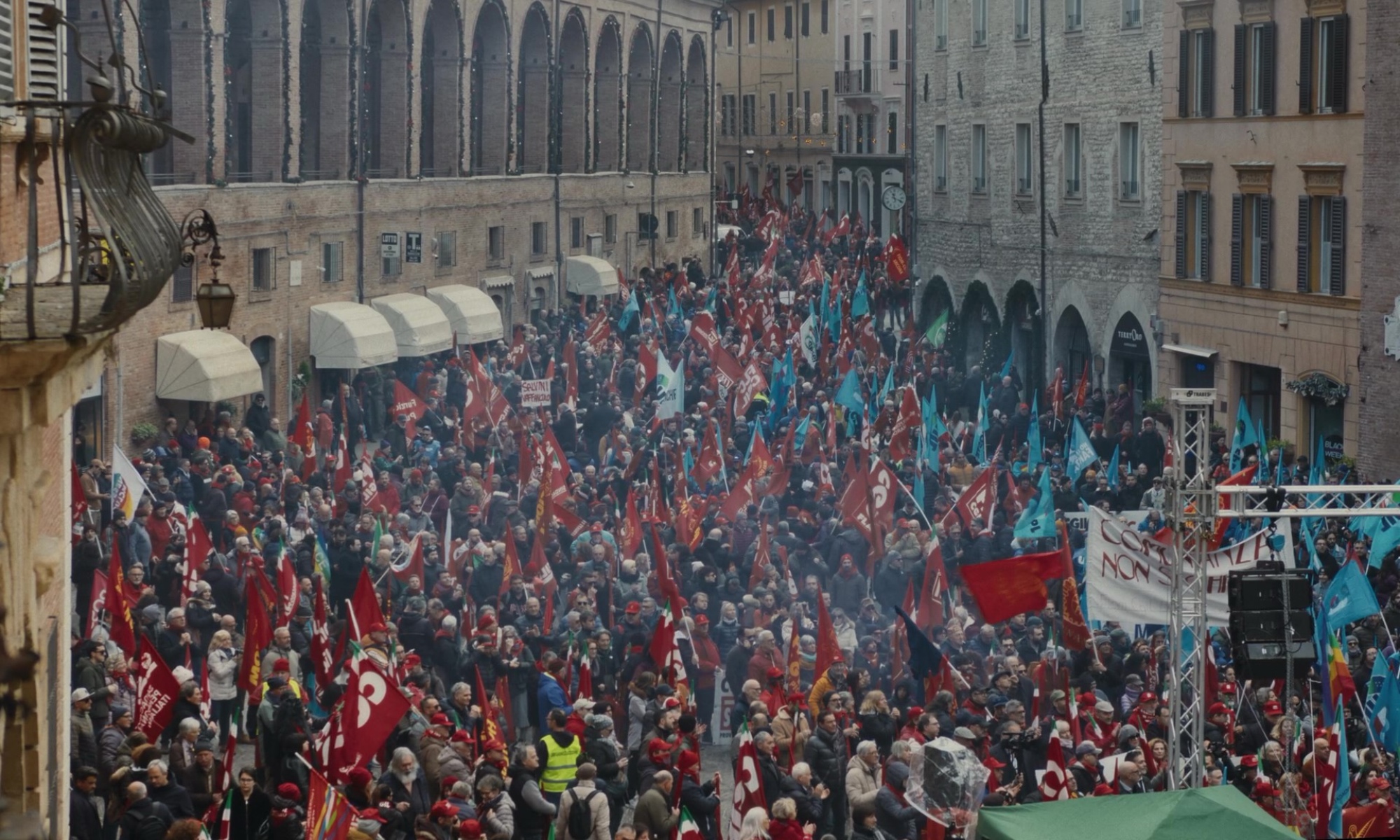
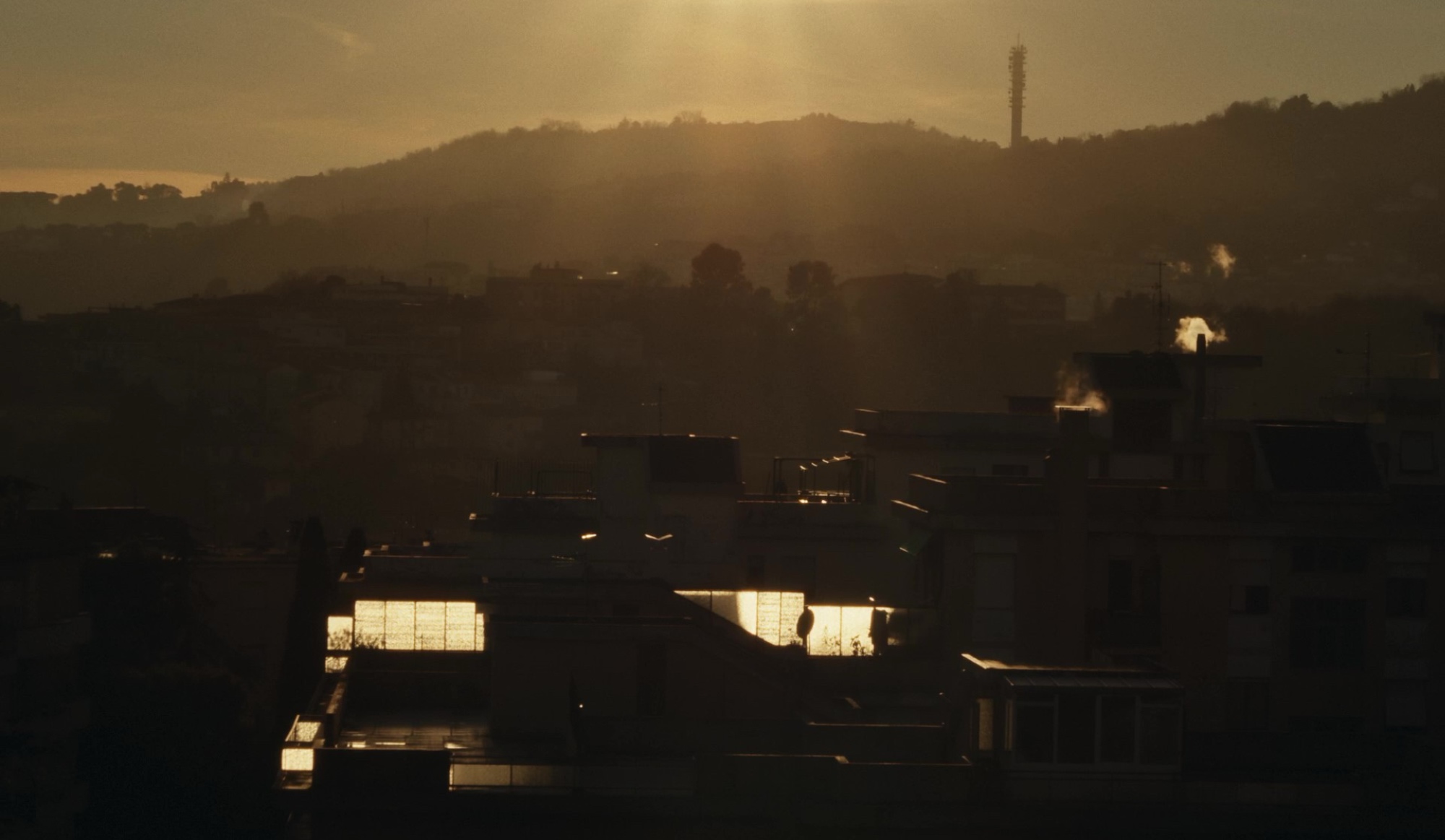
That idea came from the other two camera operators, Sara Mei and Tommaso Giantomassi. After filming the demonstration that had filled the square, they noticed that within minutes everyone had left, leaving behind an enormous emptiness. Scenes like this are common in our region: people pour all their energy into ten minutes of protest, and moments later everything is over and life snaps back to routine as if nothing happened.
I know that the people are front and centre but I can’t help but notice the intense gaze you give to the region.
Places have always generated stories for me, which is probably why every project I work on begins not with the characters but with the locations. In this project, the place is even more central, because Fabriano is not only the name of a paper brand—it is the name of the city itself. It’s no coincidence that the workers are fighting not to be forced to leave their hometown; they are deeply attached to the territory and are fighting to remain part of it. It felt necessary to represent these truths, including the fact that the region is slowly emptying and increasingly abandoned by younger generations.

Editing a documentary like this is an act of argumentation. How did you approach the rhythm and pacing in a story about the slow, grinding halt of an institution?
The editing grew out of my memories of those days. I didn’t begin by imagining what the final cut would look like; instead, with each shooting day I added a piece and gradually formed an idea of the structure. In post-production, Local Bizzarro and I agreed on a 20-minute runtime, and that boundary helped me condense three months of filming into a tight, energetic film. Editor Jan Devetak did incredibly refined work: in each scene he sought to renew the viewer’s interest, creating a visual flow that conveyed the workers’ emotions and uncertainties. Compared to my previous documentary, where I felt I had unintentionally spectacularized the fires, Macchina Continua feels far more honest—in its imagery and in its overall rhythm.
What’s next for you?
I’m currently researching and writing several very different projects. On the documentary side, I’m scouting for a film about an elderly man who, in the 1980s, seems to have sparked a kind of theatrical insurrectionist movement against industrial pollution in the river that runs through Milan. On the animation front, I’m developing my debut animated short, made entirely with archival materials and traditional paper animation. I’m also working on a Marche-based film series about ongoing genocides, and I wouldn’t rule out the possibility that this path might one day lead me to create a fiction project intertwining those themes.