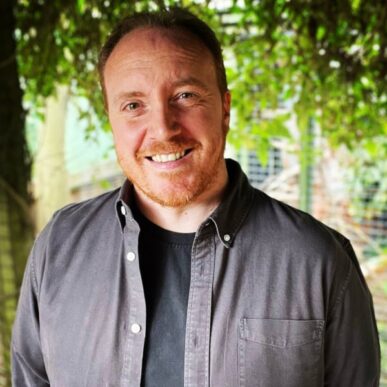
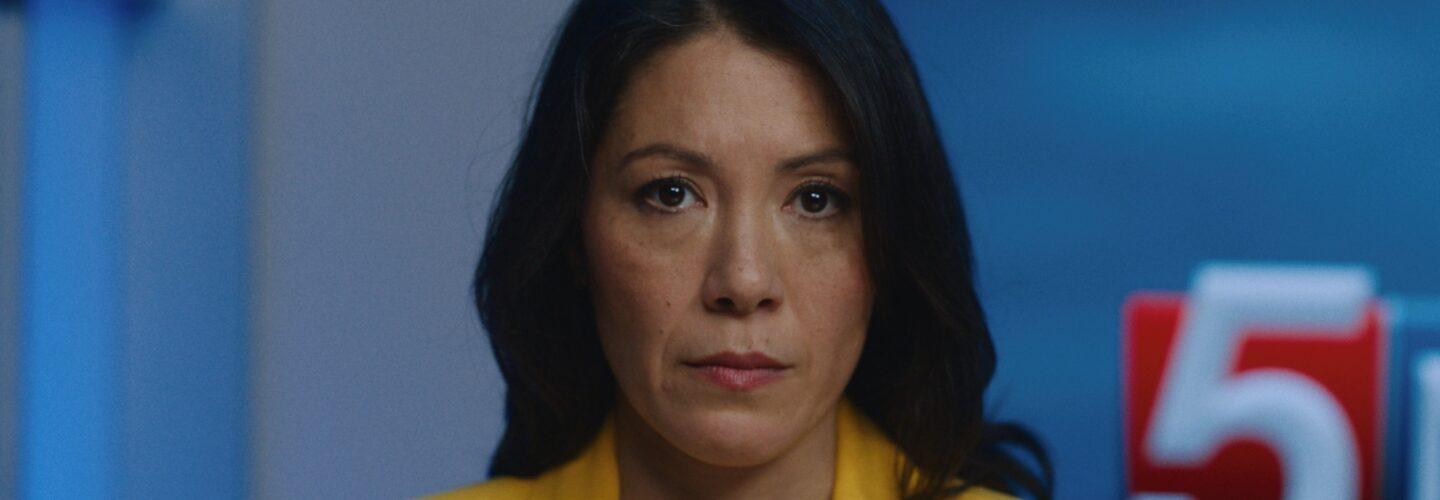

A Freudian slip in conversation can be deeply embarrassing—and at times, even spark conflict. But when such a slip happens live on air, as it did with a news anchor delivering a headline about a climber on Everest, the result can be something else entirely: a viral moment that has circulated online since 2001. In The Mountain, writer/directors Will Mayo and Ian Scott McGregor imagine the story behind this infamous gaffe. Their short comedy-drama transforms a fleeting viral clip into a fully realised world, exploring the very human relationship that might have led to that fateful mistake. In doing so, they breathe new life into the adage that “There’s always more to the story”. The filmmaking couple talk to us about the seismic event that shatters the marriage of their lead characters, their working collaboration in creating this fictitious telling, the visual language used to depict it – including one essential but hard-to-find location – and using tragedy to create comedy in an empathetic way.
The Mountain is inspired by a viral video clip of a real-life news anchor making a bizarre fumble on live TV. What about that moment spoke to you and how did you develop a wider narrative around it?
It’s one of the first viral news bloopers to hit the internet – 2001, so, years before YouTube – and it was immediately embraced by the gay community as hilariously empowering: “We, too, can conquer Everest!” Our shared love of this moment became an inside joke early on in our courtship. Ian had always teased that the slip-up was the result of the anchorwoman’s closeted husband coming out just before she went on air.
One night before bed, while trying to make each other laugh, this inside joke, and its imaginary origins, came up again. Exploring this high-camp scenario, we stumbled upon an unexpectedly moving narrative about a couple navigating their most difficult moment together. Will thought of the husband witnessing the broadcast live on the couch at home, then waiting for his wife to return. We were really taken with the idea of exploring the other side of the viral looking-glass, and fell in love with these suddenly very human characters, and wanted to know how it all turned out for them.

The film somewhat announces itself as a comedy in the beginning before dipping into more dramatic elements. How did you cast and work with your actors to make sure humour and pathos came through as and when you wanted?
The news is often patently absurd and theatrical: heavily painted faces and bleached teeth reporting on life’s grimmest horrors in between commercial breaks for pharmaceuticals. Ian happens to have a museum-grade collection of America’s longest-running satire magazine, MAD, and poking sharp fun at the ridiculous nature of news broadcasts came naturally.
Nothing is funnier than comedy played dead-seriously, and it was important for us that these characters were complex, conflicted. We didn’t want to make fun of them, or the situation they were in – we wanted to love them, and so we made them as real as we could. Comedy is always rooted in its relationship to tragedy, and the laughs here come from a deeply empathetic place – the vulnerability of these people is funny and sad in such a relatable way. In live screenings, audiences often laugh loudly at what is arguably the saddest moment in the film, when Dan breaks down at dinner. It’s a release of tension and of deep understanding. “We must laugh at this man to avoid crying for him” kind of thing.
Comedy is always rooted in its relationship to tragedy, and the laughs here come from a deeply empathetic place – the vulnerability of these people is funny and sad in such a relatable way.
Since the performances had to be pretty dropped in for the humour to work, we asked some of our favourite actors, and longest-lasting friends, to take on the big roles. Ian is an actor by trade and knows so many brilliant performers that we were able to write with specific people in mind. Carie Kawa (Mel) is so beautiful and has such command and presence. She can turn on an emotional dime. Julianne Moore’s performances in domestic melodramas like Safe and Magnolia, and Nicole Kidman in To Die For, helped us and Carie shape the style of the performance. David Burtka (Dan) has a sweet, quirky energy and an incredible sense of style and home. He’s married to actor Neil Patrick Harris, and used to living life beside an extremely bright star. His understanding of that kind of vulnerability of ego is perfect for Dan’s arc. Knowing Carie and David for over 20 years, and having worked closely with them both before, Ian was able to tap into their shared history and position them on the knife’s edge of sad and funny.
The Gardener is the only role played by someone we haven’t known for 20 years. We found Lachlan ‘Taimua’ Hannenman via a very charming casting call self-tape. The Gardener is a tricky role, and Taimua is the second actor we shot for the part. Taimua has a kind and effortless ease, and his subtle performance allowed Dan’s fantasy to feel safe, even when the spell is broken by the gardener’s leaf-blowing reality. All the other actors (Ian even makes a cameo) are dear friends we’ve wanted to work with for years. Ian’s theatre friends, Will’s college friends – all a tightly knit group of people we were happy to trust with breathing life into our vision.

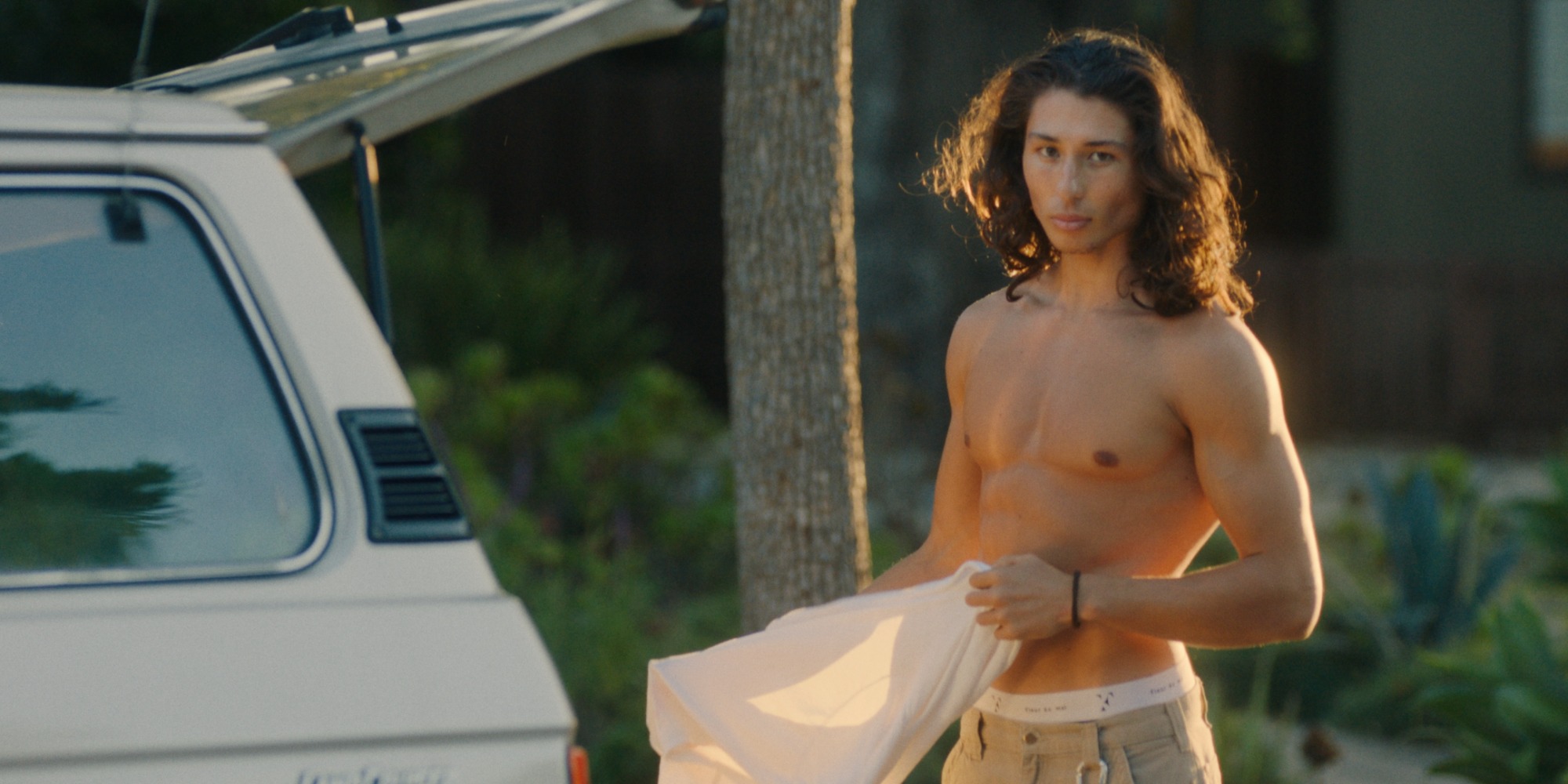

In terms of the cinematography, you’ve taken what was originally a viral meme, expanded it as a short comedy drama, and elevated it all with beautifully framed imagery. How did you achieve that?
Just like the acting had to be serious to be funny, the cinematography had to feel staid and artful, intentional. Our references included Almodóvar, Haynes, and Ozu: Almodovar’s palette and melodramatic intensity (Talk To Her, Volver, All About My Mother), Haynes’ eye for interior shots and performance (Safe, Far From Heaven), and Ozu’s composition and use of empty frames (the pool shot at the end, for example). We thought a lot about Punch Drunk Love, and the intensity of Anderson’s Steadicam work in that film. We watched The Ice Storm, and looked at artist Mia Bergeron’s incredible, glowing oil paintings of suburban swimming pools in strange places.
Most Popular
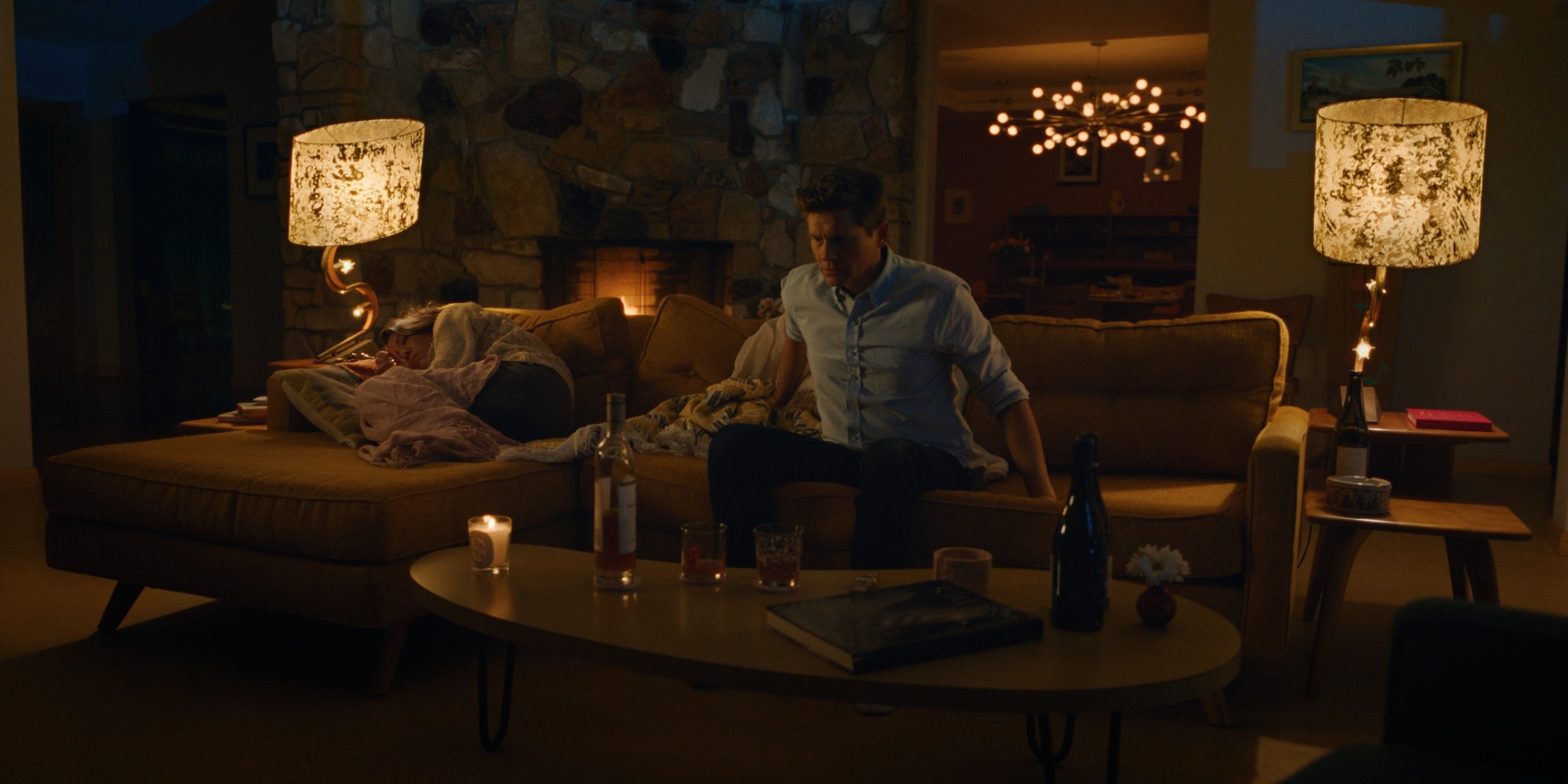
Will had worked with DOP Matthew Roveto (aka ‘Rove’) before and really wanted to use cinematography to give context to these characters within their individual spaces. The film touches on the trappings of success and affluence, so seeing these people framed artfully within unique and elaborately decorated rooms felt true. We also wanted a certain level of observational storytelling – setting up a frame and watching scenes play out in one shot so the blocking and performance carried the maximum amount of tension. There are also moments of close-up coverage in specific places, most notably right after the gaffe. Rove suggested both characters spike the lens in their respective singles, so that when cut together they appeared to be looking directly at each other through the TV screen. We loved that idea and where it took the scene emotionally, seeing the couple see each other for the first time in a new light.
We shot on Alexa Mini LF with Signature Prime lenses. We had a Steadicam rig for the one news studio shot, but everything else was on sticks, except for the underwater shot.
The film touches on the trappings of success and affluence, so seeing these people framed artfully within unique and elaborately decorated rooms felt true.
The locations for both the home and the news studio are perfect for the story, each saying something about the characters. How did you go about sourcing these locations and bringing them to life with production design?
Locations do a lot of heavy lifting in the film, and our biggest challenge was finding the right places to shoot on a small budget. Luckily, Ian had an Art Director friend, Jon Gothold, who’d painstakingly restored a quintessentially Southern California mid-century modern ranch house with his art curator wife, Katherine Huntoon – and they let us use it for free! We wanted a true showcase home with bold style that felt like an art and design museum – a place a gay man might relish obsessively caring for. Without Jon and Katherine’s generosity (and willingness to let a film crew invade their beautiful space), we couldn’t have made the film.
Finding a news studio that didn’t cost $10k a day to rent (and wasn’t just a green sheet hung up in front of a brick wall), proved far more difficult. Producer Julia Kennelly flagged a former cable television studio in Van Nuys, which included a wall of customizable screens and fit within our budget. We rented a news desk from the storied Universal Studios Props Department, and Will cut together some broadcast news-looking background videos to loop and flash on the wall of screens. We shot for 2.5 days total – one day at the News studio, and one day at the mid-century modern home. The shots of the gardener were filmed a month later in a different location from the house.
Truly, our Production Designer Kait Schuster was the one to tie everything together in an amazing way. She had a huge task in subtracting art and design from the home, as the owner’s incredible collection of folk art and vintage ephemera was so enchanting to look at. In order to keep the focus on our characters, Kait was very careful to select pieces that reflected Dan and Mel’s delicately arranged life together. Light blue is a repeating colour theme, and that was all Kait. Her unimpeachable eye for story and colour is really what makes everything work so harmoniously. She’s also a talented writer and director, so we were blessed to have her onboard.


Will, in your roles as editor (which we also appreciated in Lily Weisberg’s Working Summer), you play with the chronological order of the film throughout. Was that temporal fragmentation planned from the off or discovered in the post process?
We (read: Will, with Ian shouting from the peanut gallery) re-cut the film several times, playing with tone and structure. The original cut was chronological and more sombre in tone, and after several screenings with live audiences, we realized what the film really wanted to be. Leaning into the comedic melodrama up top, while framing the action around Mel’s Freudian slip, served the film best, and allowed the audience to fall easiest into the story and dark humour.
This structure also echoes our initial impetus to tell this story – ‘why’ did this bizarre gaffe happen? Beginning with that question, then going back in time to provide an answer, before finally revealing the aftermath, is deceptively simple, but it really scratches that narrative itch for us. The jumbling of chronology is also a nod, psychologically, to the way shame/embarrassment operates and is experienced: something embarrassing happens, and our cruel brains revisit it over and over, in order, out of order – you don’t know why it happened, then you realize what led up to it, and you feel doubly embarrassed, awake at 4am, cringing to yourself in the dark.
The music and sound design play such an important part in the tone and style of the storytelling – most notably when the confession goes unheard by the audience.
We were playing with these themes of public versus private drama, and of reality versus subjectivity. Even in the earliest drafts, we wanted to obscure Dan’s confession because it is the most painful and embarrassing part of the story. Giving this couple the grace to let their most vulnerable moment play out privately, framed behind glass, as the audience sits in quiet discomfort listening to the neighbourhood life going on around them, was far more impactful. Better to let an audience’s imagination fill in the gaps. It’s much worse to imagine the conversation than hear it. We did script it, though, for David and Carie, and it’s a truly heart-wrenching monologue. Even with that private grace, of course, the ‘truth’ slips out in the worst way on live television, in the most public of forums.
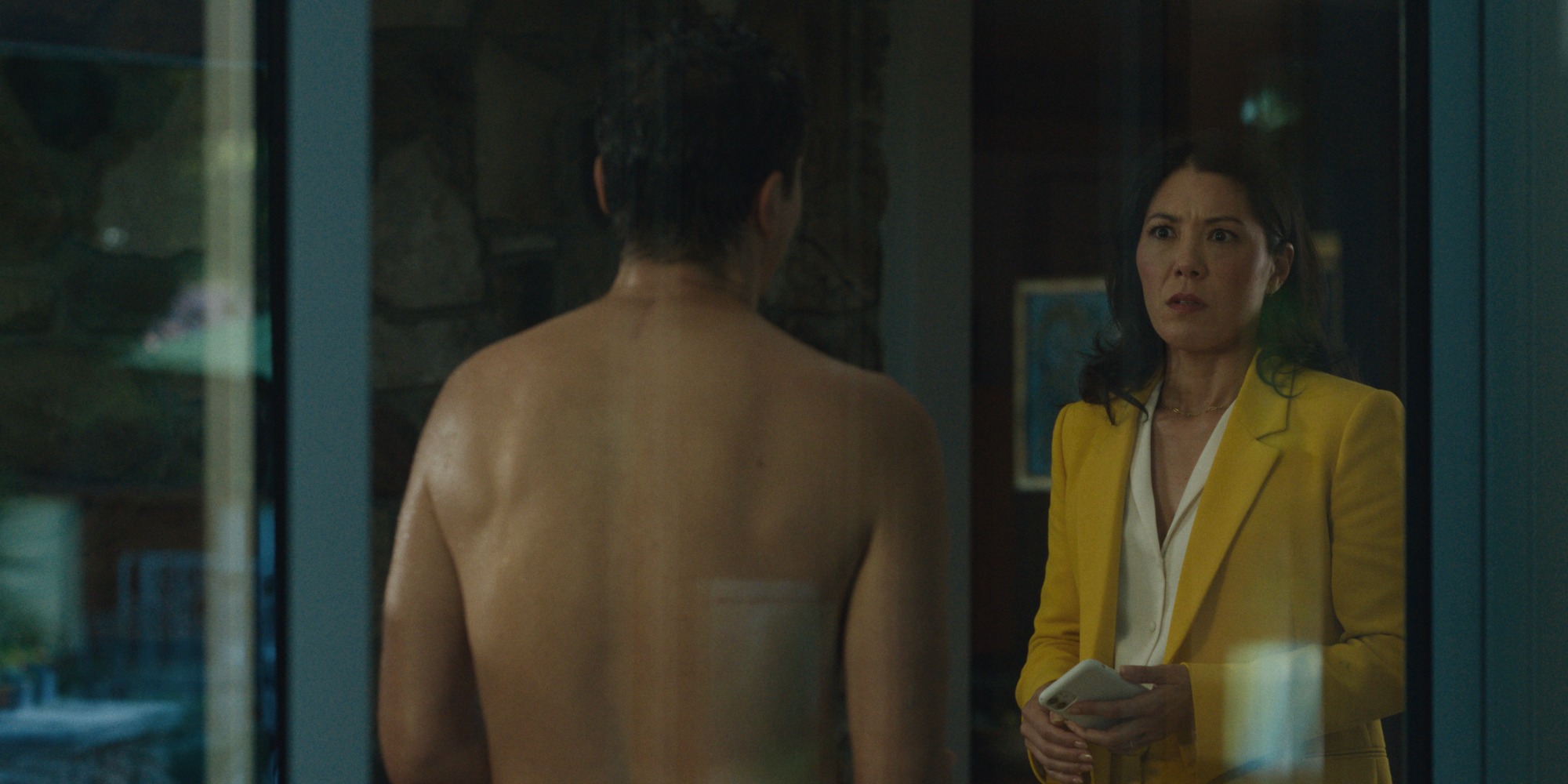
Giving this couple the grace to let their most vulnerable moment play out privately, framed behind glass, as the audience sits in quiet discomfort listening to the neighbourhood life going on around them, was far more impactful.
Composer Charles Humenry created a gothic organ score with airy choirs to reflect the extreme subjectivity and classical inner torment of these characters, and it felt right–and funny–to burst the bubble of that subjectivity by cutting the music out suddenly in strategic places. As these characters come to accept their realities, the music becomes stripped down, undressed, naked, in a sense. Sound Designer Matt Schwartz at Fall On Your Sword beautifully built out the atmospheres of these physical spaces, while keeping the audience entirely contextually aware of what was happening off-screen. It’s a recording of Matt’s own sliding glass door that plays just before the big moment.
As a married couple who both co-wrote and co-directed the film, what’s the working collaboration like between you?
We’ve been making films together for over 13 years now, and we each bring considerably different strengths to the process. Will is an editor with a background in cinematography, so the sequencing of shots comes naturally, as well as the technical know-how. Ian is an actor with a knack for dialogue and working with performers. Our writing process is quite organic and it’s hard to predict which stories are going to capture our attention, but in this case, it made us laugh and felt tonally irresistible. A lot of our ideas begin as jokes that bloom into something unexpected, and we are always trying to remain open to the muse.
It doesn’t escape us that we’re a married filmmaking couple making a film about a marriage splatting against a wall–in fact, it felt deeply resonant to us that these two people have love and tenderness for each other at the end of this devastating day. Most relationships have to face ‘the mountain’ at some point, some great challenge to overcome. Grief and loss seem to be the biggest recurring themes in our work, and this film is about the shock and denial aspects of that process.
I obviously can’t let you go without asking if the original news anchor who inspired the film is aware of it and/or has seen The Mountain?
We’re not sure she’s aware of it! But we’re excited for her to watch and see that it definitely is NOT about her. By all accounts, she’s a deeply invested mother to three young kids. Cynthia Izaguirre, if you’re out there reading this, thank you for your incredible inspiration and for your life-long commitment to journalism!
Now that The Mountain is out in the world, what’s next for you both?
We’ve many, many irons in the fire! Our next short, Dropping Off, which we are especially proud of, is finished and ready to be programmed! If The Mountain is about denial in grief, Dropping Off could be about bargaining with grief, in a very literal way: it follows an Uber driver wrestling with his conscience after being hired to spread cremated remains for a passenger who cannot bear to let go.
We’re well into developing a feature adaptation of Daniel MacIvor’s Obie-award-winning play, IN ON IT, which Ian has been working on, in one way or another, for 20 years. And we’re also working on a feature length version of The Mountain! Will has edited plenty of films at great festivals this year, and Ian has a big acting project that should hopefully come out soon. That said, HIRE US, please!
And finally, can you tell us about a short film by another filmmaker that you would recommend to the Directors Notes community and why?
Will recommends The Burden by Niki Lindroth Von Bahr. It’s a stop motion animated musical about human-like animals trapped in a corporate liminal space. Like in many of the greatest Swedish films, collective suffering is our saving grace, and the ending of this film will make the hair stand on the back of your neck with how it says that. And you will be singing “long time, long time,” for the rest of your life.
Ian recommends Great Choice by Robin Comisar. What initially appears to be a bootlegged videotape of a 1990’s television commercial for American seafood restaurant Red Lobster quickly spirals out of control into a terrifying existential horror short. The resolution of the film crash-lands in an immaculate gut-punch of a metaphor for the struggles of addiction. It stars Carrie Coon and Morgan Spector, who are standouts, but the entire cast is incredible. The concept and realization of the film is uniquely its own – an exquisitely, stunningly moving work.