
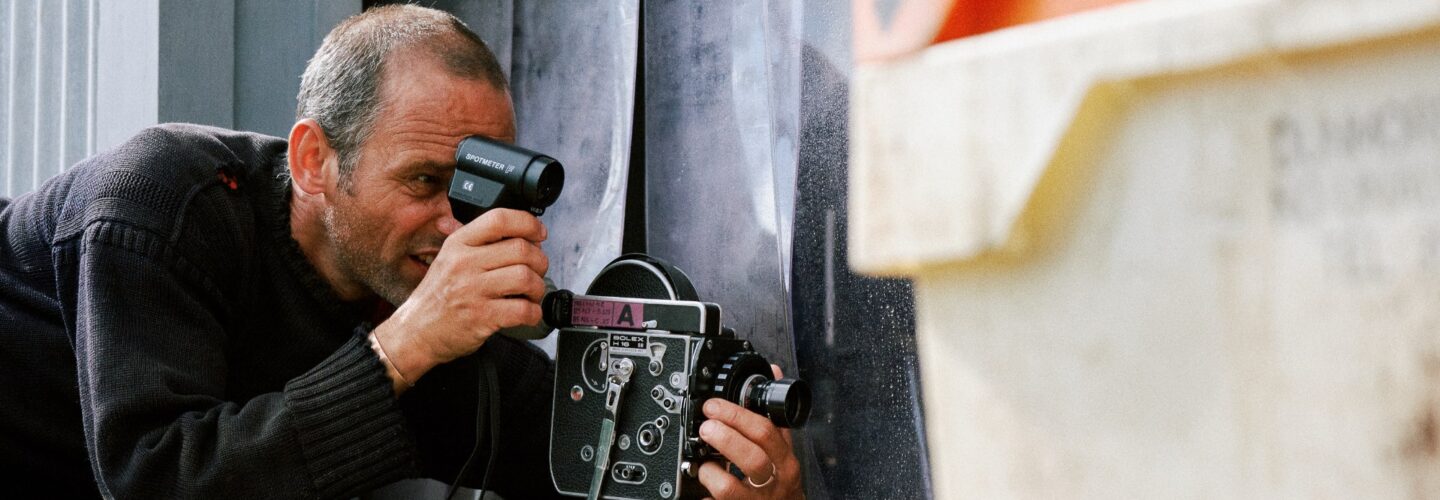
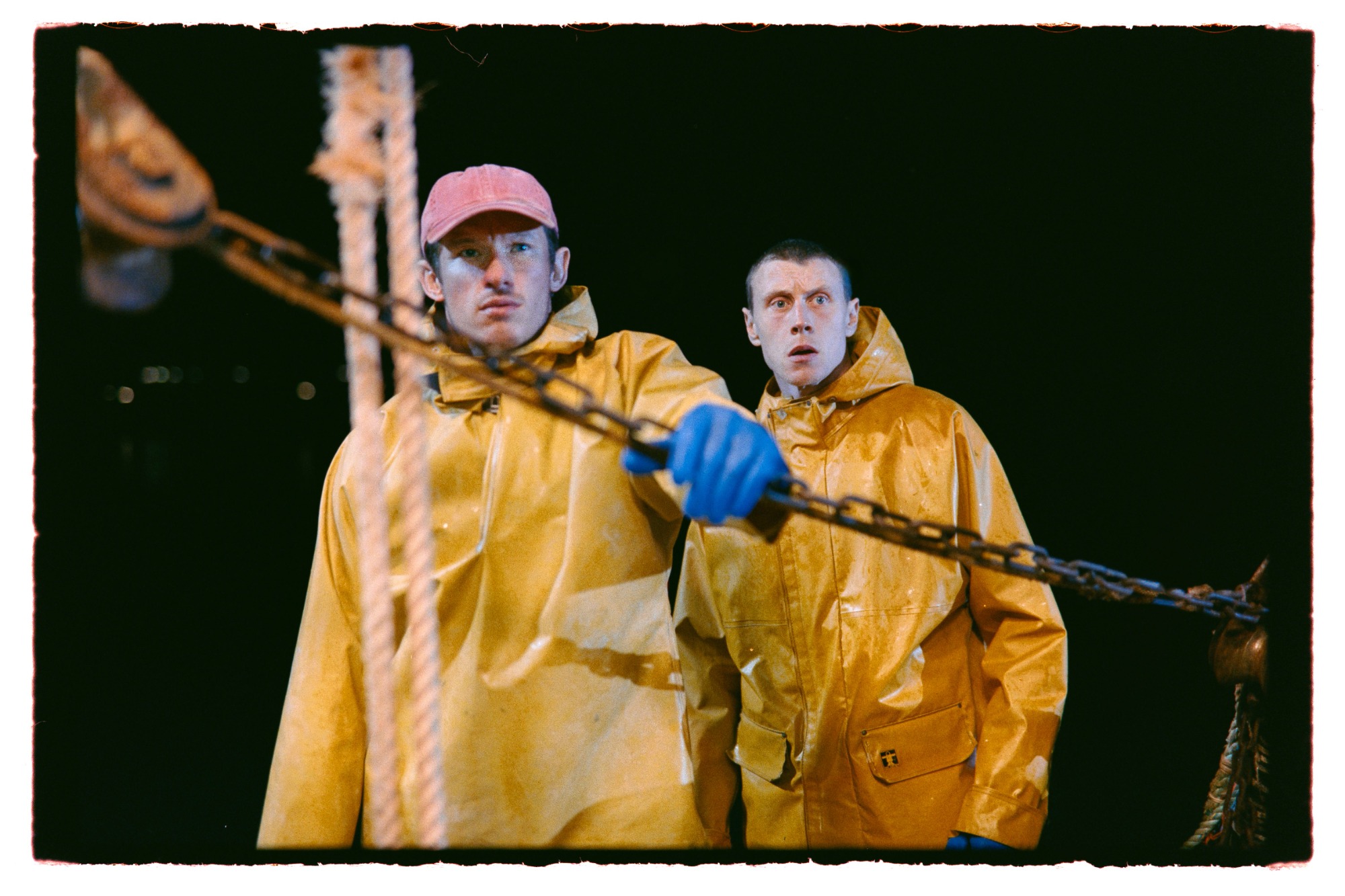
BAFTA winning filmmaker Mark Jenkin is no stranger to Directors Notes. His conversation with the site stretches way back to 2006 (our founding year), before his mid 2010s [re]turn to celluloid filmmaking, to his 2011 digital feature Happy Christmas. That early DN conversation took place in that pivotal temporal shift in Mark’s practice, and much of the chat is how he was engaging with the material of film, again, having shot digitally for over a decade, including with his first film, Golden Burn (2002), which is where DN writer Neil Fox first encountered him, while co-directing the Filmstock Film Festival in Luton.
Neil and Mark have talked about Cinema and filmmaking in so many guises over the years, including a video conversation for DN around the 2015 release of Bronco’s House, the ‘long short’ that kickstarted the interest in Jenkin’s work that has grown, hugely, in the decade since. To celebrate the release of his latest feature, the time-travel drama Rose of Nevada starring George MacKay and Callum Turner alongside Jenkin regulars including Mary Woodvine and Edward Rowe, and to discuss the simultaneous success of his latest short film, I Saw the Face of God in the Jet Wash, Neil returns to DN to talk to his friend about sound, success, sacrifice (and not needing to make them), time and gratitude. They also cover the relationship between short and long form in his work, the increasing and changing role of music, and where he gets his crazy ideas.
I know that there were small fragments of ideas and images you encountered that led to Enys Men (2022). Was there a similar spark or sparks for Rose of Nevada (2025)?
Yes. I think everything I’ve ever made, certainly everything I’ve written has come from normally a single image, all the way back to Golden Burn (2002). I remember thinking, oh, I’ve got the whole film in my head. I can see the whole thing. And then I thought, right, I better write it down and turn it into a script. And then when I wrote it down, I found out I’ve got like, one really good scene and some sort of peripheral, blurry stuff that isn’t really anything. Then you’re forced to address that in the writing where you fill in all the gaps and create the screenplay, which then becomes the building blocks of the film. I think exactly the same happened on Rose of Nevada, but there was a period of time between having one image and having all the images. It wasn’t an organic process of gathering ideas from the ether, pulling existing ideas down from the sky, Bob Dylan style. It was higher pressured than that because I had to create the script out of necessity. Enys Men had been shut down for a year because of the pandemic, and I wanted to write something during the lockdown. I had one image, which is the opening of the film: the boat being found in the harbour by the boat owner. I didn’t have anything after that but I pitched it to Mary (Woodvine, Mark’s collaborator and partner) and she pitched something back at me, and then I pitched something back at her and it went backwards and forwards like that, until we had a story that went from A to B, or went from B to A to C, whatever direction it went in, in the end, but certainly didn’t have a theme for it.
I didn’t know what the film was about, and I’m really still learning that now. But we had a story in a very compressed period, which changed a lot and changed more than any other thing that I’ve written. I think that’s because of the vagaries of quantum physics and what impact that can have on trying to write a script like this. You know, it really is a sci-fi. You do have to create the rules and then stick to them. And the rules don’t exist so there are a lot of possibilities there. Lots of possibilities aren’t always the best starting point. The spark though was definitely that opening scene of a boat being found that had been lost at sea with all hands, for thirty years. I think where it really kicked off was when Mary and I decided that not everybody in the community would be surprised by this. That felt like a subversion of expectation that took us on an interesting route.
I didn’t know what the film was about, and I’m really still learning that now.
You’ve done a huge amount of press on this film since its resounding Venice premiere in autumn 2025. I wonder how the film feels to you now, and wonder if there are any parallels with the editing process where spending so much time with repetitive minutiae, albeit positive, can skew how you see the work?
I think I’m in the worst possible period to address that question because I haven’t seen the film for ages. Mary sat in and watched it in New York (at NYFF) but I had a friend come by that screening and I kept popping out to see if they’d arrived. I say a friend, but, you know, it was Callum Turner. Callum was in town. He was going to try and get in for the end of the screening and maybe come and do the Q&A, so I was popping out to message him to see how he was getting on because he was shooting something at the time and his schedule was changing. He didn’t end up coming along and so I was pretty distracted in that screening. So, I don’t really think I saw it. I didn’t watch it in Toronto. So, I think the last time I saw it was in Venice, which is a really unique experience, watching your film for the first time with a festival audience.
I remember watching Bait (2019) at the Berlinale, and I didn’t watch a frame of the film. I was just keeping an eye on the audience to make sure nobody left and shooting daggers at anybody who did walk out, which two people did. They both came back. One of them went to the loo and came back and the other one went and got a drink from the bar and came back. Don’t ask me how I know exactly what they were doing. But yes, it’s a terrifying experience. It was at Directors’ Fortnight in Cannes with Enys Men and people walked out, and with Venice. With Bait there was enough humour in the film to track whether the audience was with the film, because there were laughs every few minutes. With Rose of Nevada in Venice it was really weird because I was predictably really anxious at the beginning, but also really anxious at the end of the film and the anxiety at the end of the film was my anxiety for the character of Nick. I was so caught up in the film, and I think there was a lot of love in the room in Venice. At some point I just stopped feeling anxious for the film, for the success of or the reception of the film and I began to feel anxious for the characters. An amazing suspension of disbelief kicked in. I don’t think I’ve watched it fully since then.
What I’m really beginning to experience now is the feedback I’m getting from audiences. I’m hearing what the audience thinks the film is about without watching it with them. I try to stay in for the first five minutes of the film to check the audio is loud enough and then we normally go for dinner or sit in the bar or go for a walk around the town. And then I try and come in for the last ten minutes, just so I can gauge what the feeling is in the room before the Q&A. I’m concentrating on what I think the energy in the room so that I can pitch the Q&A appropriately, because the danger is you go out for dinner while the film’s on and have a real old time, and you come back in high spirits to do the Q&A, and you forget that people have just gone through this pretty gruelling piece of cinema. I don’t know, it might be easier to answer this question in relation to Bait and Enys Men, both of which I’m going to be watching when they’re triple billed at the BFI at the end of this month.
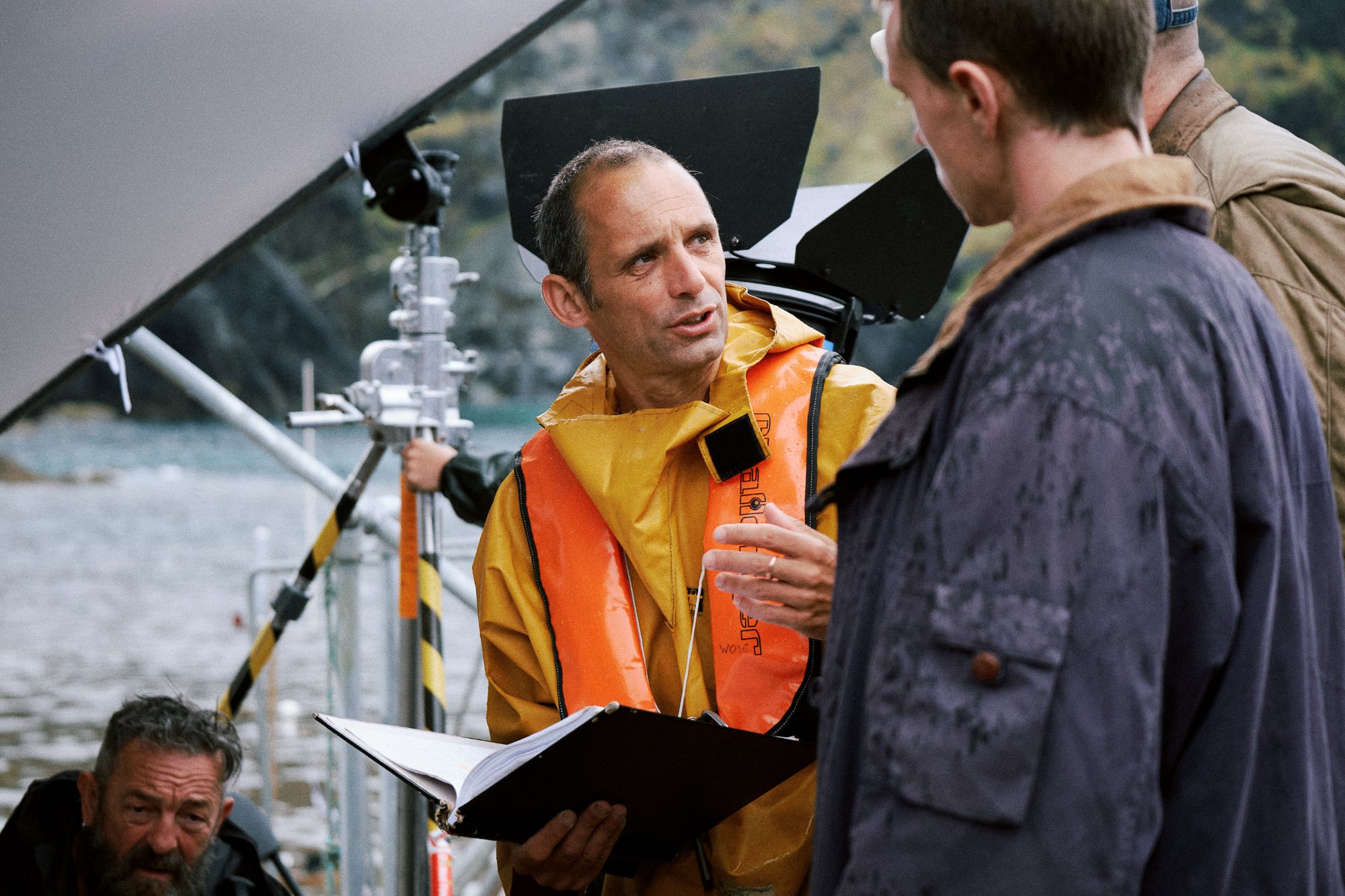
Rose of Nevada is bigger than your previous celluloid features, the largest scale project you’ve undertaken to date, in terms of cast size and working with actors like George MacKay, Callum Turner and Rosalind Eleazar, but it also feels very much in line formally, culturally and in terms of your process, with the Mark Jenkin way we have become accustomed to. What are some of the changes you’ve noticed, and did you do anything to preserve aspects of your process from the tyranny of scale?
To answer the end of the question first, I didn’t do anything to preserve the aspects of my process for one very good reason. Denzil Monk. He (Mark’s producer) entirely protects me from all that kind of stuff. And, actually, he did it quite visibly. The first time we had a meeting with some of the execs they said, “How are you going to do this?” And, I said, well, obviously I’ll work with a cinematographer, I’ll work with an editor, I’ll record location sound. As I was saying this, I could see the looks on the faces of people in the room and Denzil just shook his head. And then one of the execs said, “Why would you do that?” And I said, you know, I thought I might have to. I remember after the meeting, Denzil saying, “No, the reason we’re in the room and the reason you’re in the room has got a lot to do with the way you make films. You don’t need to go in and start saying you’re going to compromise your process”. That’s the gift I’ve got, working with a creative producer like that who gets it and protects the thing that people like, when the creative person at the heart of it, me, is second guessing what other people want and voluntarily willing to compromise. I don’t know how far down the road that would have gone, but certainly in the meeting when we got the thing greenlit, I was bowing to what I thought other people’s expectations were. Luckily, Denzil doesn’t compromise and doesn’t allow me to compromise, so we haven’t really had to change anything.
I think part of the reason they were on the film was because they wanted to make a film in a different way.
I wanted to demystify the process a little bit when George and Cal, and Ros and Adrian and Francis and everybody who hadn’t worked with me before came down. When we were in the rehearsal room I brought the camera in (Mark’s trusty Bolex 16mm) just to say this is the camera, you know, and partly to demystify it, but also sort of to show them how small and how simple it was, so that on the first day they wouldn’t go “What the hell are we doing here? This isn’t a real film”. But of course, they’re highly intelligent, very experienced actors who are cineastes and enthusiasts. And I think part of the reason they were on the film was because they wanted to make a film in a different way. They’d read the script, so they knew what it was about, what it was dealing with. They knew me because this was going to be my third film. There was enough of my work out there to know what it was going to be like, and I didn’t apologise for anything and I didn’t over-explain anything.
I think, as the old cliché goes, filmmaking’s eighty per cent casting or some other made-up percentage. I cast people I knew I would get along with and wouldn’t unbalance the way I work and the company of people I work with. It was all about balancing the production and that’s in terms of cast and crew. It’s all a continuation of what I’ve done before. And it does change. Some things do change. We had a much bigger art department. We were always going to need a much bigger art department. We shot a lot in a studio, which I hadn’t done before. We did special effects, practical effects, no CGI, but practical effects with the storm and the sea and things like that. I only changed the things that needed to be changed to serve the film. And that’s how I’ll continue to work.
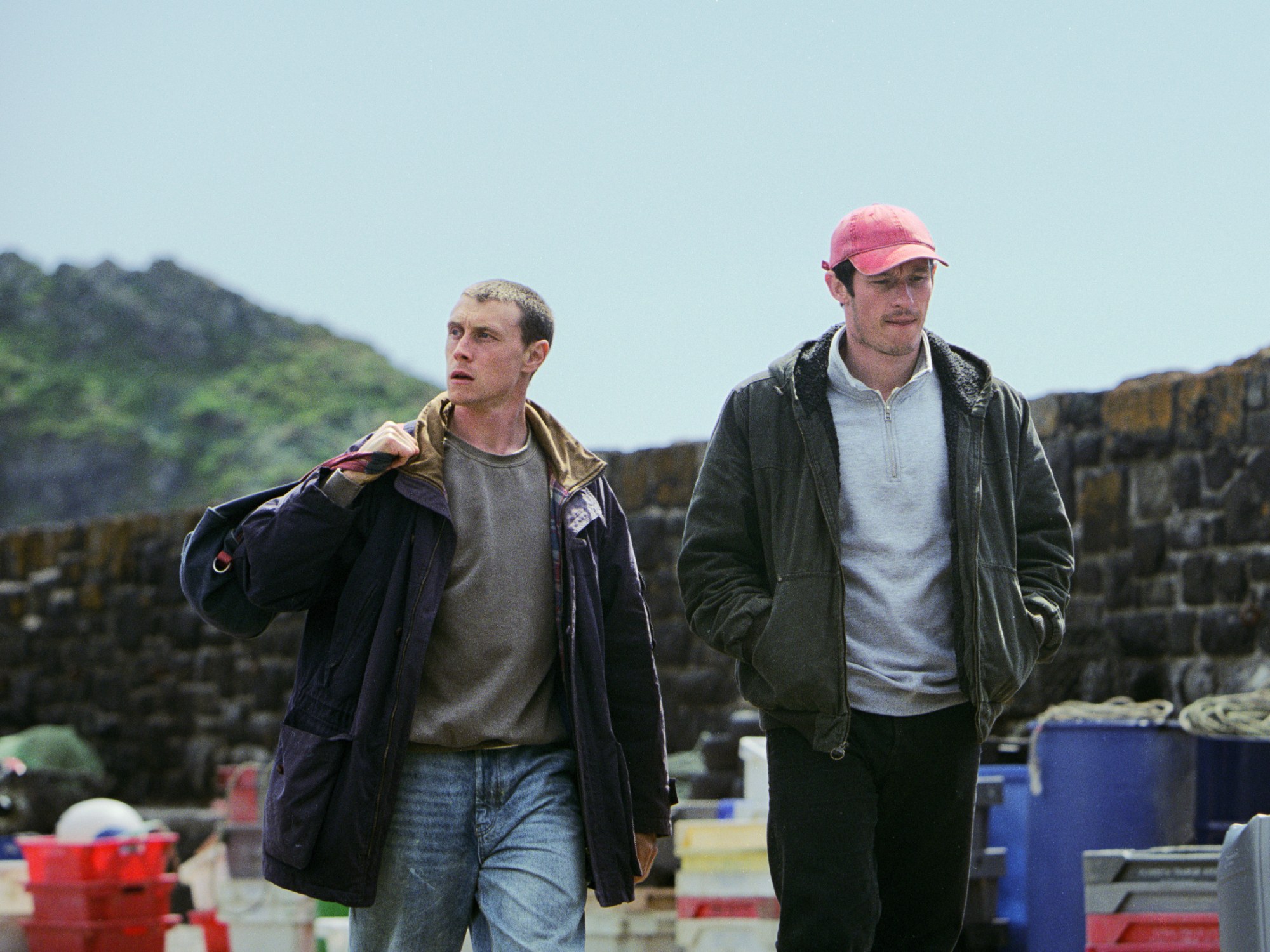
The actors you cast fit perfectly into your sonic and performance world. Can you talk about the casting process and your experience of working with the new faces, given how expansive it was compared to past productions?
I worked with Shaheen Baig, the casting director, who put together a short list. I was immediately drawn to George for several reasons. I think he’s a fantastic actor, that’s the first reason. The second reason is his filmography. Every film choice seems to be a handbrake turn on what he’s done previously. That’s a signifier of an inquisitive mind and somebody who wants to test themselves and try different things. And then equally as importantly, everybody who I knew who knew him said he was the loveliest guy in the world. So, he ticked three boxes. But, I misread him a little bit to start with because I thought he should play Liam – the role that Callum Turner ended up playing. I think it’s partly because I knew how old he was. He’s in his early thirties and I imagine Nick to be in his mid to late twenties. But then, when I met George at Shaheen’s we just chatted for an hour and talked a little bit about the film. We talked about what he’d done, what I’d done. He’d read the script with Liam in mind. He didn’t read anything in front of me. I don’t ask the actors to read from the page. I don’t get anything from that. I would let an actor do it if they really wanted to do it, but not for my benefit. At the end I thought, he’s got to play Nick. So, we went back to him and Shaheen said, “Can you read the script again? This time read it with the character of Nick in mind”.
I only changed the things that needed to be changed to serve the film. And that’s how I’ll continue to work.
In the meantime, Callum’s name had appeared on the list for potential Liams and we’ve got the same US agent. So, there was a little push from my US agents to have a look at Callum. I didn’t need much of a push though because as soon as I saw his name I remembered him from Glue, the E4 series from years ago. I remember saying to Mary at the time, that guy’s great. He played this real smouldering stable lad, horse trainer character. Didn’t say a lot. He had this brilliant, steamy relationship with Charlotte Spencer, who I also think is brilliant. It was their story, as far as I was concerned, Glue. I remember saying to Mary, he’s a movie star trapped in a TV series. I hadn’t seen a great deal of what he’d done in the intervening years but when we met, I’d managed to watch a load of stuff. I’d watched everything except for Masters of the Air. When we met, I said, “I’ve seen a lot of your stuff”. He said, “What do you think of Masters of the Air?” And I said, “Oh, I haven’t seen that one”. And that was the one he really wanted me to see. I did watch it and though it wouldn’t ordinarily be something I would have watched, I thought he was absolutely brilliant in it. Him and Austin Butler together were just fantastic. Then I watched the highlights of the press tour they did in the States. Callum and Austin. I quite often watch that stuff, you know, if they’re on Graham Norton or something or doing the press junkets, I like to see what they’re like when they’re working, but they’re not in character.
Most Popular
I did that with Ros as well because I was waiting for some clips to come through from her agent. I was watching interview clips of her on YouTube before I’d really seen her in anything. I was watching her doing promotion and I just thought she was brilliant. Her sense of humour, her energy and her mischievousness. I thought she’s Tina and I didn’t see anybody else for Tina actually. It was only because I didn’t have clips of her in anything else that I went and looked at the behind-the-scenes stuff and that really gave me much more of an insight into what Ros could do. And so, I offered Ros the part straight away based on that. Then we met up at the BFI in London and just chatted for an hour. That’s what I like to do, just to sit and chat and talk to people. I did the same with Francis [Magee]. We met up at the BFI. We sat, had a coffee and talked for about two hours and I don’t think we once mentioned the film. We talked a lot about fishing, talked a lot about Cornwall, talked a lot about Ireland, the Isle of Man, certain similarities in our very early years on this planet. Then Francis had to go and get a train, and we got up and were heading to the station and I said, “Do you want to do the thing?” Then he said, “Do you want me to do it?” I said, “Yeah, I want you to do it”. He said, “Well, I’ll do it”. And that was it. That was the casting process. It’s kind of different every time but always goes along those lines. It’s just about whether there’s a personal connection really.
Alongside your evolutions in long-form celluloid filmmaking, it seems like there have been significant formal and tonal shifts in your short film practice, particularly your diary films – and I see clear parallels between your feature Enys Men and your short-form music video for The Smile’s Skrting on the Surface. How do you see the relationship between your short film and your long form work presently, and how might it have changed?
I think I rely on my short filmmaking even more than I used to. There was a bit more of a blurry line between the two in the past. I was making films that I was really having to make off my own back or with Denzil or, whoever I was working with in terms of producing. They were all self-generated. So sometimes it would be a short film if I wanted something done quite quick. Or, it would be a longer form film if we had a bit more time to develop it. There was no real development process, we just got on and did it. Now with the features it’s different. I could continue making features off my own back but I’m in a position now where my films are bigger. They need more backing; they need more development time. So, there’s more time involved in – I’m not going to call it development hell because it’s absolutely fine. It’s not a hellish process. It’s a totally necessary process. And because I’ve had the experience of having three films get made, I go through the development process not thinking, this is a hell that’s going to go on forever. This is a part of the process that needs to be done.
But, to avoid not working practically during that process, I rely more and more on my short films, and I’ve got more I want to talk about in terms of film, now I’m getting more and more experienced in making films. So my last short film, I Saw the Face of God in the Jet Wash, is really a film about filmmaking. The diary films are difficult for me because they’re not difficult. I love making them. They’re joyous and so sort of easy in that sense. I’m obviously not saying they’re always going to be successful, but the process I find quite painless and quite exciting. The bar, the hurdle I get over and the thing that trips me up sometimes is when I stop to think, who the hell is interested in me talking about myself? So, if I’ve got more to talk about, that is one step separated from myself and I can try and convince myself people are genuinely interested in filmmaking, then the films become, in some ways, easier to make.
I rely on my short filmmaking even more than I used to.
I was talking about it in a Q&A last night. Somebody was talking about how my process differs from other people’s process and I said, “Well, I don’t know, because I only know my process”. Except for maybe the students who were there doing their first professional job, I’m the least experienced person on the set. I’m the person who makes films the least out of everybody, but I’m the person everybody’s looking to, to direct the thing. So, it’s a bit of a paradox. But, by making the short films it means I’m constantly making films. I shot some stuff last night down at Newlyn before the screening and I’m going to make a diary film at some point about the process of promoting this (feature) film. I’m making a short film called On the Idle Hill of Summer, which is sort of a diary film about my memories of the 1990s and two or three very formative summers on the north coast of Cornwall.
Enys Men and Skrting on the Surface are very linked because when I spoke to Tom and Jonny about doing a video for The Smile, they sent me the track and said, “Have you got any ideas?” And I said, “No, I’ve got nothing”. I tend not to have ideas for music videos when people send me music that I like because I listen to it and go, well, that’s complete. Whatever I do visually is going to detract from the beautiful pictures that this song has already conjured up in my mind and in the minds of everybody else who’s listening to it. But I’m also drawn in because I love the music so much and want to work with these people. We’d just finished the Enys Men shoot and when they said, “Have you got any ideas?” I said, “Well, I’ve got a location”. We went down this mine when we shot Enys Men for a day, and I told them I’d love to go down there and shoot something more significant, completely underground. And Tom and Jonny were like, yeah, do that. So, then I went away and came up with the idea from the starting point of the location. The hardest thing that I ever do is music videos. I haven’t made many and I find them incredibly difficult. Because like I say, most of the time the ones that I’m enthusiastic about are the songs I really connect with and the songs that I really connect with I see as already completed works of art.

What was it like travelling to film festivals with a short and a feature at the same time? What are the differences in how the films are presented and your experience as a filmmaker?
I went to Karlovy Vary (film festival) with I Saw the Face of God in the Jet Wash in July 2025. It was brilliant, actually, because it was a big festival and we’d already been accepted for Venice with Rose of Nevada, so I knew that was coming up. Karlovy Vary was brilliant because there was no competition or anything like that. There was no press to do. There was no pressure. It was in a short film screening, and it was quite high profile for the shorts programme. They used the image to promote the strand it was in, because obviously, there was press around saying that I had a feature coming out. So it was brilliant going to a festival like that where I wasn’t in the limelight. Having said that, when I got there, I thought, “Oh, why isn’t everybody paying attention to me?” But then it was like, I’m here with a short, not a feature. That will come when I get to Venice. So, it’s nice to hang out with some of the critics and I was in a hotel where journalists were staying. I had breakfast with different journalists and then what happened was the festival got in contact and said there are people who want to talk to you. And I thought, “Oh, that’s interesting that people do want to talk about the short”. Then I’d go and do these interviews and there would be a couple of questions about the short but then very quickly people wanted to talk about the feature film. Totally understandable. But it was really great. It got me to a big festival ahead of going to Venice. So, three years or whatever of not going anywhere while we were making Rose of Nevada and then going straight to Venice as the first festival experience of this round might have been a bit of a shock. So, getting to go and do that big festival in Karlovy Vary in July, the month before we went to Venice, was great.
And after that the short got invited to a lot of places. It played in Toronto. The short and the feature. And my thing is, originally the short film wasn’t on my itinerary. I wasn’t expected to go along and introduce it because obviously I was there to go with Callum to promote the feature, but I said I want to go if I’m here, I want to go to the short screening. I want to give as much attention to the short as to the feature because I don’t see a difference. Other people hold them to different standards or different expectations of how much attention they should get but for me they’re all my films. So, if I’m there, I want to promote the short as much as the feature and the shorts need more promoting. If I go, and I know this might sound really big headed, but if I turn up to promote my short, I just think that – you know, quite often my short will be in a programme with short films by first time filmmakers – giving it a focus in that way, well I would have really appreciated that when I was first starting out, that there was as much hype around the short film programme as the feature film programme. Because also, quite often it’s where the most interesting work is. And it’s quite often the younger filmmakers who are really cutting edge, who are doing interesting things.
I want to give as much attention to the short as to the feature because I don’t see a difference. Other people hold them to different standards or different expectations of how much attention they should get but for me they’re all my films.
I like going to the short film screenings as well. You know, not just introducing the film or doing Q&As. It was also really nice this year to sort of sneak into the awards season, because I Saw the Face of God in the Jet Wash got nominated for Best British Film at the London Critics Circle Awards, so Mary and I were able to go along to that event, a big black tie do in London, which was nice. We snuck into this awards season with a short. So, no pressure. Just go along. It’s important, it makes you feel validated, all that kind of stuff. I don’t know whether it’s important career wise, profile wise, or whether it’s just ego, but, whatever it is, it feels important to be able to do that. I don’t want to be going to film festivals every three years with a feature film. So, going with shorts is exciting to me and really important.
Can you share with DN readers a short film recommendation, something you think they should check out, or keep an eye out for?
I recommend Howlsavla Gwav (2026). I saw this short at an early screening in Newlyn. I was just blown away by it. It’s Joe Gray working with Ryan Mackfall and a team of collaborators, mostly cast, who are familiar faces from around Penwith. It’s a sublime, abstract, impressionistic film, taking the midwinter Montol celebration that we have in West Penwith as its theme, but it’s so much more than that. I said to Joe afterwards, it’s unique. That’s the one-word review, which is the review that I’m always looking for, for my films. It really reminded me of the types of films that were being made in Cornwall when I first moved back from London, when I thought there was nothing going on here. I moved back and there were just these brilliant, unique pieces of work being made with very limited resources, but endless passion and compulsion. I think this film is a continuation of that, and I would highly recommend anybody see it. There’s nothing else like it.
Since you stumbled into doing the music for your feature films on Bait (2019), you have scored your own feature films and, in collaboration with Dion Star as The Cornish Sound Unit, your most recent short. How has your approach to score changed over time, and how has thinking about the score changed aspects of your filmmaking, if it has?
I used to really be against score and thought it was a bit of a cheat, which is a very naive thing to think because there’s some amazing film music. But I used to be a bit of a purist when it came to score. I like diegetic music used cleverly within a film, rather than there being a score that could elicit or manipulate or exploit emotions. But yeah, I stumbled into doing the music for Bait accidentally because I was sick of doing the foley of footsteps. There were a few scenes where, instead of putting footsteps in, I created a synth drone to put over the top, to fill that sonic gap. And then I fell in love with my own discordant music. As you can imagine, I’m using quotation marks around ‘music’. Then I really did fall in love with score and music. I think it’s because I had total control over it. I don’t like it to be too overbearing, and sometimes I like it to be completely overbearing if it’s for shock value. In terms of mood, I generally like to pull it all the way back. I think that’s what used to irritate me, too over the top. I’ve programmed The Perfect Storm (2000) at the BFI in April. I love that film, despite how loud in the mix the score is. There’s even an extra feature on the DVD about the composing of the score where they celebrate how loud and overpowering the score is.
I think having control over the score, subverting expectations, not even being able to meet my own expectations through music and musical ineptitude means that it’s quite experimental. Ian Wilson mixed the film and I remember him saying to me one day, “It’s quite refreshing to be in the room with a composer who keeps asking for their score to be lower in the mix”. He’d never had that before. So having that kind of control and also being a little bit embarrassed about being the composer means I do bury it a little bit. I’m like a singer in a band who hasn’t got much faith in their voice. This one’s a big departure for me because I actually played a guitar on it and I’ve wanted to be an amazing guitarist since I was about ten. I’ve never achieved it and I never will, but I do get to play guitar on this score. And the thought that I’m going to be performing it live in July is the thing that’s keeping me awake at the moment.
Can you talk about your growing sound and music collaboration with Dion as The Cornish Sound Unit?
This is a really exciting thing for me. The main thing is that Dion is one of the people who I love spending time with most in the world. We’ve both got families, we’ve both got other commitments, we’re both kinda workaholics, so we don’t spend as much time together as I would like to. So, formalising a music collaboration has been brilliant because we get together and we rehearse and we play music and we geek out about malfunctioning antique or hand-built instruments that are our obsession. I rely on Dion because he’s a much better musician than me. He’ll say things in the rehearsal room like, “That’s out of tune” and I’ll say, “Oh, is it?” Or he’ll say, “That sounds really good”. And I’ll say, “Does it?” And he’ll say, “Can you play a C?” And I’ll say, “Yes. Which one’s that on my synthesiser?” He builds his own synths, and he builds pedals and he’s very different to me in outlook, but we work together really well. I’ve never played music live other than the live score for Enys Men with Dion and it was such a special thing to do. If we’d never done anything else, that would have been enough. But we’re going to get to do it with Rose of Nevada as well. I think one day, when we’ve got a bit more time, we’re going to make an album together, with no film at the centre. I mean, we might both be retired by then, but that’s something I’m really looking forward to.

You’ve a long-standing relationship with Falmouth University’s Sound/Image Cinema Lab. Can you talk about what this partnership means to you?
I feel quite emotional when I talk about this, because I know that when I left Cornwall 30 years ago, if there’d been a university in Cornwall, I don’t think I would have stayed. Going to university wasn’t my aim, getting out of Cornwall at 19 was. But now looking back at it, I think the fact that there’s a university here is incredible. One of the amazing things that came out of Objective One European funding was to get the university established within Cornwall, which I think we take for granted now, especially a lot of people within Cornwall. In 1995 when I left to go and study in Bournemouth, it probably wouldn’t have meant anything to me whether there was a university or not in Cornwall. As soon as I was in England and I realised how Cornwall was perceived by a lot of people outside of it, if at that point somebody said in 30 years’ time there will be a university and there will be a film school that’s so highly thought of, and that I would be so closely associated with it, that would have blown my mind.
When I came back from London to write and to attempt to make a film, which became Bait 19 years later, the university was a place to go in the first instance to work and to earn good money, in Cornwall, in my industry. When I left London, I thought I was going to have to go back to London every month, probably to work for a week to earn enough money to live. I never once had to do that, and a lot of that was to do with the university and being able to work there. I did that as a job to start with, but as soon as I started doing it, it became much more than a job. It became mutually beneficial. I could share what I was doing with my work with students, but also, I got so much back from the students and so much back from the Academic environment. It sharpened my brain and re-engaged me with things like film theory. If the university and the Lab hadn’t been there, and I hadn’t been involved with it, I wouldn’t be making the films I’m making now. The formalisation of that relationship between the institution and the industry, which is encapsulated in the Sound/Image Cinema Lab, is priceless, really.
For lots of reasons. The university, the film school and the Lab have helped stem the brain drain, or even the perception of a brain drain, where young Cornish people have to leave to go and do what they want to do, or think that they can’t do it here. That was always the impression but now not only can students – undergrads and post-grads – study in Cornwall without having to leave, but they can also have this professional experience, such as coming and working on Rose of Nevada. It’s not until I hear the testimonies of those students that I realise what a big deal it is for some of them. For me, it’s like, this is my film, this is what I’m doing, so I tend not to think about it too much. But, if I put myself in their shoes and think how I was at that age, in Bournemouth – I remember I did one or two days on a corporate video for work experience once when I was at Bournemouth and that felt incredible – in that context, the idea that I could have gone and worked on a film and been given a certain amount of responsibility, but also very closely shadowing experienced industry professionals I think that must be priceless. If they take that opportunity. Everybody that I met on Rose of Nevada seemed to really embrace the experience.
I got so much back from the students and so much back from the Academic environment. It sharpened my brain and re-engaged me with things like film theory.

What I get out of it is that I get to spend time with that energy, and that excitement, and that cutting edge. I turned 50 last week. I’m not the cutting edge of this industry. People who are coming out of the university are the cutting edge. And I think what the Lab does, it cultivates that. I always think the undergrads, when they graduate, they’re the cutting edge. There’s a sweet spot when they’re making their graduation films where everything’s focused on making those films, but they haven’t got market forces bearing down on them. They haven’t got execs leaning on them. Sometimes they get distracted by chasing a good mark, a good grade, which is always a bad idea. But, they’re pure in their intent and their vision and then they go into the real world, and a lot of students will never make anything ever again because suddenly the reality will hit them and it will all be about earning enough money to live. What the Lab does is give them a taste of the real world before they’re in the real world. And I think that too is kind of priceless, and also it’ll teach them as much.
Something else I’ve got from the university and the Lab is some of the people that I work with now. Michael Todd, who does my colour grading and basically looks after the post-production of the film alongside Denzil, is an ex-student. Toby Matthews, who I speak to almost every day, we don’t work together as much as I think we both thought we would, but I think that’s because we’re kind of doing the same thing, but we talk constantly. He’s a generation younger than me but we have a lot in common. We share a lot of information, ideas and enthusiasm with each other, and him being a generation younger, he’s got more energy than me. I find him very inspiring. That’s a real symbiotic relationship I’ve got with a former student. Luca, who’s graduating now, is somebody who became indispensable in the post-production process for Rose of Nevada. I never would have met him; he wouldn’t even be in the UK if it wasn’t for Falmouth. That’s a professional relationship that I think will continue and will grow and hopefully he’ll be doing his own thing and won’t be working quite as closely with me. But for the time being, I’ve got this kid who’s from the cutting edge, who I can learn a lot from, and hopefully he can learn a lot from me. To quote Ian Brown, “I like the youth, I grew up with them”. It keeps me in contact with youth, being involved with the Lab. My biggest fear is being a bitter middle-aged man and you can avoid that by being by the young, the cutting edge. The Sound/Image Cinema Lab facilitates that.
One thing I don’t think you get enough credit for is how funny your films can be. They are filled with moments of real wit and superb comic timing. I Saw the Face of God in the Jet Wash is hilarious in places, with you on self-deprecating form. Is comedy something you’d like to explore more fully in future work?
I think so. The comedy in the shorts comes out as a defence mechanism, I think, because they are narrated first person. Again, it’s being worried “Who the hell wants to listen to me wittering on about the world? And my life?”. So undercutting the potential pomposity of making a first-person diary film in the first place means that the first person to poke fun at will be me. I think that then gives me a certain amount of permission to poke fun at other targets. Hopefully not easy targets. And hopefully I’m punching up, but a good starting point is to not take yourself too seriously, especially when you’re putting a film out into the world that is effectively your thoughts on the world. There’s two ways of being self-deprecating. There’s the fake modesty that makes me want to crawl out of my own skin and then set fire to it, which I see with a lot of. I mean, it’s a very British trait to clearly be a huge egomaniac and self-centred, and self-obsessed and then say, “Oh, I don’t deserve this”. I’m much more in the school of just taking the piss out of yourself. One of those is filled with humour and one of those is filled with a skin crawling lack of authenticity. So, I go for the humour more. It doesn’t always land, but it’s nice when it does. I think essentially humans are quite absurd people, and the more I get into looking at character, the more humour will come out. I think there’s more humour in Rose of Nevada because it comes out of the clash between humans and our absurd priorities and the way we interact. Which is quite often absurd and funny.
I think there will be more humour in one of the new films I’m writing. All of the new films I think are going to be a bit more character based, so I think there will be more humour. I think there’s quite a lot of humour in Bait as well. Quite a lot that was to do with the absurdity of human interaction. Basically, it’s a film about a contested parking space, which if you zoom out from the planet and look back, seems like quite a mad thing to be angry about. But, these things matter. So yeah, I would like to write more humour because at the moment I’m touring with the film and although I said I don’t watch the film with the audience, I do stay in at the beginning, and I come in at the end. Where I come in at the end of the film is normally before where the biggest laugh of the film happens. There is a funny moment of realisation on the part of one of the characters. That is addictive. And I remember that with Bait. That very deliberately wasn’t in Enys Men. But that much more physical, visceral reaction I was trying to get from the audience was just as rewarding when it happened. There’s nothing quite like the feeling of being in a full cinema and people laughing at a joke you wrote.
The best position to be in is when you don’t have to sell too much of your time. You can sell a bit of it, but you can control the rest of your time.
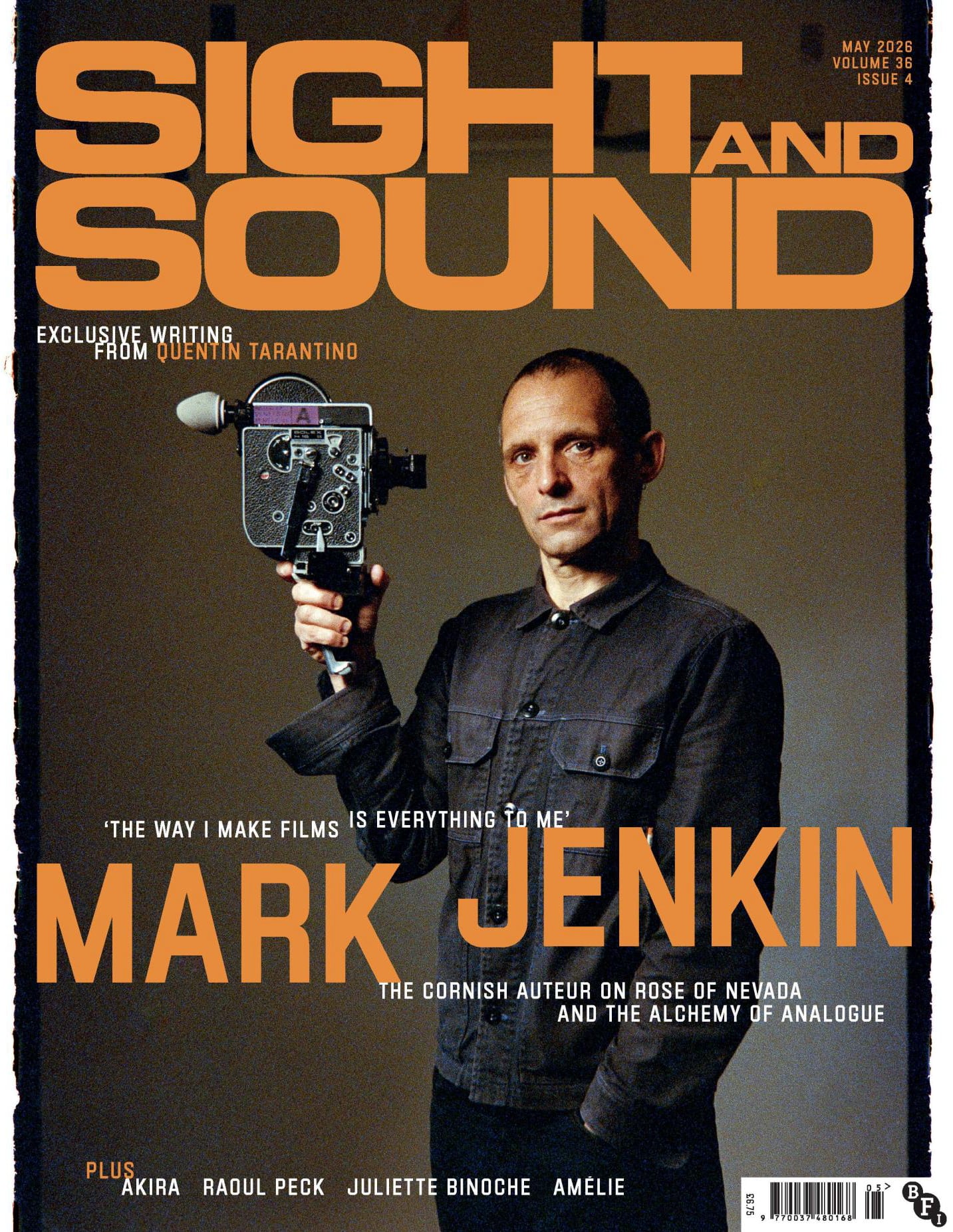
That self-deprecation also alludes to a reflection on how your life has changed since Bait. You must have had so many ‘pinch-me’ moments since then, not least the recent cover of Sight and Sound magazine. You don’t seem to be taking any of this for granted and seem to be revelling in the opportunities, creatively, but also in terms of meeting your heroes and peers, who have come because of your success…
Sometimes I’m working so hard, I don’t get a chance to fully realise what’s going on, to fully appreciate the situation constantly, but I try. A lot of the time I just feel very, incredibly lucky just that I’m in charge of my own time. That’s the greatest thing I’ve got. Health and the health of friends and family are the most important things in the world, I would say, but something personally that’s very important for me is how in control of my own time I am. I set my own schedule. I love Sundays and a lot of people I know don’t like Sundays because Sunday is the day before they go and do a job that they don’t particularly like. And I’ve had that experience. I’ve had jobs where I’ve dreaded Monday. It’s got to Sunday evening and I’ve thought, “Oh God, I remember having a job like that”. I won’t say what job it was. It wasn’t down here (Cornwall). That’s no way to live and, luckily, I was in my early 20s when I had that realisation. I think it’s really important to recognise and say “Actually, this isn’t good enough. We get one go at this. I’m not gonna live like this. I can’t be 25 years old and dreading Monday morning”. I pinch myself about that a lot of the time when I go to bed on a Sunday night and feel excited about getting up on Monday morning. That’s a real gift that I don’t take for granted.
I remember my dad said to me when he was trying to get me to revise for my GCSEs that “Qualifications aren’t everything, but the more qualifications you have, the more likely you are to be able to get on and do a job that you enjoy doing, to have control over your time”. I didn’t really understand what he meant. Or I wilfully disregarded what he was saying because I was a teenager and he was an adult. But I do find myself saying that to younger people now, including Morgan, my stepson. I remember saying to him a few years ago that we’re all born with one thing, which is time, and we have to sell that thing that we’re born with in order to make money, in order to live. The best position to be in is when you don’t have to sell too much of your time. You can sell a bit of it, but you can control the rest of your time. This one thing that you’re born with. I don’t know if I’m articulating this clearly. Some people are quite happy to sell all of their time, and they get something out of that, but I don’t really have to sell much of my time anymore. I can do more of what I want. The caveat is I know it’s temporary. I know that won’t go on forever. It might all end tomorrow in terms of my career. I’m very conscious of that and I try to acknowledge that all the time.
When I’m given the opportunity to meet a hero or somebody I respect, I’m quite introverted so my initial reaction is, “Oh God, this terrifies me. I’m not going to do that. I’m going to think of an excuse”. But then I remind myself I might not get this opportunity again. The other day I got the opportunity to meet Mike Figgis, which I was really nervous about because he’s one of my heroes. But as soon as I got there, it was great. He was great. We hung out and we had a good time. Well, I had a good time. I hope he had a good time. I learned a lot from him, from just chatting to him for a couple of hours. That’s crazy access. And then from there I ran down from North London to Soho, and I went out for dinner with Chris Petit, the Radio On (1979) director, which is one of the most significant films in the world to me. I was able to sit and chat to him about the making of that film over dinner. Again, I may never get the opportunity to meet people like that again. The opportunities are there and I don’t take them for granted. They often scare me, but I embrace them.
My copy of Sight and Sound (May 2026) arrived today. Up until now I’ve only seen the front cover. I sat and stared at it. Too scared to open it for a long time because I thought, “Is that gonna help? What’s it gonna look like inside?” The idea of being featured in Sight and Sound might be better than the reality of it. It took me a long time to open it. Luckily Mike (Williams, editor), who wrote the piece on me and did the interview, is an absolute beauty and I think he really did me justice. It’s kind of crazy, isn’t it? Being on the front of Sight and Sound. I remember the first time I was in the magazine. I almost fainted when I read that. And then, getting a five-star review in Empire magazine for Bait. I have these moments. Whether they just get bigger and bigger and that’s why they’re still having this effect on me, I don’t know. I don’t think so. I think I’m just very careful not to take them for granted because they’re amazing things, and if dreams come true, you have to sit with that for a minute and acknowledge it and appreciate how lucky you are.