
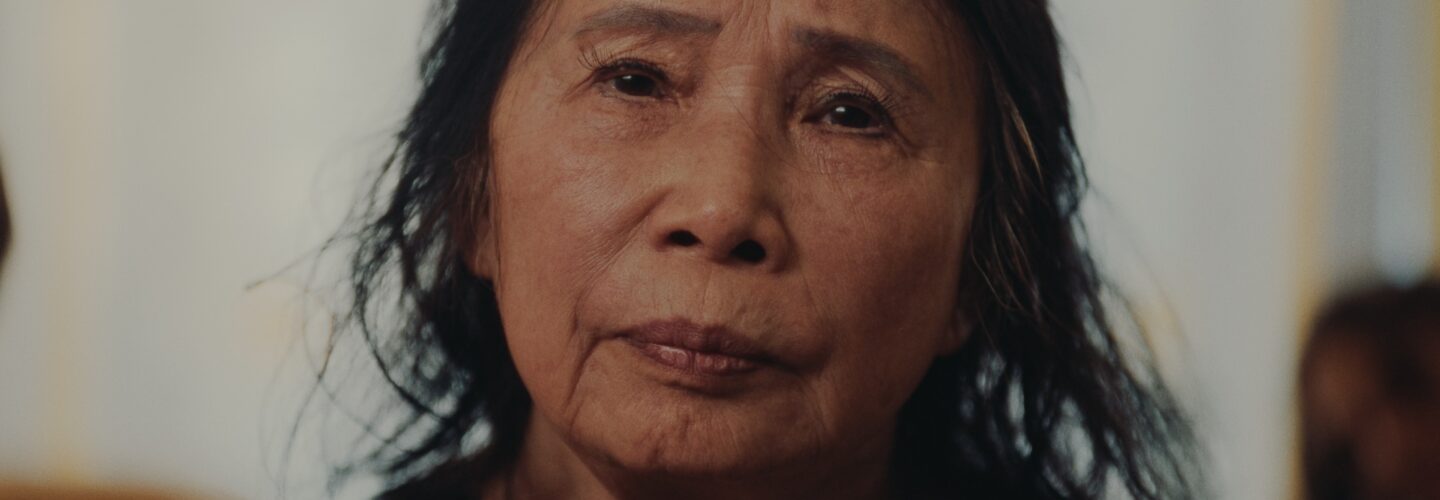

There is a sad truth in the fact that we can we can spend a lifetime loving someone without truly knowing them, a realisation that hit filmmaker Max Kane upon the discovery of his grandmother’s diaries when clearing out her house. Marking his third appearance on DN’s pages following premieres for Duck and House of Brotherly Love, Kane’s deeply personal exploration of memory and hidden truths, Ah-Ma Burns, blurs boundaries between the tangible and ethereal, reflecting a complexity of human understanding. Kane’s approach to filmmaking here is remarkably tactile and intuitive and the film’s visual language evolves as a direct mirror to his protagonist’s emotional journey. This progression isn’t merely a stylistic flourish but serves as the film’s emotional architecture. Kane’s directorial approach centres on creating authentic emotional spaces rather than manufactured moments. Trusting his cast’s work in pivotal scenes demonstrates a filmmaking practice which knows when to guide and when to surrender control. Ah-Ma Burns serves as an enthralling meditation on grief and as the short makes its online premiere today, Kane returns to talk about emergency recasting leading to a change in tone for the film, his love for editing chaotic scenes and why he ended the short with a surprising twist.
From your notes, it’s clear you were inspired by your own grandmother to write this film.
I adored my Ah-Ma growing up and always remembered her as the happiest person in my life. Over a decade after her passing, while my family was cleaning out her house, we found one of her old diaries buried in a pile of books. As I spent weeks reading through it, she transformed before me into a woman of strong convictions, deep desires, and an ingrained sadness. I made this film to honor her complex humanity – something I only came to understand after she was gone.
At the time, I was feeling disconnected from some important people in my life and that emotional state probably bled into the writing.
How did writing the film help you process your grief and reflect where you were in life at that point?
I wrote the script over a few weeks in Mexico City in February 2022. It was a time of transition for me – I was moving apartments in LA, changing jobs, and repairing some fractured friendships. I knew I wanted to write something that captured the feeling of change, while also weaving in this new discovery about my grandma. Most of the characters were written around close friends I really wanted to see in front of the camera. At the time, I was feeling disconnected from some important people in my life and that emotional state probably bled into the writing, as each character in the film grapples with their own version of loneliness.

It can’t have been easy to find the right actor for Ah-Ma?
I spent months trying to street-cast our grandma, spending afternoons in public parks, malls, and restaurants. Eventually, I met an 86-year-old woman named Winnie at a laundromat, and she loved the idea of being in a movie. Unfortunately, Winnie had a health scare two weeks before production. We decided it was best to recast quickly with a seasoned actor, which changed the tone of the project and forced me to rethink how I approached directing it.
Most Popular
I met Alice Lin through her manager and at the time she was in a deep state of despair. Weeks prior, Alice had been scammed out of her life savings in a devastating pig-butchering internet scam. In Alice’s words: “Given that I was already in extreme anguish and stress from being deceived, I believed that portraying this character might help me release my inner emotions.” The more we worked together, the more it felt like Alice’s story had become the heart of the film.
I’d love to know more about the re-framing of the project towards Alice herself after that last-minute changeover for the lead role.
When Winnie was cast, our prep focused on fundamentals: how to read a script, how to memorize lines, and how to make sense of the story. Once Alice stepped in, our limited rehearsal time focused on questions such as: why are we making this film, how do we relate to the characters, and what are their intentions? I believe this resulted in a deeper understanding of one another and allowed me to tailor my direction to her own personal experiences.

You play with angles in such a dynamic way, expressing Ah-Ma’s shifting inner state through the cinematography.
Kudos to Jay Swuen and Mike Overton, our DP and 1st AC, for working so well together. During prep, I made the storyboard and shot list, then Jay and I spent a day refining. The intention was to mirror Alice’s emotional arc throughout the film – we began static and claustrophobic, shifted into handheld anxiety, and ended in a kind of controlled chaos.
The intention was to mirror Alice’s emotional arc throughout the film.
The ceremony is intense. How did you capture the raw emotional authenticity of the moment, which feels so intensely close to tipping over into horror?
The ceremony scene was particularly fun to shoot. We took 30 minutes to get Alice’s coverage in two takes, then flipped to the friends’ horrified reactions. While we held a few rehearsals before the shoot, we never touched this scene, knowing Alice would only have one chance to bring the intensity. It’s always fun seeing people squirm in their seats while watching it. Someone even passed out at a recent festival!


The only direction I gave Alice was, “This is your chance to let it all out.” I think her visceral emotions on screen are pretty real. And, I made sure David’s friends were in the room during her coverage so that, when it came time to shoot their reactions, they didn’t need much direction – they had already lived through it.
After such an intense shoot I want to know how the edit was for that particular scene?
Cutting chaos is so fun. For this scene, I pulled my favorite moments from the dailies, dropped them into a timeline, and pieced them together like a puzzle. The sound design added another layer of complexity, as we needed to make sure each of Alice’s scream tracks flowed naturally into the next. I feel bad for my roommate who heard it on repeat for weeks! Once picture locked, we heightened the horror with Lane’s score and a ton of ADR.
The sound design added another layer of complexity, as we needed to make sure each of Alice’s scream tracks flowed naturally into the next.


Upon first viewing I had no inkling that the film was going down a fantastical route. Did you want to surprise viewers?
Yes, I’m a sucker for stories that have a magical realist twist. There was also a storyline involving a gun-wielding prison escapee and his girlfriend crashing the Friendsgiving that got cut in the edit. That probably would have been surprising too, for better or worse!
What was it in Lane Shi’s music that drew you to it as right for the tapestry of Ah-Ma Burns?
Lane Shi (aka Otay:onii) is an artist from Haining, China. I stumbled across her song Overlap on Bandcamp and immediately fell in love with her sound. Lane wrote the music in just two days, right between her European and U.S. tours. She’s one of the most awe-inspiring artists I’ve met, and if you ever see her perform live, it just might change your life. Her music has this slow-building intensity and otherworldly sound that is so cinematic. Her lyrics are impossible to decipher, which allows you to surrender to the emotion rather than focus on meaning. I had no idea if it would work, but I trusted Lane completely, and she delivered a score I fell in love with.


How has making this reframed the memories of your grandmother and how did you find the process of working on something that was so personal with such a meaningful group of collaborators?
I somehow feel like I know my grandma even less now. Journal pages can only tell you so much, and every new thing I learned about her uncovered more questions. I have a laundry list for her in the next life! There are so many people I want to thank for making this movie happen, but here are six: Jay and Jeff – to many more collaborations; Alyssa and Kenzo – for being the best producers I’ve ever worked with; Joey and Brooke – for sticking with me through everything.
I enjoyed going back to your previous films featured on DN, Duck and House of Brotherly Love, and would love to know about your progression through these projects to where you are today as a filmmaker.
I’m learning how much harder it gets to make a film with every year that goes by. Life happens, priorities change, friends move on. So I’m trying to cherish every moment of the process moving forward, something I wasn’t as attuned to during the last few films.