
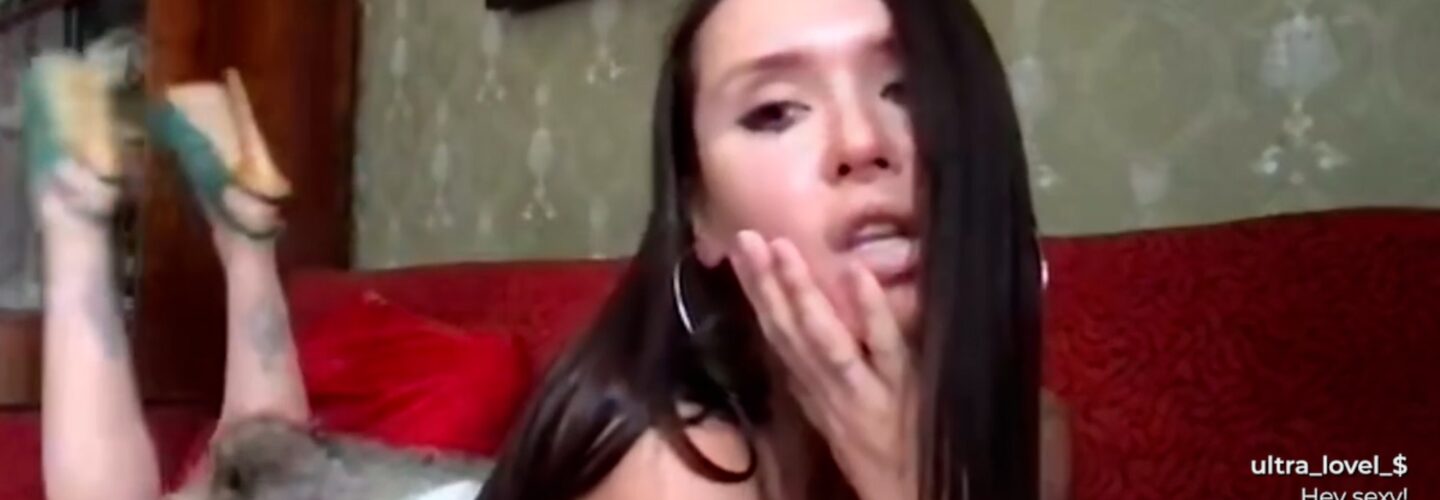

There is something unsettling in the way a static camera can strip away pretence, revealing not just what is seen, but what lingers beneath—an idea that permeates through Ira Groza’s Goosecam. A webcam streaming in a Soviet-era apartment, pointed at the well-recognised setup of a scantily dressed woman flirting with the lens, soon becomes a hallucinatory portal into the multitude of selves of someone perpetually observed yet systematically ignored. Groza’s film operates at the intersection of the absurd and the deeply personal, framing the female experience through an unsettling duality: the performative self crafted for external consumption versus the private self that bleeds through. Goosecam unfolds with the logic of half-remembered truths. The apartment transforms into a liminal space where the surreal intrudes upon the mundane, where the protagonist’s cultural heritage asserts itself in ways that defy the viewer’s voyeuristic expectations. There’s poetry in Groza’s restraint: by denying conventional narrative catharsis, the film mirrors the migrant woman’s reality—her full self always just beyond the frame, known only in glimpses. As Goosecam makes its online premiere on DN, we speak with Groza about the challenge of conveying memory through static imagery, the tension between performance and authenticity and why the most revealing moments often happen just outside the frame.
Goosecam is a surreal amalgamation of so much, I feel it pouring out the seams.
To be honest, it all started not so much with a clear idea but rather with a feeling. That sensation lingered with me for over a year, gradually growing during my first couple of years living in the US. Only by being physically far from my home, separated by a whole continent, was I able to start identifying who I really am. I deeply believe that great films can only be made when the author knows their subject intimately. That’s when I realized: I want to speak from my own experience—my post-Soviet roots, textures, faces, and the unique microcosm of a small town that isn’t even on the map but still visits me in dreams. That became the foundation for the film. What truly fascinates me is how differently people interpret this piece—and how every one of them is right. That’s exactly the point. Inside this chaotic mosaic are echoes of the wild 90s—the criminal, lawless post- Soviet period; the reality of sex workers from Slavic countries; the quiet dignity of our grandparents’ generation. And every viewer sees something that resonates uniquely with them. I wanted to give the audience total freedom of interpretation—and I feel that worked 100%.
I want to speak from my own experience—my post-Soviet roots, textures, faces, and the unique microcosm of a small town that isn’t even on the map but still visits me in dreams. That became the foundation for the film.
This film is deeply personal. There are no metaphors here—only facts. Every detail is part of the world I grew up in, a world shared by millions of others. That’s why it reflects such a range of emotions—and still manages to connect us all. This film doesn’t offer answers—it only presents themes. Is she a sex worker, or a sublimation of the male gaze? Are the babushkas simply grandmothers, or a symbol of outdated morality? Are the cop and the gopnik literal characters, or archetypes of masculinity? I present the elements, and from there, the viewer is invited to explore and conclude for themselves.
How did that amorphous feeling gradually crystallise into Goosecam? What specific images, dreams, or memories of home anchored it?
This was probably the hardest part—translating a feeling into visual language. I had a few key ingredients that meant a lot to me, but I didn’t know how to blend them: the cultural code of a girl who grew up in post-Soviet reality, the surreal moments that marked my memory, and how I experience womanhood in today’s patriarchal world. I kept trying to define it, to make it more concrete—and it only came together when I completely let go of control and gave space to experimentation.
I thought: what if I just build a collage of random memories, and let that be the film? So, I imagined myself watching the final piece, and then asked: where do these images come from? The apartment and overall atmosphere—it’s basically how my childhood home looked when we lived with my parents. It’s very typical for post-Soviet space. We lived with my grandmother, and the behavior of the twin babushkas in the film is very accurate for women of that generation. They have a specific dialect, phrases, and always that ‘it used to be better’ vibe—plus a heavy dose of internalized misogyny and judgment of younger women. In my story, they speak to each other—like the old generation listening only to itself and defaulting to hate anything modern.


Tell us more about the various archetypes that we see through the webcam.
The goose is a true story. When I was about 10 or 11, we were struggling financially, sometimes even for food. My parents would go to the market in a nearby village and trade clothes or belongings for local food. A T-shirt could become a sack of potatoes or a few kilos of cottage cheese. One day, they brought back a live goose. He lived on our balcony for three days. He was meant to be slaughtered and feed us for a month. But my dad couldn’t do it, so he called a friend to come and help. In those three days, I bonded with the goose. I fed him, stroked him. I wasn’t allowed to have pets, so this interaction hit me on a deep level. When he was gone, I grieved for a week and hated the cruel world where one being has to die for another to survive. Needless to say, I didn’t eat him.
Most Popular
The cop and the gopnik represent this feeling that the streets run on their own laws, while the official law only exists on paper. It’s also a huge part of how I experienced masculinity while growing up—traumatic and conflicting in its own way. I don’t want to go too deep into it, but I remember gopniks in black leather jackets coming into our home and taking our TV and VCR to cover my father’s debts. It was scary—especially seeing one kind of male power overpower another: my father. There was a kind of battle I didn’t understand, and I was just watching it unfold. And the carpet? A classic post-Soviet household item. Our cultural wallpaper—and honestly, great soundproofing, lol. Eventually, all of it started to feel absurd—like, is this really me?

Whilst it is based on your experiences and observations, Goosecam is deeply surreal. How did you balance literal details from your upbringing with the dreamlike structure and did you ever worry the symbolism might overshadow the personal truths?
The experience of migration allowed me to look at my roots from the outside. When I told friends from the U.S. or Europe stories from my childhood, their reaction was always: “WTF, that’s so surreal—like an arthouse film.” And for the first time in my life, I began to see my own experience, which had never seemed unusual or surreal to me, as something significant, as context for my future films. So, when I translated those factual memories onto the screen, it really did become the kind of surrealism my friends were talking about. It was like I stepped into their heads and rewatched my life through their eyes—and that became Goosecam.
I’m convinced that if you take anyone and break them down into fragments, it would all start looking like this.
Coming back to the question of balance: honestly, it was all an intuitive process. I moved by pure feeling during the edit, even enhancing the webcam effect with some intentional shakiness and visual glitch. And yes—those overly literal symbols are my personal truth. So, this surrealism? For me, it’s just real life. I’m convinced that if you take anyone and break them down into fragments, it would all start looking like this. For me, this film is truth. But from the outside, I understand it can look like a dream…or maybe a fever dream.


Shooting it as a real webcam call is honestly genius.
While the core of the film was slowly forming for a long time, the actual concept and the script came together in just one day, sparked by a sudden alignment of circumstances. My friend and co-founder of Girls Scout Studio—Oksana Belkasemi, who plays the main role, was visiting Eastern Europe for personal reasons, and we both felt it was the perfect chance to bring this story to life right now. The biggest challenge? Directing remotely. But out of that challenge came one of the film’s strongest creative decisions—to shoot it as a real webcam call. That choice didn’t just solve a logistical issue; it added conceptual power.
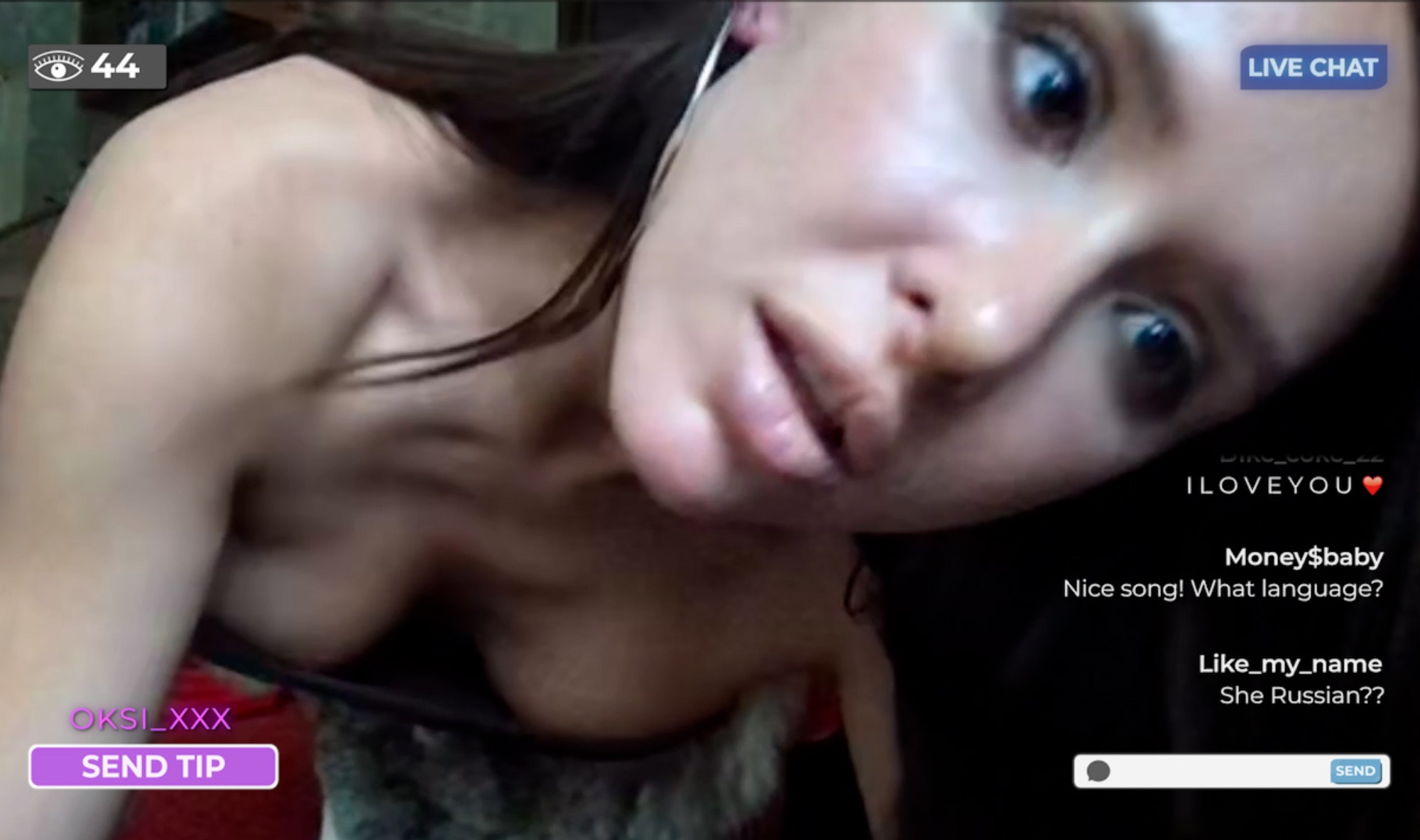
The entire setup was a laptop with a webcam and natural light from the window. That’s it. What you see is an actual video call.
The pre-production lasted just 3 days. Oksana would send me updates—locations, actors and wardrobe—via chat and we made decisions quickly. The night before the shoot, we still hadn’t found our gopnik, but someone tracked down the perfect guy within an hour. The next day he was on set. The shoot took place at 2pm Eastern European time—4am for me in LA. I directed the whole thing via Zoom. The entire setup was a laptop with a webcam and natural light from the window. That’s it. What you see is an actual video call. I gave directions to the actors and crew in real time through that same call. We kept the crew small—under 10 people including cast—and I encouraged the actors to improvise and stay natural. We didn’t rehearse lines, and I’m so happy about that decision—everything came out honest and organic. Filming lasted only two hours, but we were so immersed in the process it felt more like a weirdly magical family call than a shoot. Everyone was deeply engaged, including Olga Vladimirovna, the goose, who behaved impeccably and followed all the cues.

The real-time quality of the performances feels uncanny—did you struggle to guide the actors’ improvisations remotely?
Directing the actors was surprisingly easy. Nobody saw a script until we shot. I don’t think they fully understood what we were making, so they relied completely on me. I didn’t make them memorize any lines—there weren’t any. I’d describe a situation, and they’d improvise.
Jazz taught me this. I studied jazz vocals in music school, and improvisation was my favorite subject. We’d listen to a standard, learn the harmony and melody—and then let go, creating our own melodies by feeling, based on the structure. Start with simple phrases (in jazz, a ‘phrase’ is a small melodic unit), add more complexity, introduce dynamics and eventually emotion. I understood how that worked—and applied the same principle on set.
I’m interested in how the female body becomes the center of attention, and how that gaze shifts depending on who’s watching.
The webcam frame reduces the woman’s body to an object, yet the film subverts that gaze. Was this a commentary on sex work, performance, or the artist’s own vulnerability?
As an artist, I’m deeply interested in the subject of sex work—especially because it touches so many different aspects: the model’s personality, her relationship with the outside world, her environment, and society at large. I want to explore it—both as an artist and as a woman. I’m interested in how the female body becomes the center of attention, and how that gaze shifts depending on who’s watching. To me, it’s a theme of female vulnerability and power simultaneously. Through a patriarchal lens, it’s all about vulnerability—trying to fit women into narrow definitions. But to me, a woman is so much more than that. She’s beyond those definitions. She’s an expansive, sovereign force.
I’d love to know about interpretations that surprised or challenged you.
I can’t say any one interpretation surprised me—what surprised me was just how many different interpretations there were! And even more: they were all valid! I can’t deny any of them, because each one is the subjective view of a specific person—and I don’t believe in judging other people’s experiences. Most often, people laugh while watching this surreal mess—and I love that. We didn’t make this film with a deadly serious face. We laughed a lot while making it too. The only reaction that puzzled me was: “Is this AI?” Lol.
Tell us about Girls Scout Studio and what you are working on next?
Girls Scout Studio began totally spontaneously, with a short comedic sketch called A Very Busy Woman that I made with my friend Oksana just one month after we met. Right away we got lots of positive feedback—from friends and even some short film festivals that selected it for their programs. Soon, fashion brands started reaching out to us for collaborations. And that’s how GSS was born. It’s just me and Oksana. We love working as an all-female team and often invite female artists on set. It’s not some strict feminist principle—it’s just our way of adding more female perspective into the visual world. We’re no longer limiting ourselves to just fashion projects—we’re exploring new forms and narratives, experimenting with structure and meaning, always injecting our own cultural codes. Our favorite work so far is Goosecam, of course—it reflects us the most. In the near future, we hope to be included in gallery spaces and film festival programs—and to integrate more fully into the art world.
Separately from Girls Scout Studio, I’m currently working on two personal projects. One is a pilot episode for a series, and the other is a short film—which I envision eventually evolving into a feature. In that film, I’m diving even deeper into my cultural background and its strange, beautiful collision with the global world. I’m interested in how personal memory can become a universal language—and how identity shifts when seen from the outside.