
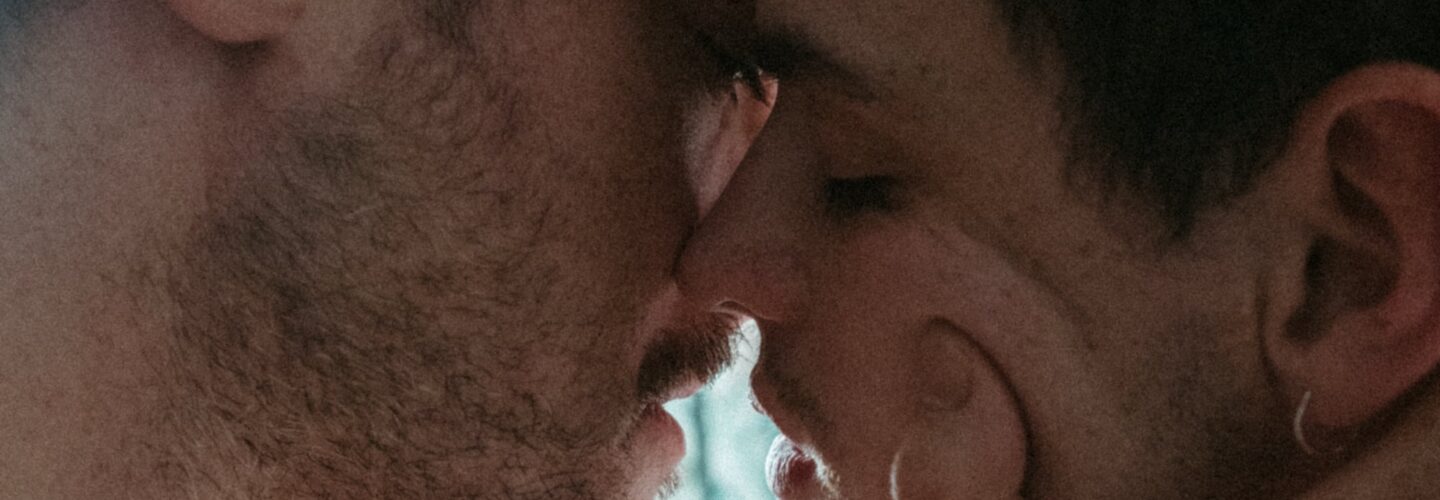

Sometimes what remains unspoken matters more than what is said aloud. This seems to be at the core of Irish writer/director Caleb J. Roberts’ tender short Purebred. Set in a sweltering, claustrophobic flat, we are immersed in a hazy confrontation between a trans man, Owen, and his on-and-off lover, Seán, following the life-altering result of a pregnancy test. Tactile and sweaty, a thick atmosphere lingers in Seán’s apartment. Hazy cinematography conjures the erotic warmth which pours from an intense heatwave, the weather acting as a physical manifestation of the claustrophobic circumstances Owen finds himself caught up in. Though the narrative is acutely specific, observing harmful patterns of queer dating culture, its emotional resonance is universal. Deep down, Purebred is about breaking the self-destructive cycles we all find ourselves falling into, while acknowledging the fortitude it takes to escape stagnation. With the short currently available to stream on All4 as part of the Iris Prize, Roberts joins DN to discuss communicating through silent body language, transcending conventional depictions of gay relationships, and how he crafted such a stellar soundtrack.
I found the narrative focus on breaking self-destructive cycles very moving. I’d love to know what drew you to such a poignant story.
I love watching people make bad decisions. I love confused characters, sexual tension and repetition. There’s something cathartic about watching someone attempt to break a cycle, especially when there’s chemistry under the surface that brings them back, and we catch the moments that make it worth it. Nothing is ever straightforward.
We are told so much through the use of silence, and often what goes unsaid feels just as important as dialogue. Was this written into the initial screenplay, or was it something that emerged organically?
A little bit of both. I always felt what was most important about this film was the silences and the small movements in body language, rather than the words being said. The dialogue is mostly questions and then answers that bring us nowhere. Two people unable to properly communicate what they want or need from the other. But the way that they look at each other, the way their bodies move together, that was what I really wanted to focus on. The subtilty and the slowness of it and the contradiction that leaves. I’m a big fan of slower cinema, and my direction naturally lands itself in the observation of characters, usually uncomfortably close.

I’m interested in the choice to set Purebred within a heatwave and what that sense of oppressive atmosphere adds to the narrative.
A few years ago, there was a massive heatwave in Belfast that no one was prepared for. We’re a rainy, cold city for most of the year, so when the sun comes out, it hits us really hard. For these characters, it’s also about being stuck physically in that heat, in this cramped apartment building, as much as it is about their relationship. It’s uncomfortable, they look uncomfortable, and that adds another level of tension between them. I wanted the audience to feel like they could smell them, which sounds gross, but I think really works. We don’t know what’s coming from the heat, what’s coming from the vomit sweats that Owen is experiencing, or the shower that Seán has just had. It’s all mixed up.
Most Popular
Owen transcends traditional media depictions of both transgender and gay men.
Being a queer man who also happens to be trans, it’s just the way that I move through the world. I’d become a bit jaded with the trans men/trans masc. representation I’d seen, and by that, I mean, feeling either totally left out of the conversation, or only seeing trans-masculinity through the perspective of someone who formerly identified as a lesbian. We need those narratives of course, but it’s not one that I personally connected to and was struggling to find anything that felt more grounded in my own experiences and feelings. There’s also a massive problem more generally in trans-focused films that involve sex or relationships with someone who isn’t trans, where a character’s transness is viewed as problematic in some way to their cis counterpart. We end up in a space where, despite being sexually desired, it’s only allowed behind closed doors, and the questions that it raises for the other person and their own sexuality become the focus of the story, rather than the perspective of the trans person.
I wanted to make something that felt more balanced. The relationship between these characters is by no means perfect, but it moves away from transness being a focus point. The word trans is never mentioned. This is a gay relationship in the way any relationship between two men is, it’s just that they’re dealing with something specific to that dynamic. I think that’s why people have connected to it, because they can see themselves in some way in this familiar story, that just happens to feature a trans character. Owen’s transness is not the reason why things are failing between them; it’s everything else. It moves away from identity being a focus and lands somewhere that feels a bit more real.
We wanted it to feel like you are watching something so intimate, it feels like you maybe should look away.


Stylistically, your visual vocabulary feels both intimately naturalistic and very intentional.
I had a very clear vision for the way that I wanted this film to look and feel. Something that felt incredibly still and repetitive but also had moments of intensity and movement. Our DoP, Eoin McLoughlin ISC, works a lot in fashion and music videos, where the body is doing a lot more than the dialogue, so he was already tuned in to the visual style and the way we wanted to tell the story. Using longer takes, slow, constant zooming movements and creating the feeling like we’re staying on certain shots for a bit too long for comfort. We wanted it to feel like you are watching something so intimate, it feels like you maybe should look away, and he captured that so well. It’s incredible when you just land on the same page with someone as talented as Eoin. I’m so glad I had the chance to work with him on this film.
Stephanie McCutcheon’s edit is linear, yet features occasional flourishes of non-linearity, alongside hazy time-jumps. How did you find such a distinct rhythm during post-production?
Stephanie McClutcheon and I talked about the project a lot before we started shooting. By the time we got into the edit, we were already playing around with the positioning of the intimacy and figuring out the ways it changed the narrative. It was important to both of us that the sex felt like a repetitive cycle that can’t really be placed in an exact time. This could be the moment of conception we’re watching; it could be the sex after they step back inside the flat before Owen leaves, playing back over and over… it could be a mixture of all the times they’ve hooked up, left, and found each other again. Those moments just really defined the relationship for us, because the exact time didn’t matter. By the time we got into the edit, we were already playing around with the positioning of the intimacy and figuring out the ways it changed the narrative.
It was important to both of us that the sex felt like a repetitive cycle that can’t really be placed in an exact time.


Intimacy and proximity tell us so much about Owen and Seán’s dynamic. Could you explain your approach to blocking and directing Pete MacHale and Diarmuid Noyes?
I really enjoyed working with Pete MacHale and Diarmuid Noyes because the way they move through scenes is so different from one another. This was my first time directing something that relied so much on the physical chemistry of a pair, and we didn’t really rehearse anything. Instead, we just had conversations about these characters, the three of us, and how they’ve ended up in this situation. Where they’ve been and maybe where they’ll end up. Pete is an incredible performer; the way he can convey so much with so little is a testament to his talent. Diarmuid is a deep thinker and has a lot of consideration in his approach. He really lives his character on set, as opposed to being able to properly switch on and off between takes.
These styles blended exactly the way I wanted them to; Owen and Seán are frantically orbiting each other with different energies and that makes their performances so believable. In the linear timeline, these two characters, until the very end, never cross into each other’s physical space. Seán chases Owen down the street at one point, but they never touch. When Seán is the one to cross that line, it’s a really important moment for his character, being the one to not back away from it all. We also worked with an amazing intimacy co-ordinator, Demi O’Hara, on creating sex that felt real. It was Pete who reminded me that he’d never seen a trans man enjoy the sex he was having on screen, and that became a priority for us. Letting Owen feel equally in control of it all and enjoying it.
The soundtrack features tracks from Irish bands CHALK and Fontaines D.C. What did you feel these tracks contributed to the tone of the narrative?
I wanted to ground Purebred at home. The film was shot a few streets over from where my now fiancée used to live, but unless you’re from Belfast, you won’t recognise that area. The soundtrack brings the film back. CHALK are a fast-rising band from Belfast who I know personally, and their tracks are so important to the rhythm of the edit and the overwhelming sense of constant turbulence. Fontaines D.C.’s Motorcycle Boy was a track the crew listened to a lot during the shoot. Romance came out the week we shot the film, and it sort of took over. We got ahead of ourselves and cut the end of the film to the track without knowing if we could have it. Thankfully, Fontaines connected to what we were doing and gave us the track for free, forever. It’s melancholic but not entirely hopeless, and keeps the film tied to Belfast and Ireland, no matter how far it travels. I am so grateful to both bands for letting us use their work in ours.
I knew it would have a home at queer festivals, but I was more interested in the reception outside of spaces where it would be a comfortable watch for people.

Purebred is in the midst of a very successful festival run. How have audiences responded to the film? Have any reactions stood out or surprised you?
Given the state of things right now for trans people, I was nervous about the reception of such an explicitly trans and queer film. I knew it would have a home at queer festivals, but I was more interested in the reception outside of spaces where it would be a comfortable watch for people. Audiences have responded in really interesting ways. Deliberately not mentioning the word trans in the film and dropping the audience into a men’s public bathroom stall… you can see the cogs turning in people’s heads. At the Galway Film Fleadh, about halfway in, an older woman turned to her friend and loudly whispered, “I knew it!” and I loved that. The film is exposing people to an experience that might never have crossed their minds and is doing it in a way that feels familiar.
And finally, what can we expect to see next from you?
I am in development on a feature film with Northern Ireland Screen and shooting a TV pilot short at the end of the year, with the hope it gets commissioned for a series. I’m really excited about the opportunities this short’s success has opened up for me, and where it will go next!