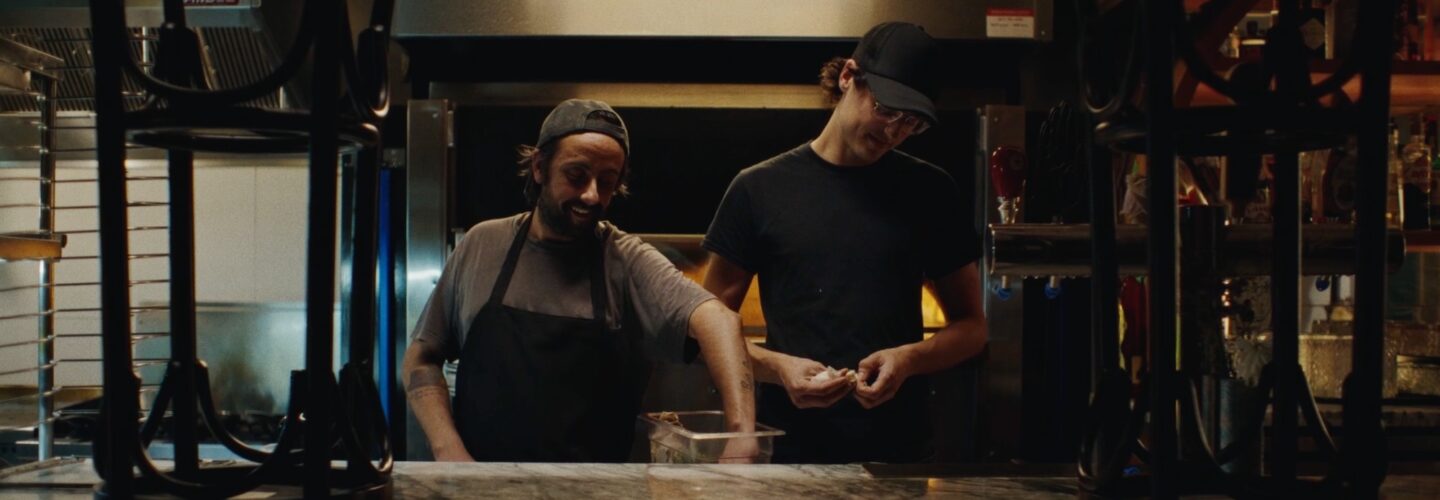
A restaurant is usually portrayed on screen as a place of chaos: shouted orders, sizzling dishes, hurried footsteps and plates moving from kitchen to table in a seemingly endless rush. In her TIFF-premiering short Dish Pit, Anna Hopkins offers a different take on the familiar setting, bringing us into the quiet moments after the shift has ended, when the restaurant becomes a space for connection and unexpected vulnerability. At the centre of the story are two men, each searching for something they feel they have lost — or perhaps have yet to find. One dreams of building a career in cinema, while the other has found himself washing dishes, despite his true calling lying in being a chef.
Working with the simplicity of a single location, Hopkins transforms the restaurant into an intimate stage for their after hours encounter. Away from the noise and pressure of service, the two characters are given the space to talk, reflect and reveal themselves, allowing the film to explore ambition, disappointment and the desire to find one’s place in the world. What may initially seem like a simple conversation between two restaurant workers gradually becomes something more profound: a meeting between two people at very different points in their lives, yet united by the same uncertainty about what comes next. Joining us on DN, the actor/writer/director talks through her decision to build a film around stillness rather than service, the rehearsal process that put a real chef’s movements into an actor’s body, and why the simple act of cooking someone a meal after hours felt like the truest thing she could point a camera at.
You worked in restaurants when you were younger, and it’s fascinating to think that, after leaving hospitality to pursue filmmaking, life brought you back into owning a restaurant yourself. How did returning to that environment as both owner and filmmaker change the way you saw the story you wanted to tell? How has your perspective shifted after all the years spent away from that industry?
I think what being part of ownership of our restaurant gave me was a very holistic understanding of its ecosystem, because at various times I was deeply embedded in front of house, back of house, construction, food, design and everything in between. And what this allowed me was to connect with so many different people and observe human behavior within so many different contexts. It’s such a privilege as a writer to be able to immerse yourself in another world and get to observe. It was from all those observations that this story emerged.
You’ve said you wanted to capture a side of restaurant life that isn’t often seen — finding drama in the quietness of a job usually portrayed as very lively. It’s a beautiful inversion of how restaurants tend to appear on screen, where filmmakers usually focus on the adrenaline and chaos of service. Did you ever worry that building a film on this stillness was a creative risk, and that audiences might expect a more hectic environment?
No, I never worried, because while it may not be everyone’s cup of tea, I know what films I love to watch, and what I’m drawn to, and I know there’s an audience for that as well. When I was writing Dish Pit, I had just seen Trần Anh Hùng’s The Taste of Things, and just loved it so much. It gave me that feeling of wanting to live inside a film. And while some people who I love and respect did not like that film, it made my soul vibrate, and that’s what you’re looking for when you’re making something of your own.
It’s such a privilege as a writer to be able to immerse yourself in another world and get to observe. It was from all those observations that this story emerged.
I also thought a lot about the scene in Tampopo where one of the characters breaks into a kitchen in the middle of the night and makes a fried rice omelet for a little boy. For me, I could’ve watched an entire film that was just that scene and those two characters. It’s intimate and quiet and wondrous and delicious. There is absolute chaos in the restaurant world for sure, but I guess it’s what you as the writer observe as the most pertinent parts of that world that mean something to you. And for me it’s connection and quiet after that chaos that is special and worth paying attention to.
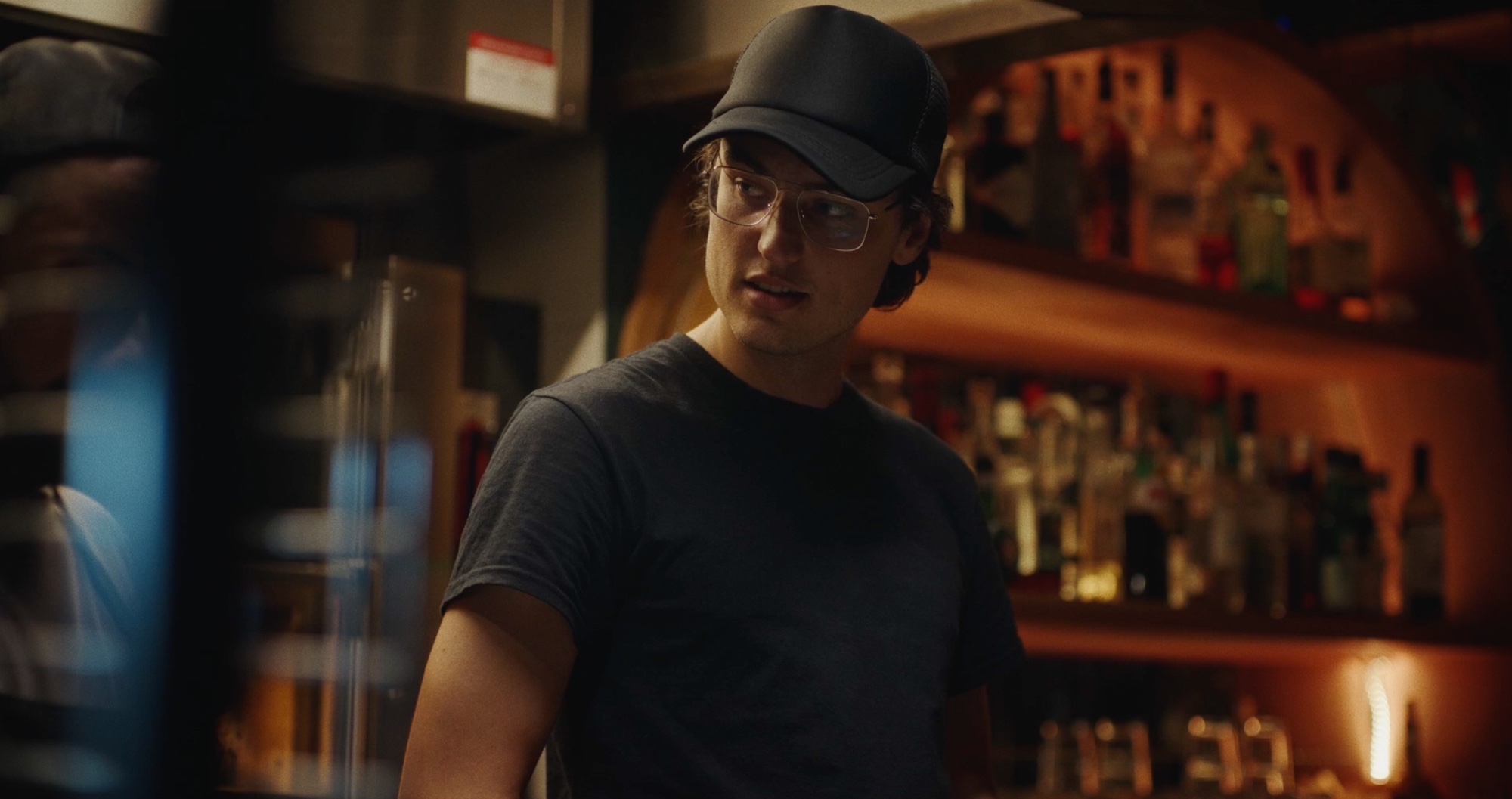
The restaurant also becomes a very different space from the one we’re used to experiencing as customers. How did you and cinematographer Mat Barkley approach photographing that transformation?
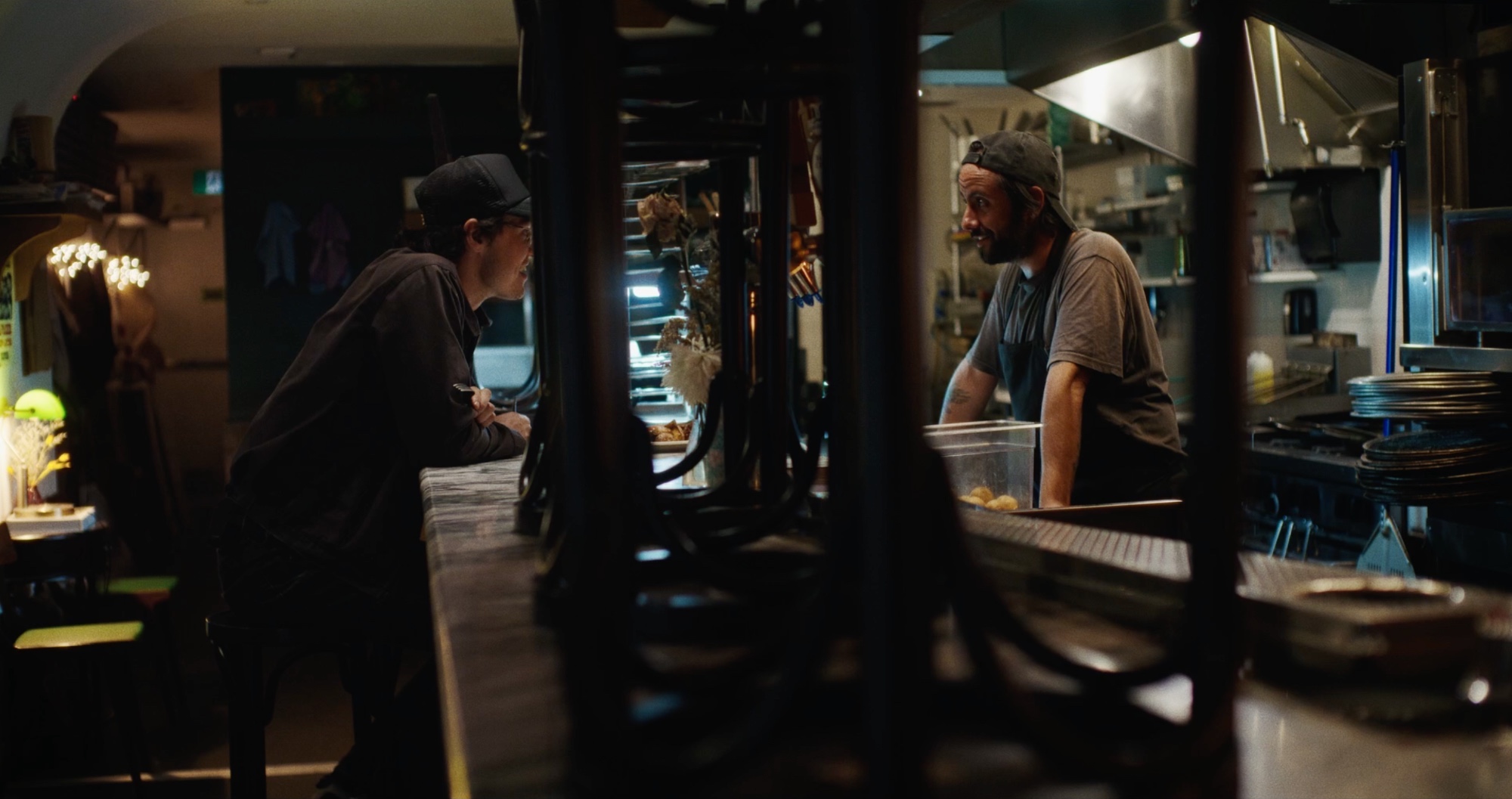
We wanted the space to feel completely intimate, cozy and safe from the wild outside world, in a sense. A space that was conducive to slowly opening up. So the biggest thing for me was to create a sense of warmth throughout, which Mat achieved so beautifully. The fire from the pizza oven in the center of the space gave us so much, as did practical lamps throughout.
Most Popular
Working within a real, functioning restaurant must have shaped how you could move actors through the space. How did you approach blocking within those tight, practical constraints — the pass, the kitchen line, the floor?
Having access to the space prior to shooting was really what shaped the film. I worked with the actors in the space, workshopping the scenes and building specific blocking from their instincts and insights. I didn’t change the environment much, but encouraged them to use the space and the tools already there as much as possible, so that we could incorporate as much behavior into the scenes as possible. While I made sure this was first explored in a fluid way, once a certain physical behavior worked well, I would incorporate it into the blocking and we would rehearse a lot. The key to this was tons of rehearsal, to get the movements into the actors’ bodies so that on the day it felt genuine and seamless.
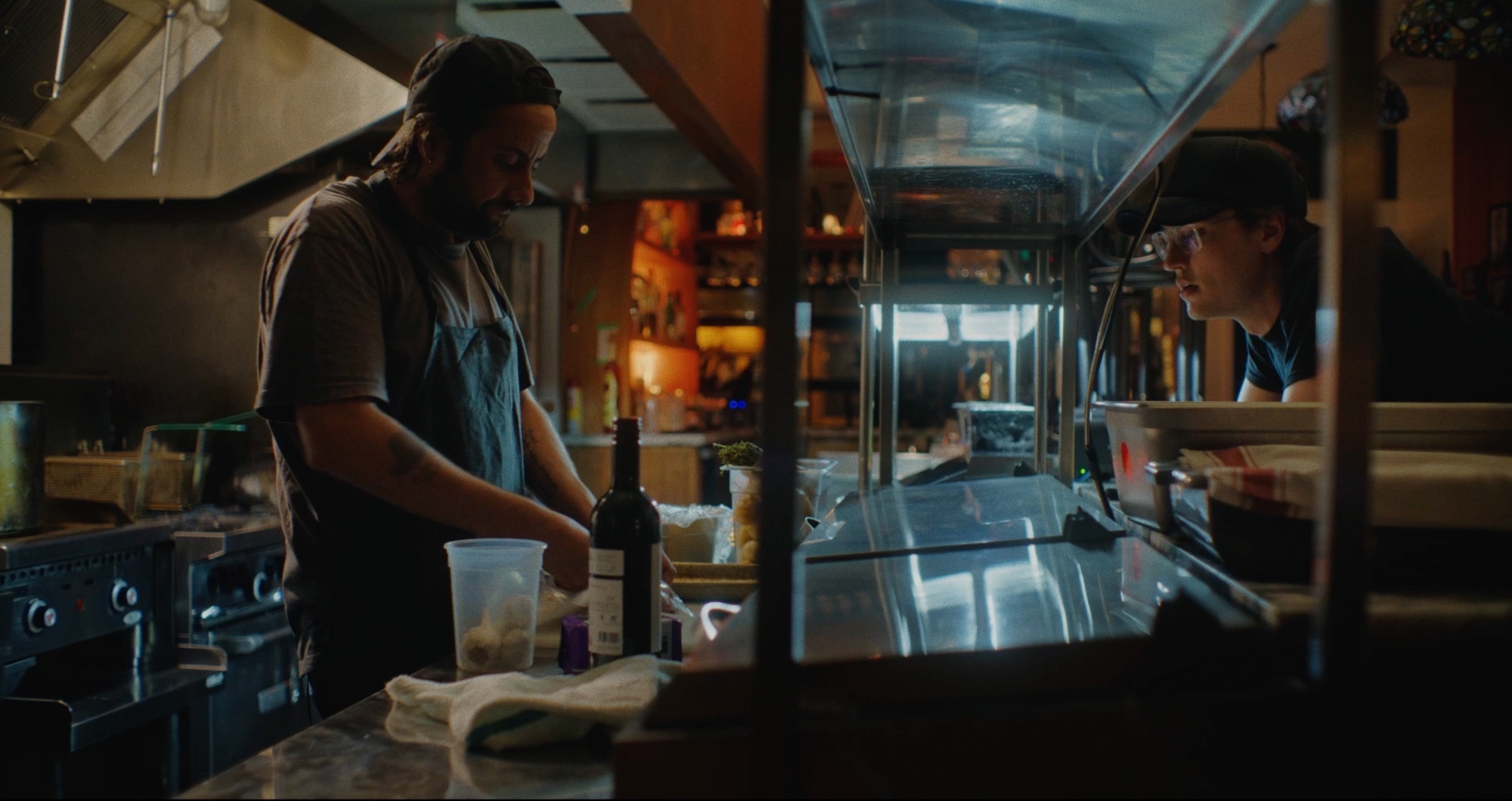
Going further into the technical side of the film: you shot on the RED Komodo X with Zeiss Super Speed lenses to give it a very intimate feel. It seems like the right choice: a camera small enough to stay close to the characters, paired with lenses that bring warmth and character to the image. Was the compactness of the RED Komodo X important in preserving that sense of closeness and spontaneity during the shoot, even before getting into the edit to shape the film’s look?
Yes, absolutely. The genesis of this shoot was an experience I had a few months earlier, where I was the second unit director on a large-scale commercial. I worked with a tiny skeleton crew with awesome talent, and the freedom that I felt doing that was something I wanted to emulate on my own shoot. While, of course, certain size shoots require specific things, I felt like I wanted to challenge myself to work really minimally and wear a ton more hats to achieve that. When I described the kind of freedom and flexibility I was looking for to Mat, he immediately understood and built out his gear appropriately. While there was a tremendous amount of prep prior to the shoot, we were small enough on the day as a crew to move around seamlessly and really capture as much spontaneity as possible. This approach also allowed us to shoot during actual restaurant service for a few hours each night without creating much disruption at all.
Both Max and Joe are, in different ways, people who have stepped sideways from the futures they once imagined for themselves. One is still chasing a dream, the other has deliberately retreated from the pressure of one. Did writing them change the way you think about what success or fulfilment looks like?
I think what writing these two did was allow me to focus on the sort of simple moments of connection in the present — that may seem mundane — but that ultimately create a sense of fulfillment in themselves. We don’t know what will happen to Max or Joe, or where their lives will take them, but I do know their shared meal meant a little something to both of them. As I get older, it just becomes clearer and clearer that there will always be a certain degree of uncertainty plaguing you at all times, and so appreciating unexpected human connection, and a simple pleasure like eating something delicious, can give us a few fleeting moments of relief.
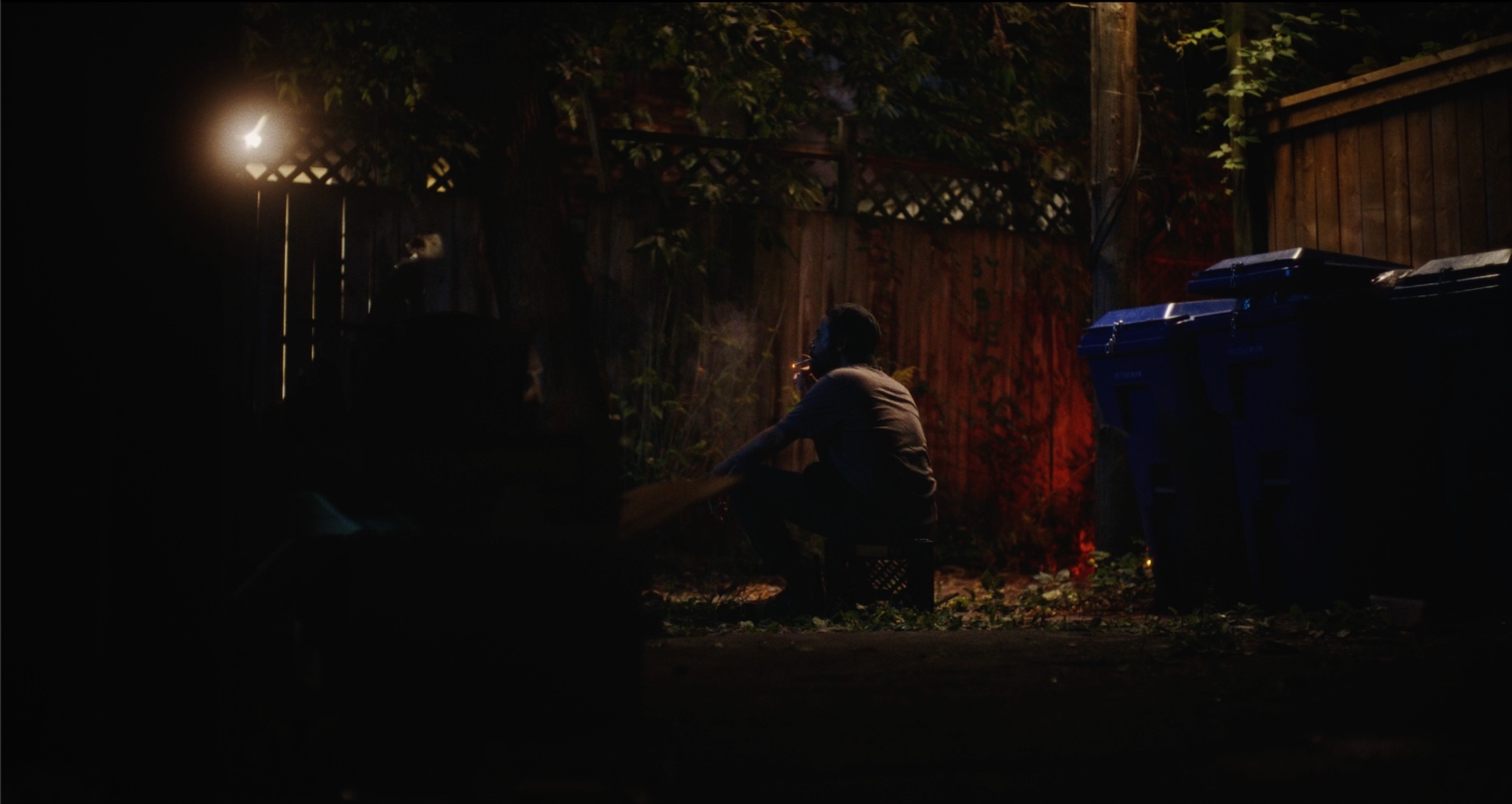
Let’s focus on the film’s only outdoor scene — a brief moment that interrupts the intimacy of the restaurant. It gives tangible form to something that had previously only existed in conversation: Max’s longing to break into the film industry, and, in the same breath, the sting of rejection. How early did you know you wanted to externalise that part of his journey, rather than leaving it as something only talked about?
I wanted to create a tiny bit of a ticking clock in the story, to have a touch of momentum in this otherwise relatively still story. As I explored what it would look like for Max to really go after the thing he wanted, it just instinctively felt right to have him be rejected quite swiftly. I think that just came from my unconscious, because rejection is such a huge part of going after any artistic or creative life, and I wanted him to experience that, but still be okay by the end. Maybe even have a bit of hope and a laugh too. It just made sense to head outside into the world for that moment, and to come back into the safety of the restaurant afterwards, to do a bit of healing.
As I get older, it just becomes clearer and clearer that there will always be a certain degree of uncertainty plaguing you at all times, and so appreciating unexpected human connection, and a simple pleasure like eating something delicious, can give us a few fleeting moments of relief.
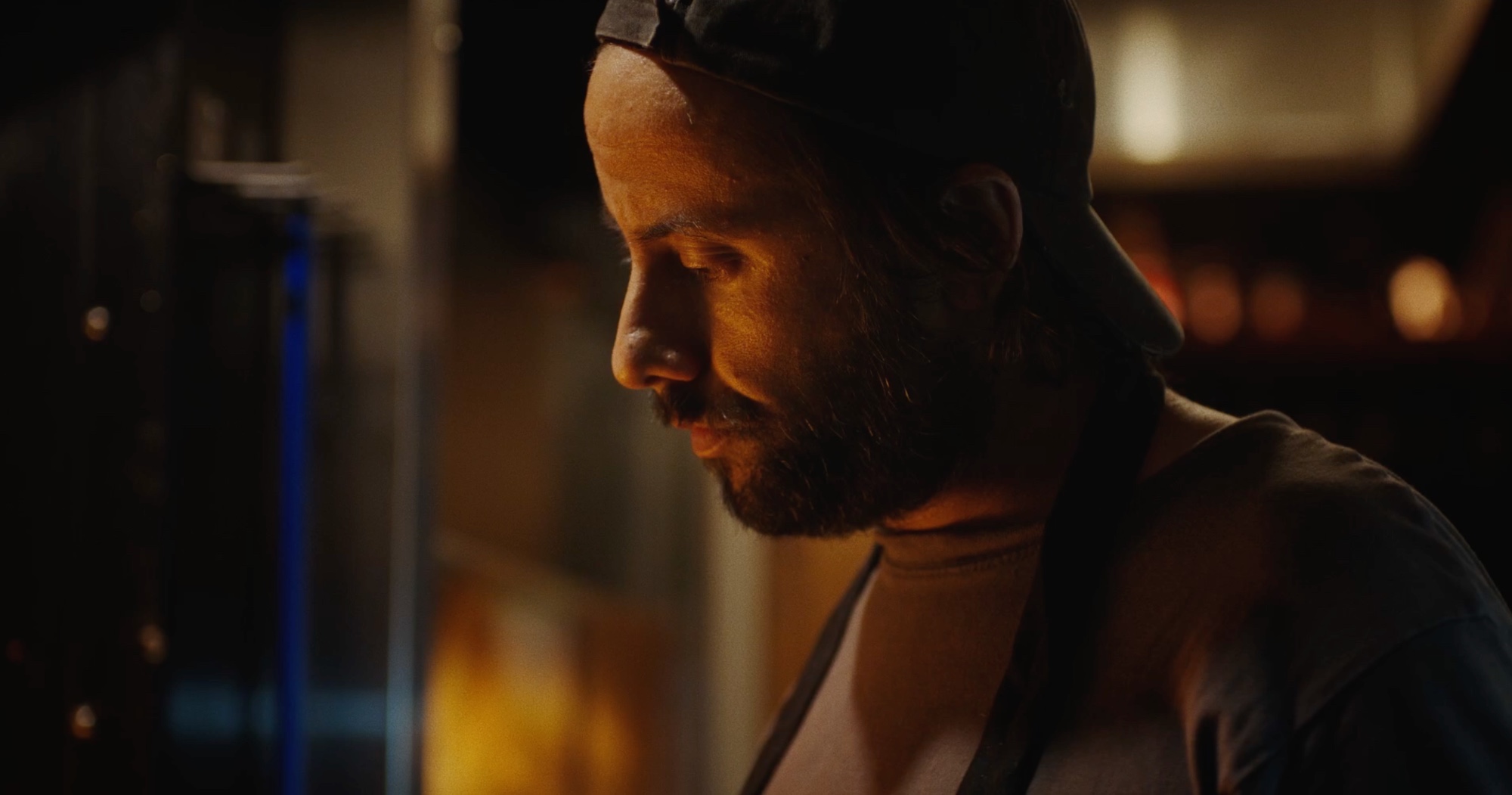
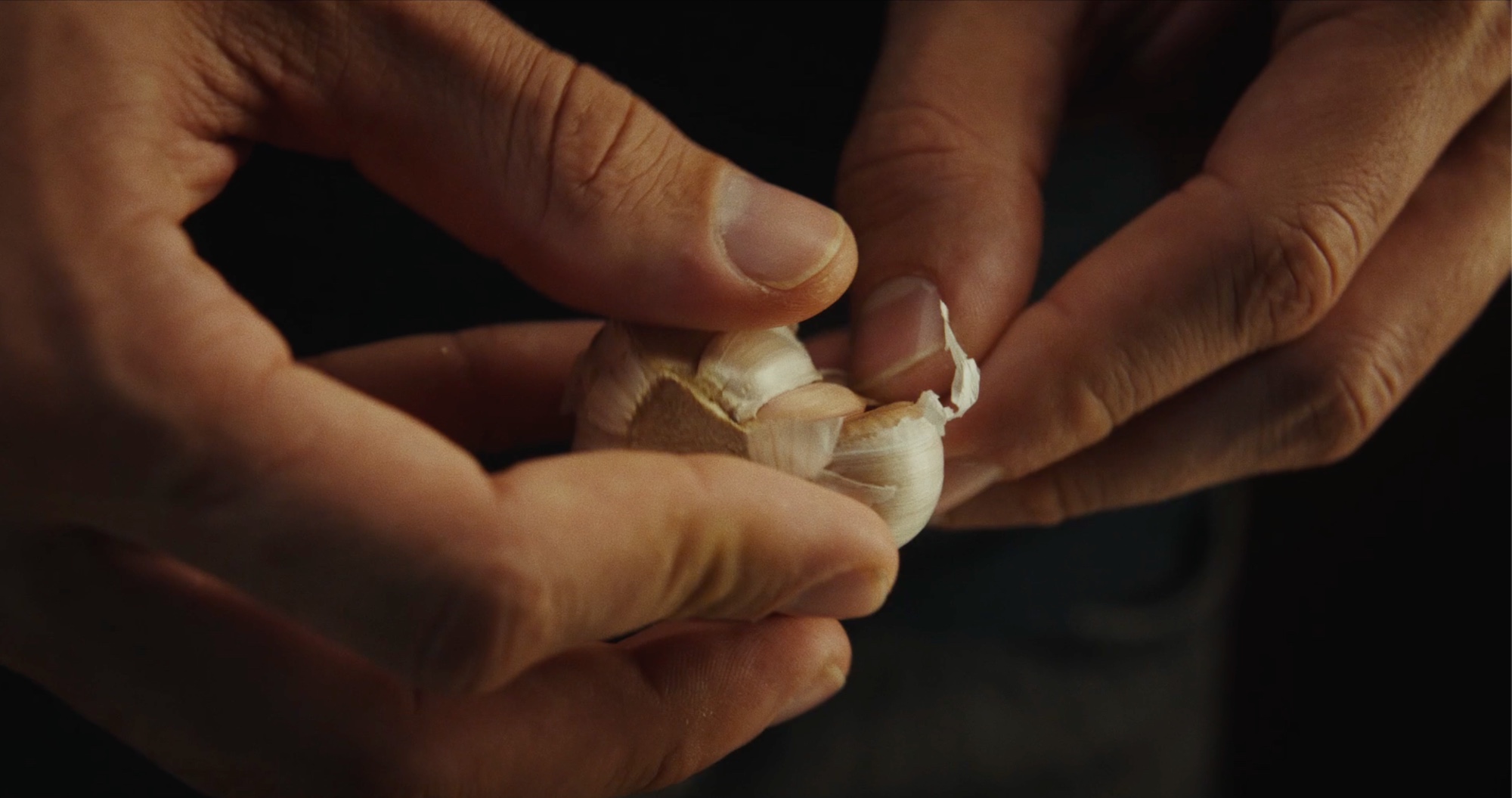
One of the things Dish Pit captures beautifully is expertise that’s almost invisible. You made the most of your restaurant, not just as a location but as a source of authenticity, ensuring the believability of the acting by having Chef Jon Pde choreograph the kitchen movements and serve as a hand double for actor Matthew Gouveia. Why was this important to you? Do you think physical truth is something audiences register instinctively?
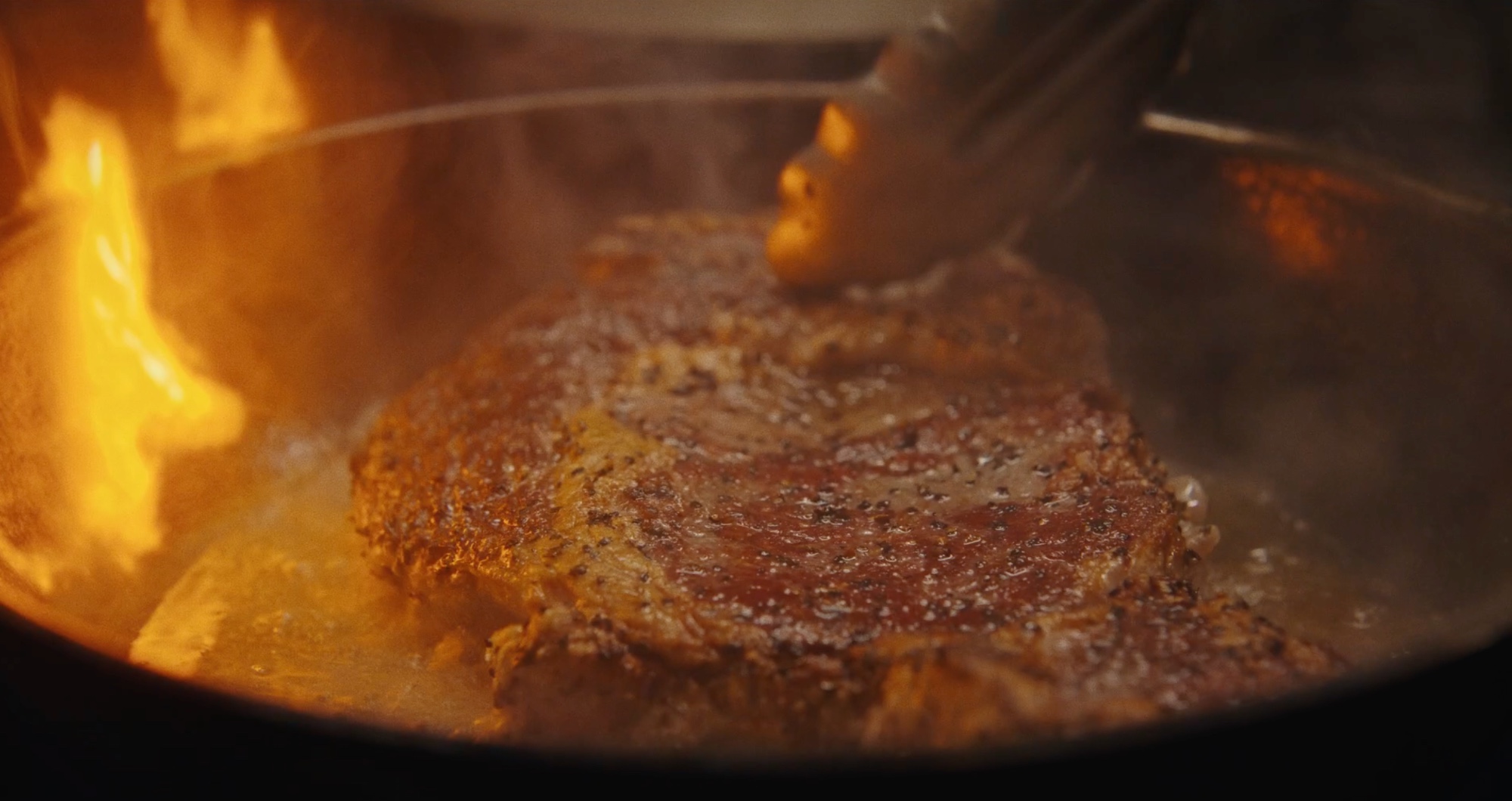
As I come from an acting background and studied with many incredible acting teachers over the past 20 years, what’s been nailed into my mind is the paramount importance of behavior. “Acting is behaving truthfully under imaginary circumstances”, as Sandy Meisner famously said. I knew if we didn’t have the truthful physical behavior for Joe (the chef) in particular, the whole thing wouldn’t work. To achieve that, first I had the privilege of working with the immensely talented actor Matthew Gouveia, who is the perfect mix of not taking himself too seriously, but taking the work incredibly seriously. Then I brought our real chef, Jon Pde, into the fold, particularly during rehearsals, so we could break down every single physical moment with Matthew and allow him to practice until it felt right. For anything like chopping or searing, I used Jon Pde’s hands as a double for Matthew, which added a really important element of authenticity.
I also filmed Jon Pde actually cooking the meal in rehearsals, and adjusted the script while doing so, adding some moments in the story that weren’t there before. Austin Hutchings, who so beautifully played Max, was also a bartender at our restaurant prior to filming Dish Pit, so he knew the space so well, which added in that layer of ease that I needed to sell this late-night conversation. I do think audiences absolutely register anything inauthentic behaviorally, and when that happens you get taken out of the story, which is the worst-case scenario.
As I come from an acting background, and studied with many incredible acting teachers over the past 20 years, what’s been nailed into my mind is the paramount importance of behavior.
Food on screen usually gets the glossy, sensuous ‘food porn’ treatment — glistening close-ups designed to make an audience salivate. Dish Pit feels more interested in the labour behind the plate than the plate itself. Did you consciously resist that seductive way of shooting food, or did you want moments of that beauty to sit alongside the grind?
I think I just love watching a meal come together, and the life that happens at the same time while that’s going on. This is something I witness all the time at the restaurant, like for instance watching someone engage in the complex process of making dough while chatting to their colleague about the date they went on the other night. It’s those two activities in tandem that I find beautiful. As for the dish itself, I wanted to show the deliciousness of the food in its most simple form. Because I wanted to show that Joe can cook for real, without any frills. What he ends up making says a lot about him.
Could you share your favourite short film and tell us why you chose it?
That’s a hard question! There are so many! But I’d say a short film that has always stuck with me is An Extraordinary Person (Quelqu’un d’extraordinaire) by Monia Chokri. It’s such a brilliant mix of depth and humor and sophisticated character studies all packed into a wild ride. It’s a must-see.
Finally, what are you cooking up next (pun intended)?
I’ve just finished a new short, titled Full Circle, which captures an intimate conversation between a mother and son throughout the entirety of a total solar eclipse. Mat Barkley worked his magic on this one as well. We had so much fun practically emulating the eclipse light shifts from beginning to end, building out that strange experience of witnessing such a cosmic phenomena. I’m also writing a few feature screenplays at the moment, continuing to act, and of course helping out at the restaurant when I can.
I think I framed the restaurant as a safe haven in Dish Pit, because in a sense that’s what it is for me. As I’ve navigated the world of freelance work in creative fields my entire life, there’s something comforting about going back to the restaurant and working with your hands, with people who you admire and respect, who have absolutely nothing to do with the film industry. If there’s any advice I’d give to writers, directors, and actors, it’s finding a world you can engage with sometimes that is far removed from your day-to-day in filmmaking. It’ll give your writer/director/actor brain a rest, which in turn primes it for more creation.