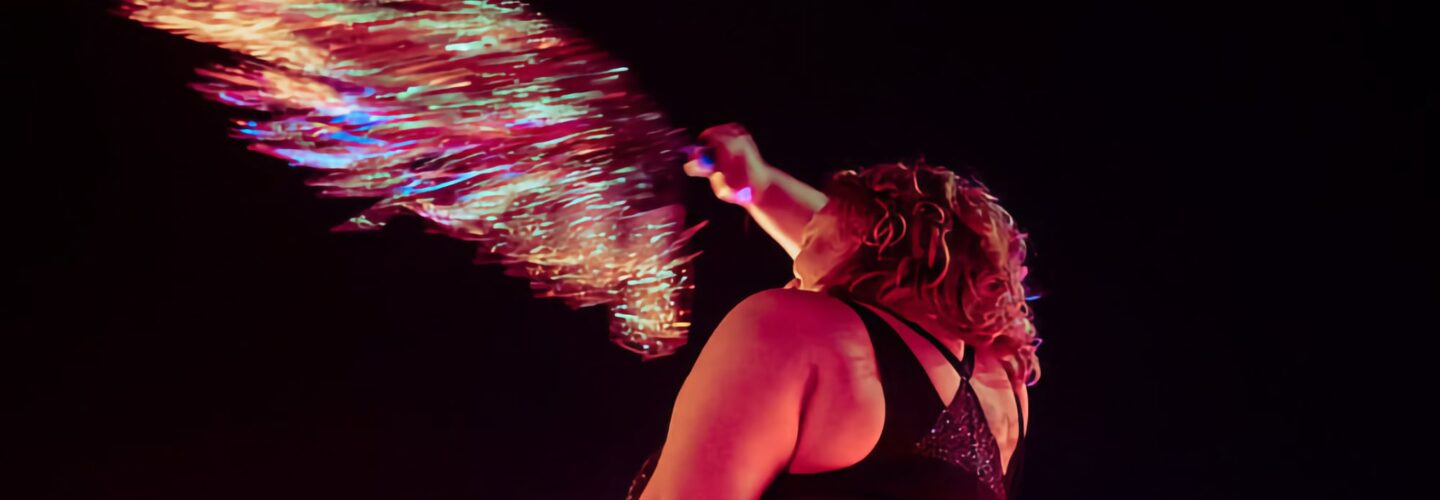

Sarah Grant’s comedic drama Candy is a short that speaks unreservedly from the heart. When a funding opportunity became available, the Glaswegian filmmaker and performer decided to develop a story which reflected her both professionally and personally. The resulting Candy follows a young woman who, despite her personal reservations, finds the confidence to perform the burlesque routine she’s been practising to her full power when it matters most, proving to everyone (and herself) that her size and others’ expectations should never be barriers to self-expression. It’s a lesson championed by Grant who soon realised, with the support of her team, she was exactly the right person to take up the main role. Whilst the world is moving in the right direction in regards to inclusion and breaking down the archaic barriers of judgement, it’s unfortunately clear that we’re yet to reach that goal and so Grant is a welcome voice in an industry where body size and appearance still strongly dictate the work that gets made and the roles we see onscreen. Candy is a delightful breath of fresh air and it was a pleasure to speak to Grant about exorcising her own demons in the writing, performing and direction of the short and consistently celebrating empowerment and autonomy in her work.
What drew you to want to tackle issues of body, sex positive and inclusive female-led stories in such a direct, forthright manner with Candy?
Candy was developed through the Short Circuit and Screen Scotland development programme called Sharp Shorts. I pitched for a place on this scheme with a 500 word synopsis and a small director’s statement. I first started to think about what kind of film I wanted to make, something that would not only be my calling card but also be a great example of my work, tone and approach for taking other projects forward.
Going into Candy I knew that I wanted to make something that reflected where I was both personally, in my relationship with my confidence in my body, and professionally, where I was in my career as a writer, director and occasional performer. Comedy is how I mask talking about things that are really important to me in my work, so I was determined to go into this film with my usual approach so I could push myself emotionally and create work that translated more vulnerability. I wanted to be confident and to be brave, and I knew that telling Mandy’s story was a way for me to face my demons almost without actually having to think about them.
I was determined to go into this film with my usual approach so I could push myself emotionally and create work that translated more vulnerability.
Mandy is confident and sexually empowered and she loves burlesque. She knows that she can do it well and she is surrounded by people, mainly her best friend Jenna, who encourages her and validates her in a very personal way. However, what Mandy struggles with is that being confident in private is not the same as being confident in public. Mandy’s self-assurance and self-love have to be tested and the big bad world is full of people who would tell her that she is wrong for being confident and for loving herself because of her body. That is exactly how I feel as a film director. I have done really well on small scale films with zero budgets and I have been an advocate for myself as a working class artist and a plus size woman, in front of and behind the camera, and I could keep doing that forever, but I knew that if I was going to step into the world of the film industry properly then I would have to be that person, that storyteller, in the big bad world. Candy was my chance to put my money where my mouth was, to walk the walk as a writer, as a director, and as a performer.

What experiences did you bring from your earlier low budget films to this more ambitious production and how did working with a dedicated producer expand the short’s possibilities?
I have worked extensively with zero and micro budgets, purely because I’m a working-class artist and I don’t believe budget should ever be a barrier to creating work. If it were, I would never get anything done. Also, I feel that I am my most creative when I have the most constraints placed on me and my project. I knew that the funding I was being given brought the luxury of both budget and time, and I knew that if I wasn’t very strict with myself, I would allow that luxury to bloat the process and get in the way of me doing what I do best. I approached Candy with the same momentum that I have learned to throw at all my other projects, no matter what scale they are.
Most Popular
I didn’t start looking for a producer until after I had been confirmed as a recipient of the funding, and through recommendations I met Misha McCullagh. While these kinds of initial and introductory conversations usually are entered into politely and tentatively, with no pressure for anything to come from them, with Misha it was love at first sight. By the end of the call we were making plans and charging forward. Every day after that was magical as we got to work and started to pull things together. My prep was very limited compared to Misha’s, and one thing that I think makes her stand out as the best producer I have ever met is that she could tell when I was limiting my vision for the sake of production. I have been in production roles myself so I know what things are possible within the budget, so sometimes I would find myself self-censoring for the sake of ease, but Misha would call me on it and tell me to push myself and my vision as far as it would go. It was her job to then work out the realities. Because of that, I was allowed to be more ambitious and more unapologetic with the way I told this story, and the film is absolutely stronger for it.
I feel that I am my most creative when I have the most constraints place on me and my project.

I love the empowerment and unapologetic female gaze that push against the all too familiar moments of toxic masculinity, both narratively and from a larger conceptual perspective, which speaks to established narrative tropes.
I am a huge advocate for plus size women in film and television who are portrayed in ways that don’t centralise their fatness as a fundamental characteristic or make them the butt of the joke. I am so sick of the ‘Fat Girl Best Friend’ trope, where the plus size character’s only function is to be a mirror for the thin lead, or a comic relief when things get dark. Candy asks the question, “What if the fat girl best friend was the main character?” Mandy is self-assured and she has wants and needs of her own, and even though Jenna’s arc is attractive to an audience because of the dramatic narrative, Mandy’s want to reclaim her sexuality through the art of burlesque is valid and she deserves to play out that story as the main character.
The character of Chris, someone entrenched in toxic masculinity, someone who thinks the women in his life are a reflection on him and something he can control to avoid embarrassment, is representative of how plus size women are told to feel about their bodies by society. I wanted to use this to really hammer home that it’s not Mandy who is wrong for celebrating herself, but Chris is wrong for placing his own expectations on her body.
I knew that I was surrounded by talented and supportive women who knew me and knew my intent. That was the crutch that I needed to both direct and perform.
How did you balance the practicalities of working as a director who also stars in and wrote the film?
The creative team and I had a lot of discussions about who would play Mandy. I have starred in my own shorts multiple times out of necessity and budgetary constraints rather than a genuine desire to act, however when I knew that I had Katrina Allen in the role of Jenna, Misha McCullagh in the role of producer and Charlotte Daniel as first assistant director, I knew that I was surrounded by talented and supportive women who knew me and knew my intent. That was the crutch that I needed to both direct and perform. Relying on them for safeguarding and creative input while I was in front of the camera just felt like an extension of the collaborative process I have with my crew when I am solely in the directing role.

Could you tell us about your process for constructing the choreography for the film’s dance?
Bringing the element of dance into the film was so important for me, as it is a space that I have felt culturally excluded from for many years. I have always loved to dance but have never done so in any sort of formal way or pursued any training, feeling that my body would be a barrier to the art form. However, during the pandemic a local studio, Dance Glasgow, run by an incredible creative, Marion Baird, started putting her classes online. The class would all dance in our living rooms and learn the MTV choreography for Britney Spears songs and it was a joy that was needed in that very dark time. Learning to dance in private gave me the confidence to go to classes in person when they returned, and to fully engage with the joy. Marion and I worked on the choreography together. She is the most incredible teacher, creative and an absolute dream to work with. I would write dance into all my future films just to get to work with her again.
The only thing that tripped us up was in the initial plan we had hoped to film the dance on the last day, so I could give it my all and then be done (and if it went horribly wrong I never had to see these people again), however there was a football game on that date so for safety reasons we decided the week of the shoot to swap our schedule round so I was dancing on day two. I was so nervous about being that vulnerable in front of this new group of people, but if anything, it solidified our bond. Everyone got to see me put my money where my mouth is early, and they showed up with renewed vigour to tell the story, which was very affirming as a director.


What inspired the sharp and bright look of the film?
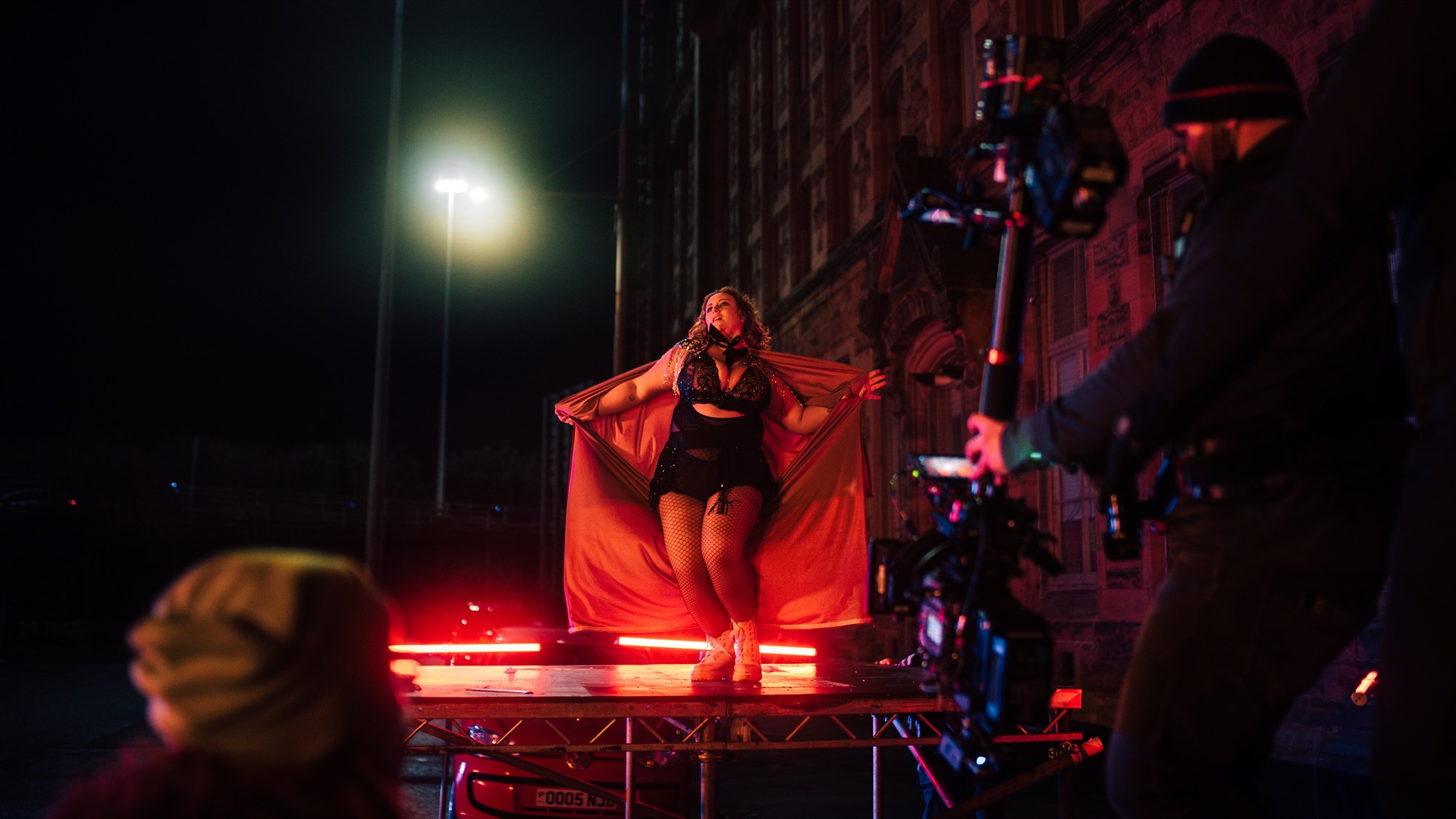
A big influence for me tonally is the film Wild Rose written by Nicole Taylor. Coming from a working-class Glaswegian background, I’m very used to seeing my stories and my streets portrayed through the poverty porn lens, and I am very tired of seeing my history and my culture on screen where the deprivation is almost glamorised. There’s so much joy in spite of the hardships, and what I loved about Wild Rose was that this film brought the magic and sparkle of country music to the well-trodden streets of the scheme. I wanted to bring the same element of glamour into Candy while still being grounded in reality, so I had a very strong visual reference that I could go with when articulating my vision to the post team.
Our executive producer, Lauren Lamarr, was someone I approached after being awarded the funding. She was on the judging panel when I pitched for the funding and as I knew she was an amazing producer and an ex-burlesque dancer, I really wanted her to be involved in the project in some way. She agreed to come on board as executive producer and then also got the post-production house, Blazing Griffin on as execs too.
I had to really fight the voices of doubt throughout the whole production process telling me I was going to make a fool of myself.
Candy was the first film I cut at a post-production house and it was an amazing experience. Our editor, Elizabeth Clutterbuck, was someone I knew from uni and she was a dream to work with, and all the team in sound and colour were brilliant. We even had a post production manager, Dionysis (Dee) looking after the whole process, which was amazing. The original score was created by my husband, Dev, and seeing it all come together was very powerful. I had to really fight the voices of doubt throughout the whole production process telling me I was going to make a fool of myself, so being surrounded by a post team that brought the story together in a way that made it look better than I could ever have imagined was very special.
This is such a powerful story and I can imagine audiences have shown some big feels!
Going to festivals with Candy has been one of the best experiences of my career. It’s usually programmed at the end of a screening, and you can feel the energy in the room as everyone is left feeling uplifted. I used to be so worried about making films that people thought were good, but Candy has taught me the real thing I want is for people to feel happy when they see my work. What I could never have imagined happening is that the body positive movement would regress, and yet with the rise of things like SkinnyTok and Ozempic culture, I’m starting to see things online that make me scared. I hope that people see Candy and know that confidence is the sexiest underwear imaginable, and you should share it with the world. This film taught me to be unashamed to take up space, and I hope it inspired to help others feel that too.
*What short films do you love and should be seen by a wider audience?
A short film I’m really excited to see out in the world is Static by Miranda Stern. Miranda comes from creative documentaries with amazingly emotional and personal films, such as Clean and Milk [three-time winner at the 2025 WeAreDN Awards], where she chases truth in a poetic way. She carries that poetic and emotion led style into Static, which is a fictional short about two young addicts living together and looking out for each other in a caravan. She tells stories like no other filmmaker I know. I love it.
I’m also obsessed with Truckload by Aella Jordan-Edge, written by and starring Evie Jones. I love any film that explores tragedy through comedy, and this is just a perfect example of that.
Tell us where filmmaking has taken you since Candy?
I have been on a WILD ride with my filmmaking journey. In November 2025, I picture locked my first feature called Fight Me, an office comedy drama starring Sharon Rooney, who plays a wallflower in a corporate office who sets off the collapse of her corporate culture when she punches the office misogynist in the face. What started as an ambition to make something longform for no money and calling in all the favours, turned into a purely independent co-production between Scotland and America with a low six-figure budget and the best people I could have imagined being a part of it. It was a real Cinderella story, and we are due to finish early Spring and hit the festival circuit in Autumn. If you liked Candy, you will love Fight Me.
*Note: This section onwards was appended to this interview on 13th February 2026 for Candy’s online premiere.