
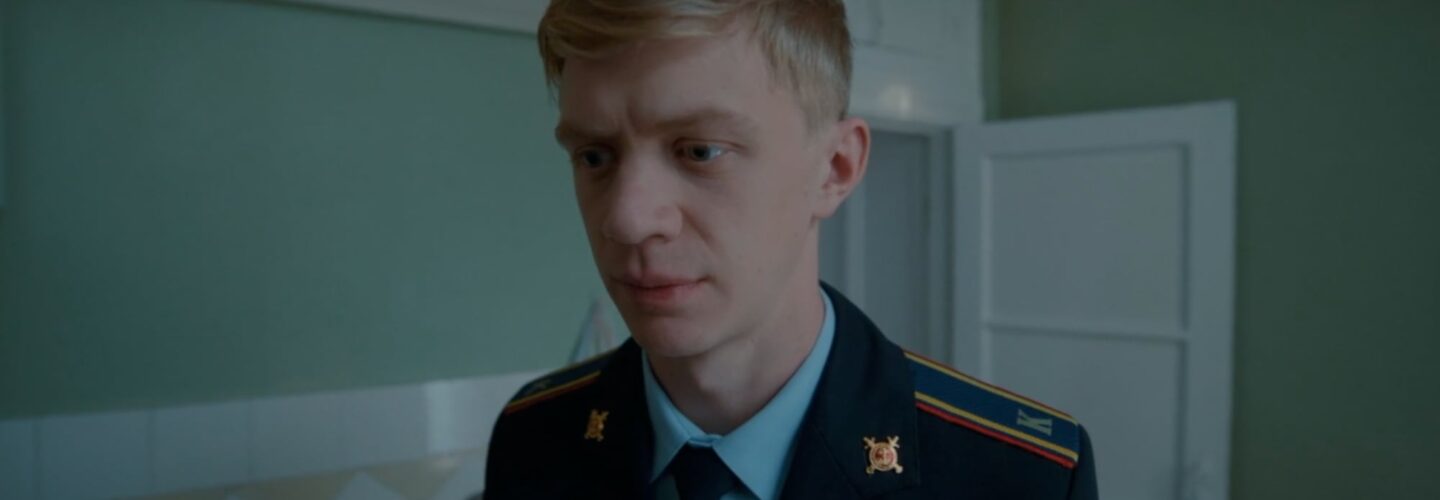
Some films are born of a single, furious question. For director Ellen Rodnianski, that question was a roar against the systemic apathy allowing domestic violence to fester in Russia. Her taut, claustrophobic short, Family Matters (Дела Семейные), is forged from this outrage. The film’s tension ignites not with the violent sounds from a neighbouring apartment, but with the inaction that follows, sharpening its focus from a private moral crisis to a direct confrontation with the system that enables it. Rodnianski masterfully builds this claustrophobia, framing her apathetic would-be seducer within the tight confines of his mother’s apartment. Completed just before the full-scale invasion of Ukraine, the story was shelved, its relevance questioned amidst a new, violent landscape. Yet it was resurrected with a re-edited ending, a crucial recalibration. The personal apathy it diagnoses is revealed as the very toxin that enables larger, geopolitical violence, demonstrating how the silence behind one wall is tragically connected to the explosions beyond another. As Family Matters premieres on Directors Notes, Rodnianski speaks to us about the young cadet serving as a critique of a wider system, how a meticulous pre-visualisation process was crucial for executing the film in just three days, and how the outbreak of war transformed the film’s meaning.
Just before the release of this interview, the foremost NGO fighting domestic violence in Russia was forced to shut down as a result of political repression. For any Russian-based readers who want to help, please donate to this group of psychologists and lawyers still working to help victims of domestic violence.
Andrey is a police academy cadet, a figure who should represent state intervention. How does Family Matters use his specific position to critique the very system he is training to join?
Andrey’s position as a cadet was central to the film. In theory, he should stand for protection and justice, but in practice, he is powerless, hesitant, and morally paralyzed. Through him, I wanted to show how violence becomes normalized. He is training to serve a state that tells him not to interfere, that domestic abuse is a family matter. His inaction mirrors the institutional apathy that allows violence to persist.
What significance did you want the relationship between Andrey and his date to play in the narrative?
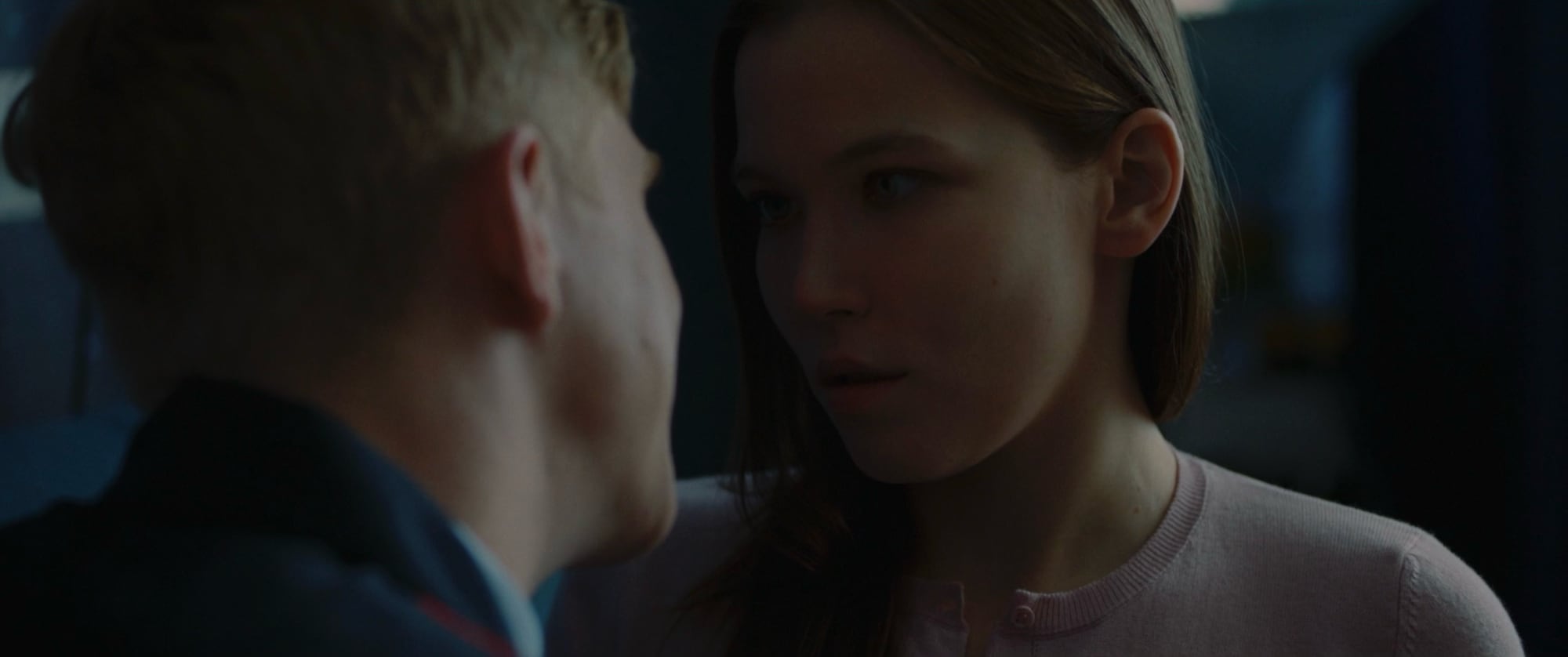
The relationship between Andrey and his date serves as a mirror. Their dynamic begins with awkwardness, an attempt at intimacy, yet it’s constantly undercut by the sounds of violence next door. It’s a parallel between the private and the public, and moral responsibility. I wanted to show how something as ordinary as a date can become charged when one’s conscience is tested. Their relationship exposes the gap between emotion and action, how people compartmentalize empathy to preserve their comfort.
Their relationship becomes a microcosm of the film’s larger critique.
There’s also an additional layer: Andrey is the only cadet who got the weekend off, and his peers are pressuring him to prove himself by sleeping with this girl. That peer pressure, the performance of masculinity, is the same social conditioning that teaches young men to suppress empathy and equate dominance with strength. In that sense, their relationship becomes a microcosm of the film’s larger critique: how toxic masculinity operates quietly, shaping silence and complicity long before any physical violence occurs.
Most Popular
Why did you choose to have the entire conflict heard and not seen?
Choosing to have the violence heard but not seen was deliberate. I didn’t want to reproduce or aestheticize violence against women. Instead, I wanted the audience to experience what it means to witness and do nothing. You hear the violence, you know it’s happening, but you’re separated by a wall, like the characters. That psychological distance is the essence of the film. The real horror lies in complicity, in the silence that follows.

What was the practicality of shaping the sound of the argument to achieve the right level of heard through the wall verisimilitude?
During post, we played with the acoustics and muffling, making sure it felt too close for comfort yet slightly distorted, as it would through a thin wall. The goal was to make the audience share Andrey’s physical and moral position: close enough to act, yet choosing not to.
What did your shoot plan look like in order to achieve all of your coverage on a tight shoot in a confined location?
Shot over three days in the middle of Russian winter—which felt appropriate—the crew was young and many heads of department were female. We pre-shot most of the film on an iPhone with stand-ins, testing light, blocking, and lens choices. This process gave us clarity on rhythm and composition and freed us to focus on emotional beats during the actual shoot. It also allowed our small team, many of them young women, to feel completely in sync.
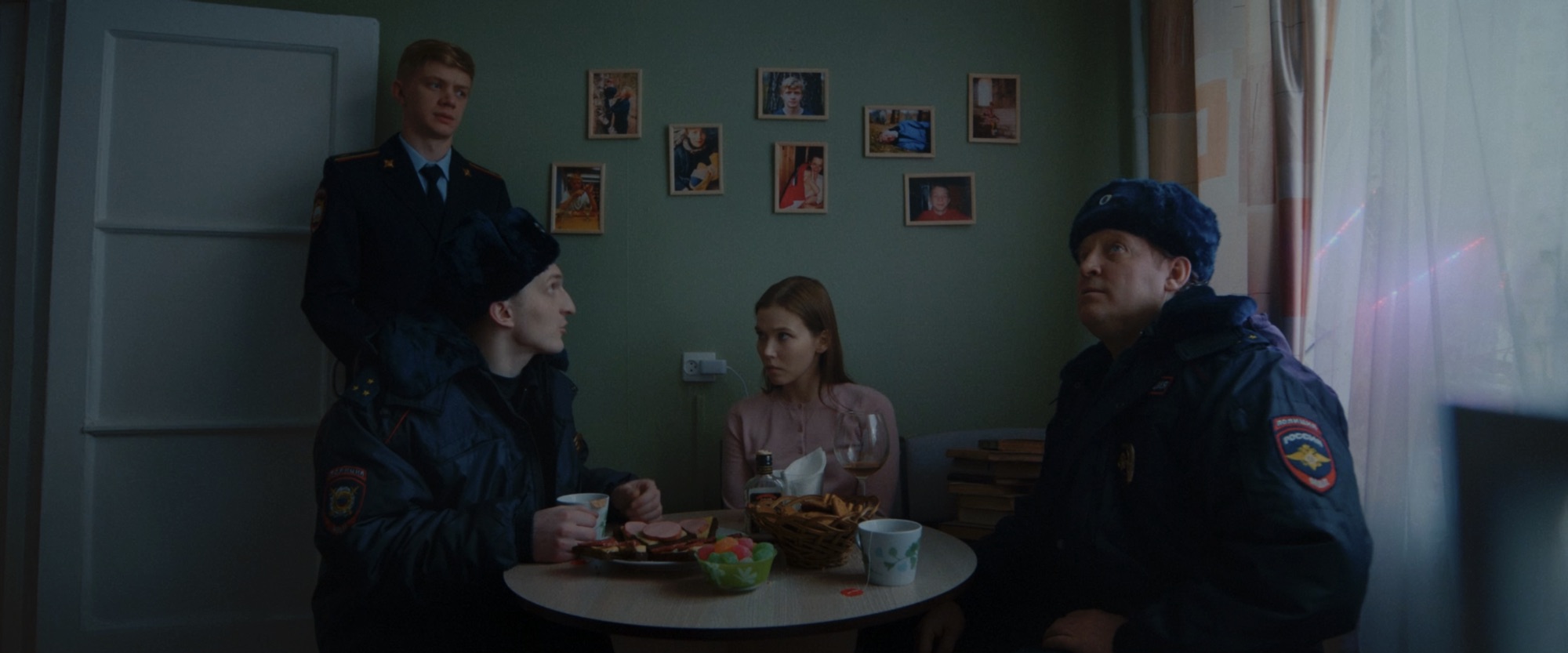
We used long takes and slow pans to build tension, making viewers constantly aware of the off-screen space, the unseen violence next door.
I felt trapped in the apartment with them. How did you decide to shoot to enhance that feeling of claustrophobia and growing unease?
I wanted the audience to feel trapped with the characters. We avoided wide shots and embraced tight, constricted framing. The camera rarely leaves the apartment, often staying close to the walls or framing through narrow doorways. We used long takes and slow pans to build tension, making viewers constantly aware of the off-screen space, the unseen violence next door. The confinement wasn’t just physical; it was moral.

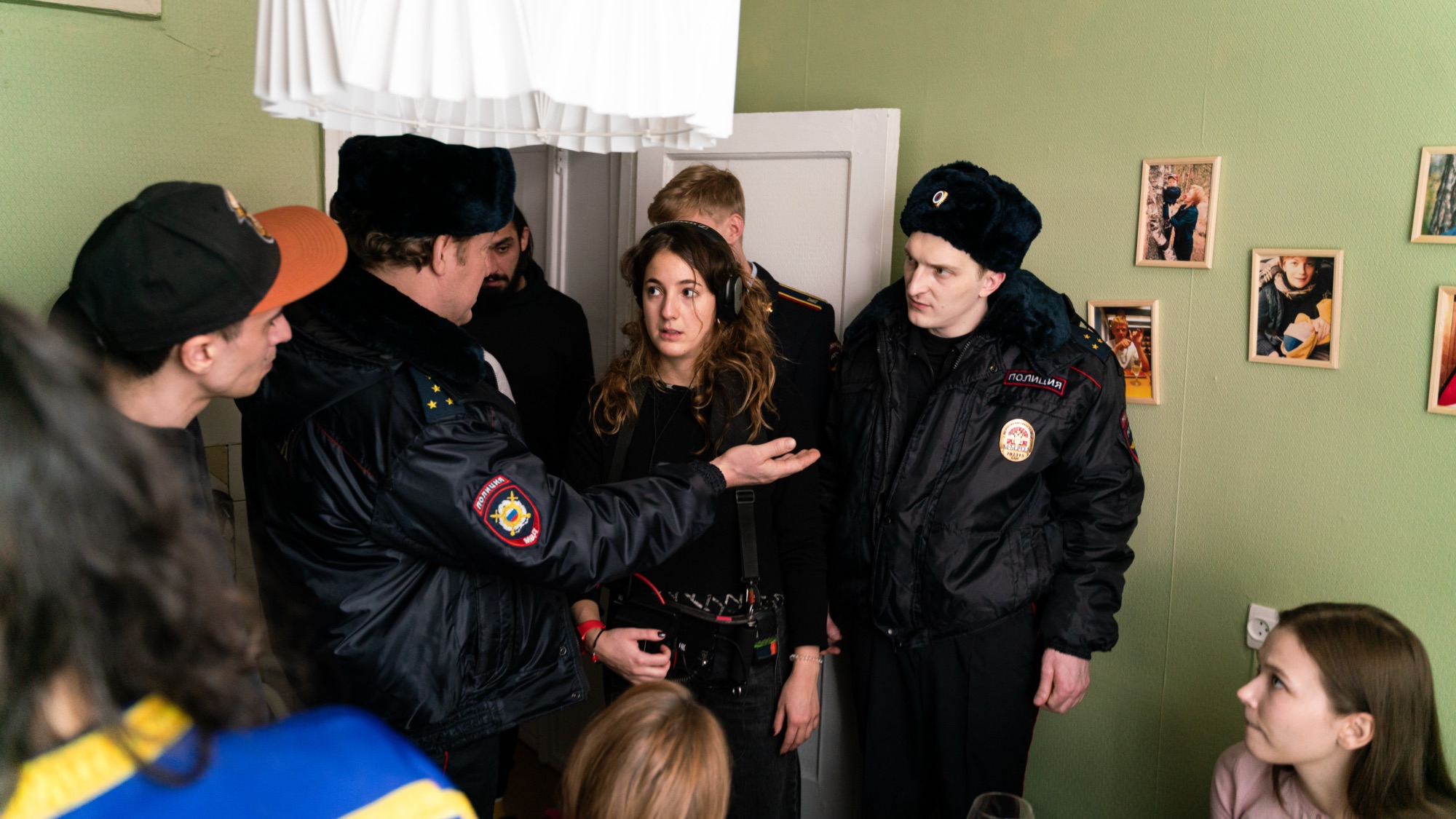
When the two officers arrive and leave, you frame the shots through them using different angles, breaking with the visual aesthetic established earlier.
When the officers arrive, I wanted to disrupt the sense of order. The shifting eyelines and fragmented coverage reflect Andrey’s internal disorientation, the crumbling of his belief in authority.
You produced Kantemir Balagov’s feature Beanpole, a film widely praised for its aesthetic mastery. I would love to know how your experience there fed into the making of Family Matters and you as a filmmaker?
Working on Beanpole taught me a lot about emotional precision and visual restraint. That film also dealt with trauma, silence, and post-war numbness, themes that, in a way, echo in Family Matters. On Beanpole, I learned the power of stillness and composition, how a small gesture or an unbroken shot can carry enormous emotional weight. That experience shaped my discipline and my belief that visual language can reveal psychological truth more powerfully than dialogue ever could.
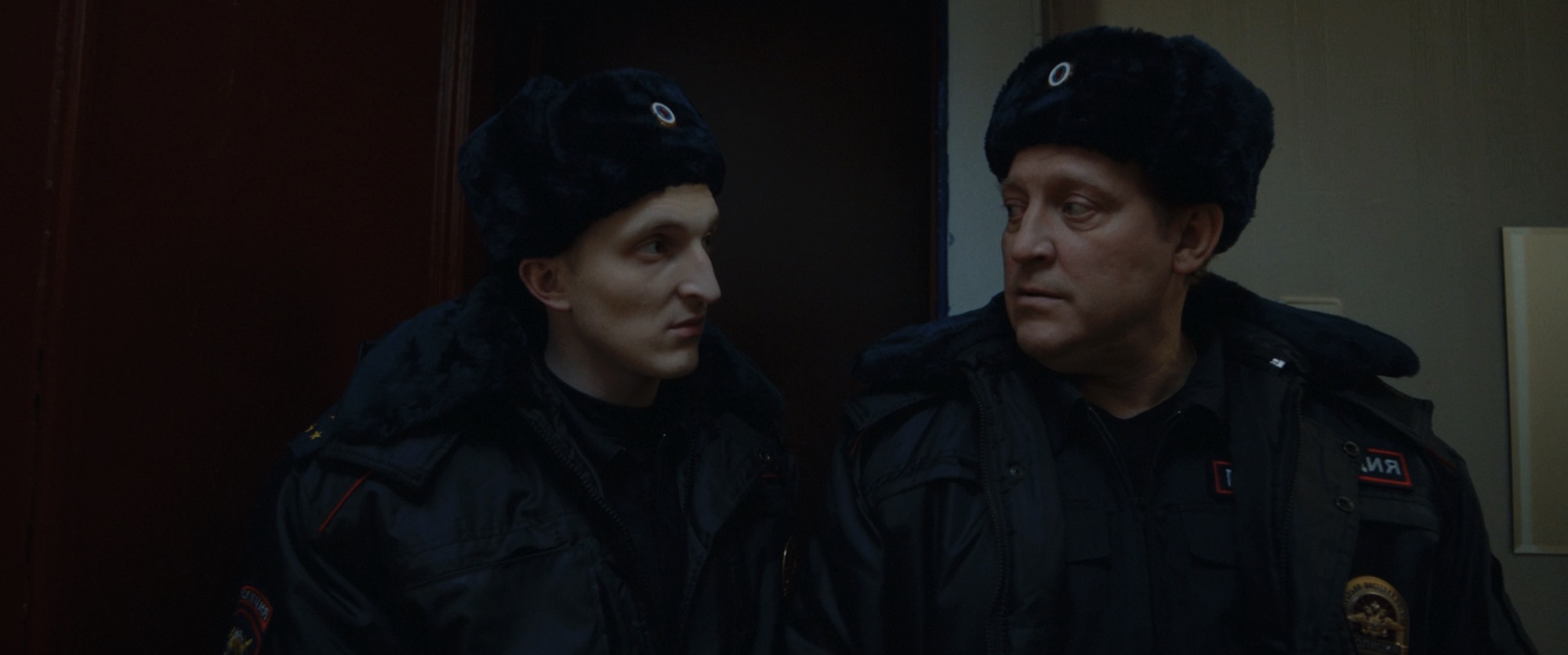
You spoke about returning to Family Matters and re-editing it so that the film might resonate with current issues.
Well, to take it back a little, we shot the short film on Christmas Day (and the two days preceding it) in 2021, exactly two months before the full-scale invasion of Ukraine began. We edited for a few weeks and finished post-production just before February 10th, 2022. That date is etched in my memory because that’s the day I left Russia. If not forever, then for what will likely be a very long time.
Suddenly, this short film about a Russian police cadet trained to ignore human misery felt like not enough.
As someone from a Ukrainian family who mostly grew up in Russia, when the war started, it felt like my entire world had blown apart. My parents had to flee their home of twenty years in Moscow after speaking out against the war, something that could (and still can) lead to imprisonment. My grandmother in Kyiv was running to bomb shelters in the city center. Everyone I knew, in one way or another, was navigating this immense tragedy. Suddenly, this short film about a Russian police cadet trained to ignore human misery felt like not enough. It didn’t make the horror of domestic violence any smaller, but the figure of a cadet now carried a much heavier meaning. It’s apathetic young men like him who were being sent to fight in an expansionist war for a totalitarian regime.
How do you feel as a filmmaker making and putting out these types of films, talking about polemic issues?
As a filmmaker, I feel a responsibility to question why certain forms of violence are normalized, excused, or forgotten. I believe if you don’t confront this truth it can escalate. As it did in Russia just a few months after we shot the film, with the full-scale invasion of Ukraine. For me, filmmaking is a way to understand how societies collapse into moral apathy, and maybe, in some small way, to push back against it.