
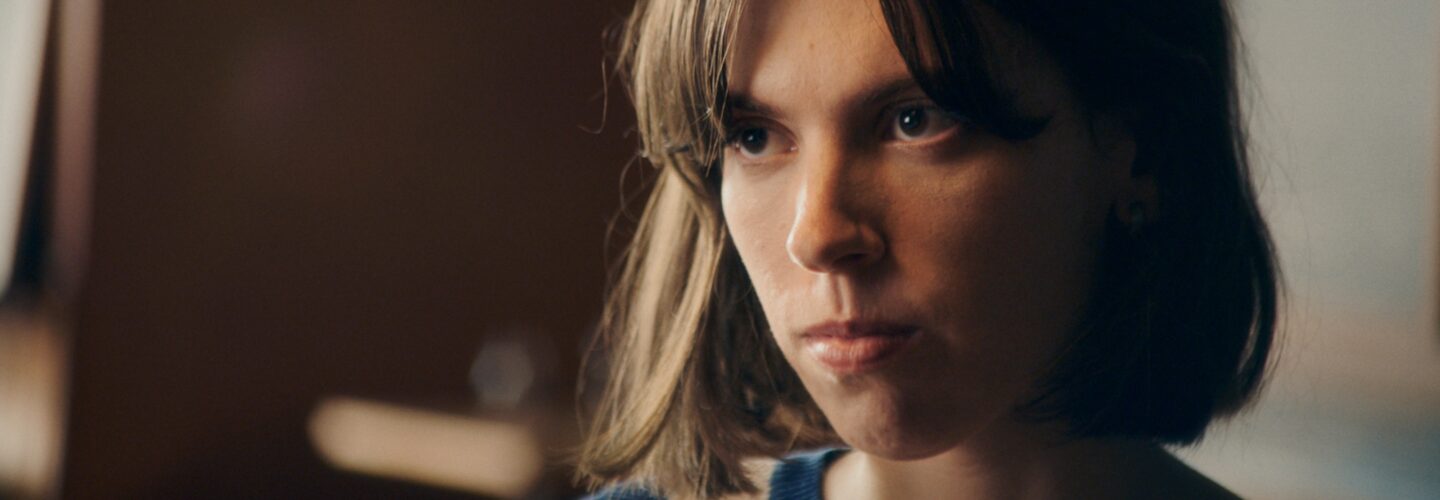

Ethan Edwards’ Goose offers audiences a comforting opportunity to indulge in the unsettling power of storytelling. A pair of old college friends find themselves in a battle of will and ego as the contents of a debut novel start to resonate far too close to home. What begins as a tense but civil exchange escalates into a deliciously barbed duel, where every line carries the weight of buried resentment and the absurdity of seeing oneself refracted through someone else’s fiction. Edwards uses subtle visual cues to underscore the shifting power dynamics with camera compositions that trap the increasingly tense back and forth, belying the casual setup between his two actors. Goose is a whip-smart exploration of authorship, memory, and the uncomfortable truths we’d rather leave buried and not weaponized by supposed friends. As his film premieres on DN, we speak to the writer/director about finding the perfect secret to hit his tonal alchemy, carefully deciding where to place the two women in their single location setting and relying on the instinctual synergy between actors Tess Goldwyn and Melanie Brook, opting for minimal rehearsal to preserve raw tension.
This is delightfully a story I have never seen before. How did you come up with the concept?
Ken Burns did this really great documentary on Hemingway, and while watching it I learned that we know all the real people Hemingway based his characters off of in The Sun Also Rises. The characters in the novel (all of whom were his friends) are oblivious to the emptiness of their lives, and I couldn’t stop thinking about the fact that these people who would’ve otherwise been forgotten to history were now immortalized in a very unflattering way.
My mind went to thinking about what the modern day equivalent of that would be, and how it would go down. At a certain point the two characters emerged and the fictitious novel also took shape. There was dramatic weight and clarity to the soon-to-be published novel having revealed this big dark secret about Mara, played by Tess Goldwyn. It took a while to figure it out, but the secret we ultimately landed on struck (I think) the right balance of psychologically damning but really strange and funny in a way you can’t exactly put your finger on.
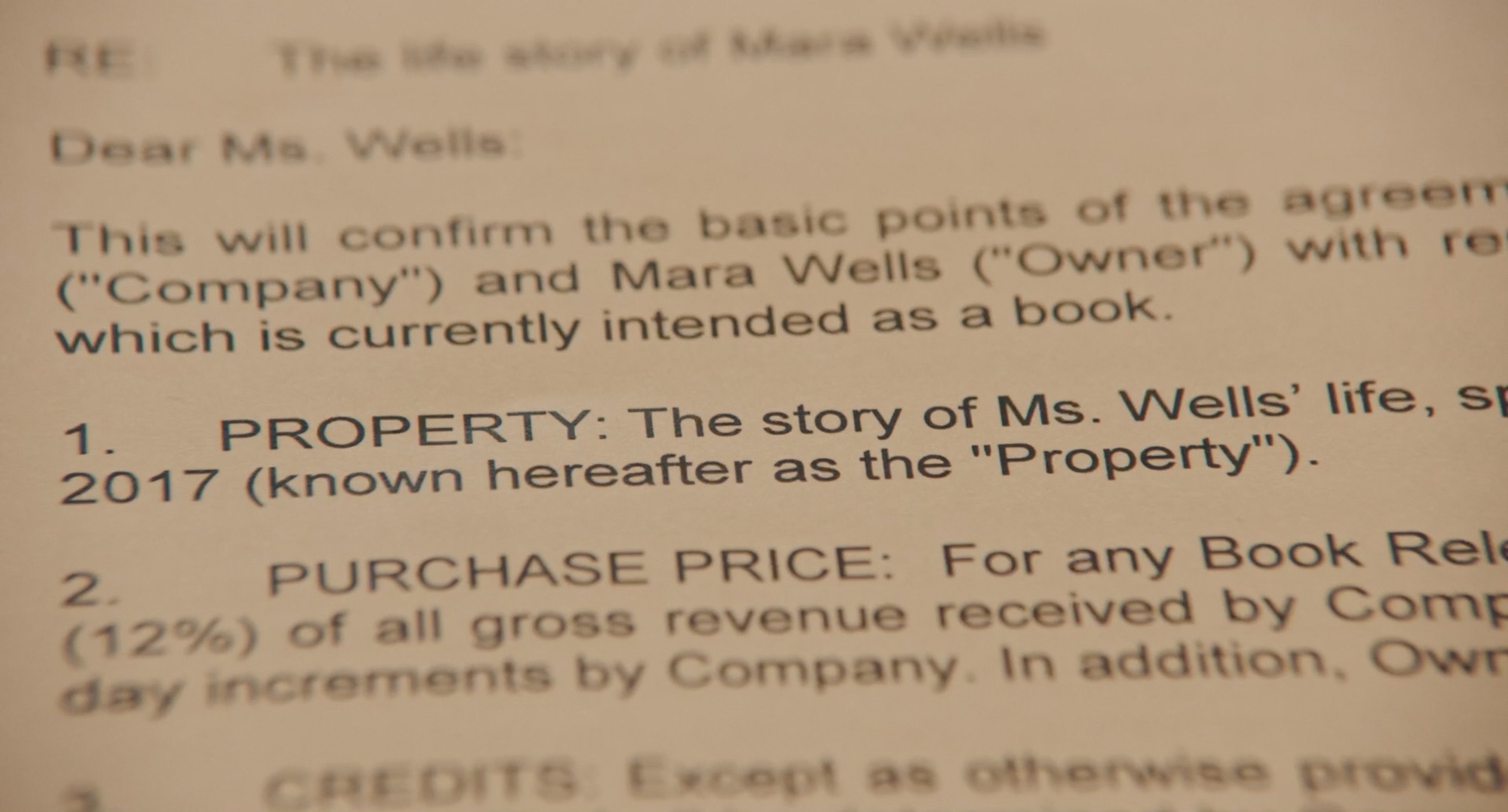
That big, dark secret about Mara is so pivotal yet almost thrown away despite the power it holds. How did you land on your tonal balance and the delivery?
Whatever the secret was, I knew I wanted it to have multiple notes. The easiest way to break the illusion of reality, I’ve found, is to let things be one-note. I don’t know why that is. Maybe it’s because reality is rarely one-note. If anything, there are so many notes as to be incomprehensible. But in the writing process, it got to the point where, okay, I’m amping up this The Sun Also Rises thing into Melodrama, and to get to Melodrama, horrifying felt like a step in the right direction. At some point I remembered this recurring thing amongst psychopaths, where they harmed animals as a kid without remorse. It was a great find cause it felt like common knowledge to me, like something even people who aren’t immersed in True Crime know about. But what if, when learning of the secret as an audience member, you couldn’t help but laugh? It felt like a more complete experience.
What if, when learning of the secret as an audience member, you couldn’t help but laugh?
There wasn’t any improvisation in the traditional sense. I’ve worked with Tess tens of times now, and I knew I could get her to deliver the line in a way that would communicate many facts at once. The stakes, her culminating agitation at Melanie’s character, the feeling that she’s been trying to put this behind her for years, and even a slight recognition of the secret’s built-in absurdity. If I remember correctly, on that medium shot where Mara says it out loud, it was the second take. It also made it fun, I realized later, because it’s Camille (Melanie’s character) who we see acting without remorse.
Most Popular
The dynamic between the two characters hinges on subtle power shifts. Did Tess and Melanie rehearse together to build tension, or was their chemistry immediate?
I wrote the script in a month or so with Tess in mind for the part of Mara. I’ve collaborated with Tess more than anyone else. As an actor, she is a tide that lifts all boats. There really isn’t anything she can’t do and everyone’s job becomes a lot easier when she agrees to act in your film or play. Tess recommended Melanie Brook for the other part, and after watching her reel, it was an immediate yes. She could, with great specificity, do this dead-inside thing that I find a lot of novelists have when you see or hear them talk in person. Their disposition frequently conflicts with the aliveness of their prose and even the words that come out of their mouth.
I started out doing plays and on my last short we rehearsed pretty heavily. Despite the time crunch, I wanted to shake up my process a bit. We only did one light read through a few weeks before the shoot and then didn’t talk about it until set. Naturally, this means I’m completely trusting my actors. I cannot stress enough how agile Tess and Mel are as actors. Their chemistry was pretty immediate in the sense that they immediately could make the dynamic legible to the audience.


How did you approach framing each character? What differences in composition did you employ to reflect their emotional states?
My DP Jacob Mallin and I went to the set a couple weeks before the shoot and scouted the bar. We liked the idea of Mara being blocked off from the exit and having more frontal light on her face. Jacob pointed out when we were there that day that the bar kinda felt like a library, with both of the characters being surrounded by all this burnished wood. At some point in the short, when all pleasantries between Mara and Camille were dispensed with, I wanted us to use a tilt. I originally wanted to go more tilted, like a real Dutch angle, but thankfully Jacob talked me out of it.
If perception or their life in the outside world was mentioned, we tried to go to our medium or our wide overhead.
The camera shifts between the two characters. Did you use a strict pattern or was there intentional variation?
There was no pattern that we were consciously going by, but if perception or their life in the outside world was mentioned, we tried to go to our medium or our wide overhead. Obviously, this couldn’t be implemented every time. I don’t even think it ended up playing out like that in the final cut, but it was fun to run with for a bit.


What do you hope the audience feels from the relentless duelling back and forth?
I wanted it to feel claustrophobic, definitely on Mara’s side of things. The hope was that, especially towards the end, the screws were being tightened and we didn’t miss anything the actors were giving us. My editor Phil Flack and I wanted it to feel like they were playing tennis. Both Mel and Tess have lots of theatre experience and the rhythm on the day was very easy to develop. I want to brag on Tess and Mel again. They had twelve pages of dialogue to memorize in one day and it was a lot to ask of them without rehearsal, and yet they came in and could change in very precise ways. It made directing them daunting, in a surprising way. It was like the tools at my disposal were bigger than my ideas.
The heavy, ominous chorus as your sound design is unusual but I love it.
Thanks for saying that! It’s a piece by Schubert. I was so happy when I found it. Felt like it added some absurdity and then turned and served to elevate the drama.
What are you working on now?
I am writing a feature that is set in Arkansas, where I’m from. The best way to describe it is Steinbeck meets Eternal Sunshine.