
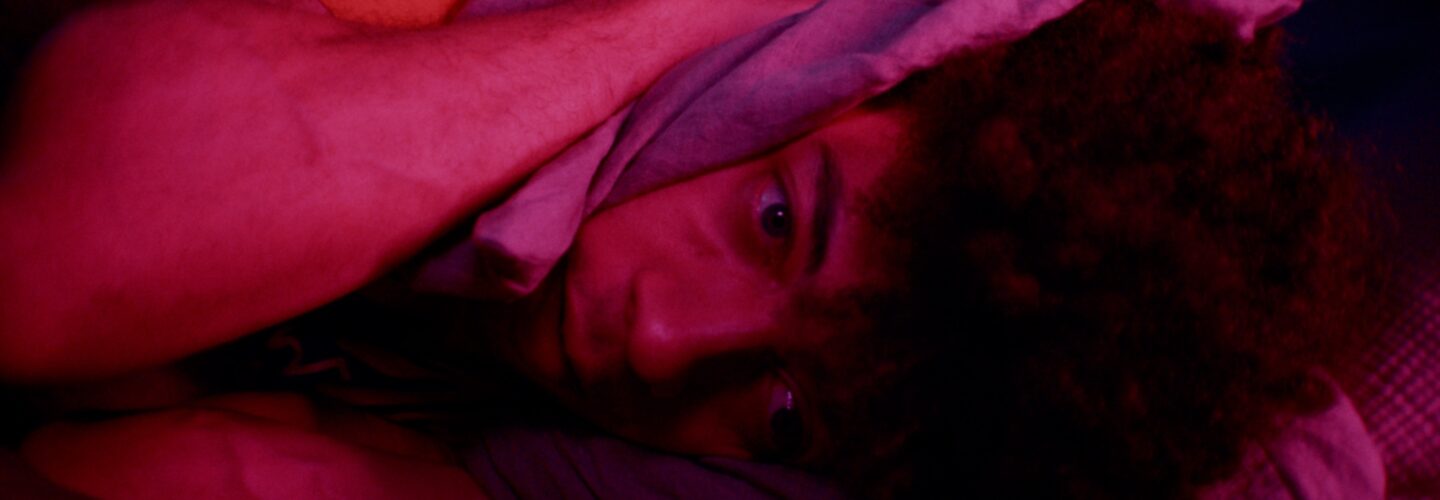
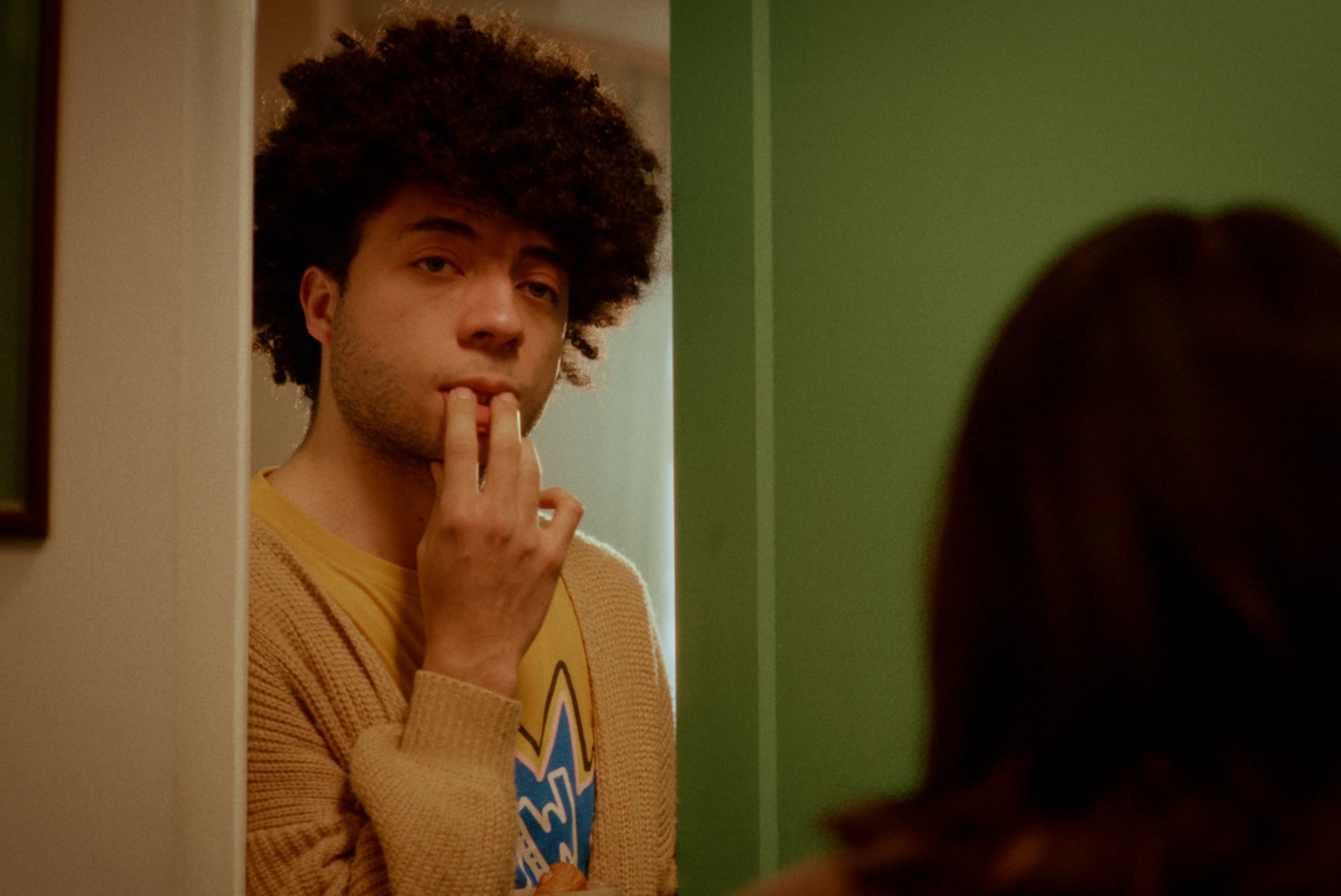
The modern houseshare, necessary for so many grappling with adulthood and independence and true cesspools of bizarre social contracts and raging frustrations. Filmmaking duo Hansel Rodrigues and Ieuan Coombs mined this universal, urban experience for their latest short, An Indirect Message. The film plunges us into the private hell of a young man longing for undisturbed sleep who is continuously subjected to his housemate’s loud amorous role-playing bedroom Olympics, and explores the peculiarly British aversion to direct confrontation. What could be an awkward but simple scenario is elevated by Rodrigues and Coombs into a surreal and visually inventive study of anxiety, where internal frustration manifests in a brilliantly externalised cacophony. An Indirect Message mirrors their protagonist’s spiralling psyche, and the film’s visual approach boasts resourcefulness and intent, juxtaposing composed, static frames that reflect their sleep-deprived character’s stifled politeness with bursts of handheld chaos which signal his manic desperation. This is not a film that feels limited by its single location; instead, the directors and their team use the confines of their location as an expressive canvas. Through a bold, theatrical lighting scheme of vivid pinks and deep purples, the space transforms from a simple room into a psychological prison, bathed in the neon glow of sleepless anxiety and secondhand embarrassment. As An Indirect Message premieres online with us here at DN, we chat to Rodrigues and Coombs about visualising anxiety, their essential test shoots and employing that bold, surreal lighting scheme.
So which one of you lived through this?
We worked together editing in the same office. Ieuan would come in every day really tired, complaining about his flatmate and how awkward it was to confront her. As a joke, Hansel said the only way she would understand the experience is if we made a film about it—we thought that seemed like a funny concept and that’s what we ended up doing! We also wanted to make something that was achievable from a budget perspective—one character in a room in this sort of hellish comedic situation seemed like a fun way of doing that.
What was the specific quality of the “hellish comedic situation” as you put it, that made you believe this scenario could sustain an entire narrative?
Both of us felt that this should be quite short. The idea feels comedically broad, and neither of us thought that for that reason, the film could be particularly long. Seven minutes or so felt like the sweet spot. It gave us enough room to be punchy, pack in gags, and get visually creative due to the nightmarish, surreal quality of the story.
It’s also a universal experience. Loads of people have told us they’ve been through something similar. The sexual themes were fun to play with too, especially combined with an awkward, British sensibility. We liked how that sensibility exaggerated a situation that should be simple to resolve. The meta reveal at the end also gave it an extra layer, which was fun to build towards.
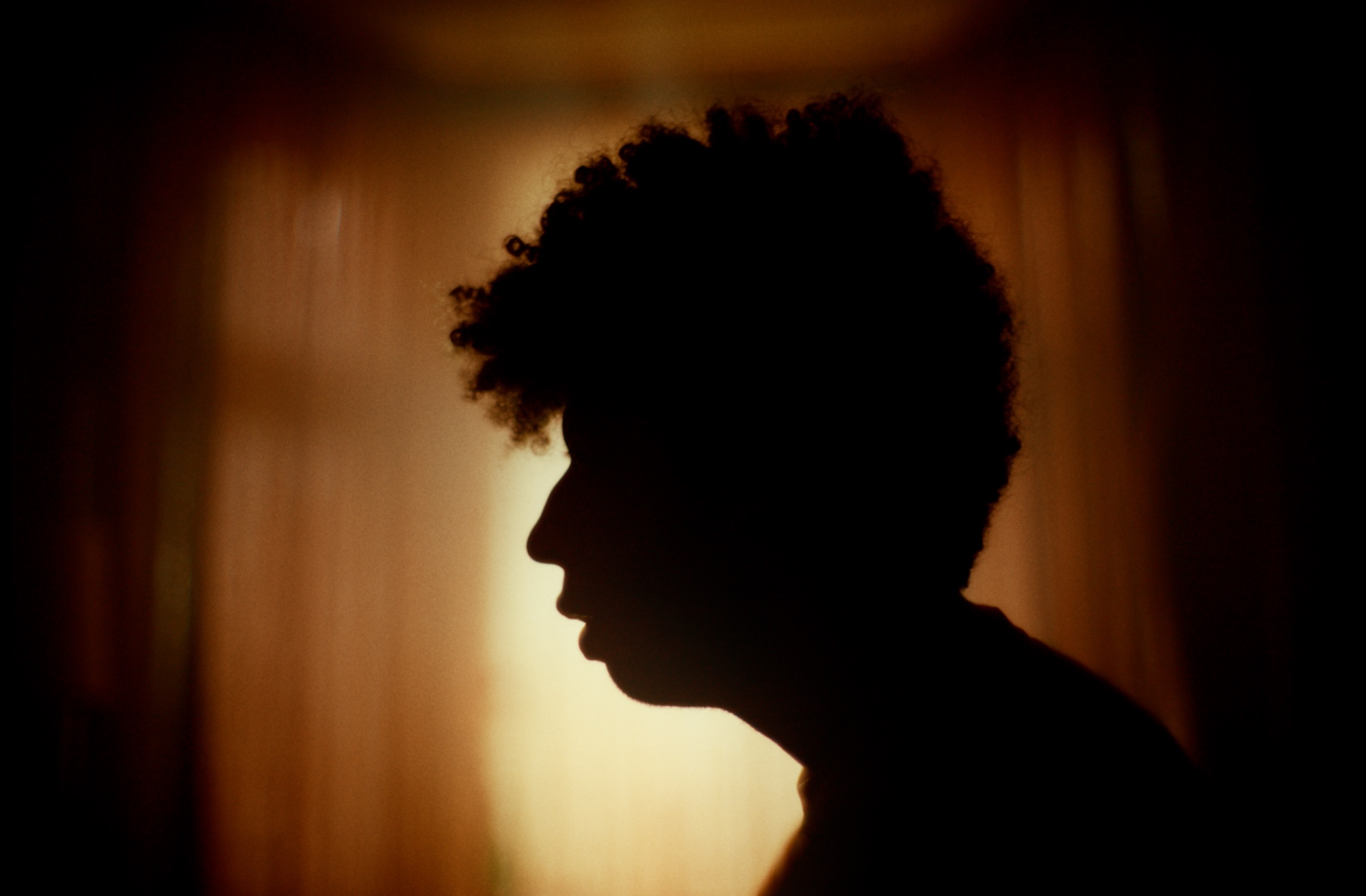
We were keen to have a very considered and composed cinematography style.

We know our readers, especially the filmmakers, are always keen to hear about journeys in funding.
We both put in around £2,000 each, and Hansel successfully applied to the Emerging Voices Foundation, who added another £1,000. That brought the total budget to about £5,000. It was tough, as we weren’t paying people and had to call in a lot of favours. It was all very DIY: a lot of begging, borrowing and returning things to Amazon, and Ieuan driving a van full of kit all over the place. Dan, our DP, was working at a rental house called Focus Canning back then, and they were incredibly generous with camera gear.
We’d set out not to depend on external funding, so it was funny that this ended up being our first project to get any. We wanted it to look as polished and punchy as possible, putting what little money we had on screen so that everyone could stretch their creative muscles. It also helped that we both edited it, which saved a lot of time and money. Emerging Voices was a massive help in getting it over the line and staying out of the red.
Most Popular
The house felt like a typical house share, beloved and bemoaned by so many.
We shot it in Bristol in the house Hansel just moved into and used lots of local Bristol crew, which is a great way to meet people when you’ve just moved to a new city. We considered other spots, but Hansel’s house just ended up feeling the best, and of course, massively helped us from a budget perspective. We also took a lot of time doing test shoots with us both playing the part of the tenant. We were keen to have a very considered and composed cinematography style for this and felt it was appropriate for the film. The test shoot was very helpful for us in seeing what worked and didn’t work.




What were the key visual or blocking discoveries you made during those test shoots that fundamentally shaped the cinematography?
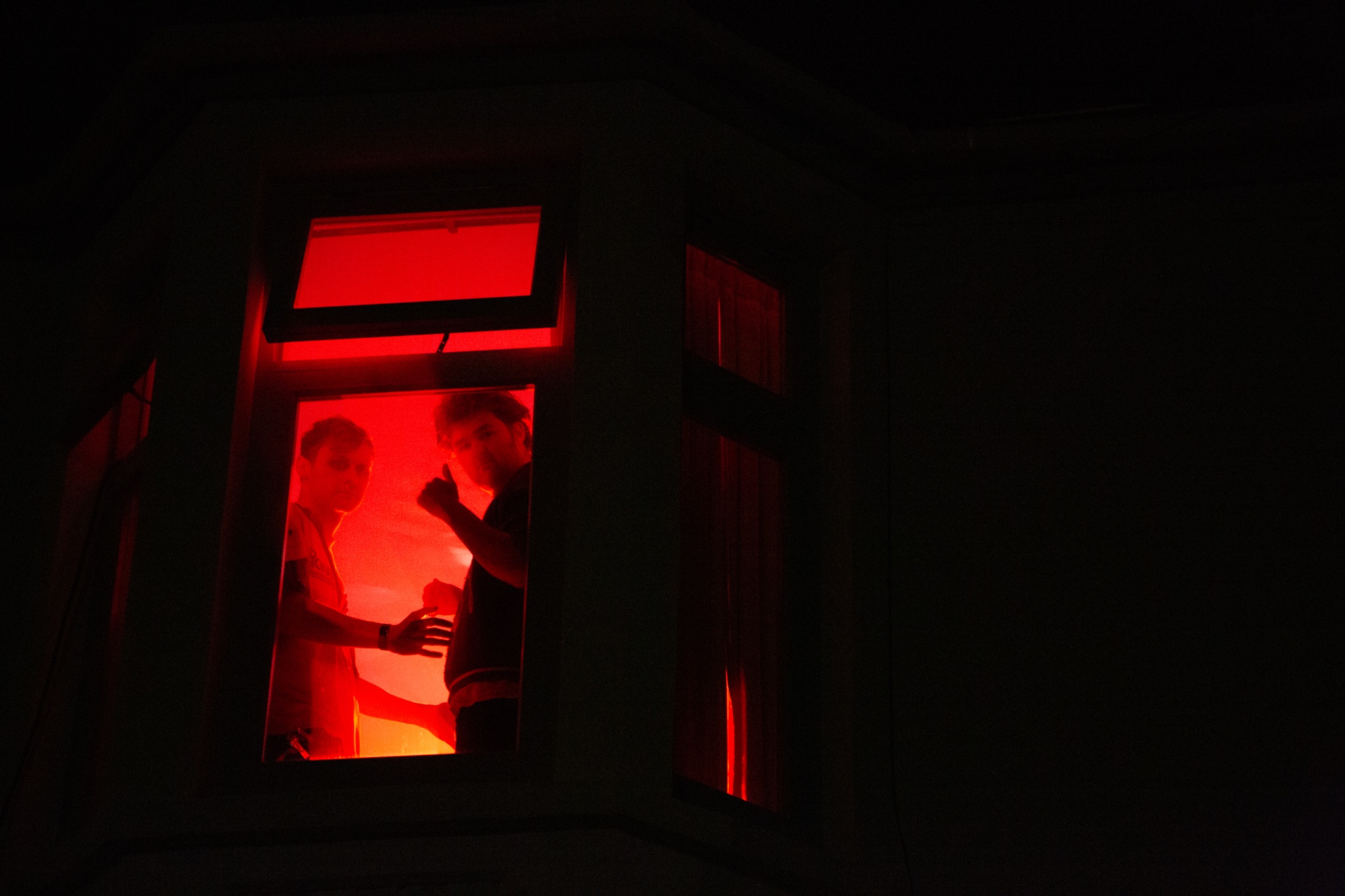
The test shoots were crucial. We spent a lot of time experimenting with how to transition from the exterior shot of the upstairs couple to the tenant in the downstairs bedroom. We also tested a version of the scene where the tenant nearly confronts his housemate in the bathroom, rather than his bedroom. That process ultimately led to our decision to buy a door and transform the living room space into a bedroom, which worked well thanks to Didi Valer’s production design.
They also helped us refine transitions and gave us confidence in deciding to do one long take where the tenant nearly confronts his housemate. Sharing the footage with others also gave us useful feedback on pacing, so by the time we shot, we knew what worked. It meant fewer decisions on the day and helped everyone get on the same page regarding the film’s tone.
You also created a large diagram with images for the cast and crew to track the narrative. How was it different to storyboarding, and how did it help guide the non-linear storytelling?
The main difference was that these weren’t sketches – they were stills of us from the test shoot. As we were shooting out of order, it really helped us track what we’d done, what we could afford to lose, and what was essential. It was possibly clearer than a traditional storyboard, since the stills were taken in the actual location with similar lighting. We’d tick shots off as we went, so everyone knew exactly where we were in the story. It kept the team aligned and made progress feel tangible.
Sharing the footage with others also gave us useful feedback on pacing, so by the time we shot, we knew what worked.
The camerawork serves to mirror the tenant’s spiralling state of mind. Could you walk us through the specific language you and DOP Daniel Simpkins developed for the camera?
We decided we wanted the film to feel clean and composed overall, but when our actor Joshua Griffin starts to unravel or finds moments of manic inspiration, we wanted to go handheld. Those moments gave us permission to break structure and inject some chaos. It also felt a bit meta, since the main character is a film student ‘directing’ his own life, so the more stylised, expressive shots reflected his film geek mentality.

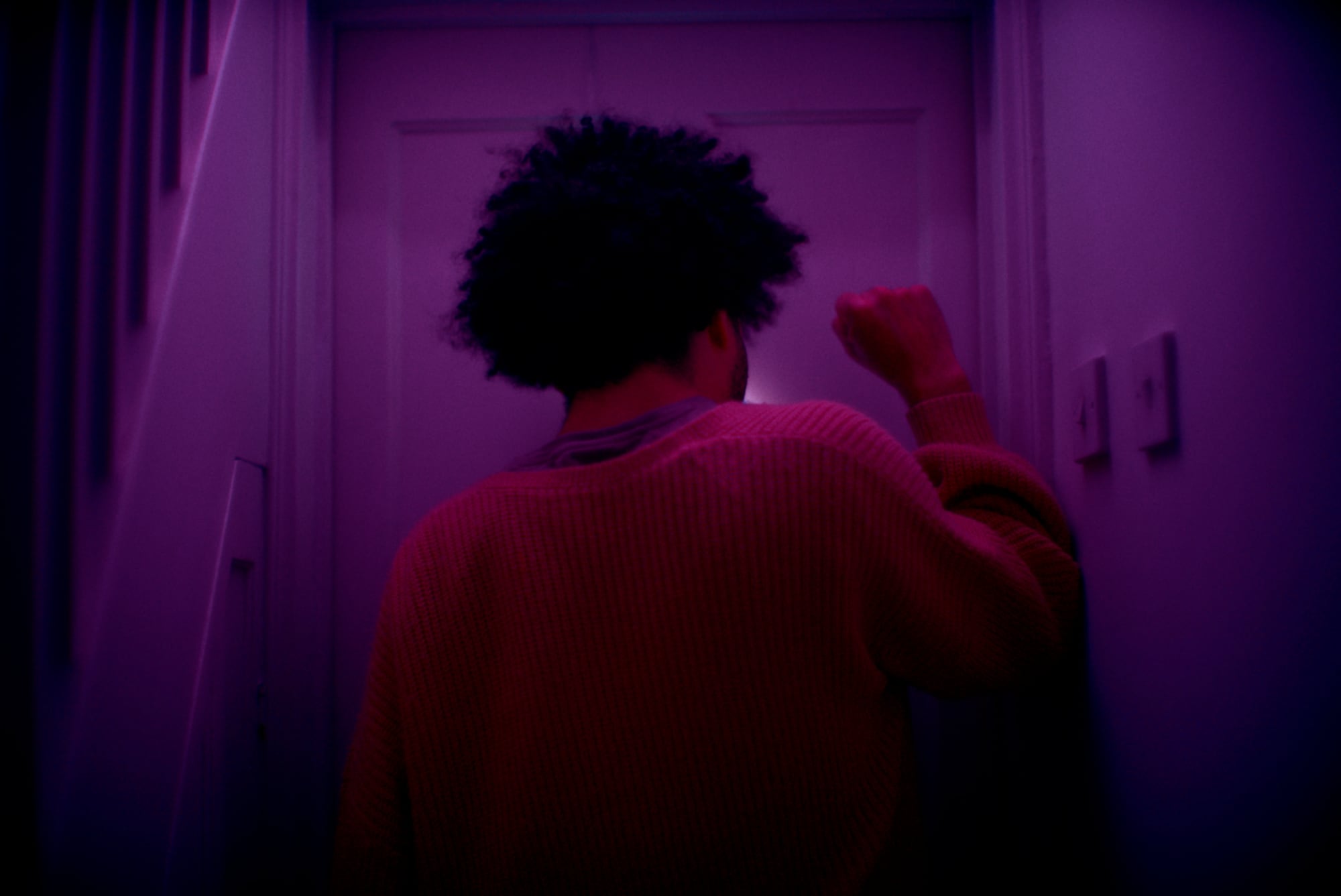
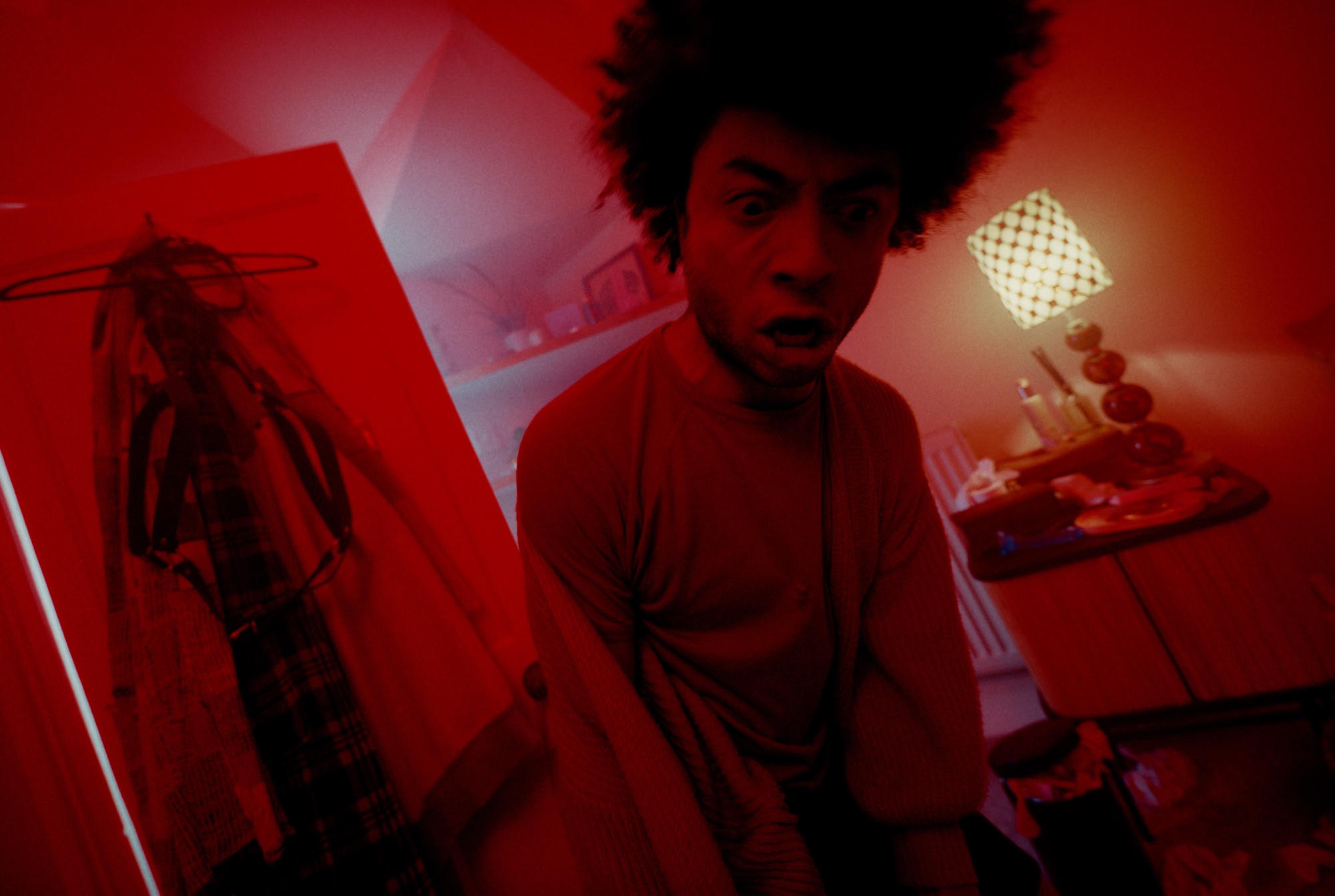
An Indirect Message’s visual language is so distinct, particularly in its use of lighting, which bathes the tenant’s hellish situation in vivid, surreal tones of pink, red and purple. It very much feels like the lighting is externalising his internal anxiety and frustration.
That was a big part of our discussions with our cinematographer, Dan Simpkins, and our production designer, Didi Valer. We wanted to take full advantage of the film’s surreal tone and make it as visually playful as possible. Many of our visual references leaned into a heightened style, and the fish tank lighting ended up being our way of justifying the extreme look we went for in the bedroom.
There’s often a trap with shorts set in one room that they look and feel flat because of the limitations inherent in the budget.
Since so much of the film takes place at night while the tenant is trying to sleep, we spent a lot of time discussing what we could get away with—what could feel just believable enough, while still being visually bold and interesting. There’s often a trap with shorts set in one room that they look and feel flat because of the limitations inherent in the budget. We wanted to flip that on its head and push the visual language to the extreme.
How did post go, and how did the edit keep the pace and flow you needed?
We both edited the film together, passing edits back and forth, and it came together fairly quickly. The hardest part was the music, as we’d cut a key montage to two temp tracks we couldn’t get out of our heads: Le Monde from the horror film Talk to Me and Beat It by Michael Jackson. The lesson we took from it was that if music is so integral to a sequence, it’s very worth composing it prior to shooting. Darren Sng did a brilliant job with that montage, and Simon Porter’s score was also a joy to work with. It was really fun to compose a track with lyrics, and we had the amazing opportunity to collaborate with Lifford Shillingford on vocals.
If music is so integral to a sequence, it’s worth composing it prior to shooting.
I love the work you guys are doing. Tell us what we can expect from you both next.
Ieuan is in pre-production for a proof-of-concept short for a feature, Mickey the Muscle, set in an old-school bodybuilding gym and inspired by a documentary he made about Ian Dowe, a former world champion bodybuilder.
Hansel has a short film called Homing, which he co-wrote and co-directed with Lizzie Atherton. It’s premiering at a major European festival next year—can’t announce it yet! He’s also developing another short with Lizzie, a horror-comedy vampire film called Maternity Cover (for Future Takes, fingers crossed), and developing a dramedy feature called Neanderthals, about a South Asian divorcee who moves to Cornwall and joins a caveman club.