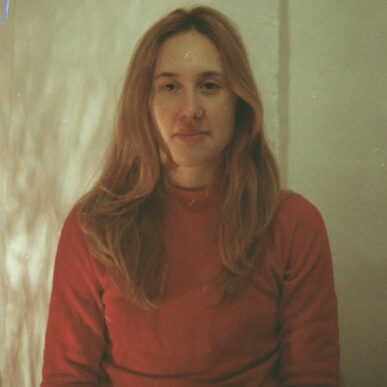


Annika Chavez turns a moment of intimate waiting into an emotionally charged, wry two-hander in Three Minutes. Set almost entirely within the confined, vulnerable space of a bathtub, the short captures the fragile uncertainty of waiting for a three-minute pregnancy test result. As two best friends navigate this pivotal moment, the narrative explores the unpredictable dynamics of their relationship—fraught with bluntness, unspoken emotions, playful banter, and the looming prospect of a life-altering revelation. In her collaboration with screenwriter and producer Sophie Thomason, Chavez crafts a story that evolves organically, with key scenes being developed on the fly. The tight, confined space of the bathtub amplifies the rawness of the protagonists’ connection, offering a chance for natural, spontaneous dialogue that reveals a fluid and intricate bond—both on-screen and off-screen. Chavez’s direction carefully captures the nuanced shifts in power and vulnerability, particularly from the female perspective, as the character grapples with the weight of an uncertain future. For today’s premiere of Three Minutes, Chavez talks to Directors Notes about the film’s impromptu, organic creation, focusing on the joy of acting on impulse in the creative process and shaping a piece that unfolds as dynamically and open-endedly as the emotional terrain it explores—reflecting the unpredictable nature of both the characters’ journeys and the filmmaking experience itself.
What dynamics between these two characters did you find most compelling, and how did you approach directing this two-hander?
I was drawn to Sophie’s exploration of a best friend suddenly thrust into the reality of being the potential co-parent of a prospective child. The fun and games cease, and the characters are forced to confront a real-life problem that could potentially change their relationship forever. I’m particularly interested in the brutal bluntness that can exist in close friendships. I like the idea that if an outsider listened in on the conversation between our two characters, their banter could be mistaken as an argument or vitriol (which it is to an extent). Yet, there is this impenetrable sense of unconditional love that everything operates on top of, which allows their dynamic to oscillate between serious and very unserious on a dime. I have always been drawn towards ambiguous relationships and situations that exist within a grey area that are neither here nor there—just like the one in the film.
My approach for directing this was different from any other approach of the past because of how quick and intimate the process was. Sophie wrote the script a week before we shot, I read it, and we developed it four days before shooting. Our cinematographer Ksusha Genenfeld and I planned things out the day before we shot. It exercised my impulses in a way I hadn’t experienced. There was no time to overthink or overintellectualize things.
I have always been drawn towards ambiguous relationships and situations that exist within a grey area that are neither here nor there.
What were some of the significant developments or shifts during your collaboration with Sophie in shaping the final version of Three Minutes? How did the back-and-forth between you both influence the script?
Sophie and I have been collaborators since college. We expect a lot from each other and are uncompromisingly honest in the name of our projects. We are opposites in many ways, which tends to work in our advantage creatively. In the case of Three Minutes, Sophie’s initial draft had stellar character development and dialogue. Together, we were able to push the film towards what it was trying to say.
We added the last two scenes on the day of the shoot. The short was originally going to end with Chas Conacher’s character in the tub, shouting out a singular “What does it say?” However, when we got to set, the image of the character in the tub alone, repeatedly calling out into the void, kept bouncing around in my mind. I felt like there needed to be a resounding moment of confusion for the character, so we added the “What does it say” sequence. We also added the last scene on the deck for a moment of finality – it felt like we needed to bring the characters back together again as they step into a new, unsure reality together. So, we were essentially collaborating on the script until the last shot.


The dynamic between the couple touches on themes such as the body, shared responsibility, and abortion. Was there a particular focus on the female perspective, even though it’s a two-hander? What qualities or emphasis did you want to bring to the female perspective within this dynamic?
The goal of starting with Sasha Buravsky’s character seemingly alone in the bathtub was to bring us into her world, to drop right into the tension of waiting for a pregnancy test result. The intention of starting that way was to subtly frame the following conversation in her perspective until she leaves the tub.
Additionally, I liked the idea of her having a moment of actual privacy in the end to see the result—it felt respectful. To me, even though the short ping pongs between Sasha’s and Chas’s characters, there is an undeniable feeling of her pushing things forward; she is in the driver’s seat. The messy, crude, and uncompromising qualities Sophie wrote and Sasha embodied feel like real-life women I know and love, and I’m proud we were able to capture that.
Most Popular
You mentioned that there was an improvisational quality to the entire process that felt really freeing for you. In what aspects of Three Minutes—such as directing the actors or the fast-paced nature of the production—do you think this improvisational quality is most strongly felt? What draws you to incorporate improvisation in your work as a filmmaker?
I feel it in everything. One of my favorite moments of the film is when Sasha’s character says, “The last time I took birth control I couldn’t see the color green,” and her hand rather poetically obstructs everything but her eyes. That happened spontaneously. I threw out the line for Sasha to say, and she just happened to lift her hand to her face, and Ksusha just happened to shoot it the way she did. It felt magical to be left with moments like that, where all the improvisation worked together to create something unexpected and fresh. We were experimenting within a focused environment, which allowed us to move in sync. It was very organic.
I’m drawn to the awkward uncertainties of improvisation; it feels like real life because it is to a degree. Beyond acting improvisation, working with a crew of people you trust and respect, who feel liberated to try something if they are moved to do so, is very meaningful. To me, that’s the peak of creative collaboration. My attraction to this way of working likely goes back to my roots in the theatre and an obsession with the communal experience of ephemerality. Going for a take has a similar ephemeral nature; it is like the set becomes a stage, and we are all, crew and cast alike, performing, and nothing can ever exactly duplicate this present moment. At the same time, I have a deep respect for text and rehearsal; balancing the planned and the spontaneous is a constant negotiation.
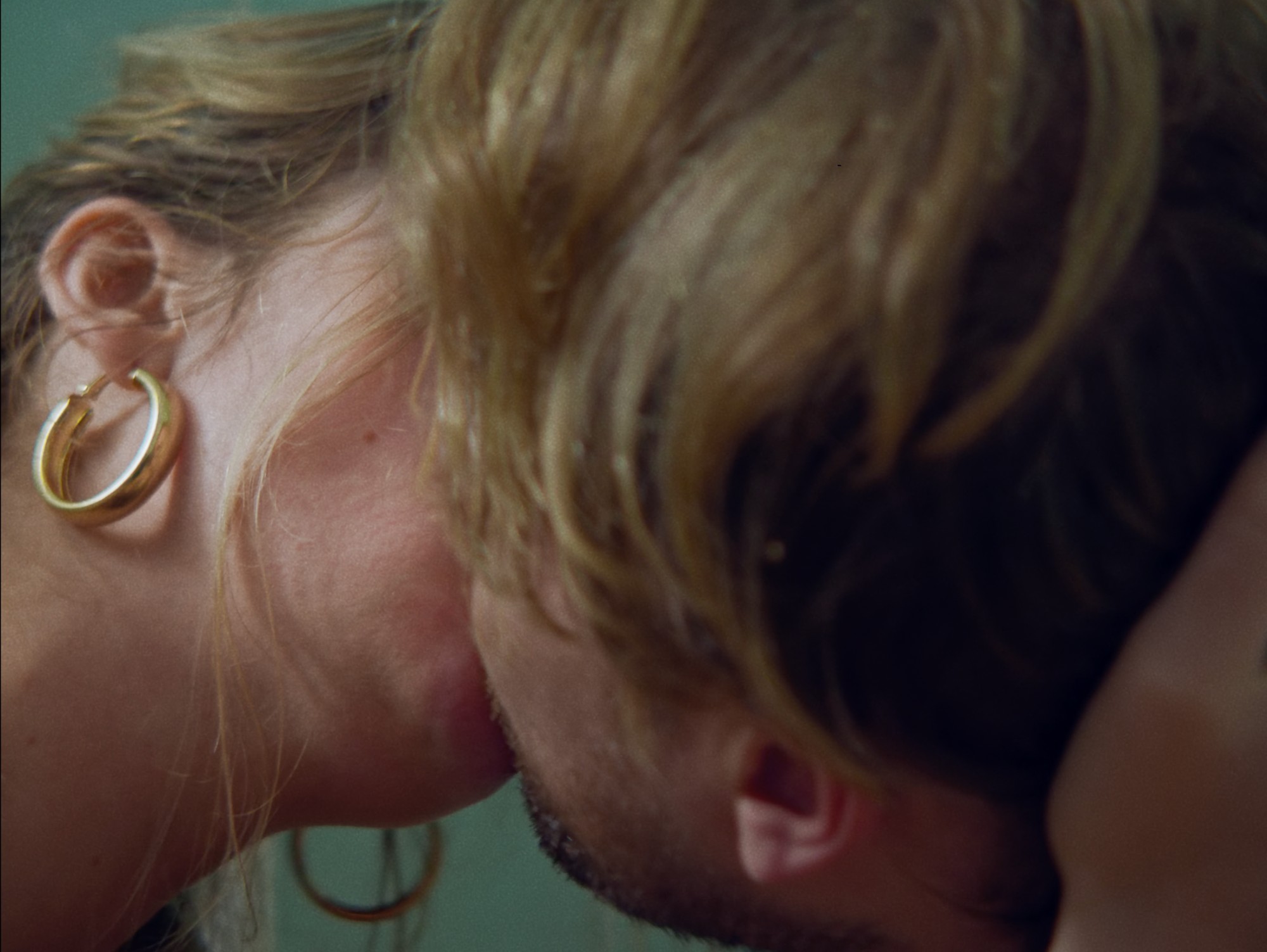
I wanted to see how close we could get to the line between fiction and reality.
What was your approach in directing Sasha and Chas? How did you work with them within the setting to help them embody their characters, and what were you specifically looking to capture in their performances?
Chas and Sasha both respond well to spontaneity, are not afraid of taking risks, so I found that throwing out suggestions of lines or activities their characters could do was quite fruitful. We did the oner scene about nine times, and each time it was incredibly different. I knew that if I kept the environment playful, Sasha and Chas would take care of the rest. They are both incredibly present actors, so creating new situations for their characters to deal with kept it buoyant.
In the edit, Jill Saoro, our editor, and I ended up picking an earlier take of the oner, when Sasha and Chas were still slightly unsure of their lines – it has such an unpredictable quality that feels so alive to me. It was ultimately exactly what I wanted to capture; I wanted to see how close we could get to the line between fiction and reality. Of course, the situation is completely fictional, so the reality aspect comes from the actor’s experience in the moment – and because they were volleying, searching, and listening, we ended up with a pretty spontaneous result.
The characters’ moods shift from resentment to tension, teasing, and playful banter. How did you approach this emotional fluctuation in the direction of the actors? Given that the script was inspired by the real-life dynamic between Sasha and Chas, how did you draw on their personal connection to shape this emotional landscape?
The shifts came primarily from Chas’s and Sasha’s inherent understanding of the text. They were already locked into the characters and dynamic when we got to set. They had been in a play together prior to our shoot, where they established a certain language amongst themselves, so for me, it was about shaping and facilitating where we went by creating a focused space where they felt free and safe to play without judgment. They were vulnerable with both their minds and their bodies in this short—I mean, they were nearly nude sitting in shallow water for half a day together, so it was of utmost importance that they felt comfortable and supported.

The bathtub is the primary setting in Three Minutes, and it’s the only setting where conversation and interaction take place in the film. How did this confined, intimate space influence your directorial choices?
Everything is candid in a space that is that confined—figuring out how to create privacy for the characters and surprise for the audience was like a puzzle. It was my intention that the continuous shot would be quite tight on the actors for the majority of the scene for a couple reasons: it would create the illusion of physical distance between the two characters as we panned, it would reflect the vulnerability and direct nature of the characters, and it was the most strategic logistical decision relative to the space we had to set up the camera.
Figuring out how to create privacy for the characters and surprise for the audience was like a puzzle.
Creating the feeling of distance in such a small space helped us to create a little world in the bathtub. The limitation the bathroom presented for the camera, crew, and actors allowed us to authentically represent the space because we only had so many options for blocking and shots. Limitation in filmmaking can oftentimes feel like some kind of divine fate to me, woo woo as that sounds.
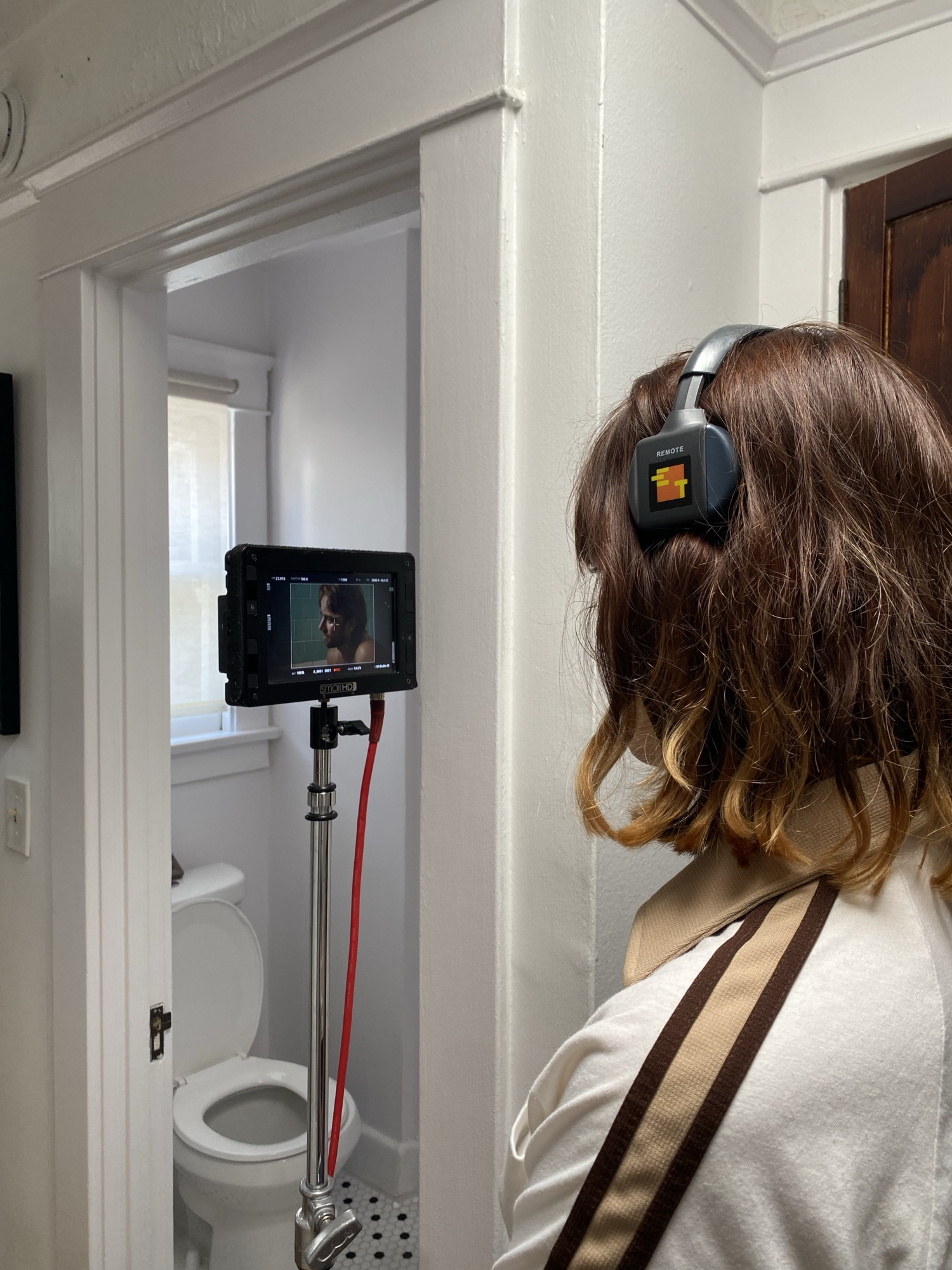
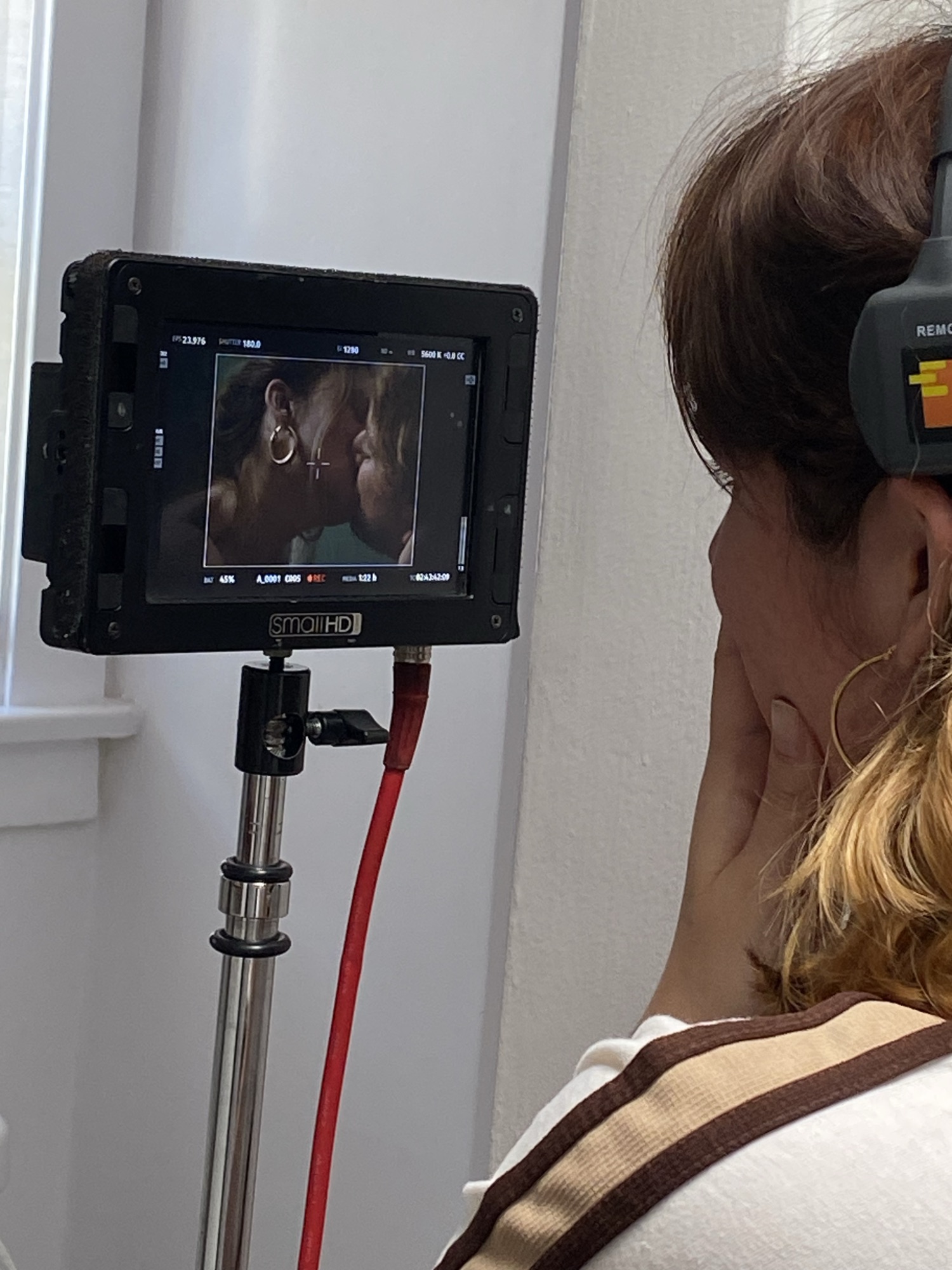
I’d like to ask you more about the choices behind the cinematography, particularly with Ksusha Genenfeld working as a one-person camera crew. In the entire first shot, I’m struck by the lack of cuts, the zooms, and the ping-pong effect of the camera throughout the conversation. Can you tell us more about how you approached these choices and what you aimed to achieve with them?
I had known that I wanted the whip pans from the start, chiefly to honor the comedic pace of the script, and Ksusha suggested using a zoom lens. It was the perfect tool to explore the comedy of a claustrophobic conversation. We didn’t want to overuse the zoom; we only wanted to implement it when it was really earned in order to maximize the impact. Ksusha is a very intuitive artist—her intuition drove the rhythm of the whip pans as she began to feel Chas’s and Sasha’s pace. It was like she was dancing with them. She was such a champion panning and zooming and focusing the camera simultaneously.
To contrast the dynamic camera movement inside with a static wide shot outside felt like the right choice for the end. We become more observant and distance ourselves from the reality our characters find themselves in.
I had known that I wanted the whip pans from the start, chiefly to honor the comedic pace of the script.
At the end of Three Minutes, the two characters pause, with classical music playing in the background, and there’s no explicit mention of the pregnancy results. What were you hoping to convey with this open-ended conclusion? And what led you to choose the Mozart aria for this final moment?
For me and Sophie, the pregnancy results themselves didn’t matter as much as the relationship between the two leads—the goal of the open-ended conclusion was to indicate that something has shifted between them, the details of which are left to the audience to fill in. They are simultaneously unchanged and forever changed.
I chose the aria from Bastien und Bastienne, which is a comic opera about two lovers who quarrel despite ultimately wanting to be together, primarily because I thought that the whiplash between Bastien and Bastienne from lover to enemy to lover really suited the back and forth of the short. Bastienne laments that Bastien has abandoned her, and yet through many misgivings and misunderstandings, they end up together, which mirrors our ending as well.

What do you think you principally brought away from your work on Three Minutes, and where is your focus turning to next?
It made me reconsider how I think about process and product: that something I make for no money in a couple of days with friends can hold just as much value as a higher budget shoot that I meticulously plan for. It was so joyful to act on impulse, to have an idea and almost immediately enact it. It was incredibly fulfilling. I would like to keep the spirit of fluidity and adaptability alive for projects big and small moving forward.
Sophie and I are currently writing a feature that will be completed next year, and I am independently writing a short story. Another short of mine, Gift, will have its US Premiere at Dances with Films NY this January as well.