
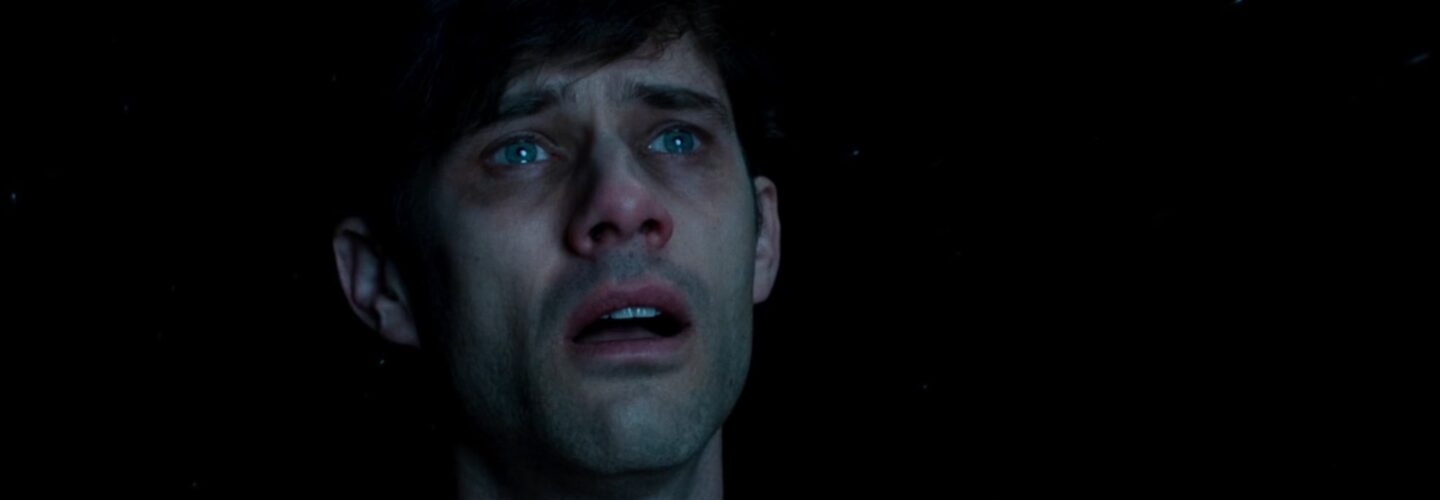

The French call it ‘L’appel du Vide’, the ‘Call of the Void’. That feeling when looking down from the top of a great height, like a mountain or building, and there’s a fleeting temptation to jump. A compelling curiosity about what it would feel like to plunge into the open air, ground rushing up at you, and perhaps for a moment, feel like you’re flying. Like you’re free. Oscar Garth gives that temptation a robotic face and a retro-futuristic infomercial style in his absurdist sci-fi short Benji. This darkly funny tale shows off the shiny, new garbage disposal system of the future and how one family welcomes it into their home with open arms. Premiering the film on Directors Notes today, Garth talks to us about the making of his self-funded short, capturing the retro look and feel of the commercial-like story, the challenges for him and his cast creating the dialogue-free script, the design and build of the Benji unit itself, and the VFX used in a spectacular final sequence.
Benji strikes an incredible tonal balance between fun style and existential dread. Where did the idea come from to merge these two opposing points of storytelling?
Well, my background is in comedy, so the majority of what I make tends to be pretty daft. At the same time, I’m really drawn to expressing quite personal ideas, outlooks, and experiences within a silly container. One of my favourite things ever is witnessing quite serious circumstances play out in an utterly ridiculous world. I love riding that line between serious and absurd, and I think injecting a bit of absurdity into a project can disarm an audience enough to let the more serious themes slip through. Life is quite daft after all, isn’t it? I think it’s always good to have a sense of humour about things, no matter how serious things get.
I love riding that line between serious and absurd, and I think injecting a bit of absurdity into a project can disarm an audience enough to let the more serious themes slip through.
I’ve also always had a fascination with retro TV adverts, particularly retro-futurism. The happy-go-lucky family dynamics and overly optimistic ideas about future tech, I just find incredibly charming. I knew I wanted to write something in that world, I just wasn’t sure what. Then, during one of the COVID lockdowns, I experienced what I can only really describe as an existential meltdown, and became very interested in capturing those feelings on screen. From there, the manufactured ad-world, the Benji bins, and the idea of recycling matter all sort of fell into place. It felt like the perfect playful vehicle for exploring those emotions.


The film sets itself up as a retro TV ad, then seamlessly pivots into an existential drama, but the shift in the visual language/soundscape between the two is so subtle. How did you go about marrying these two worlds together in one short?
That tonal balance, and especially the transition between the two worlds, was something I was really keen to get right. I think it came from a combination of a lot of different elements working together. First and foremost, Jim Rastall and Bex Finch’s superb performances. I think the subtle ways they respond to the changes in the ad world really pull you in, and given the lack of dialogue, the audience is left with only visual cues as to our characters’ inner workings.
Visually, the slow physical zooms played a big part. We used an old beat-up Canon servo zoom lens to achieve that, and it really helped emphasise key moments and create this creeping sense of unease, in stark contrast to the playful snap-zooms of the ad-world. There were also shifts in the colour grade over the course of the film. I really wanted to create a sense of the façade slowly slipping, so I didn’t want anything abrupt or too in-your-face. I wanted it to feel like a slow burn, gradually revealing some truth underneath the commercial.
Most Popular
I briefly toyed with the idea of shooting actual 16mm film with my Bolex, but decided that not only had I already spent more than enough on this film, because I was also directing, I wanted to play it safe and not overcomplicate things in the camera department. I ended up using my Blackmagic Micro, which has a gorgeous super-16 sensor (the next best thing). I paired it with the old Canon servo zoom lens, which alongside the grade, got me most of the way to a film look. Then, of course, there’s the scene with Jim and the Ether right at the end, which was graded completely differently. I stripped back a lot of the film emulation effects and opened up the aspect ratio to 16:9, so that when the shot of Jim floating in front of the ether arrives, it suddenly fills the cinema screen. We finally break out of the ad, and it really lands.

The retro advertising for a very futuristic product is reminiscent of shows like Fallout, with a style like the old Cadbury’s Smash adverts. What references did you have in mind when devising the style of the film?
You’re spot on with Fallout. It’s one of my greatest loves and was absolutely a huge inspiration. I love everything about that world design. The 1950s nuclear family aesthetic, and the way it sits alongside a much darker undercurrent definitely fed into the film’s style. When I was pulling references together for Benji, I ended up amassing a bit of a treasure trove of 1950s and 1960s TV ads. Some were hilarious, some were very ‘of the times’, but mostly they’re just delightfully charming. I also remember as a kid watching old Tex Avery cartoons like The House of Tomorrow. It’s sort of an infomercial, which showcases contraptions and various household gizmos that make no practical sense at all. They’ve always really stuck with me; there’s something so daft about those overly optimistic visions of domestic life.
I really wanted to create a sense of the façade slowly slipping, so I didn’t want anything abrupt or too in-your-face.
The production design and locations are perfect – especially that kitchen seen in all its glory from the stairs towards the end of the film. How did you go about finding and dressing that location?
When searching for locations, most of the places I was looking at were fairly basic domestic houses, just with retro wallpaper. It took me a while, but I eventually found The Houseboat in Dorset, and I honestly couldn’t have been happier. It was the perfect retro show-home, a real ‘House of Tomorrow’. It came almost fully dressed, with some finishing touches from our production designer Jamie Foote, and populated with a few knick-knacks I had lying around my flat. I’m incredibly glad I held out for it, it’s tough to imagine what Benji would’ve been without it.


The non-spoken performances of Dad and Mum perfectly complement the style of the film. How did you go about casting and collaborating with your leads, as well as their young daughter?
Casting was a fun one and a new experience for me. I initially put out an ad on Starnow/Backstage, etc. and got some very… interesting responses. At the same time, I happened across a single-take short drama called Struck starring Jim Rastall. I was immediately sold on Jim’s performance, asked to meet for a coffee and effectively cast him as Dad on the spot. He was amazing on set, fully understood what I was trying to achieve, and his performance in the final sequence will forever be one of the best things I’ve ever shot.
Bex Finch was also a joy to work with. I cast her as Mum after a director friend suggested we meet. She had the exact right energy, and watching her and Camilla Birkett perform together was incredibly wholesome. Camilla definitely brought the energy on set. Her mother caught wind of my callout for the Daughter character and dropped me an email. She was exceptionally bubbly, with very expressive features, so naturally she got the part.
The lack of dialogue was an interesting one. It meant that we had to collectively figure out what was going on internally with these characters and communicate that through subtle facial expressions and body language. Jim’s final scene, for instance, came from us sitting together with a coffee and chatting about life and death. Once Jim had something that felt real, we jumped back in and got the take that made it in.

On to the real star of the show, the Benji unit design is perfect for the 70s/80s style of the film. Can you walk us through the design process, followed by the manufacturing?
Getting the Benji bins made was a whole adventure in itself. I had quite a clear idea of what I wanted them to look like, and when I stumbled across Ann-Sophie De Steur on Instagram I knew she’d be the perfect person to bring them to life in 2D form. I started reaching out to props manufacturers and getting back eye-watering quotes. Then, after popping to their workshop for a coffee and a chat, JSM Model Makers down in Marlborough agreed to take it on for a very generous price. They absolutely nailed it, truly bringing Ann’s sketches to life and with all sorts of LEDs and switches to boot. Even the eyes moved. They’re currently in my flat – small Benji on a shelf above the TV, medium Benji serving as my actual desk bin, and big Benji just taking up huge amounts of space.
The lack of dialogue was an interesting one. It meant that we had to collectively figure out what was going on internally with these characters and communicate that through subtle facial expressions and body language.
You voiced the narrator and Benji yourself. What was the process for writing, recording and manipulating those lines?
To be perfectly honest, I just waffled aloud in a stream of consciousness on a few long drives and transcribed from that. Then it was just a Zoom recorder in my flat, nothing glamorous at all. In post, I managed to find this bit crusher plugin, which digitised my voice in a really cool way, then pitched it up an octave or two, and Benji was born.

The film boasts a stunning sequence at the end when Dad has chosen to send himself back to the ether. How did you go about devising and capturing that sequence with VFX?
I had a very distinct version of that sequence in my head from the very beginning. In fact, it was the first image I had for the film. From there, it was really a case of pulling references together and chatting with my good friend and VFX wizard Paul Marke, about how we could actually achieve it. The plates I shot with Jim were actually filmed in a community hall round the corner. We basically threw up a load of black fabric, sat Jim on a box, and got him to flail about a bit. Luckily, he’s a good sport. The one key practical effect was the lighting. We placed a 300D in a lantern on a roller stand, and as I tracked the camera into Jim’s face for those final moments, we moved the light in at the same time to create the feeling that he was physically approaching the Ether. The rest of it was all built in post but having that movement and light interaction captured in-camera really helped make it feel tangible.
What’s next for you?
I’ve always got daft ideas on the back burner I’d love to make. The next one will likely be a short film called Channelling Walter Fishman, about a hermit who lives underground and makes crap electronic music. Alongside that, I’m also developing a comedy debut feature with long-time collaborator James Button, about a 900 year old man in a care home who just wants to get back to his castle… so stay tuned for those!

And finally, what short film would you recommend to the Directors Notes community and why?
That’s interesting. One short I keep coming back to as a solid source of inspiration is The Privates by Dylan Allen, about an unknown rock band struggling with a radioactive energy in their music that blows up amps, liquefies tape decks, and starts electrical fires. It’s a little bit Edgar Wright, with a touch of Spielberg whimsy, and not only is it beautifully crafted in terms of cinematography, art direction, score and sound design, but the stand-out attraction for me is the naturalistic performances and editing. It all feels highly conversational, a bit like in Alien, where quite often you’re lingering on reactions rather than line delivery, and fully buying into the idea these guys are in the same room talking over each other. I honestly can’t believe it was never picked up for a feature.