
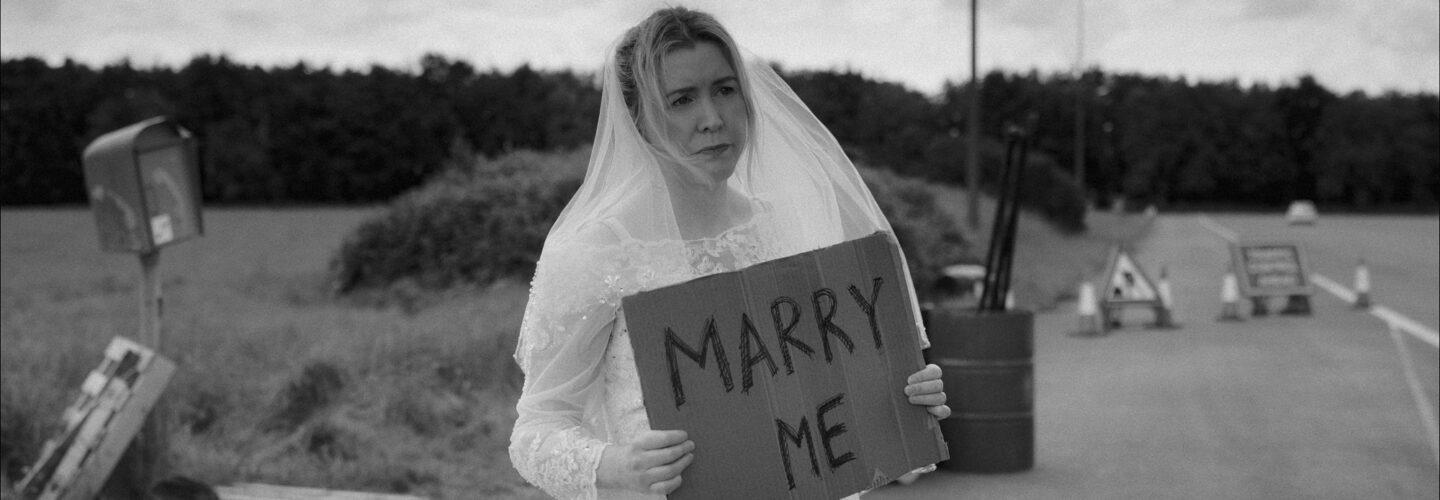
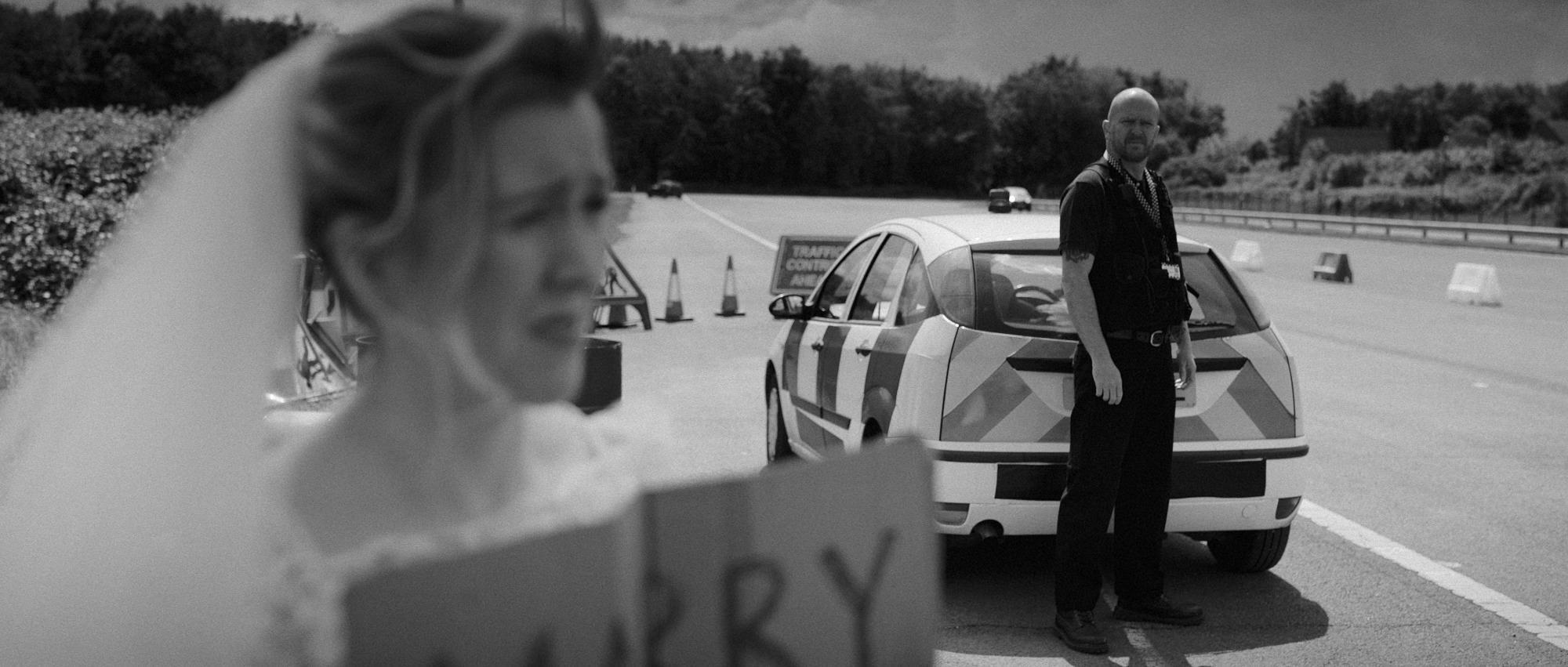
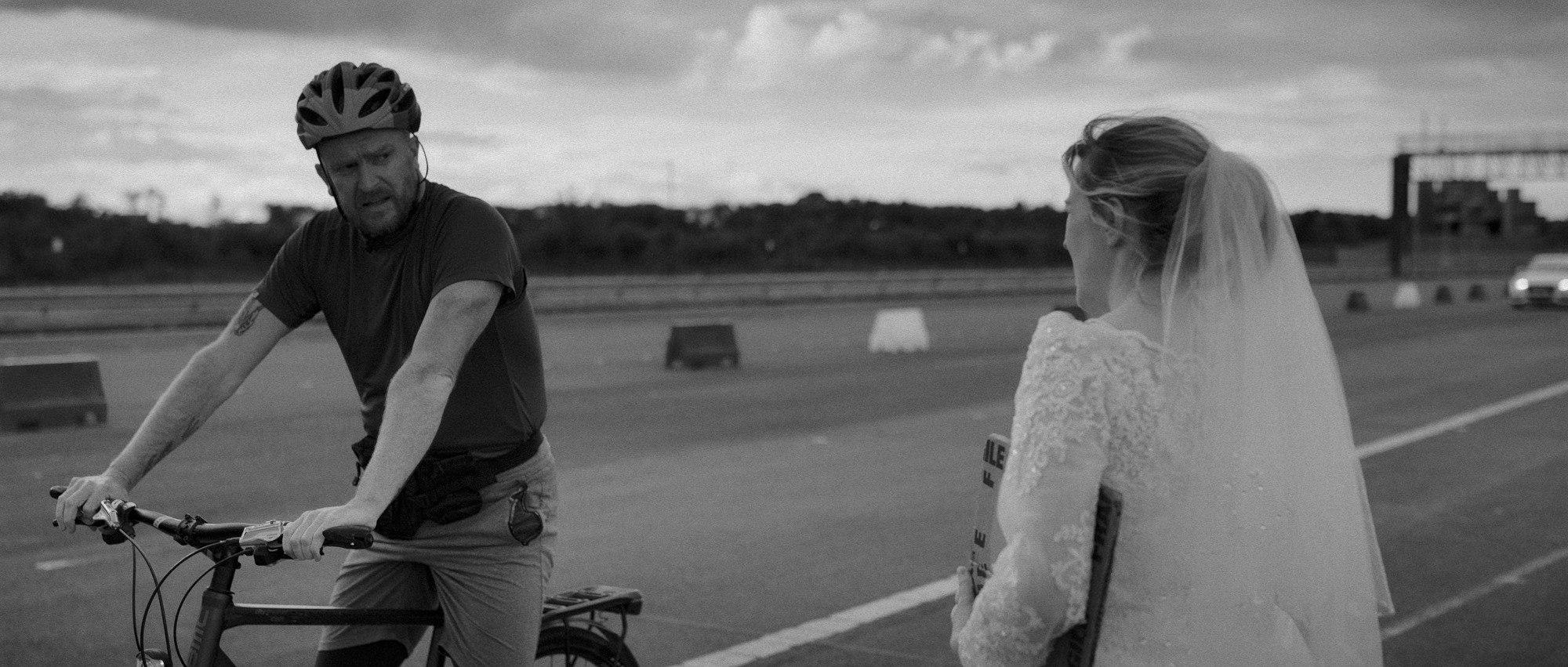
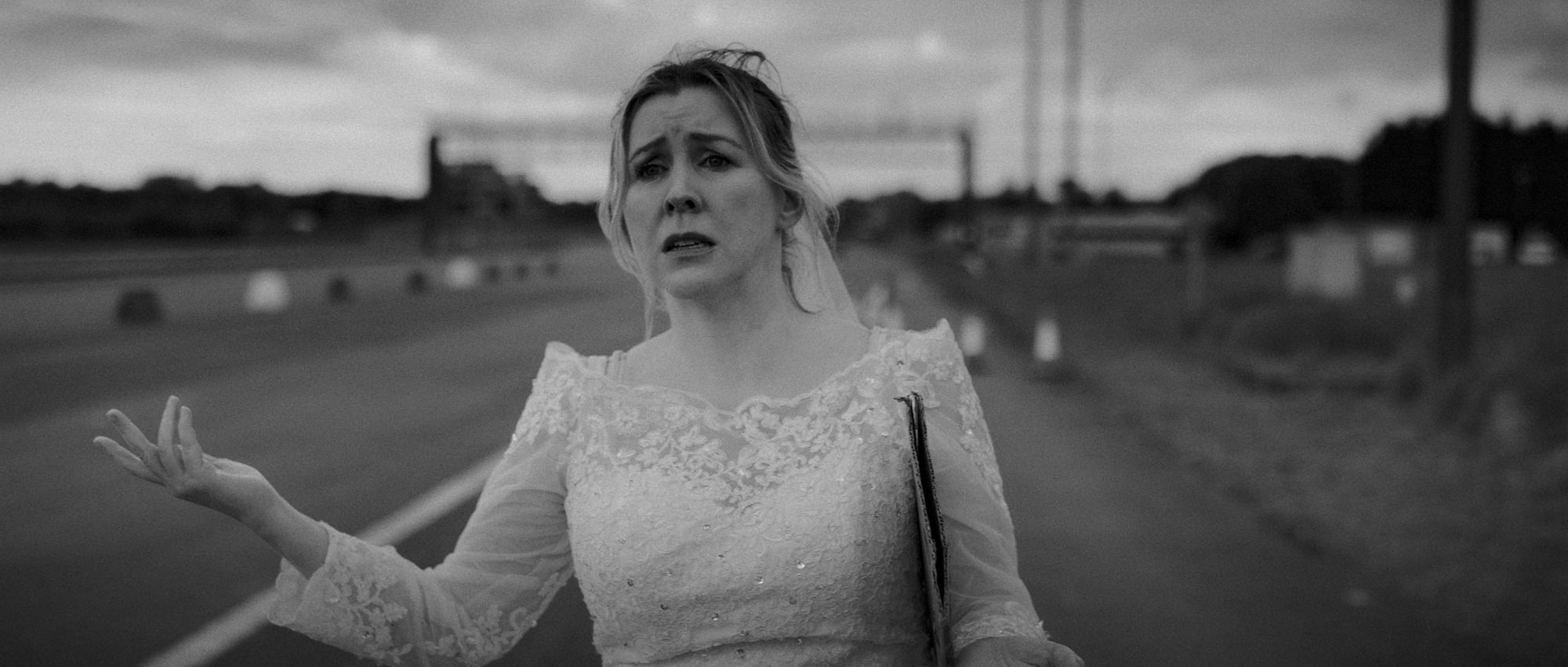
A woman stands at the side of an A-road in a wedding dress, holding a sign that reads MARRY ME. We’re never told how she got here, what she’s running from, what she’s already lost, or which bad decisions left her bargaining with passing traffic for a husband. Kitty Percy keeps her hopeful bride- to-be’s backstory off the table and trains the camera instead on the present-tense absurdity of her predicament: 40s, single, childless, stuck in a dead-end job, and somehow, perhaps convinced that the right stranger might still pull over and fix everything. What pulls over instead is a succession of men, each with his own agenda, each encounter tipping through the bizarre and the unwelcome.
For Better brilliantly highlights a situation that looks ridiculous on the surface yet lands with a deeper uncomfortable familiarity — the quick fix that fixes nothing, the small humiliations that pass for an ordinary day. It’s a delicate balance, and it ought to curdle into parody. It never does. Heartbreak gets scored like a romance, staged like melodrama and shot in stark black and white, and the film stays funny, tender and genuinely sad, often all at once. Most appreciated by me and I’m sure many others, is that beneath the gags sits a sharper argument: that marriage ensures nothing, and the only thing really worth trusting is the solidarity of other women just as disillusioned as you are. As For Better premieres with DN, Percy joins us to discuss scoring loneliness like a love story, the moment colour bleeds back into the frame, and finding the film’s true salvation in female friendship.
For Better conjures a very specific kind of modern loneliness, and you stack the indignities on Jeanine with real intention, yet none of it tips into cruelty. How did you calibrate that escalation?
For Better is a story about the times we live in, i.e. connected in every imaginable way yet lonelier and more isolated than ever. Jeanine’s situation — 40s, single, childless, dead-end job — will resonate with anyone who’s found themselves looking toward a long, hard future and wondering if they’ll have to live it alone. We don’t know the details of the bad choices Jeanine has made before she landed here on a roadside, in a wedding dress, holding a sign saying MARRY ME, but I think we can all relate to her goal — “I just want someone to say my name in the dark” — and to the appeal of a quick fix. I wanted Jeanine’s encounters to start out harmless, then escalate to a sense of real threat when the car with a darkened window pulls up and hovers ominously.
If unwantedness is the malaise of our age, then For Better doesn’t attempt to find an answer.
It’s partly a genre question — For Better is a drama with a comedy pulse — and though there’s a version in which the cruelty and threat could have gone full slasher movie, I also wanted to show the kindness of strangers, i.e. most people want to do good, even if their behaviour suggests otherwise! The story is, above all, a celebration of friendship. If unwantedness is the malaise of our age, then For Better doesn’t attempt to find an answer. Instead, it suggests we gather around what we can’t understand and try to grapple with it (or burn it down) together.
Her roadside gambit is instantly relatable. Were you more drawn to the dignity of that impulse or its absurdity, and how did the wedding dress, as an object, sharpen what you were trying to say?
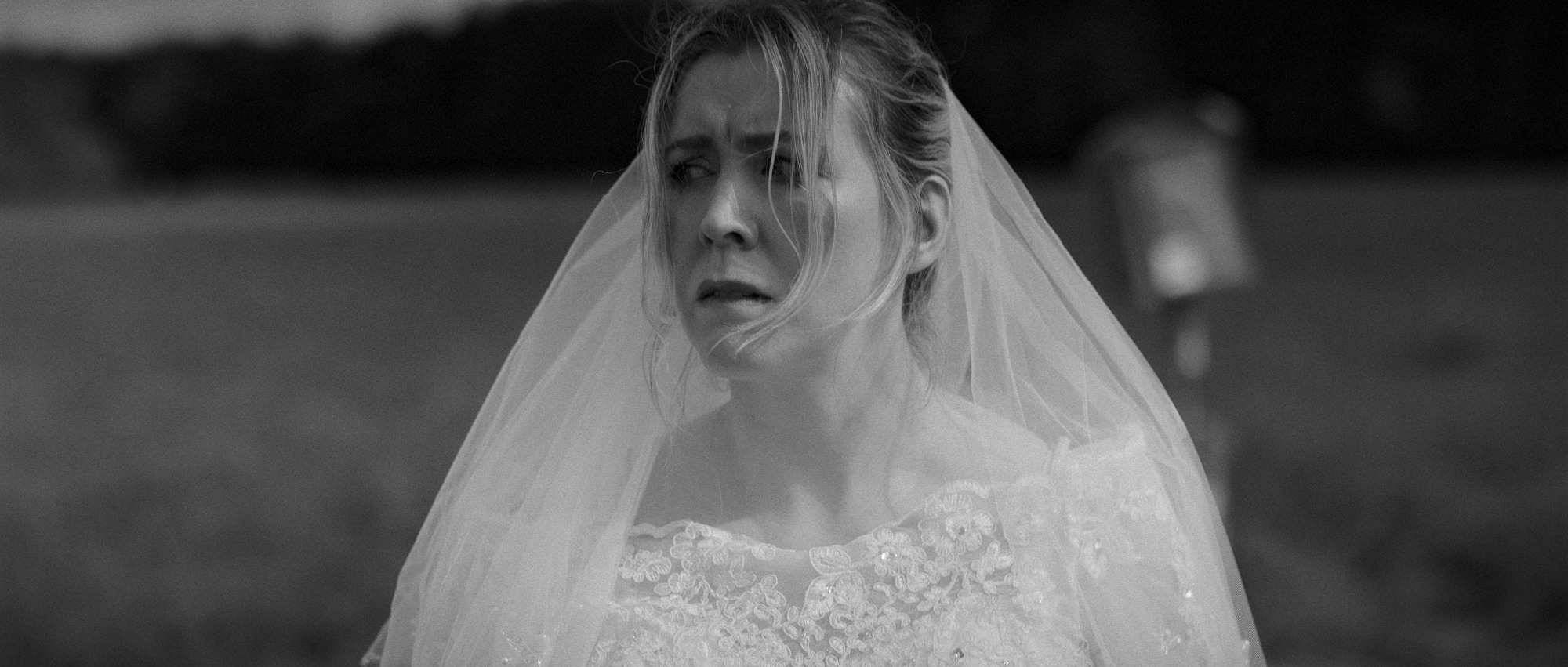
Thank you for seeing dignity in Jeanine’s meltdown! I wanted to show her courage in the face of frustration and loneliness. I love creating those moments when we’re called upon to be brave, or noble, or honest, and instead we end up being stupid, vain or shallow — the truth of what we should do, versus the messy human truth of what we actually do. I do find wedding dresses extraordinary — and yes, my childhood Sindy doll bride is still somehow magical to me, despite the fact that her rubber feet have disintegrated with age and her wedding dress is grey from endless handling by small grubby fingers.
The way we fetishise brides and give them symbolic powers of transformation — it’s easy to understand how Jeanine could see a wedding dress in a charity shop window and decide it could fix her. Later, in the edit, there was a lot of discussion around Jeanine’s line about the dress — “saw it in Cancer Research and thought what the hell, either this or suicide.” She’s mostly joking, but Alice Lowe injected the line with such pathos that we worried about whether it had gone too dark. I’m glad we stuck by it, though — the pain of loneliness is huge, and it seemed right to confront that.
Most Popular
What did your Steadicam setup give you that locked-off or handheld couldn’t, and where did it feel essential to Jeanine’s story?
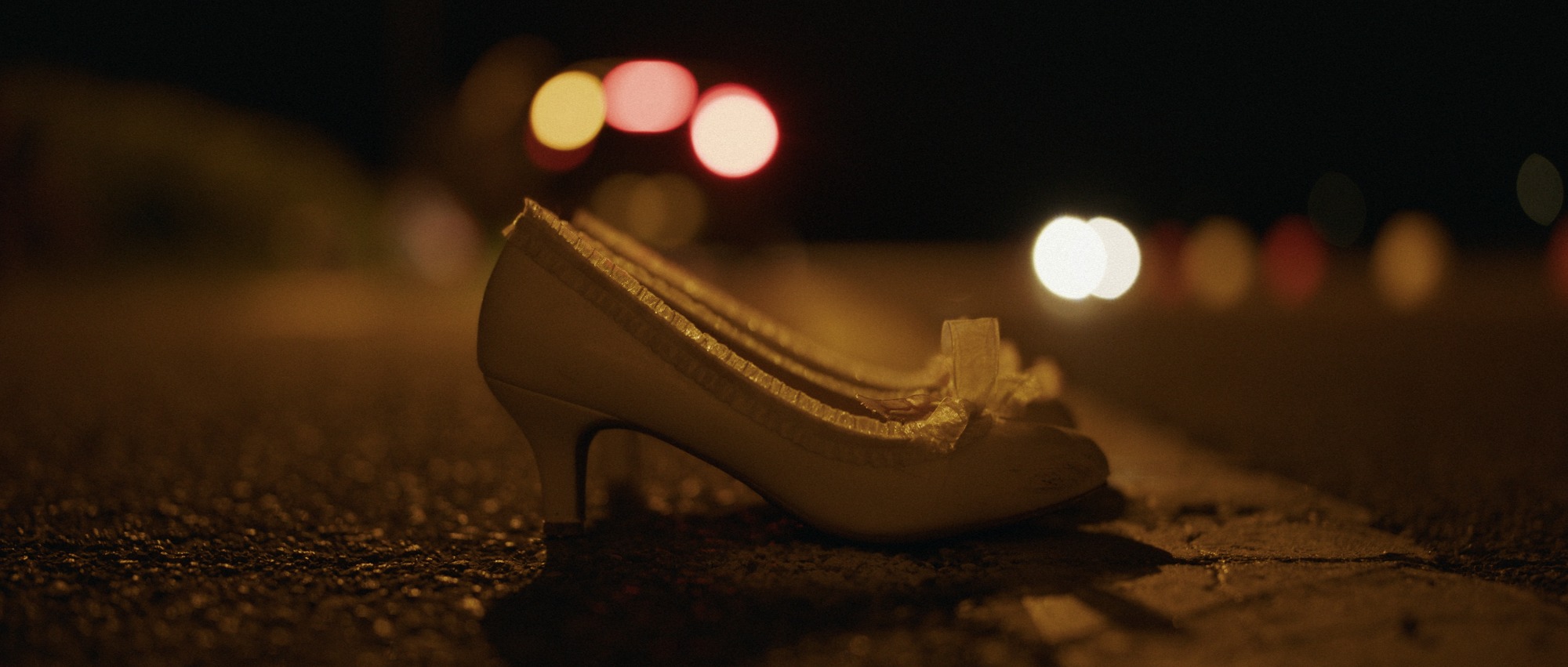
I’m an experienced screenwriter but a novice filmmaker (For Better being my second short), so understanding cameras and lenses is a fascinating and ongoing challenge. DP Robbie Bryant was keen to use Steadicam right from the off, and although it used up a significant slice of budget, it was worth it. The opening shot conveys a huge amount of information: council worker’s boots on the ground as she picks up litter, pausing at the pair of bridal shoes randomly placed in the lay-by, Jeanine rushing into frame to put them on, camera panning up to see the wedding dress stuffed into her cagoule — so many character beats and useful details contained in just a single shot. And again, when Jeanine falls asleep and wakes up to the arrival of the Angry Bride and her hen friend, Steadicam operator Adam Opie did a brilliant job of delivering a cascade of narrative information without a cut.
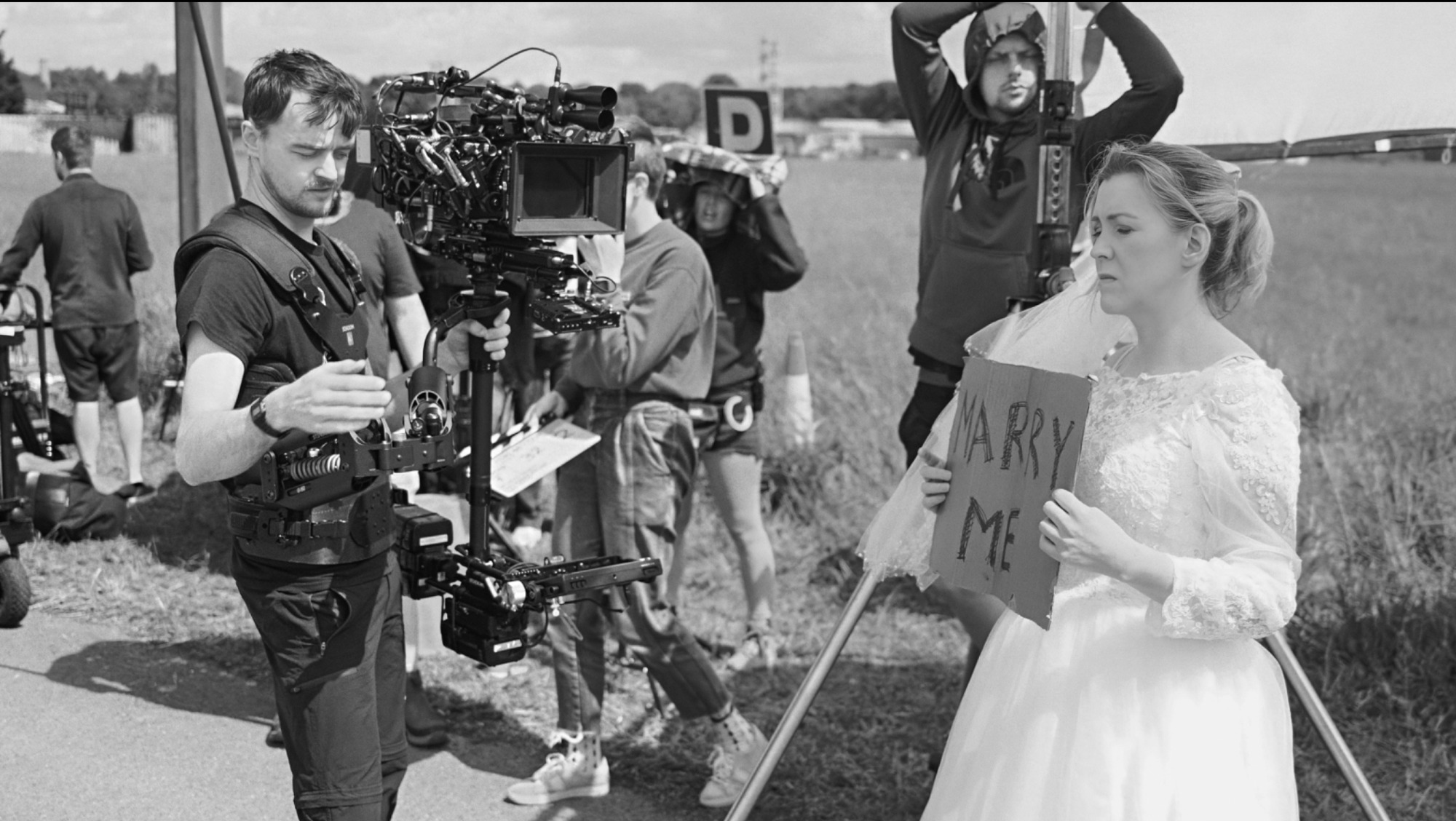
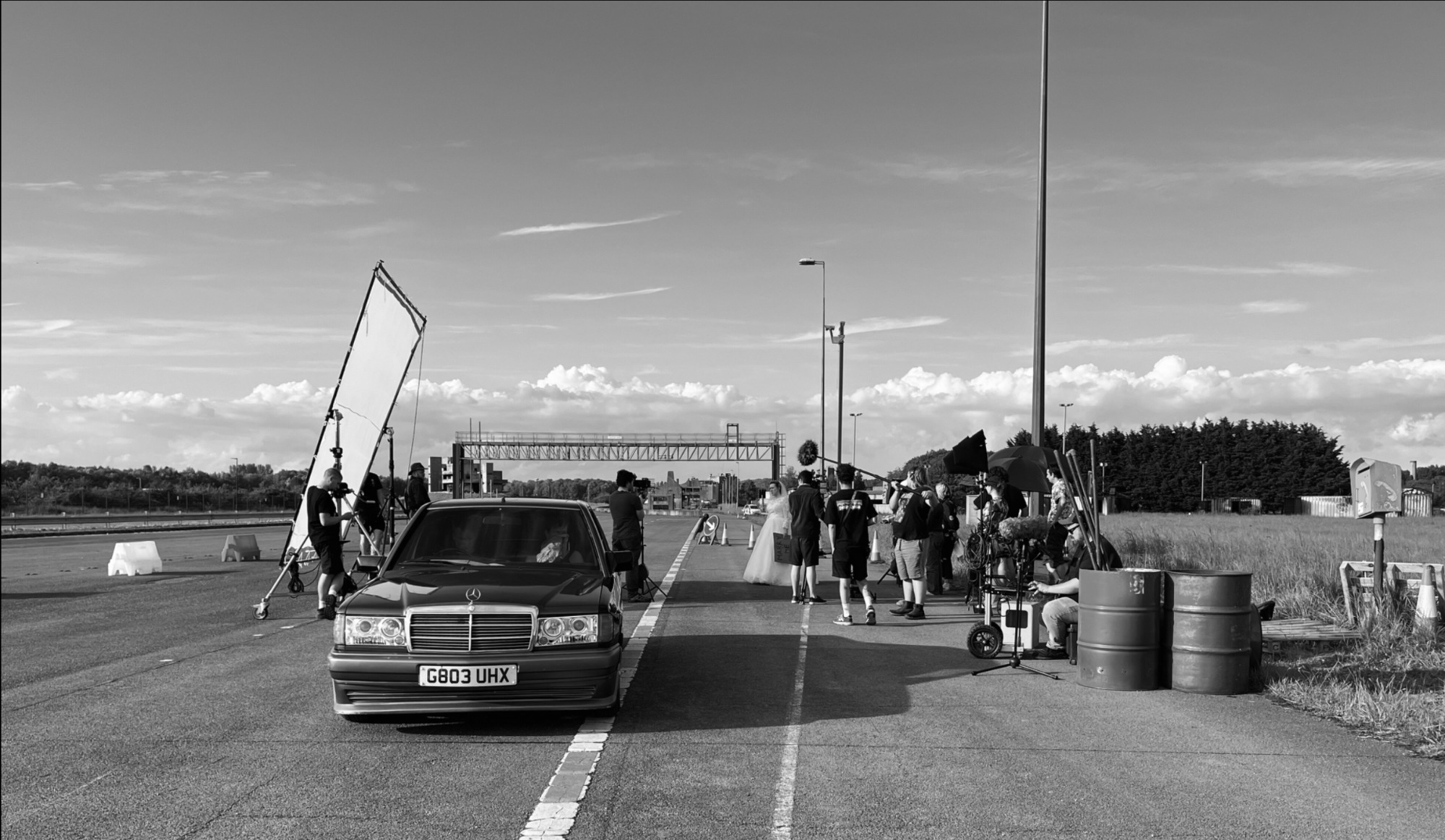
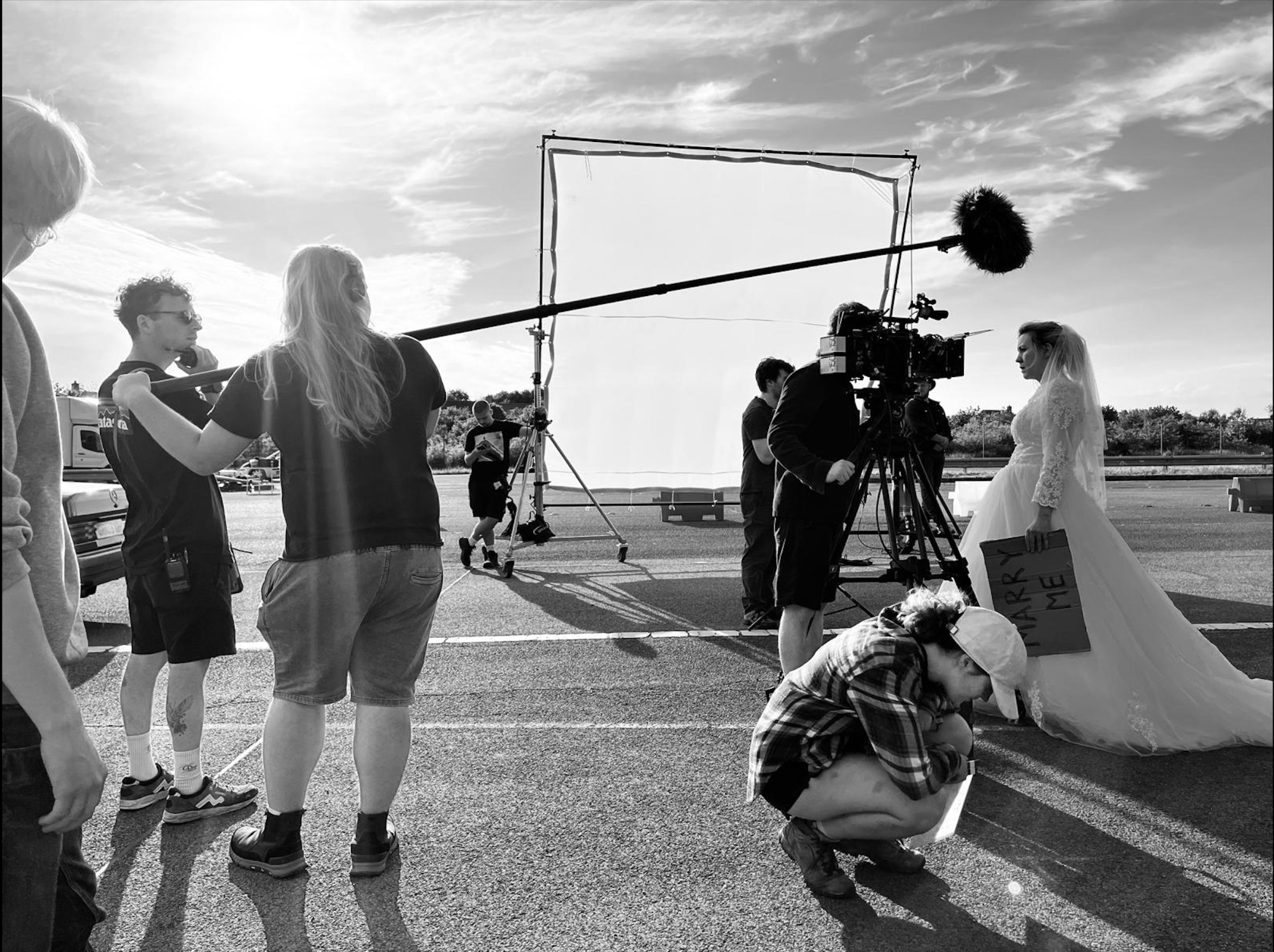
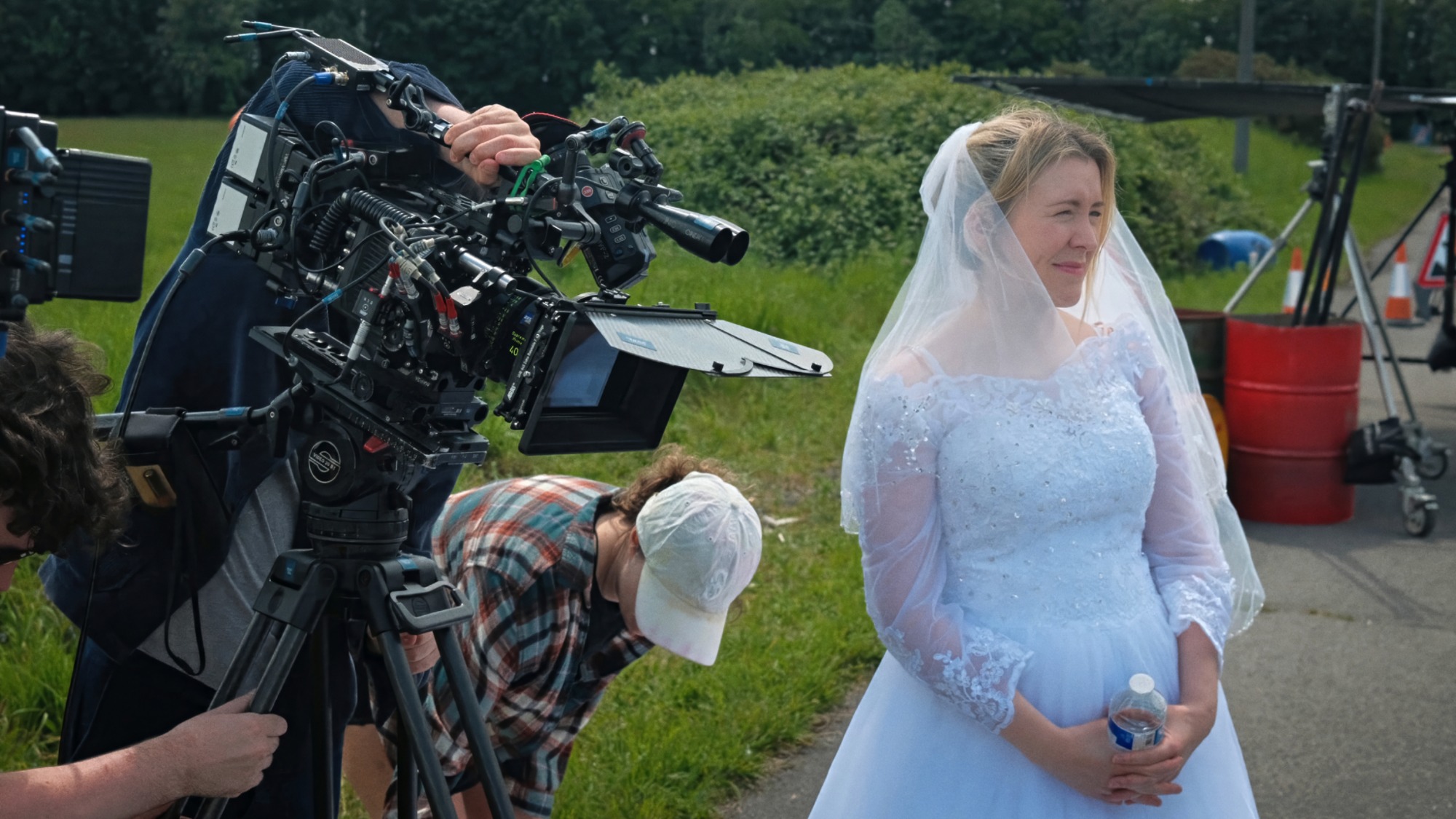
I’m not experienced enough to have a directing style, but I knew I wanted to be as invisible as possible, and every cut has the potential to insert the director into the narrative. Steadicam gives fluidity but also an intimacy that was useful in telling this particular story, which requires the camera to be flexible enough to notice tiny reactions and awkward beats between characters.
We filmed over two days at the Fire Service College in Moreton-in-Marsh, both days starting late and shooting into the night. The campus there has a stretch of motorway used to train firefighters, and although we had to provide our own passing traffic (i.e. long-suffering runners and friends, who patiently drove in and out of shot) it was great to be able to plan and practise these complex camera moves — way simpler than applying to the local council to close a stretch of actual road and parachuting the production in.
Steadicam gives fluidity but also an intimacy that was useful in telling this particular story, which requires the camera to be flexible enough to notice tiny reactions and awkward beats between characters.
The opening score sounds lifted from a rom-com with the soaring strings we’ve been trained to read as the arrival of hope. Was that gap between what we hear and what we see always the plan, and how did you get the register exactly right with your composer?
Composer Alastair McNamara created an amazing score that elevated the story in ways I didn’t think possible. I asked for a big, overblown orchestral sound to reflect Jeanine’s inner landscape: she’s embarking on her own romantic odyssey, so the swelling strings needed to feel hopeful and pure, but I was keen for there to be an odd disconnect between what the audience hears and sees. So the brief I gave Alastair was pretty vague and contradictory, and I’m still bowled over by what he came up with: the tonal discomfort in the meeting between Jeanine and Officer Craig; the Hitchcockian suspense and intrigue he conjures when the Angry Bride arrives.
But I think my favourite part of Alastair’s score is the meet-cute between Jeanine and Pete, who appears with a handful of lost cat posters and seems like Jeanine’s prince has come. That cue is so enchanted and playful, so full of promise and possibility — until, of course, we realise that Pete’s a sleaze and the music curdles into something nasty and weird. The score becomes more pared-down and realistic as the film progresses, until the last frame, when it’s just a solo piano. The music not only demonstrates the emotional progression of Jeanine from start to finish, but also gives each character their own tonal identity.
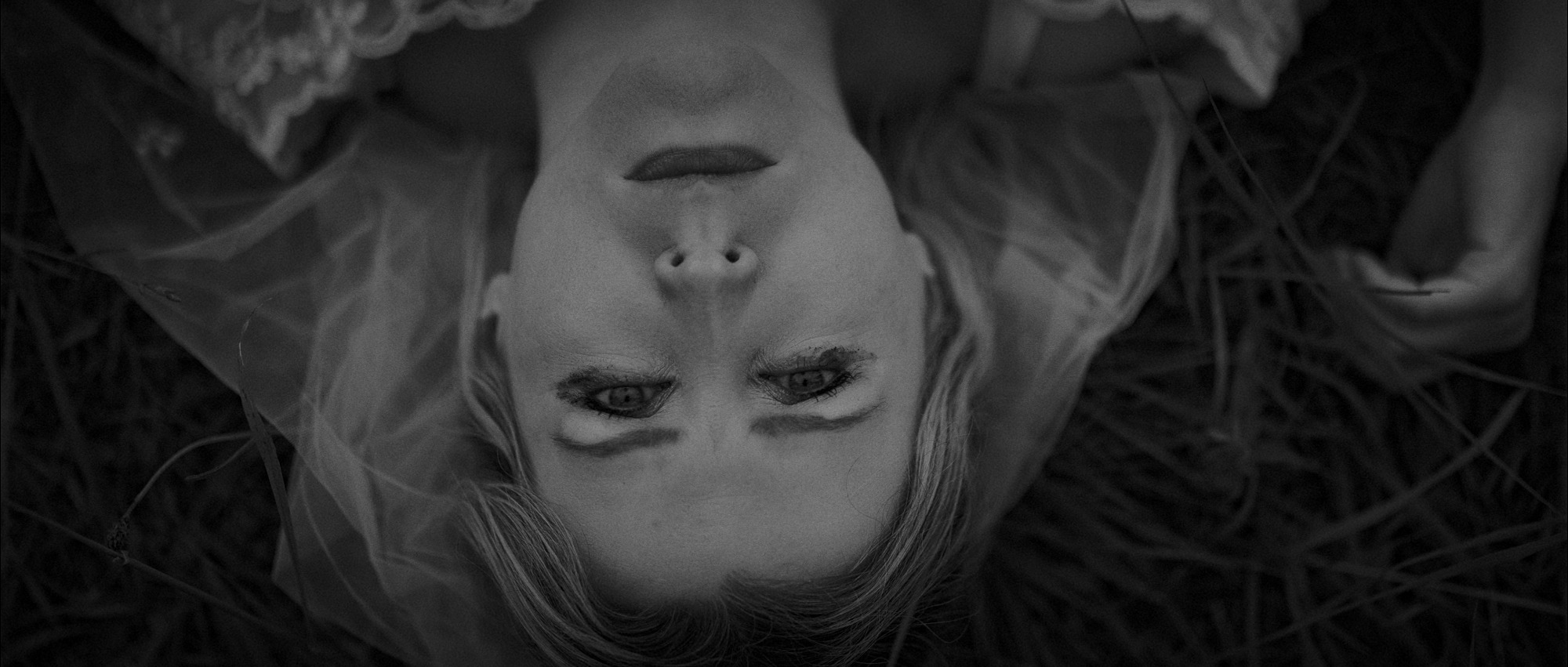
I found the film funny, beautiful and devastating all at once, and none of those registers cancels the others out.
I’m delighted to think that it’s all of those things! But yes, tonally it was tricky to get right, and if we did, then it’s thanks to the actors. Once the script was finished, producer Andrew Harmer and I were lucky enough to get selected for funding from BFI Network and National Lottery, and though we still had a significant budget hole (some of it filled by Bournemouth Film School’s Funding Futures), the BFI affiliation was hugely useful in attracting cast. When I told casting director Lucy Hellier that I’d imagined “an Alice Lowe type” in the lead role, she suggested I simply ask Alice Lowe. Who, of course, read the script and said “yes”, proving herself not just brilliant in front of the camera but kind, collaborative and endlessly patient. We had other well-known actors in the cast, and I knew they’d be too busy for rehearsals, but we managed to gather enough actors for a couple of table reads, which proved incredibly useful in balancing irony vs sincerity, funny vs sad, and cruel vs kind.
My main note was for the performances to be deadpan and without affect, but I’ve since learned that this, of course, is a terrible note to give an actor.
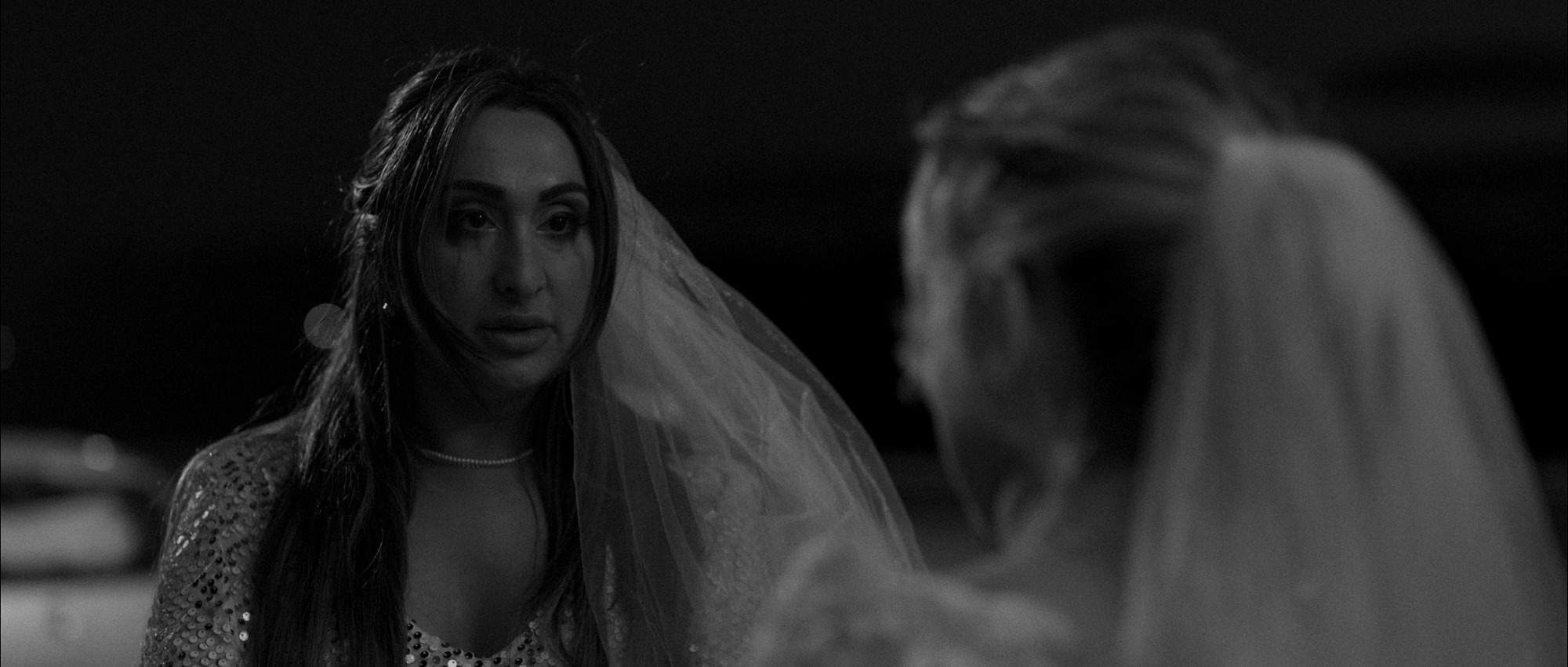
One of the trickiest scenes to get right was the meeting of the three women. Tina, the Angry Bride, needed to be angry — obviously — but also full of disdain; Jeanine needed to make a connection with her but to also know on some level that she hasn’t earned her friendship yet; Maz needed to have a history and an emotional shorthand with Tina that made her entirely comfortable with Tina’s apparent rudeness. My main note was for the performances to be deadpan and without affect, but I’ve since learned that this, of course, is a terrible note to give an actor: good acting relies on an internal engine — motives, stakes, objectives — not a ‘result’ or a specific aesthetic shell. Luckily, the actors were too gracious and professional to call me out, and delivered the scene perfectly. What also became clear on set was that Alice Lowe and Edward Rowe are hilarious together — I was tempted more than once to throw away the script and let them make the whole thing up! — so I had to make a conscious decision not to push it into broad comedy.
Black and white risked reading as grey and depressing, or as the kind of choice festivals find pretentious. How did you weigh those risks against what the format gave you?
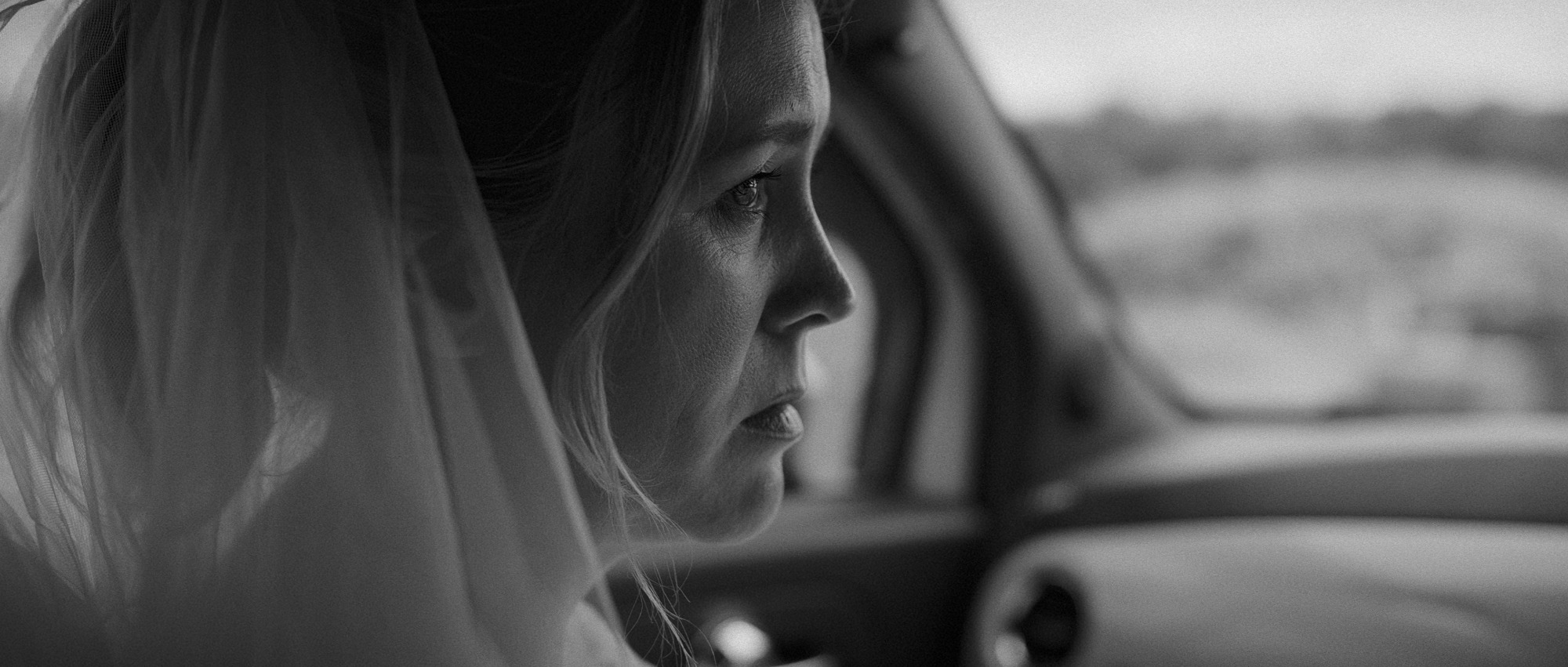
Though we shot in colour, we were a couple of days into post when Robbie messaged me to say “just me, or would this film look great in black and white?” Oddly enough, I’d had the same thought on set: Alice Lowe has a remarkable ‘silent movie’ face — deeply expressive and communicative, she can speak volumes with just the arch of an eyebrow or the twitch of a lip — so we asked colourist Carl Thompson to try a black and white version. Though I loved the melancholy it brought, it was a big decision: would black and white be a turnoff for some audiences? Would it make the film feel grey and depressing? Would festivals consider it wanky and pretentious?
I’m pleased that we committed to it — and fortunately, I’ll never know how many festivals passed on the film because of that choice! Katie Bignell at Festival Formula did me a huge favour by watching the film (even though we didn’t have enough budget left to employ their services officially) and chatting through the pros and cons of black and white vs colour, so I felt confident in our decision. Ultimately, it was the right choice narratively: whereas using colour throughout would have made the film lighter and more accessible, there’s a timelessness about black and white that somehow speaks to the truth that loneliness, in some form or another, is part of the human condition.
It’s supposed to feel like an anarchic, joyful celebration of female unity, so it seemed right for colour to seep in as the wedding dress burns.
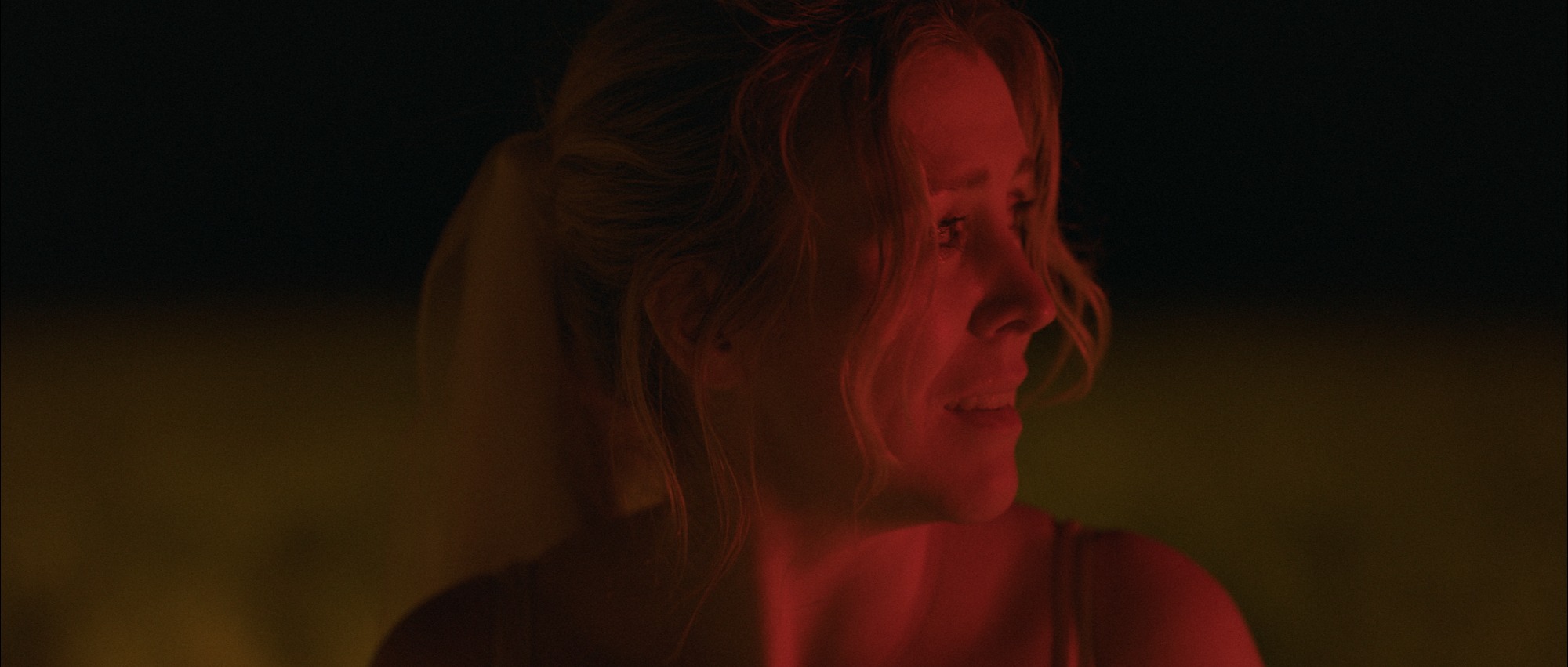
Colour seeps back in at the end — reality biting as Jeanine is pulled out of her matinee reverie — and it lands on the dress burning. Why that moment?
We ended up referring to the colour change as ‘reverse Wizard of Oz‘, in that Jeanine’s world starts out black and white, with a dreamy, melodious score, when she’s at the peak of her romantic delusions. She gets increasingly frustrated by the various men who stop and talk to her, all of whom have their own agendas (not all of them honourable), so when an angry jilted bride-to-be rocks up, we know there’ll be a reckoning. Jeanine realises she can unite them all, in their various frustrations, by burning her wedding dress. It’s supposed to feel like an anarchic, joyful celebration of female unity, so it seemed right for colour to seep in as the wedding dress burns: Jeanine has connected with these random women who’ve apparently rescued her, so she’s finally allowing reality in. The message that friendship matters above all else is key to the story, and the switch from black and white to colour at this moment seemed the best way to make that land.
You’re a screenwriter directing your second short. What surprised you most about the gap between writing a scene and directing it?
Screenwriting is basically directing on the page, but I hadn’t appreciated how little control a director has over the humans who will assemble to turn that page into a film. Relinquishing that control is a skill that every writer-director needs to learn. I’d somehow assumed that everyone in the cast and crew had imagined the same film that was in my head, so it was a surprise to discover that everyone arrives on set with their own interpretations. In an ideal world, you hire talented, experienced, capable people and just let them do what they do best, but in reality — especially when you’re making a film outside of London — you get whoever’s available and will do the job for the (pretty dismal) fee.
Overall, I was incredibly lucky with my cast and crew, and though they had different levels of experience, I was reminded more than once, by my own mistakes, that the most inexperienced filmmaker was me. All credit to 1st AD Alex Tawney and script supervisor Anna Symonds, each of whom, in their own ways, provided exactly the support I needed to not feel totally out of my depth. (I wish I’d watched before the shoot an interview with the brilliant and inspiring Sarah Polley, who explained that directors are often the least experienced practitioners on set, but to remember that if you’ve also written the script, then you are the expert in the room…) My other pleasant surprise was how much actors can bring to a script in ways you’d never imagined, so I have a new appreciation for the importance of casting — it really is everything.
What’s your favourite short film, and why?
Ooh, so many great ones, but I’m going to choose Rhys Aaron Lewis’s beautiful, uplifting comedy Run Like We, about a sports-hating 14-year-old and his Jamaican ex-athlete dad. It was on the Dinard Film Festival shorts programme along with For Better, so I watched it several times on the big screen and found a new layer to appreciate with each viewing. Comedy shorts are so difficult to pull off: I know from my own screenwriting day job that making a script funny and light is incredibly hard work; for Rhys to establish such brilliant characters and comedic tone in the space of a 10-minute short shows the most amazing craft.
So, have you caught the directing bug, and what’s next?
Have I got the directing bug? Absolutely, and I notice every day how much it informs the way I write. However, I do wish someone had told me that directing two shorts back to back would almost bankrupt me. (To be fair, someone may have, but I probably didn’t listen.) The fact is that when you get public funding to make a short, you’ll probably get half your budget, but you still have to pay your cast and crew properly — no freebies or favours.
So, unless you’re the one-in-a-million to win a prize fund, have rich friends, private finance, or can commit to the gruelling time-suck that is crowdfunding, it’s going to hurt. Luckily, I’ve already written a feature-length version of my first short Red Planet Blue, so I’m hoping to direct that: not a very ambitious project — just a sci-fi love story, traversing different timelines, with a complex cast of very young and also very elderly characters, set 300 years in the future, on one of Saturn’s moons — I mean how hard can it be, right?