
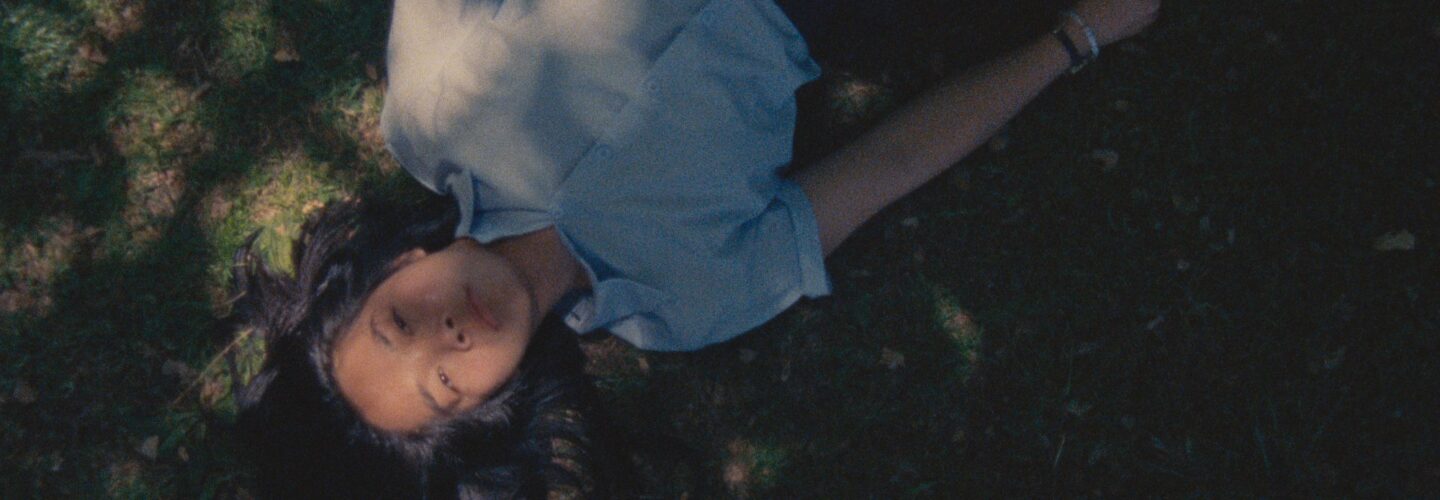
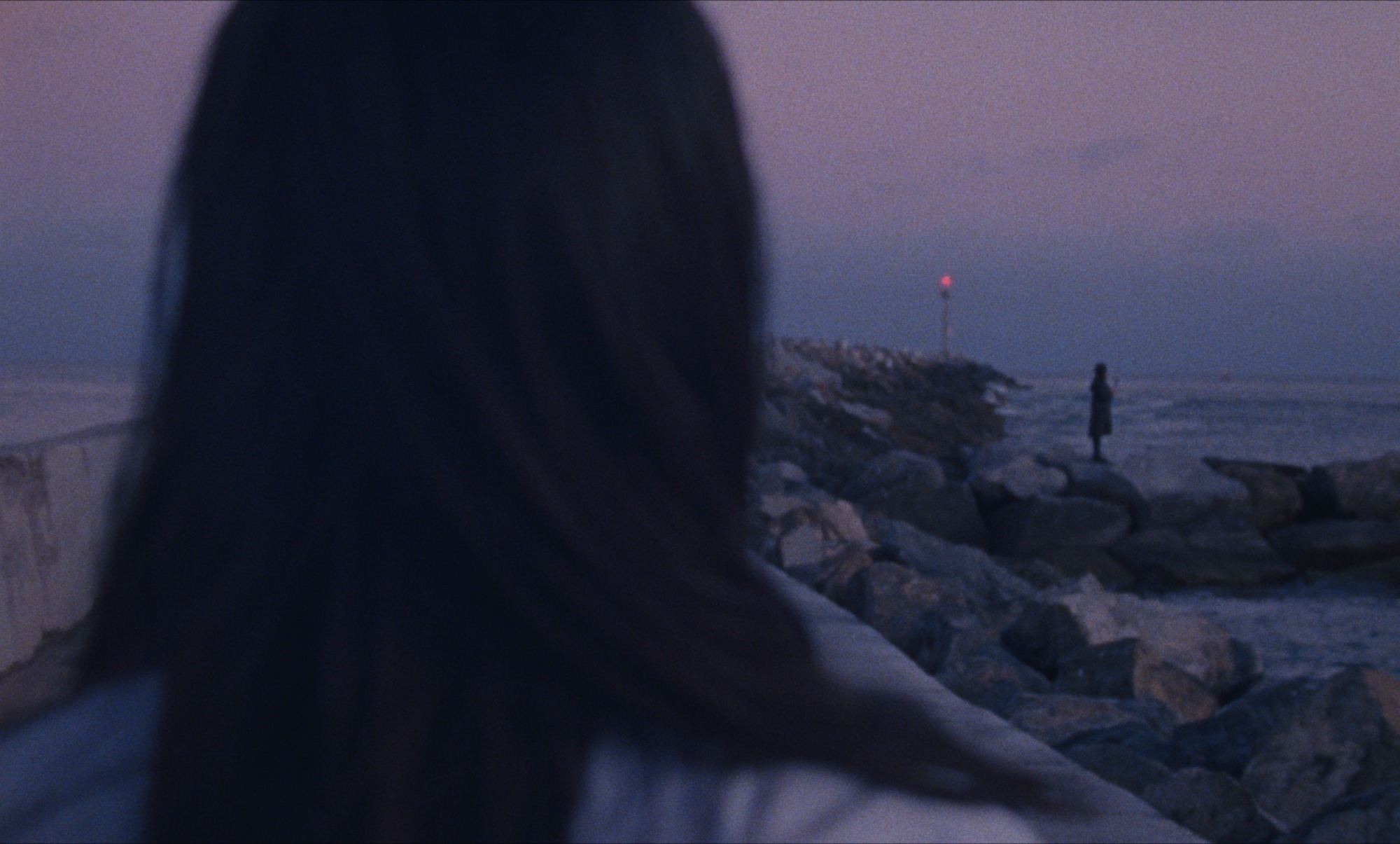
Ghost stories usually run on threat — the cold spot, the thing that shouldn’t be there, the dread of being watched. Li Anne Liew’s glide (all the people i’ll never be) runs on something far quieter and more unnerving: the ache of being the one who watches, unseen. Her ghost, Ophelia, drifts through a sun-softened Los Angeles that has no history of hauntings and no need of her, slipping into the private lives of strangers — a phone call at a jetty that looks like the end of the world, two sisters walking a river toward nothing, a girl reading a poem in a bookshop — and mistaking their curated closeness for company. She is sentimental not for the life she lived, but for all the lives she never will.
It’s a beautiful film, and that beauty is precisely what unsettles. Shot on 500T in available light, glide holds the wind in every exterior and lets post-rain blues and greens bleed across grey concrete until Southern California turns melancholy and strange. Eyes that should meet don’t. A voice arrives distorted, too late. Funeral oranges and white chrysanthemums punctuate the drift. Nothing lunges; everything simply fails to see her — and the film leaves you, gently, haunted.
A film which I described as, “A work of profound atmospheric sensitivity, haunting and ethereal, and quietly impossible to shake.” in our NFFTY 2026 Best of Fest selection back in March, glide premieres on Directors Notes today with Liew joining us to discuss chasing a dreamlike reverie on a single roll of film a day, letting composer Yoki Ng’s score become the voice her ghost cannot use, and calibrating when to give the audience a foothold on Ophelia’s otherworldliness.
glide grew out of a very particular emotional weather — losing a job you loved, preparing to leave the US, drifting through sentimental corners of LA and feeling, quite literally, like a ghost yourself. How did that internal state begin to find a shape on the page? What was the bridge between the feeling and the script — the first images, fragments, or scenes that told you this was a film?
For a while, I knew I wanted to make a film about a ghost reacting to a world that cannot see her. I drew out scenes of a very turbulent character surrounded by a world filled with noise, unnoticed and reckless wherever she goes. When I decided to leave the US, the story pivoted to something quieter and focused. I wanted to capture what it meant to feel temporary in a place: all the possibilities I would leave behind, the different ways we leave people, and a growing longing for a place in the world. It naturally built off the bones of the ghost story I had in my head. The life I was living felt so close to its end of existence, and I was ready to mourn it even though I was still there, so I rendered it in the form of a ghost trapped between worlds. Much of what I had written was filled with the ghost intentionally inserting herself into situations. I filtered out all the noise from earlier versions and decided to follow the ghost’s aimlessness instead.
I wrote most of it on plane rides and road trips, showing my thesis film at festivals while trying to see as much of the country as I could before I left. Everything felt fleeting; every trip was like a sad goodbye. This feeling slowly bled into the script on my walks around LA. I kept getting distracted by distant strangers whose faces I couldn’t see, but it felt like they were looking at me. I would catch brief glimpses of conversations that would somehow make me emotional. It was also at the time when I saw the photo En su propia cárcel (1950) by Lola Álvarez Bravo. It shows us a lone woman sitting in a window, and a lattice-work shadow casts over her. The woman’s face had this quality of omniscience, and she looked so deeply lost in her own world. I built an ensemble of characters observed by an outsider looking into their secret internal lives, trying to find connection and meaning from a distance.
For a character who can’t interact with the world, I wondered what it would be like for her to make sense of who she is through fragments of conversations she’d find herself in. These strangers feel like they have been perfectly curated for her life, as if they are haunting her. Instead of walking through her old memories, she becomes sentimental about a life she hasn’t lived. Though she wants to transcend the past, she still holds on to it.
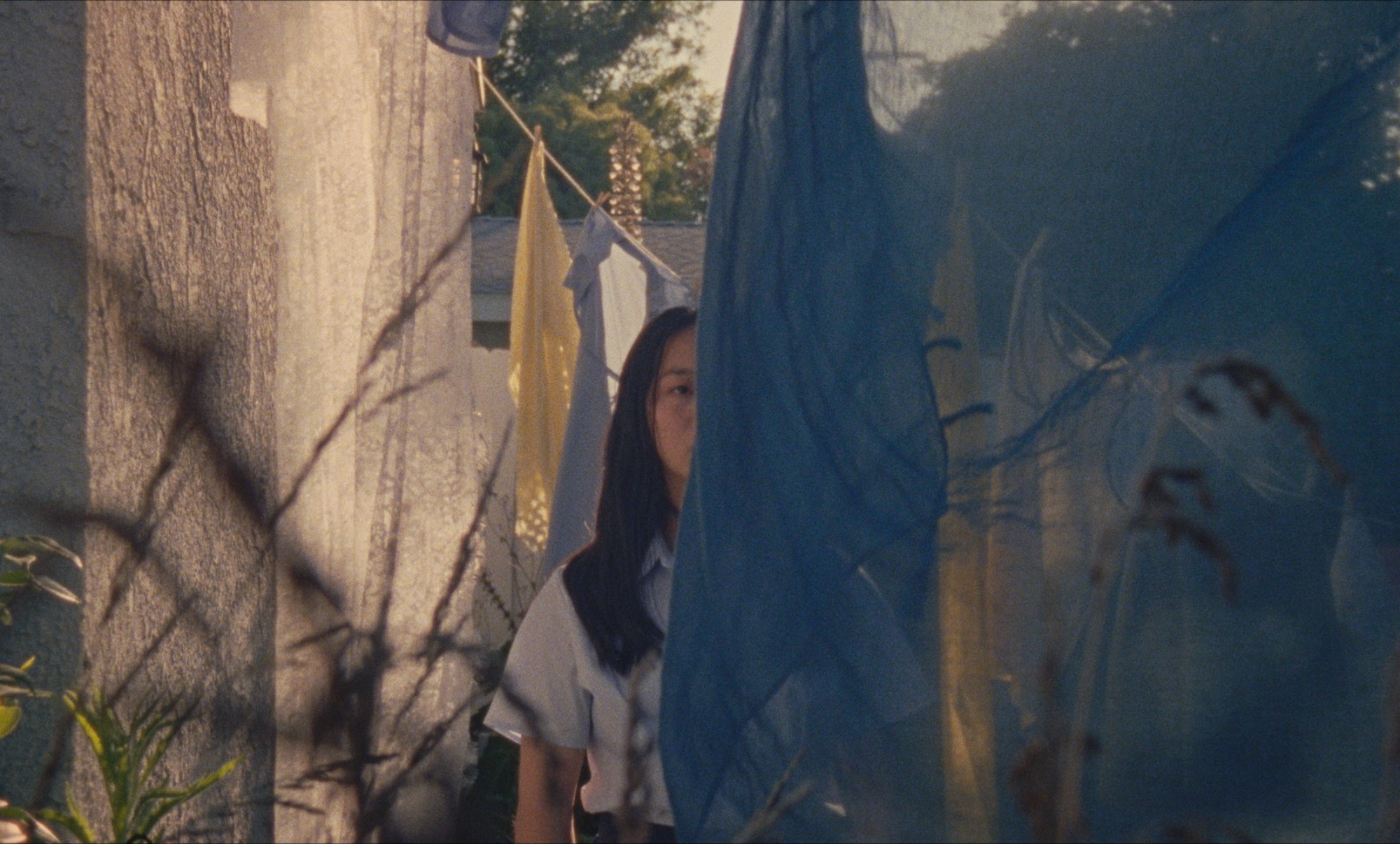
I built an ensemble of characters observed by an outsider looking into their secret internal lives, trying to find connection and meaning from a distance.
You describe Malaysian ghosts as threatening, and Southern California as ‘ghost-less’, and you were drawn to writing a gentle ghost trying to find her place in the world. What made gentleness the right register for this character, and how did your idea of what a ghost could be shift across the writing?
I only saw it as ‘ghost-less’ because I had moved to a place where I had no history. I grew up around Malaysian ghost stories that all felt very visceral and frightening. So when I moved to California, where the only ghost stories I knew about were fictitious monsters in Western movies, it kind of felt like a cleansing. Naturally, I started writing ghost stories of my own. I was interested in what people are like when they can’t be seen. Instead of exploring it through a violent, trapped rage, I wanted to write a story about a young girl navigating through a slow-moving grief. We live our lives surrounded by ghosts, so I wondered about a ghost observing the life around her.
The ghost’s gentleness stems from who she was when she was alive. She wouldn’t change just because of death. She is still as reserved as she was when she was alive. She has every reason to behave recklessly, but she still keeps to herself even though she cannot be seen or heard. At first, I thought it felt antithetical to what a stereotypical ghost would be like that she finds a silver lining in it. She’s hardly lived her life and has now been given the freedom to meander. She finds a new sense of openness being in a place where nobody knows her. It all feels limitless at first. But though she is now ‘immortal’, a certain fear of mortality strikes her. She treats this new state of being as fleeting, so the thought of it ending bites at her. She doesn’t think she can face the people she knows; she can’t even face herself.
In Malaysia, the scent of jasmine means the presence of something supernatural nearby. Strangely, I smelled jasmine constantly in the month we shot the film and I left LA.
Most Popular
Your ghost drifts into the lives of strangers and the ‘secret selves’ they reveal when they think no one is watching — a beach, a river walk, a playground, a phone call. How did you choose the situations she observes, and what made each one earn its place in her night?
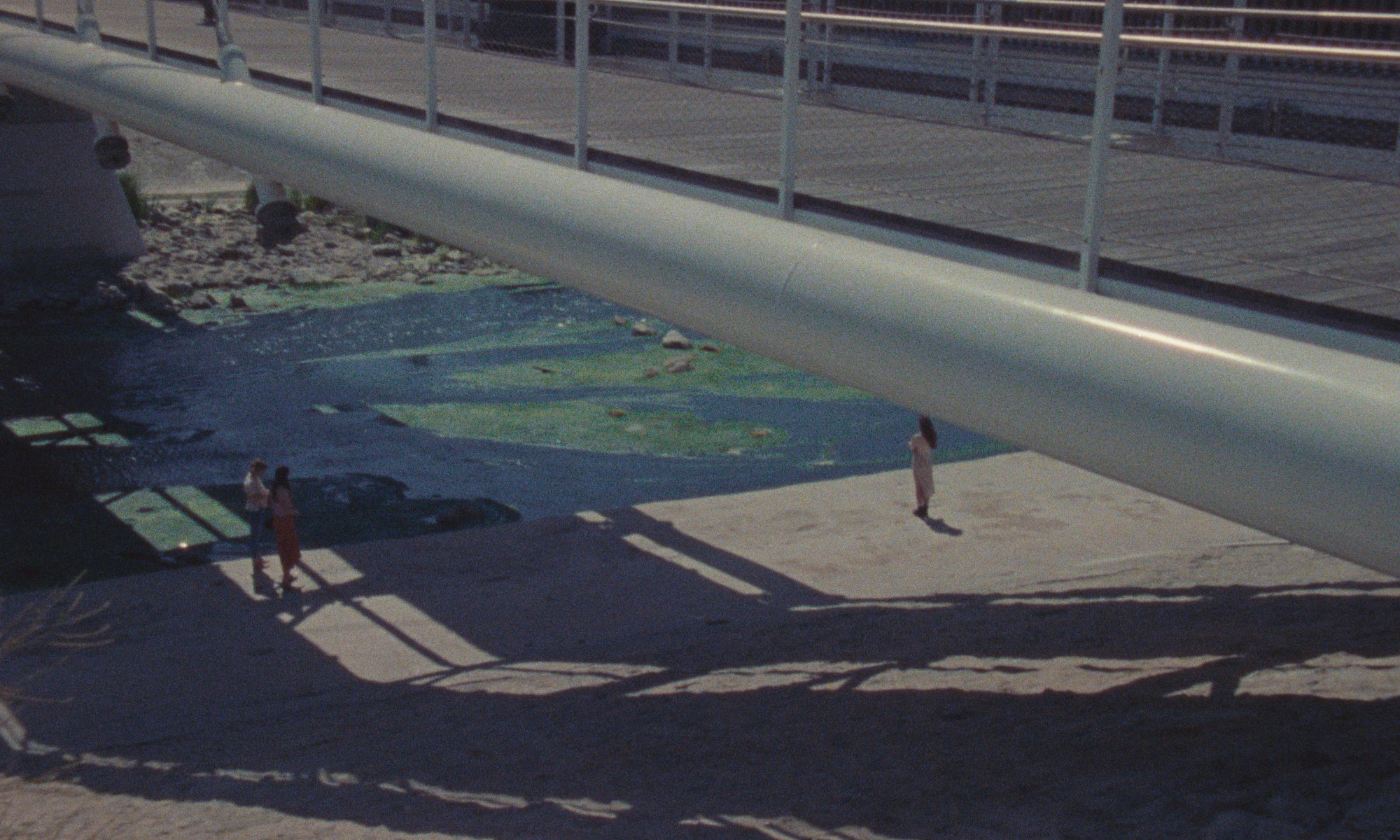
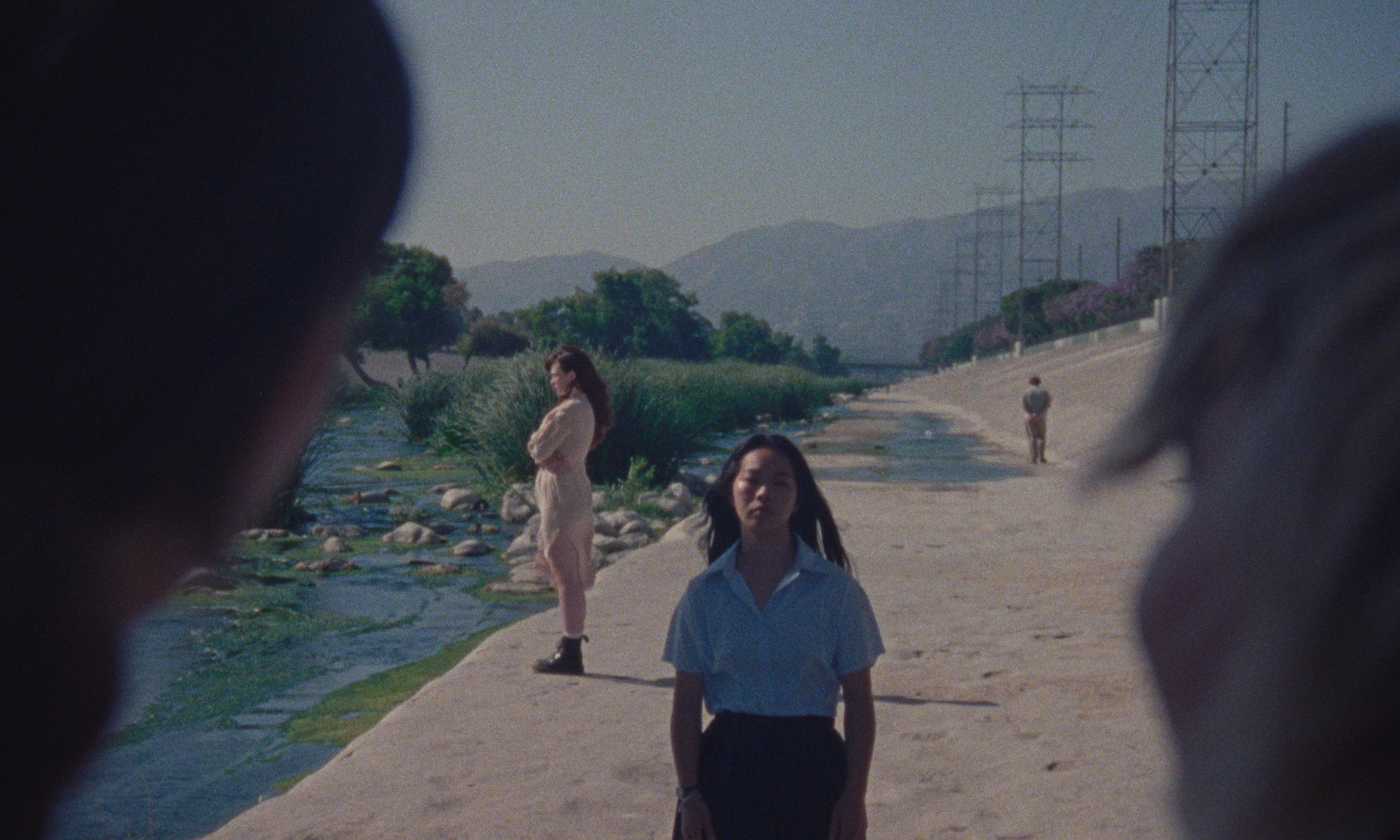
Ophelia finds connection and eventually her own disconnection through these strangers. I chose the jetty because it looked like the end of the world. And I chose a phone call because I wanted Ophelia to feel as if she were the one on the other side of the phone call. Just like Ophelia, the man on the phone represses his feelings for a loved one so that they may move on without them. The sisters’ river walk represents Ophelia’s uncertainty. This scene is a long-drawn conversation filled with quiet pauses and looking back to the past, yet it wanders and goes nowhere. A young woman struggles to say goodbye to a place she loves, while her sister grapples with accepting a life she is no longer a part of. All of this resonates with Ophelia. The sisters also do their own bit of people-watching while Ophelia watches them.
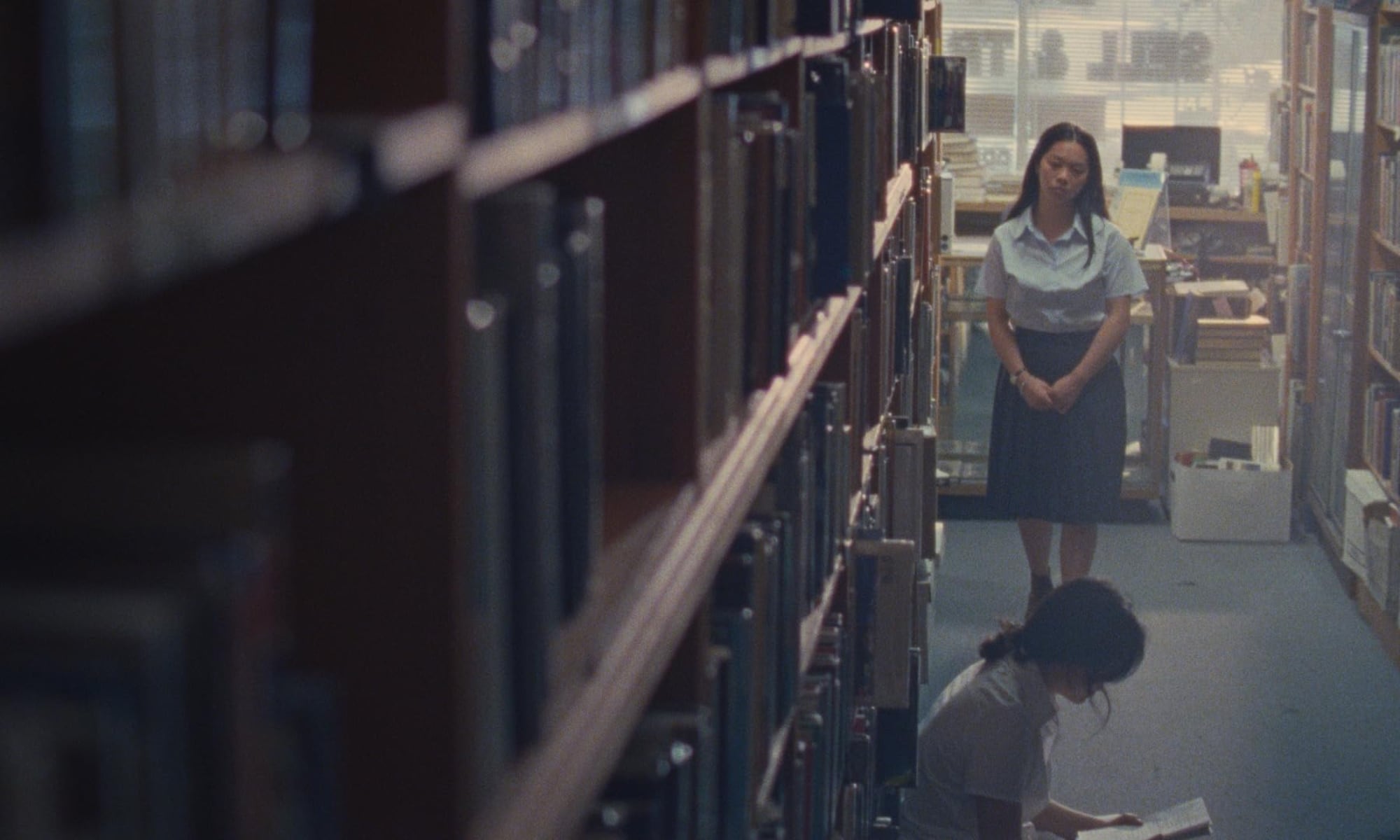
The house is where Ophelia begins to feel detached. She doesn’t hear her mother’s voice there, unlike the others. There is a bit of sadness when she sees her mother still holding onto her, and there is nothing she can do about it. When the window shuts and the light goes off, she can’t quite reach into the warmth of her old bedroom. The bookstore is where Ophelia finds someone who reminds her of herself — someone who keeps to herself — and thinks they are sharing a private moment. Though she doesn’t fully grasp the meaning of the poem, she understands all of its emotions. The playground at night, where no one should be, is rooted in nostalgia. Ophelia seeks childlike comfort there until she is confronted by an unexpected presence. She recognises the man from the beach. Very briefly, she hopes that another lonely soul sees her, but it only makes her feel further hidden.
Strangely, a year after we shot the film, I was walking in London just ahead of someone on a phone call. He was reassuring his friend, who had just moved to LA, to stay and try it out — that everything would be okay. It was so vividly reminiscent of the phone call at the beginning of the film. I felt affirmed, and so comforted by it, even though I wasn’t the one on the other end of the line. Life imitates art; art imitates life; life imitates art.
You’ve spoken about wanting to embrace “natural observation with a supernatural funk”, a phrase that captures something really specific about the film’s register. Could you unpack what that means to you?
Daj and I were both drawn to the street photography of Nguan and Vivian Maier — that way of catching people completely inside their own worlds. The idea was to embrace that same natural observation, but with a supernatural funk. I wanted to maintain a naturalistic approach in capturing these vignettes of everyday life, like we’ve been dropped right into these spaces the way Ophelia has. Since the approach was so rooted in naturalism, I tried to dig into Ophelia’s funk in a slightly abstract way rather than leaning into special effects. I say ‘supernatural funk’ because I wanted her perspective to feel omniscient, like a bird gliding over a scene. I also wanted to convey her lingering presence. Ophelia is always roaming, watching a little too long. There’s a degree of pretence with the strangers. While I wanted them playing out realistically, I also wanted a bit of it to look staged for Ophelia because all she can do is watch. Ophelia is portrayed as quite ordinary, but her presence feels transcendent. It needed to be very clear that she is completely separated from the people around her, even when they inhabit the same frame.
Since the approach was so rooted in naturalism, I tried to dig into Ophelia’s funk in a slightly abstract way rather than leaning into special effects.
There are several interlude shots in the film. Each act is separated by a series of insert shots that depict a funeral altar. White chrysanthemums, oranges, the burning of joss paper. Ophelia’s mother (and Ophelia herself) mourns for her. There are also several shots of the sea. I used the ocean as a symbol for the vast unknown to represent Ophelia’s temptation and fear of the unknown. I also inserted little nods to the classic sheet-ghost image with students clad in all-white uniforms and a picnic cloth thrown over Ophelia. We shot in available light on location. I really loved seeing the wind in each exterior scene. I thought it gave such a magical quality. Along with that, the colour palette is filled with vivid blue and greens of post-rain LA permeating grey concrete structures to portray a melancholic view of Southern California.
It’s never thrown in the audience’s face that this is a ghost story; it surfaces through small tells, and eventually through hearing Ophelia’s distorted voice. How did you calibrate when to give the audience a foothold and when to leave them gliding?
I wanted to open scenes from the ghost’s point of view, and then give the audience a foothold on her otherworldliness when Ophelia begins to feel unsettled. There is a slow build-up that reveals an unsettling quality about her. We see eyes that should meet and connect, but they don’t. When she desires closeness, we see her suddenly teleported, but still unacknowledged. Then, when enough desperation creeps at her, we hear her voice. Though Ophelia feels that she may be a part of their worlds for a moment, they are still separated. I also wanted to shift perspective from hers to the audience’s. She is no longer just observing, but finds herself empathising.
The film tracks an arc from aimless drift toward something like acceptance, without ever announcing itself. How did you plot that emotional shape on the page, and were there beats whose meaning shifted between script and edit?
I approached the film by asking the question, “How do you say goodbye?” For Ophelia, she says goodbye by avoiding it, so I plotted the story around where she goes when she tries to evade her old life. She has nowhere to be, but everywhere to go. Her reality blurs to protect herself from the anxieties of moving on. At the first sign of nostalgia, she returns home, where she sees her old bedroom completely unchanged and still taken care of. It renders her motionless. She even misses her mother’s nagging. She knows her mother can’t hear her, and she doesn’t feel ready to give up her newfound independence, but the longer she stays away, the harder it is to go back.
Ophelia begins to feel burdened and finds more fragments that remind her of her old life. She attempts to start reaching out, but it only makes her feel more disconnected. These encounters weigh on her more and more, and eventually culminate in a sense of loneliness and stagnancy, particularly when she sees the reunion between two loved ones at the playground. It seems as if all of these people have come to haunt her. She finally comes to the realisation that her vices carry on with her no matter where she goes. Before Ophelia goes back to her mother, there is a roaming shot of an empty street. This is where she lets go. All she needed was a very long, still moment to relinquish everything she was holding on to. Her mother finds some lightness too.
The edit stayed close to the script, just tighter. We dropped some shots that leaned conceptual and very stylistic. These successfully emphasised Ophelia’s loneliness, but felt out of place in the big picture of the film. We did lose one character: a very cute cat. In the scene of the bedroom window, we cut a moment where her cat doesn’t see her. It disrupted the emotional beat of the scene, so Aleia Jacobs (my editor) and I chose to embrace the connection purely between her and her mother instead. But we thank Poof the cat for her stellar acting abilities.
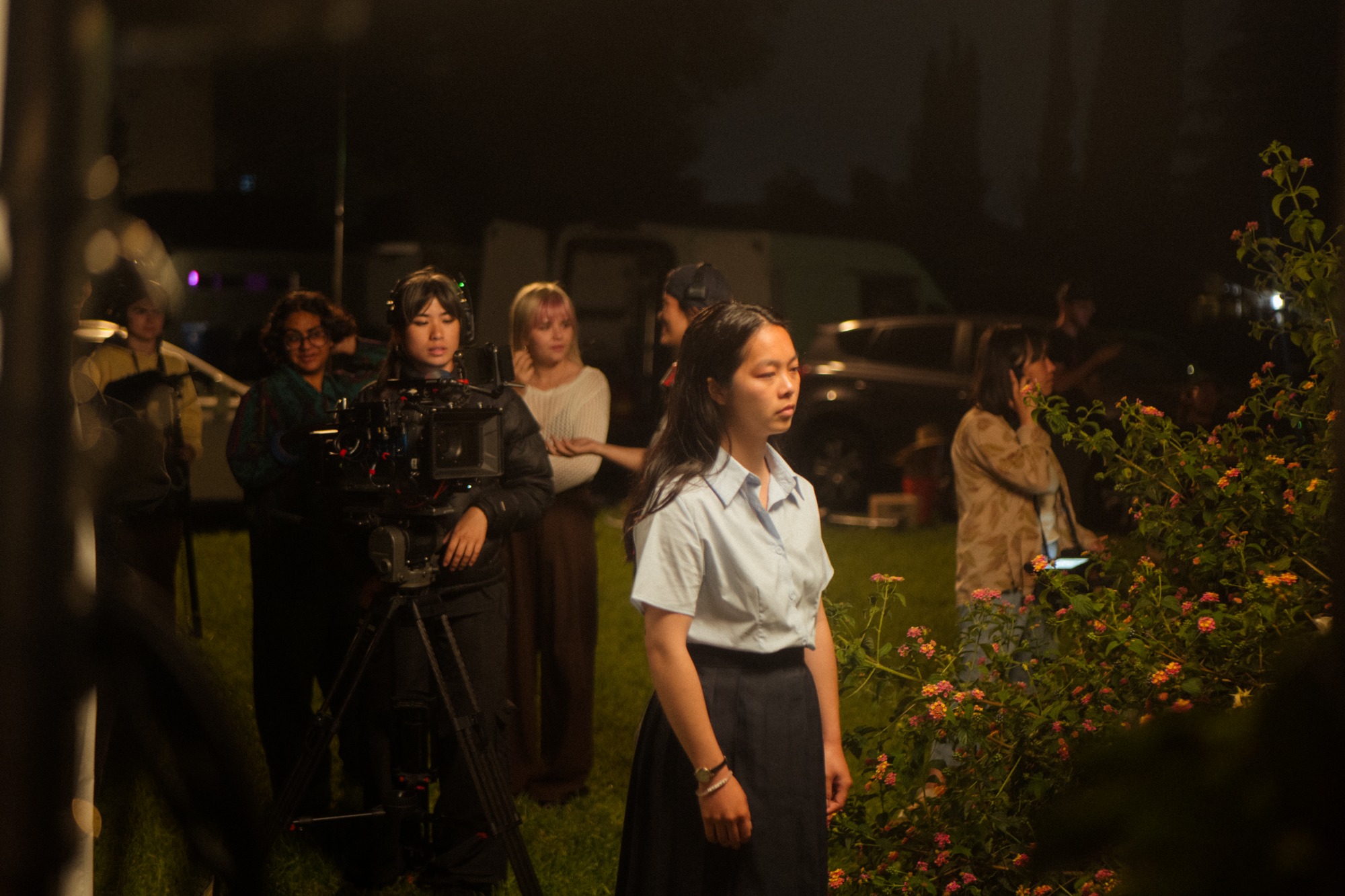
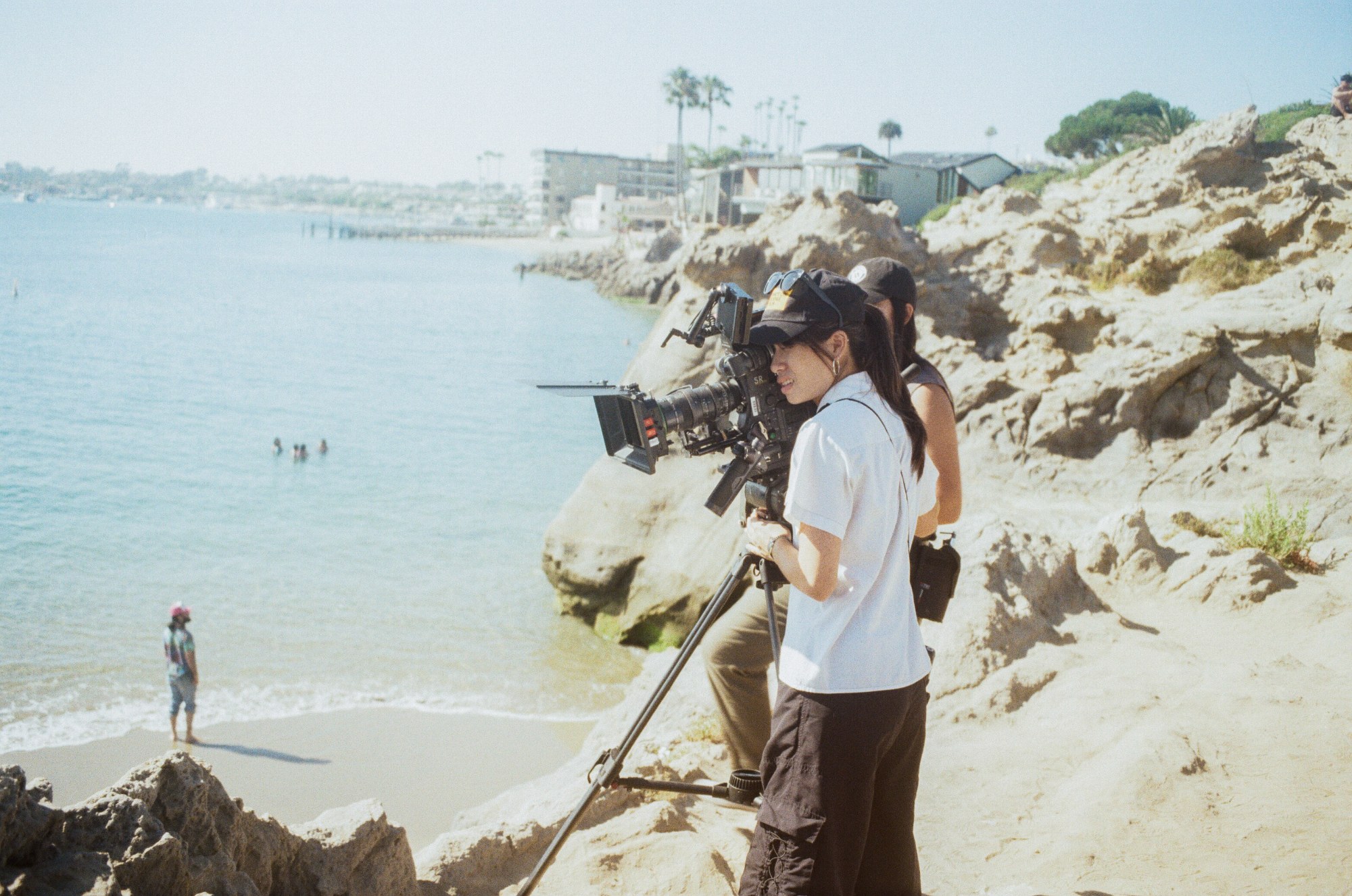
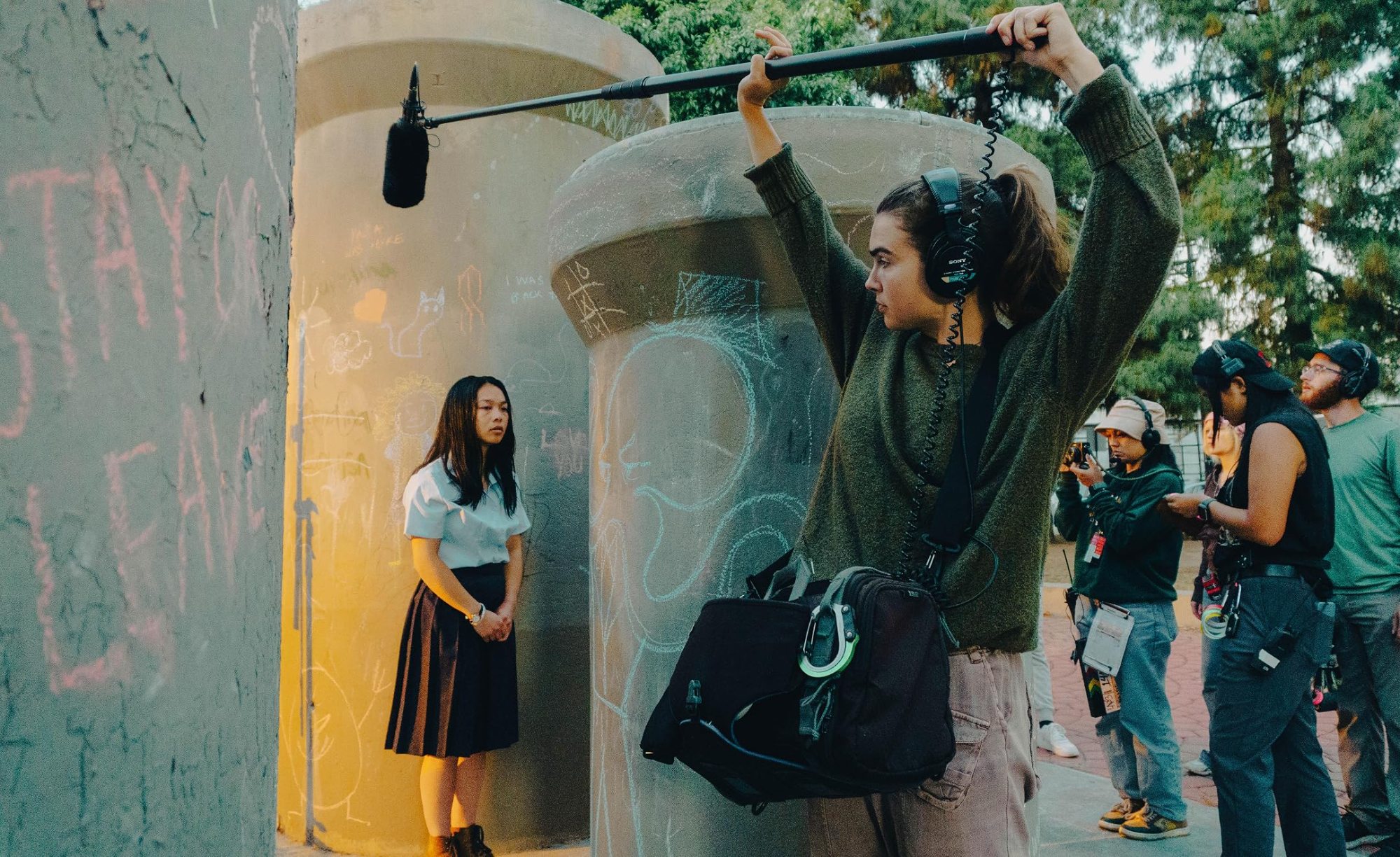
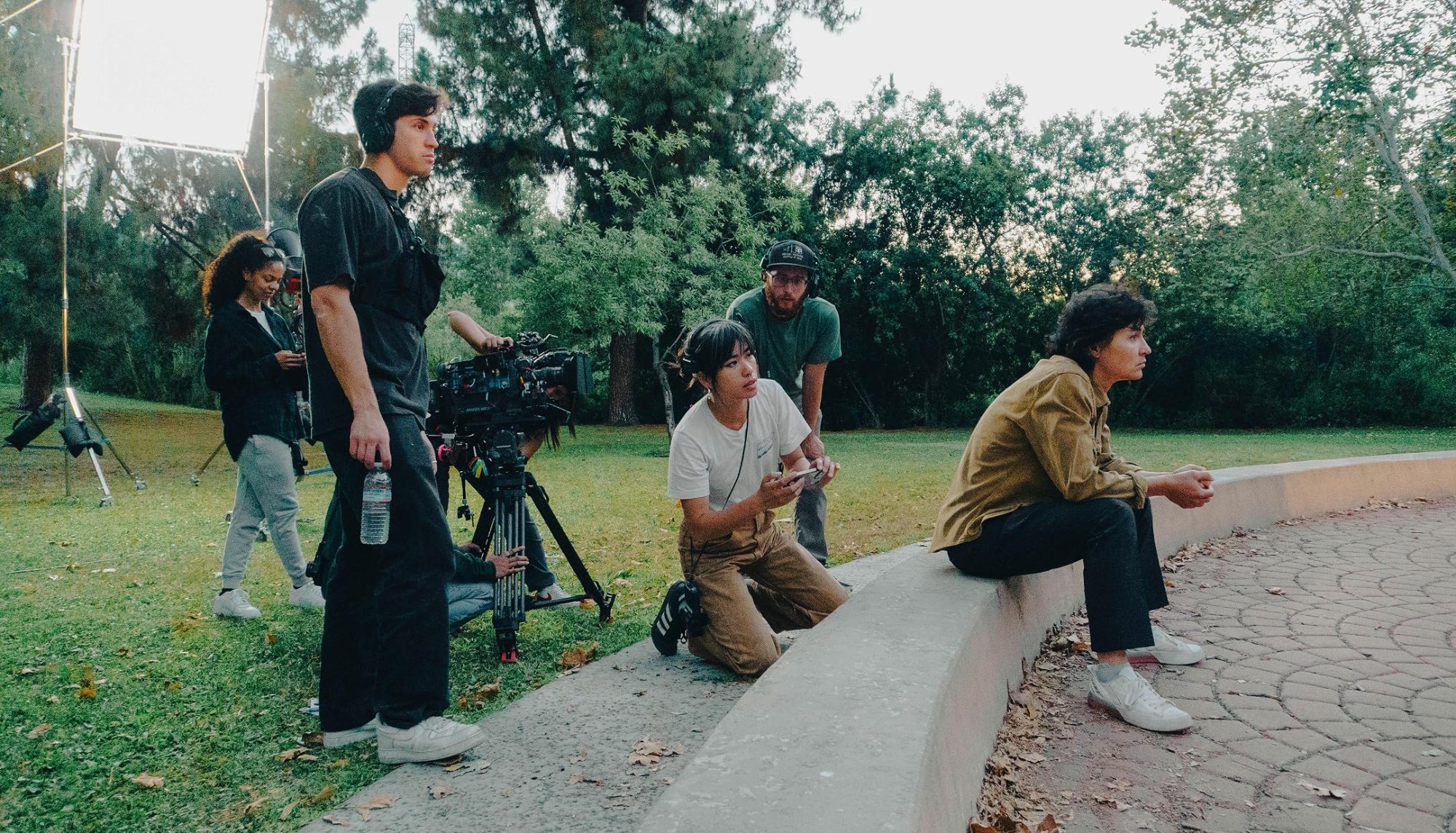
You and Dajiana Huang shot on an ARRI SR3 with 1600 feet of Kodak 500T, one roll a day across four days, ten minutes of footage at a time. How did that constraint shape the way you went after the dreamlike reverie the film holds, and how much of it was waiting for the light versus chasing it?
Shooting on film, I knew I wanted to be quite minimal with the diversity of shots and instead emphasise the blocking, camera movement, and composition. I wanted to convey the emotional distance within a relationship in a single shot. We’d focus on one or two key shots per scene, where we would see these characters completely in the open from Ophelia’s perspective before shifting to a more subjective shot. In tighter frames, we composed layered shots of Ophelia and the strangers as she attempts to fit her life into theirs. We cut sparingly, so that each cut shows us that some sort of change has happened, whether it is a change in the strangers or in Ophelia. I knew I wanted minimal traditional coverage of scenes, and that, in turn, worked well with the limited rolls we had.
I wanted to convey the emotional distance within a relationship in a single shot.
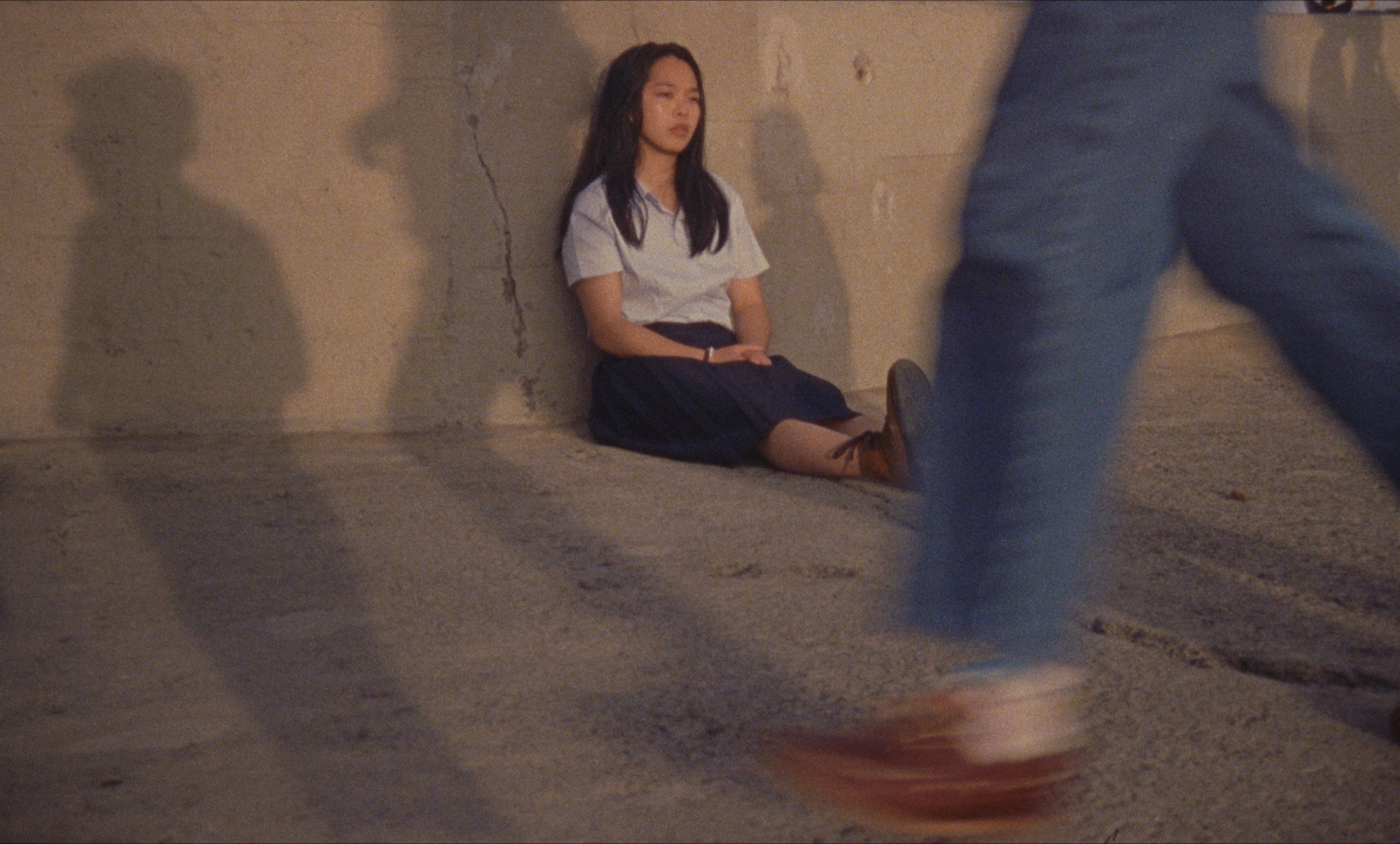
I’d written most of the film to be set in the day (partly for thematic reasons; partly for convenience; partly because most of my California experiences always looked sunny). We shot in the summertime and had such a long window of high-angle sunlight. I wanted Ophelia’s world to feel like one very bright and endless landscape. When we see her out of the afternoon sun, it conveys a deeper yearning and melancholia within her. Those were the scenes where we only had brief windows of that beautiful golden and twilight hour. Because of these brief windows and the limited rolls of film, we rehearsed heavily, so it never felt like we were waiting for the light. Lots of props to scheduling (thank you to Claire Loudis, our AD, and Jess Stossel, our producer). The only shot where we were simultaneously waiting and chasing the light is the shot of shadows running past Ophelia while she sits against a wall. The clouds kept covering the sun!
I love your deception of the music becoming the ghost voice. What were those sessions like in developing this crucial side of it?
Ophelia hums a very simple, repeating five-note melody that Kallie Pong (who plays Ophelia) and I played with together. It feels like something a teenage girl would have stuck in her head, singing it as a way to fill time. Something like a bird song. It is also something that pulls her back to her old life. Yoki Ng, our composer, builds off of this hum so hauntingly. I wanted the music to echo Ophelia, like an extension of her voice attempting to reach out, but no one can hear it.
Yoki and I dived deeply into what Ophelia is feeling and how we might express those thoughts sonically. Longer notes would represent doubt; swelling layers of harmonisation to express conflicting thoughts or a mournful cry; heavier synth sounds that bring about alienation; pauses that feel like we are coming up for air. We’d share songs, poems, and essays that would explore Ophelia’s headspace. Some pivotal songs were Change by Big Thief, Class of 2013 by Mitski, and On the Sea by Beach House.
There is one specific moment when the piano comes in while the student reads her poem. Before the piano enters, there are empty spaces and pauses in the music, where we hear the movement of the characters and their environment: her footsteps, the touch of paper, a pencil tapping. The first section of the piece feels hesitant and like stumbled whispers, while Ophelia and the student keep themselves hidden. When the piano enters, the music creates an emotional push (almost filling in for their voices), and that contrast makes the silence feel more intimate. It almost feels as if they’ve started revealing themselves to each other.
What shorts have been catching you lately — ones you’d press into a friend’s hands?
Bi Gan’s A Short Story explores a vignette of different characters, seen through the eyes of a black cat. It is the much better expression of this short 🙂
glide is your first film after your thesis, made in the strange between-space of leaving the US and finding your way back to Malaysia, with your producer, DP and sound designer all scattering to different cities and countries after the wrap. Where does it sit in the bigger picture of what you’re building, and what’s the next thing pulling at you?
I feel very close to home now, and as I age into it, I find that the art I want to make is to preserve my home, and like glide, my memories of it. I want to make so many films here in Malaysia. These days, I’ve mainly been experimenting with animation. Everything lives in a very playful, childlike realm.