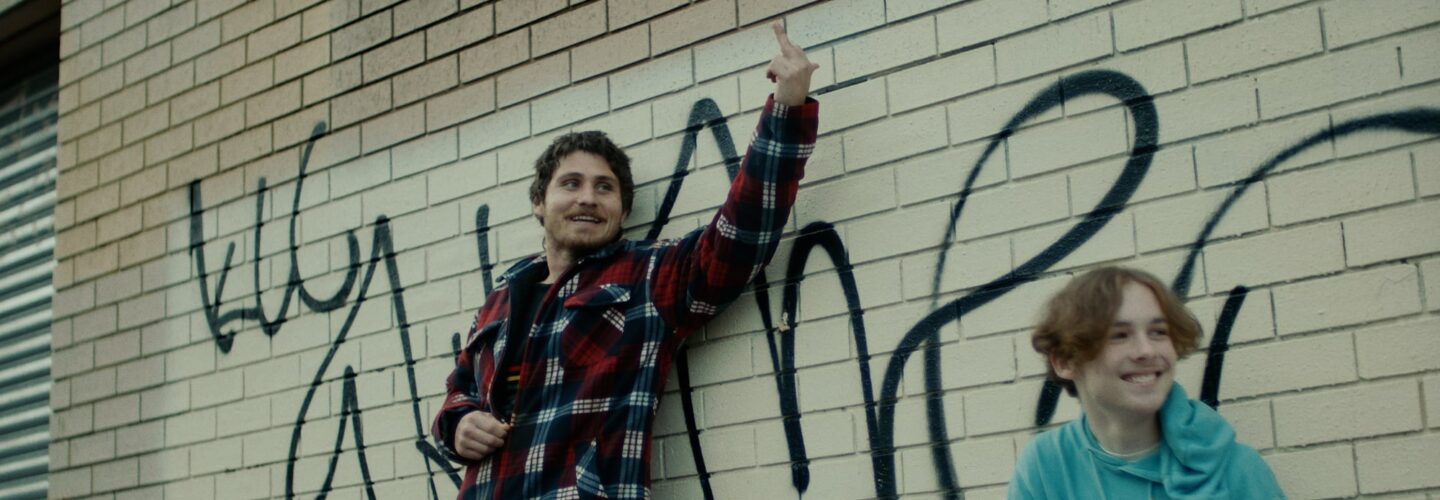

The trope of the ‘deadbeat dad’ is so hardcoded in society that it’s rarely offered any further exploration when it comes to characters in cinema. The reason is obvious; if an adult man is too selfish to put the needs of his child ahead of his own, he’s worthless. What George-Alex Nagle’s Mate shines a light on is the nuance behind that trope. There are many reasons why fathers become estranged from their children. Yes, it can be a purely selfish decision, but here we see and ‘feel’ how it can also be because someone is not emotionally ready or equipped for fatherhood – especially if they are still young themselves, never evolving beyond their own adolescence and yet to face the myriad of responsibilities that come with adulthood. They may even be carrying their own unresolved traumas. Whatever the underlying reasons may be for an absent father, the tragic inevitability is that their absence will leave a mark on their child, whether they mean well or not. Nagle’s gripping drama reminds us that no matter how much we might root for someone to see the light and become the positive influence we hope for, sometimes they simply don’t have the tools to do so. As we premiere Mate on Directors Notes today, we speak with Nagle about the decaying location that helped shape the narrative, deploying improvisational ‘grenade takes’, and how a complete reshoot of the ending ultimately served the story’s chaotic nature.
With the Mate focusing so much on the fractured relationship between a father and son, it was a surprise to learn that wasn’t the starting point for the story, despite capturing so well the plight of a man so clearly ill-equipped, ready, or willing to be a father. Can you talk us through the genesis of the short?
Many people assume it’s a true story, which I’m sorry to say, it isn’t… at least not technically. Almost every part of it is drawn from real experiences without it being a ‘true story’ in itself. The genesis of the film really lies in writer Daniel Corboy’s struggles with his mental health, which, along with other factors, reached a crisis point in the time around his 30th birthday. I think a lot of people, myself included, can get through their 20s in a kind of denial of adulthood, but then hit 30 and come to the stark realisation and they’re no longer young, and should probably be ‘better equipped’ for adulthood. For some people, a lot of pain comes with that. Corbs and I had played in bands and made small film projects together in the past, and we were looking for a new creative project. He came up with a very simple premise: “What would my 15-year-old self think of my 30-year-old self?” That became the backbone of a story about an estranged father and son forced to spend a weekend together.
John, the father, was written as a kind of exaggerated version of the worst parts of ourselves but is also based on many people we know or have met, some of whom are sadly no longer with us. He’s all bravado, usually misplaced, often self-destructive, and masking a lot of pain and sadness. He’s not just ill-equipped for fatherhood, but redundant in a modern, changing world.
He came up with a very simple premise: “What would my 15-year-old self think of my 30-year-old self?”
Jack, who would eventually become 13 years old, to be pubescent, while John, about to turn 30, puts them on opposite ends of a spectrum — the first and last thresholds of adulthood. Jack would provide not just an innocence lost but also someone with his own problems as he moves deeper into life, who comes looking for personal validation in an absent father. In many ways, they’re two sides of the same coin, with John representing a failed adult looking to the past, and Jack representing an unsure teen looking to the future. And they seemed like a good pair to throw into conflict with each other. Essentially, the story was born out of frustration and stagnation, and it became a vessel to explore some rather dark thoughts. For me anyway, it started as a study in depression, but also, in a perhaps less than obvious way, it became about optimism for the future.

The casting in both roles was pivotal because of the ebbs and flows in the dynamic of their relationship with each other as well as the audience. Especially for John, who needs to be likeable one minute and thoroughly unlikable the next. What was your casting process, and what do you feel Joshua and Jeremy brought to their respective roles?
For John we needed someone who could be volatile and unpredictable, charismatic and genuinely funny, but also deeply damaged. He had to be all of that while keeping both Jack and the audience on their toes, never quite knowing which way he might flip at any given moment. Not exactly an easy task. We looked at some well-known leading actors in Australia at the time. For a while we even had someone specific in mind and had written certain elements of the story for him, but fortunately, that never eventuated. Joshua Brennan wasn’t exactly who we’d first imagined for John, and to be honest, we may not have looked at him if it wasn’t for the strong recommendation of our casting agent, Stevie Ray. We didn’t audition Josh directly, we just watched tapes of him reading for other roles in features and TV shows, but I could see so many of the layers of John in those performances. It quite quickly became clear that no one else could play him. And just to clarify, because people always ask, Josh is nothing like John in reality. He’s caring, intelligent, talented, and honestly an incredible performer. Why he isn’t one of the biggest actors in the world is beyond me.
Most Popular
Finding Jack was much harder. We looked at many talented young actors between 13 and 15, and we needed someone who could not only stand opposite Josh but also hold his ground and contrast him. Jeremy Blewitt was the right mix of technical skill, curiosity, and natural vulnerability. But what really struck me about Jez, apart from his impressive dramatic chops, was his intelligence, both emotional and creative, especially for a then 14-year-old. I realised that with Jeremy, it wouldn’t just be a matter of directing but collaborating with him. Unfortunately, not long after his audition, just as we were about to offer him the role, the country went into lockdown, and all we could do was hope he’d still be available and keen, and that, given his age, he wouldn’t change too much in the meantime. Thankfully, it worked out and I’m proud to see how Jez is continuing to grow into not only a talented working actor but a writer and soon to be director.
Both brought so much to their roles. They worked incredibly well together, at times equally attracting and repelling each other. It wasn’t just in their professional chemistry, which I think Jez really learned a lot from, it was their emotional chemistry and contrast. Although this story started out as Corbs’ and my project, looking at it now, it really belongs to Josh and Jeremy. It’s not quite right to say that without them there would be no film; they are the film.
I asked Jeremy to go out and buy a tie for Josh as a character-building exercise.
The significance of the blue tie gift from son to father could be explored and interpreted in a hundred different ways. What was the significance for you in that particular gift and what it represented?
A tie is both a symbol of masculinity and maturity, as well as white-collar respectability and suburban conservatism. At the same time, it’s also a largely redundant artefact from the past, and mass-produced and often made of cheap polyester. It contains all these connotations and contradictions. Jack, as a young guy, wears a tie as part of his school uniform, as a kind of early signifier of his induction into manhood. So, it felt like the most obviously believable gift a boy might give to his estranged father, but also one that highlights their disconnection, because John is not the kind of guy who wears ties. I’d like to say there was greater meaning in the colour, but the truth is, I asked Jeremy to go out and buy a tie for Josh as a character-building exercise. That was the one he chose, so that’s the one we used. Which, I think, gives the object even more personal significance for both of them.
There is a real authenticity to the locations in the film, especially where John lives. How much work had to be done from a production design point of view and how much was simply capturing the area in which the film is set?
Our story is set in Western Sydney, specifically around the Penrith area where Corbs grew up. It’s as far from picture postcard Sydney — the bridge, the Opera House, the beaches — as you can get, while still being Sydney. It works in more ways than just geographically and symbolically as our story-world. For those outside Australia, Western Sydney is urban sprawl personified. It’s a melting pot of cultures and classes, a place that means very different things to different people. On screen, it’s often either glorified or rubbished, and we wanted to avoid both. The social and cultural changes in that part of Sydney over the last few decades have been enormous and mostly positive, although they’ve also caused a lot of dislocation for some. That sense of change, for better and worse, bubbles away in the background of the story.
The story world was already there, not just in the sense of transience, construction, and decay built into the location, but in the furniture, props, and objects that came with it.
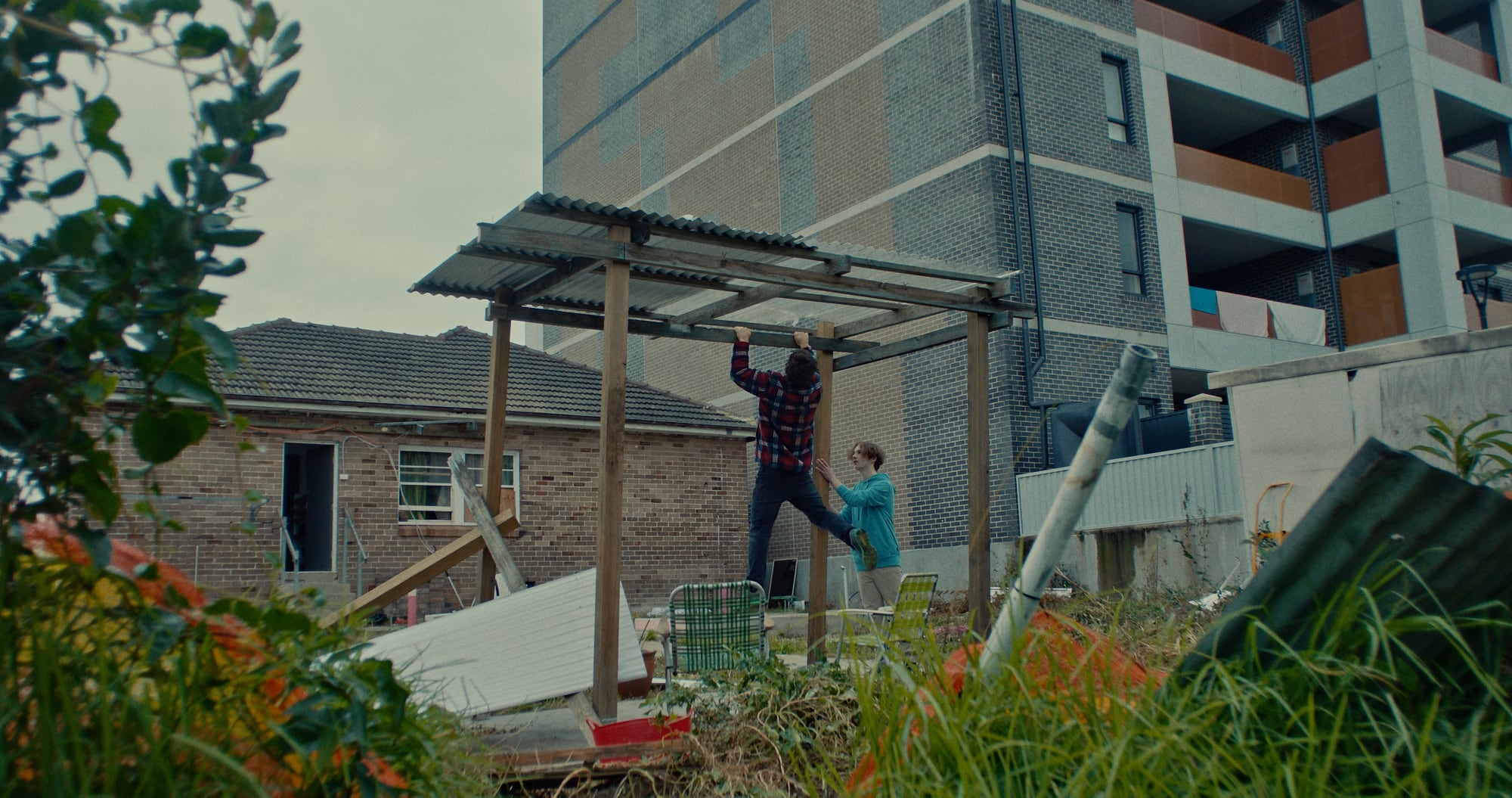
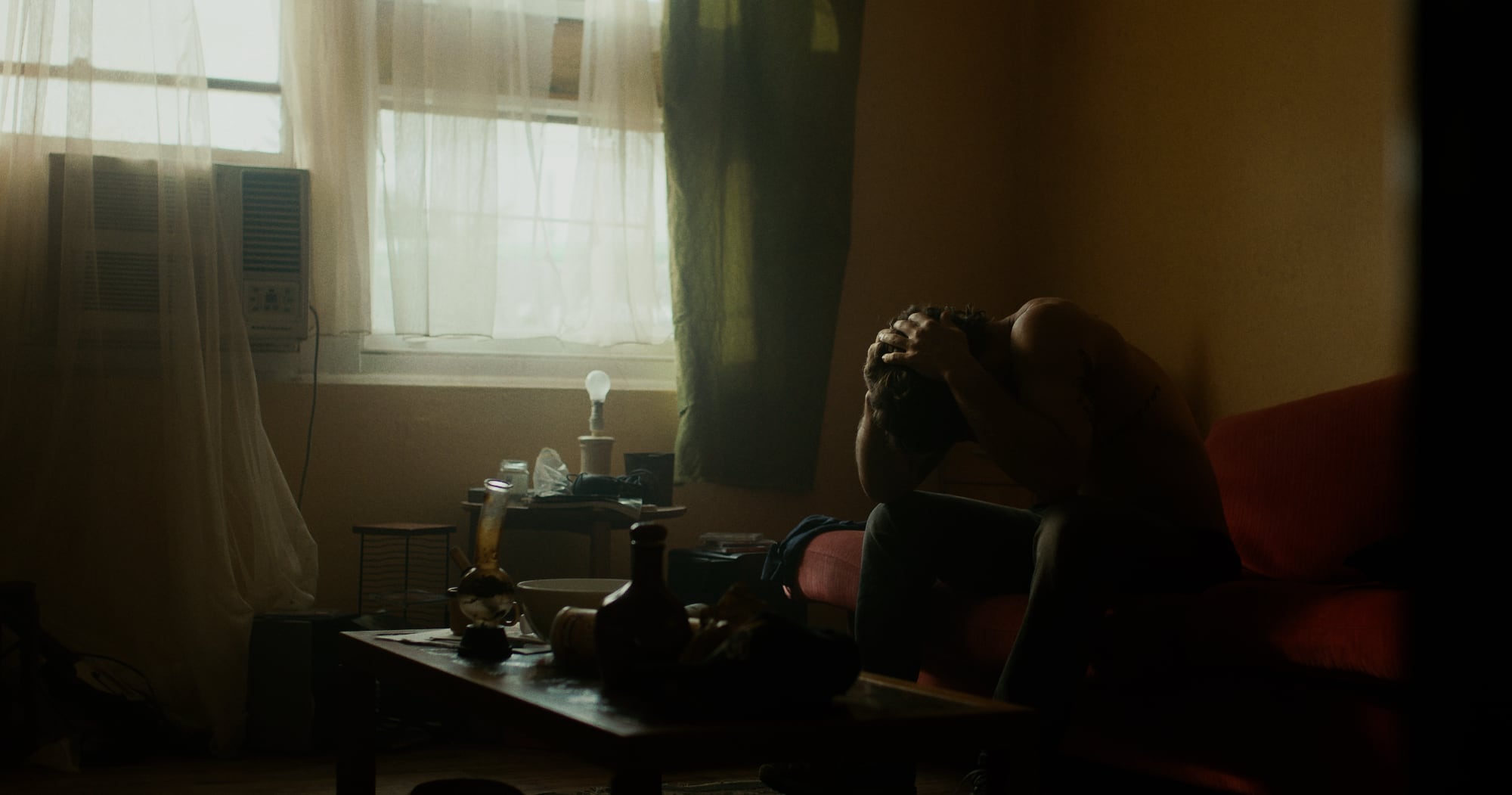
The house location really carries the film. I might say this a few more times, but I don’t think we would have had a story without it. It reflected the kind of squalid share houses many of us had lived in during our band days, but in most versions of the script, right up until production, John was living in a tiny apartment in a big complex. The idea was that he’d be isolated yet surrounded by other isolated people only an arm’s length away, like prisoners in cells. But practically, it proved impossible to secure a location like that with our budget and resources. The house we ended up with was the only place we looked at, and was found by our producer Nick Bolton, on Airbnb, funnily enough. We were their first and I think their last ever guests. It’s a decaying old bungalow that was barely standing on one of Western Sydney’s major arteries, surrounded by brand new apartment complexes, some were completed while others were still under construction. I think the owner had tried playing hardball with developers who were buying up the whole block. They called his bluff, built around him, and he lost the opportunity to cash out and was left stuck with a property he couldn’t sell. There’s something uniquely ‘Sydney’ about that. It was like the house from Pixar’s Up, only more tragically realistic.
The house became the perfect home for our story, both creatively and practically, as it also became our production base. There was very little we had to do with it. The story world was already there, not just in the sense of transience, construction, and decay built into the location, but in the furniture, props, and objects that came with it. Our art production designer Tom Coppola added a lot to bring it to life, but Corbs really invested himself personally in shaping the authenticity. Even that collapsing timber pergola thing in the backyard was left over from a temporary construction office for the building next door. We only had to make it safe for Josh to swing on. The image of John hanging on it, while Jez supports him perfectly encapsulates both their characters and some of the film’s thematic idea – defying change leads to decay. It’s the contrast between progress and stagnation.
Coincidentally, there was actually a bloke living there at the time. He stayed in his room with his dog for the entire shoot, smoking and gaming. His name was also John. Lovely guy.
The production had to contend with the start/stop nature of Covid lockdowns. From both a production perspective and for you as a director, what were some of the challenges of having to make the film this way and were there any unexpected benefits to the enforced breaks?
We were originally getting ready to shoot in early 2020, just as Covid was breaking out, the first variant anyway. We were already in pre-production when we had to down tools and go into lockdown, but thankfully this was before we’d started spending too much money. I’m sure everyone remembers just how uncertain that time was, not knowing if the world was about to end or not. Many productions at the same time collapsed altogether, but we were lucky enough to be able to hold our project together. When we came out of the first lockdown, we didn’t quite have to start from scratch but we had lost cast, crew, and locations, and had to adapt to a lot of changes. Strangely, most of those changes turned out for the better. We ended up shooting as soon as it was possible, and I think that lent the film an eerie quality of a sparsely populated world with people still slightly wary of being outside. On top of that, the shoot was pushed into the dead of winter, which worked better for the story than what we had first envisioned.
A lot of our post-production happened during the Delta wave lockdown, with final pick-ups after that. By the time the film was finished, we were premiering at Clermont-Ferrand in January 2022, just as the world was coming out of the Omicron wave lockdowns. Although Covid was a constant foil, in a strange way it also shaped the film. Again, without it, I’m not sure we would have been able to make it.
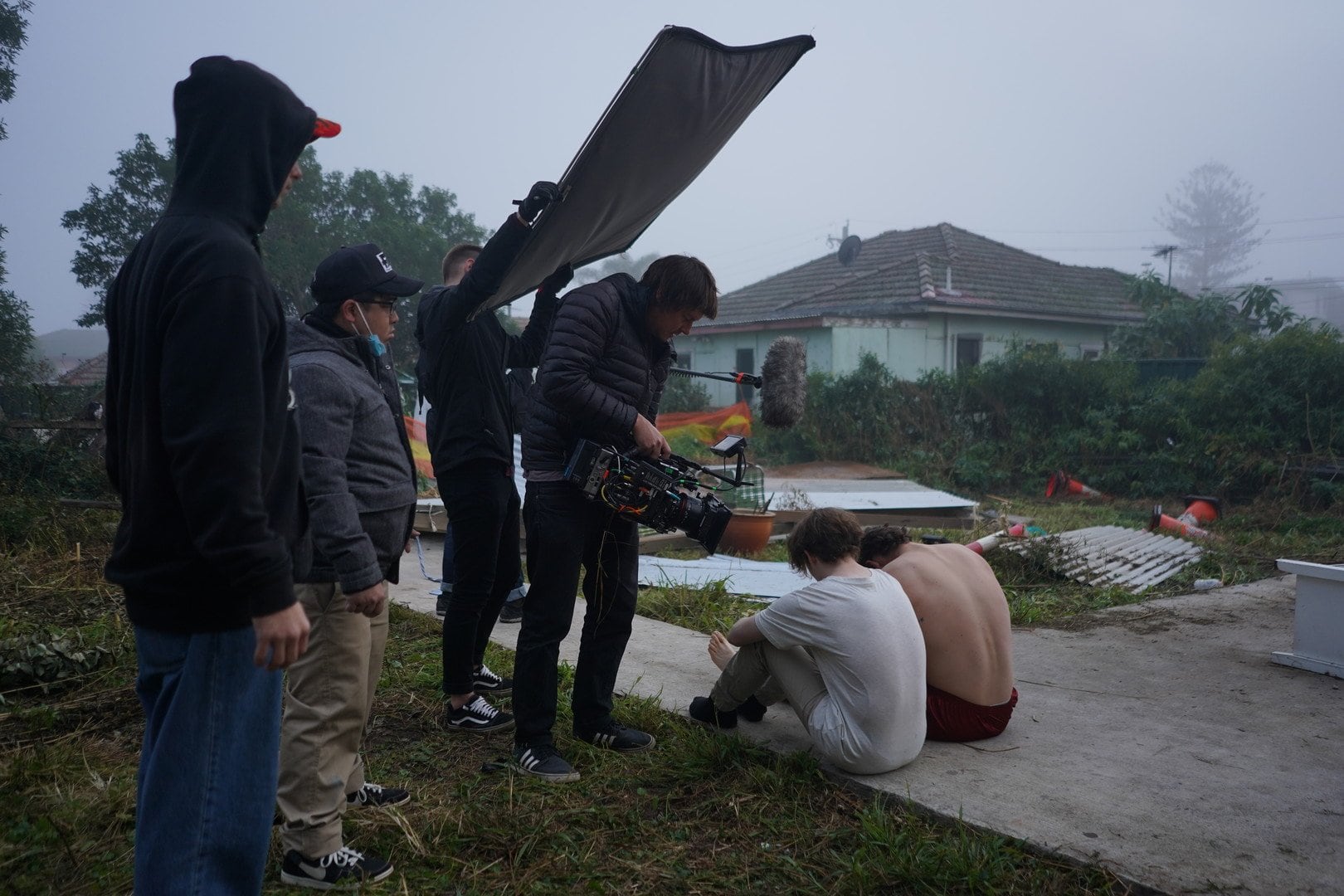
The film was shot on Alexa Mini with Canon K35 lenses, which were apparently the only set in Australia at the time. How did that come about and how did you and cinematographer Campbell Brown work together to decide which lenses for which scenes?
Campbell came on relatively late in the process. We had another DP attached before the first lockdown, but unfortunately, we lost him as priorities shifted once things reopened. At that time, crew really had to take whatever paid work they could get. Campbell was a fantastic addition though. He’s highly collaborative, relaxed, and brought a fun, positive energy to set, which was much needed given the material and the impossible schedule.
I wanted the coverage to be loose and rough and a bit shambolic, as long as we were experiencing the right character’s point of view at the right moment.
Both the camera and the lens kit were his. And yeah, I believe those K35s were, and possibly still are, the only set in Australia. They’re a beautiful set with so much character. If they’re good enough for Kubrick and Cameron, they’re good enough for us. Which is a shame in a way because we decided to limit ourselves to only three of them. We mainly used the 55mm and the 35mm, with the idea being that most of John’s shots would be on the 55mm. On a Super 35 sensor, that’s just a little tighter than comfortable for interiors, which suited him and his energy. For Jack, we’d open up slightly to the 35mm, and as the film progressed and the perspective shifted more towards him, we leaned on that lens more and more. There are a few key montage shots on the 20mm as well, which give a sense of scale larger than either character, almost like we’re seeing the story from outside both of their perspectives, and step into fantasy a little.
I do love lenses, and I can nerd out about them all day, but my approach on this film was to not get too precious with stuff. My focus was mainly on the story and the performances, and I wanted the coverage to be loose and rough and a bit shambolic, as long as we were experiencing the right character’s point of view at the right moment. The truth is, we used that package because it was Campbell’s. If he’d had a different kit, we would have used that. If we’d needed to shoot on a phone, as Ben, perhaps not so jokingly suggested, or worse, on a RED, then we would have.
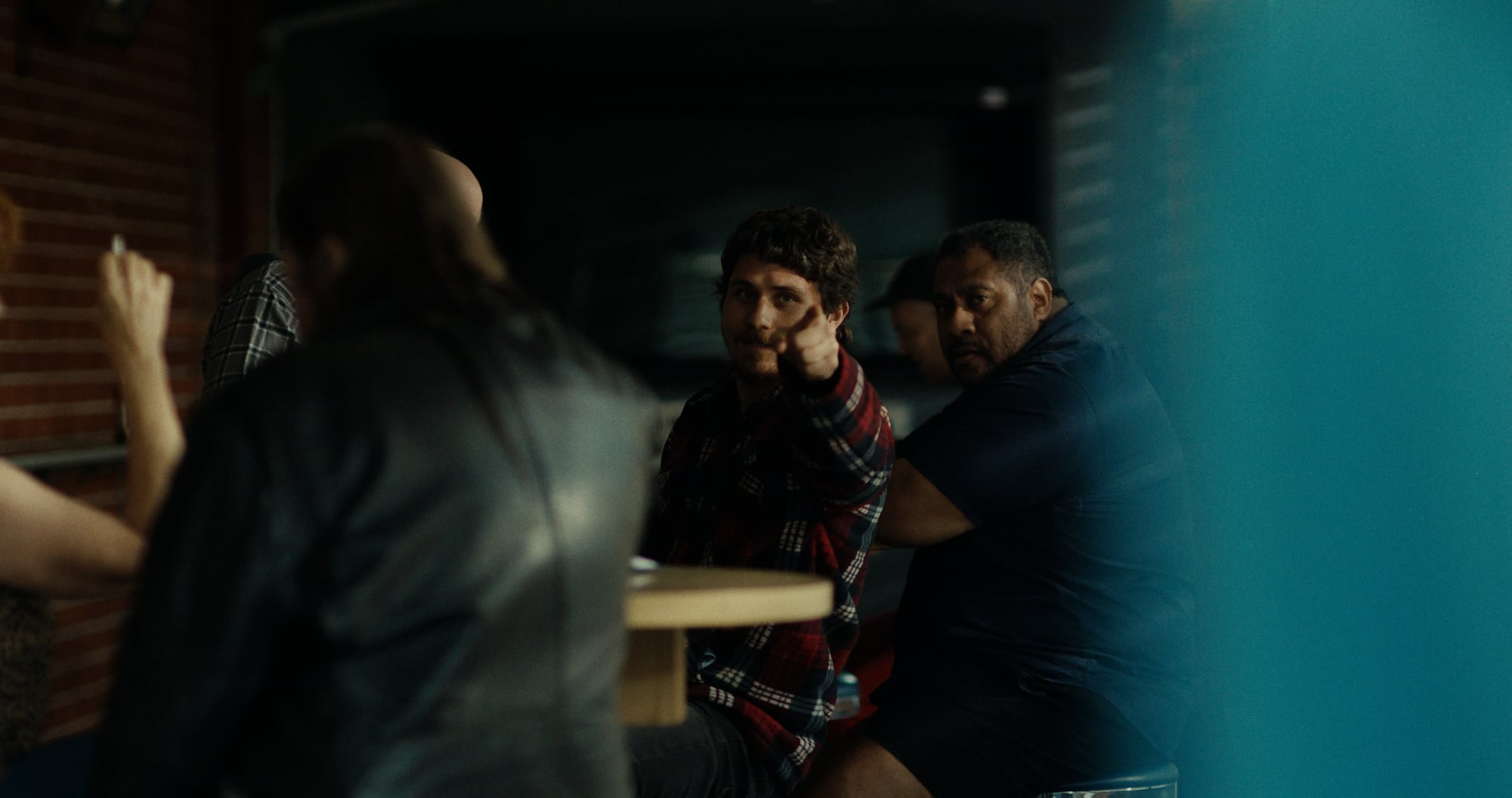

When shooting Mate there was a mix of highly planned, scripted moments with loose and improvised sections and takes. What were some of those improvised, magic moments that made it into the final film?
The film was all scripted, but I was very unprecious with a lot of the dialogue and many of the scenes and let the actors make it their own if they wanted, with the exception of key narrative lines. Jez was quite young at the time and, given he doesn’t have as many lines, largely stuck close to the script. But Josh really likes to play around, and I was really keen to let him rip. It’s been a while since I’ve looked back through the script, so I’d honestly have a hard time identifying which lines were ours and which were his ad-libs. I had planned for ‘grenade takes’ during each scene, where we’d forget about dialogue, blocking of the actors and camera, and just embrace the chaos. We did this a lot, but we weren’t always due to time constraints. There were whole sections of banter in the pub scenes that I’d hoped to use more of, to really feel the day slowly slipping away over beers. Some of that made it into the edit, but unfortunately not as much as I would’ve liked, even though it’s a long short, it’s still a short film.
I had planned for ‘grenade takes’ during each scene, where we’d forget about dialogue, blocking of the actors and camera, and just embrace the chaos.
The montage moments were very loosely scripted. For the most part, we just let the actors do their thing and shot it like a documentary. Aside from a couple of key beats and one or two designed shots, like John swinging on the pergola, it’s largely just them messing about, having fun the first time, and not having fun the second time. We had many different versions of the first lounge-room scene, where John is monologuing while Jack plays PlayStation. Some versions were more funny, playful, and even a bit more violent. If this had been a feature and we’d had more time, I would’ve loved to include more in that scene. In fact, although I’m proud of a lot of the writing, if I had the chance to do it again, I’d probably be even less precious with the material.

Two endings of the film were shot, and it was also essentially edited twice over. When/how did you identify that further filming would be required, and what did having a second go at both allow you to do?
Yes, unfortunately, we did have to completely start out edit over. Our first editor brought out a lot more of the humour, but Kelly Cameron, our second editor, really tapped into the core of the drama and tragedy of it all. Although we never finished it the first time around, there were many similarities between the two cuts, but perhaps many more differences. It was a long process, both times, and not as straightforward as I expected, especially considering we didn’t exactly make life easy for ourselves on set. We realised pretty quickly that we’d need to reshoot the ending, because, well… we just didn’t quite get it the first time around.
Securing the location for the final scene at Jack’s mother’s house was difficult from the start. Things kept falling through at the last minute. Eventually, production secured a place that looked good on paper, but we were in the middle of shooting John’s house scenes by then, so neither myself, Campbell, Nick, nor our first AD, Lenny Fung, had the chance to recce it. It was fine, but we had limited access, it was noisy and restrictive, and although we captured some beautiful performances, not just from Josh and Jez, but also the supporting cast, including Nick Bolton, who plays Brent, a lot of it was rushed, and frankly, we just didn’t get everything we needed. I remember driving away from that scene pretending not to feel sick while thinking, “Shit, I don’t think we have an ending.” At first, we planned to just pick up a select number of shots with a skeleton crew. But we couldn’t get the location again, nor the original actor who played Jack’s mother. It became obvious we’d need to reshoot the whole thing. If it were up to me, I probably would’ve tried to piece the original together, but I’m incredibly thankful that Ben Tarwin (producer/writer) pushed for us to give the entire ending another go.
I remember driving away from that scene pretending not to feel sick while thinking, “Shit, I don’t think we have an ending.”
The final five minutes of the film were shot six months after principal photography, and ended up quite different to how it was originally scripted. That first version was more subtle, and the final exchange was warmer but also sadder. I wouldn’t go so far as to call it a happy ending, but there was more scope to interpret it that way. With the reshoot, we figured that if we have the opportunity to do it again, why not give the story a slightly different outcome to honour the natural chaos of the story and the idea that it could swing in any direction at any time. What we ended up with is more intense, complex, and chaotic, but still ambiguous, leaving open different interpretations of where both characters might go next.

And with that said, what projects do you have lined up next and will you be keeping any of the non-traditional processes experienced on this film when making them?
I don’t necessarily see our process on Mate as ‘non-traditional’. If I had the chance and means to make this film again, I’d probably dive even deeper into the less traditional practices. But having said that, I think we all agree that we weren’t sure traditional filmmaking really exists. At least, not for us. You do whatever you need to do to tell your story, or you sink.
Corbs currently has a new short in production that he’s both written and is directing, with some crossover in themes and character and world. Nick is also, as I write this, directing a new short. Ben and I are currently developing a feature, and when it comes to that shoot, it will certainly be far less traditional than this one, both in form and in process. It will be more chaotic and shift into some far more interesting territories, which we hope will deliver in many ways that Mate did and more, while hopefully both reaching and alienating even more people. As Ben says, “The day we follow ‘traditional processes’ will be the day we produce ‘traditional films,’ which will be a sad day indeed.” From my point of view, there are plenty of people out there making ‘traditional’ films, so why even bother following suit?