
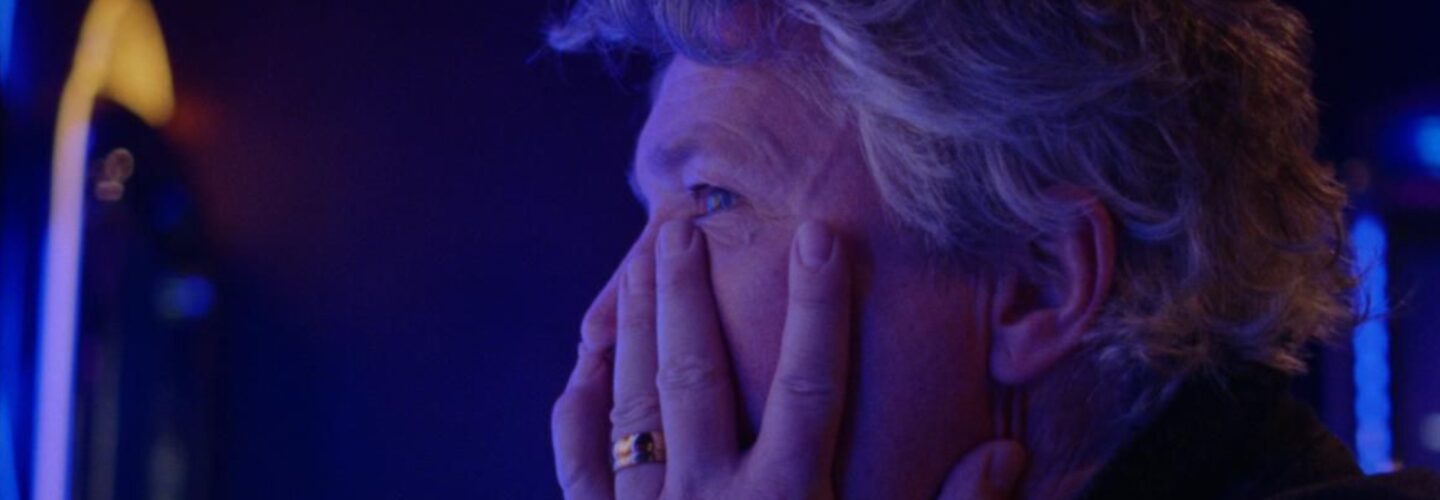

For director Kathryn Ferguson, the transition from documentary to narrative in her unsettling new short film Nostalgie feels like a homecoming. Ferguson, who first graced our pages seven years ago with hybrid documentary The Greatest Luxury, closely followed by the cathartic Margate-set Taking the Waters and whose powerful debut doc feature Nothing Compares explored the life and legacy of Sinéad O’Connor, turned her lens to her native Belfast with a keen, insider’s understanding of its unique textures and tensions. Adapted from Wendy Erskine’s short story, Nostalgie follows a faded English pop star navigating a bizarre and very unexpected revival gig. Ferguson’s deep-rooted grasp of Belfast’s specific humour ensures the film cuts with precision rather than caricature, but its power lies in its nuanced exploration of contemporary North of Ireland. The narrative deftly examines the enduring disconnect with England and a profound lack of understanding of its political history. At its core, Nostalgie is a poignant study of futile resurrection. The film draws a compelling, tragic parallel: a paramilitary battalion and a washed-up 80s one-hit-wonder, each desperately clinging to a distorted version of their heyday. Their shared longing for a past long gone—and arguably best forgotten—creates a deeply unsettling portrait of communities and individuals trapped by their own nostalgia. A short we first picked up as one of our favourites screening at the London Film Festival this year, we invited Ferguson back to DN to take us through landing the legendary Robbie Ryan as her cinematographer, creating 80s anthems with Bastille’s Dan Smith and the film’s deliberate, character-driven cinematic language.
You were last on our pages with your documentary short Taking the Waters and since then you’ve released your debut feature doc Nothing Compares. What brought you to drama?
After my debut feature documentary Nothing Compares came out in 2022, a number of drama producers got in touch asking if I’d ever considered drama. One producer in particular, Kath Mattock, asked if I’d read the work of Belfast writer Wendy Erskine. I’d read her first book of short stories called Sweet Home and loved it, so I was excited to dive into her new collection Dance Move. I read through all the stories and Nostalgie really jumped out at me. It felt so instantly cinematic, and even more than that, I was fascinated by its core theme: what happens when an artist’s work is taken out of their control and politically co-opted by the wrong people (like Sinead’s music being used in US rallies, or paramilitary groups in Northern Ireland blasting Tina Turner’s Simply the Best as a theme tune). It also felt like a contemporary fable reflecting on England’s apathy and lack of understanding towards the North of Ireland. So after Nothing Compares, it made a lot of sense to me.
Producer Kath Mattock and I began working together on bringing Nostalgie to life in 2023. My company Tara Films (co-founded with Eleanor Emptage, who was an EP on this) and Stile (Kath Mattock) were the production companies. I’d met Belfast writer Stacey Gregg the previous year and we got on like a house on fire, so they were the first person I thought of to adapt Nostalgie for screen. We worked on the script while trying to secure funding. That stage took a long time, a year or two in reality, but we were incredibly fortunate to eventually have the backing of Globe (Universal Music’s film division), Hopefield (formerly IE Entertainment and EPs on Nothing Compares), and of course Film4.
How did you and Stacey collaborate to translate Wendy’s specific literary tone into a distinct cinematic language?
Wendy’s short stories often focus on ordinary people dealing with the small dramas and quiet preoccupations of everyday life. In pieces like Nostalgie there’s this subtle sense of looking back, of paths not taken and moments that slipped by, and she captures that without ever labouring the point. Her work is mostly set in Belfast, my hometown, and she writes it in this completely authentic, unshowy way. She also uses humour, our very specific Belfast humour, so well. There’s a dryness and a musicality to the dialogue that I really responded to.
From the start we talked about how to carry Wendy’s lightness of touch into something cinematic without simply illustrating the story. Stacey instinctively understands restraint, knowing when to let a moment sit and when to let the humour come through in a way that cuts rather than cushions. We went back and forth on the dialogue and the Belfast-isms we wanted to keep, but the key was trusting the spaces and silences and letting the visuals and performances do what the prose does on the page. Stacey is razor sharp at that, and working with them made the tone feel alive on screen.

You got some heavy hitters on board this project with Robbie Ryan as DOP, and actors Aidan Gillen and Michael Smiley, among others.
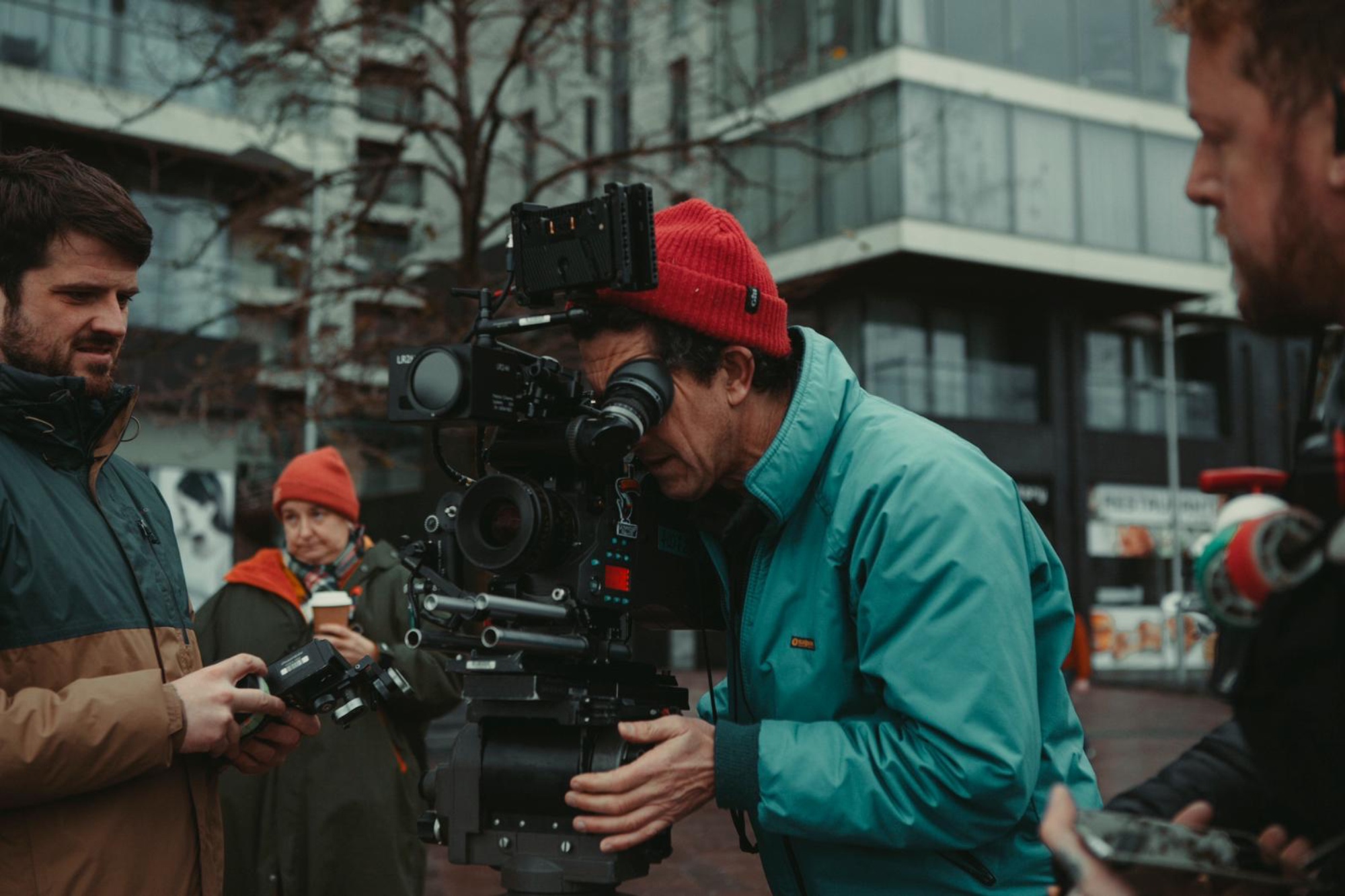
The biggest coup came with the DOP. I’d long been a fan of Robbie Ryan’s (who isn’t!) and had met him at a Film4 event the previous year. We decided to chance our arm and ask if he might be interested, fully expecting a polite no. Amazingly, he said yes, but he only had four days free for the rest of the year. Suddenly, we went from cruising along to racing into production with just weeks to prepare. We shot at the very end of 2024 in a freezing Belfast.
The key was trusting the spaces and silences and letting the visuals and performances do what the prose does on the page.
Having Robbie attached massively helped with casting, and within weeks, we’d secured an unbelievable cast through casting agents Shaheen Baig and Mary Ellen O’Hara. Aidan Gillen also had those same four days free, so he came on board as our lead, Drew Lord Haig. Michael Smiley, Jessica Reynolds, Sean Kearns, Seamus O’Hara, Pat Lynch and others quickly followed. It was a chaotic few weeks pulled together brilliantly by Marie-Thérèse Mackle, the film’s Belfast-based producer but somehow it all clicked, and we shot the film over four days.


I was honestly shocked to find out that Nostalgie de la Boue isn’t a real song!
The film is set around an 80s one-hit wonder being invited to Belfast to perform, so we needed to create his 80s hits for him to sing. That meant working with a skilled songwriter and musician, and we were incredibly lucky to have Dan Smith of Bastille take this on. Dan has recently been writing music for film and agreed to work on Nostalgie. It was miraculous to see what he came up with: the film’s two key tracks, Shady Lane and Nostalgie de la Boue (as per the title), performed by Aidan, were written by Dan in a matter of weeks. Aidan then recorded the tracks with John Reynolds, Sinead O’Connor’s music producer and an EP on Nothing Compares. Quite suddenly we had two 80s hits at our disposal.
Most Popular
The locations—the tired ferry, the bathroom mirror, the gig venue—are so evocative of clinging onto a lost past.
The locations were central to the film’s atmosphere. I wanted everything to feel worn-in, places that had lived a life and still carried the marks of it. The story deals with nostalgia in an uncomfortable way, so we looked for spaces that felt frayed around the edges, where the past still clings. Belfast is full of those places. Our Belfast-based producer, Marie-Thérèse Mackle, and Location Manager, Catherine Geary, were brilliant at finding spots that hadn’t been overused on screen and had that particular Belfast texture. The ferry was one of the first things I knew I wanted. There is something recognisably bleak about those early morning crossings, a kind of purgatory, a sense of being in between places, which mirrored Drew emotionally.


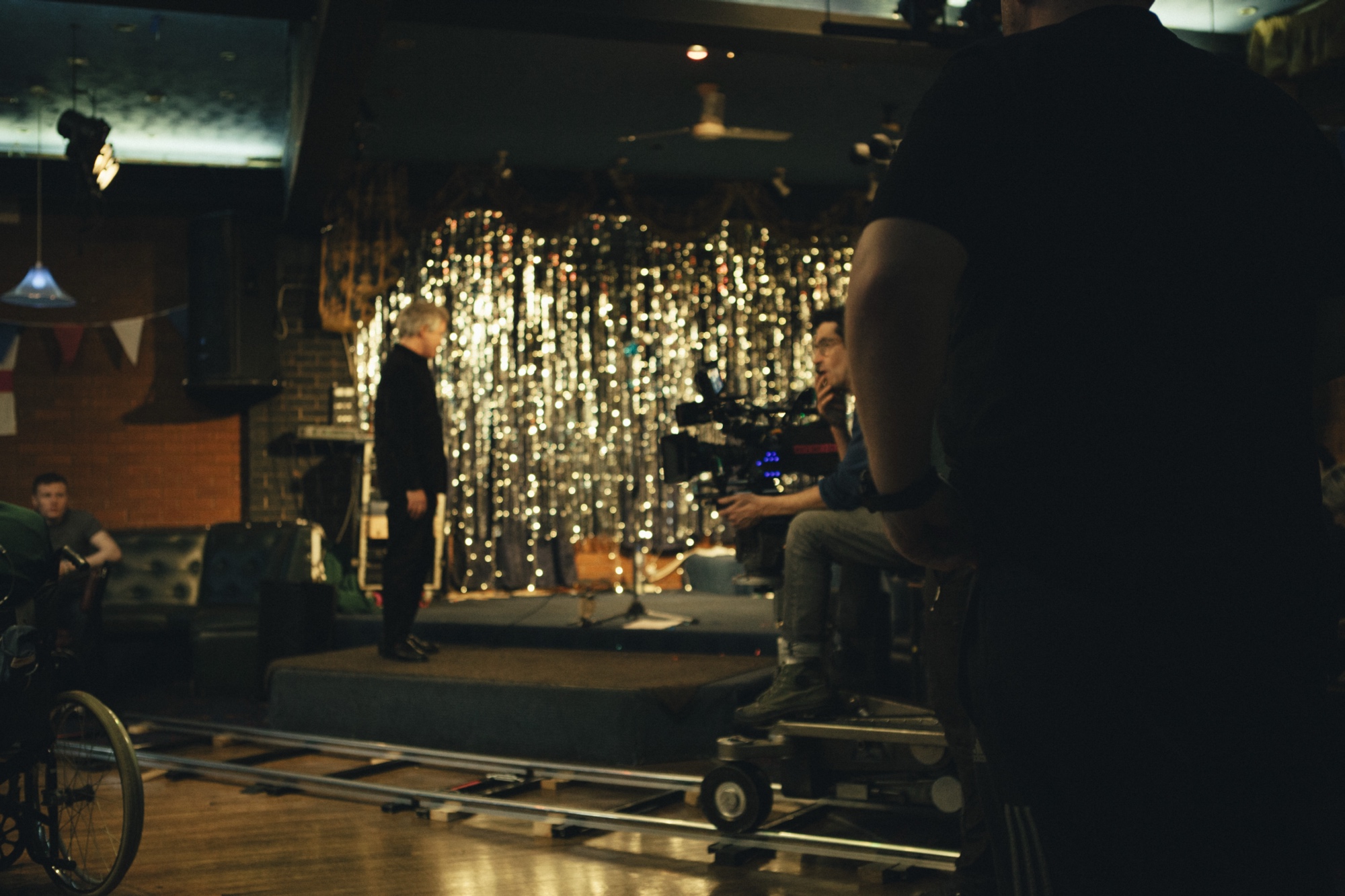
The centenary gig venue was the biggest challenge. It had to feel authentic for a gathering of this nature while also working for a live event. We scouted several locations before landing on the one we used. It was almost ready to go. Our production designer, Heather Greenless subtly layered in just enough detail to bring the space to life without overwhelming it. Scouting and gathering all the elements in Belfast, especially with Robbie, was surreal and getting to shoot with a Belfast team made this a very special shoot for me.
The story deals with nostalgia in an uncomfortable way, so we looked for spaces that felt frayed around the edges, where the past still clings.
I was fascinated by the visual construction of Drew’s character. Could you discuss the philosophy behind the composition and framing used to communicate his fading stardom and internal vanity?
Building up Drew visually took time and was hugely enjoyable. Shaheen Baig cast Aidan Gillen as Drew, and he was the dream option for both Wendy and me. We wanted the camera to reflect both his fading stardom and his vanity, that mix of insecurity and self-importance. Robbie instinctively used isolation in wide shots to emphasise Drew’s distance from others and close-ups to capture subtle moments of self-consciousness or ego. He is very much a fish out of water.
I worked with costume designer Timmy White to support these choices, ensuring Drew’s look bridged his wannabe John Cale in the Velvet Underground 1986 pop persona and his present-day life as an IT company owner. The framing and composition carried the character, placing him alone in the frame or letting him dominate a space to show his emotional and social dynamics without dialogue.


The scene where Lord Haig is greeted by Jimmy is a masterclass in tone. It feels playful, yet there’s a palpable sense of unease and that something is about to happen.
I was happy that Michael Smiley came on board to play Jimmy. We needed a Belfast actor who could really get him, a character with a sparkle in his eye but a glint of danger, someone who could charm or intimidate in equal measure. Shooting the scenes with Aidan and Michael was a joy, and their total disconnect felt like they were speaking different languages. It’s uneasy, confusing but playful and perfectly captures the disconnect between England and Northern Ireland, with Drew, our faded 80s English pop star, walking into a Northern Irish situation he is very ill prepared for.
The Battalion feels like a perfectly cast, fascinatingly accurate ensemble. What was the specific balance you were looking for in that group of men to embody the story’s complex themes of nostalgia and sectarianism?
Casting Director Mary Ellen O’Hara worked on all the Belfast casting and she did an unbelievable job. We needed an ensemble of men who felt completely believable. Growing up in Belfast in the 80s and 90s, we were well used to seeing these types of characters in the news daily, so we had a strong idea of who we were looking for. Because it’s a contemporary story, we also needed to get the age range right with a spectrum of characters and identities. Working with the large cast was one of my favourite shoot days.
Our cast and ensemble of extras had to learn Nostalgie de la Boue and brought exactly the rowdy, wild energy the film and the song needed. A pinch-me moment came on set when this huge crowd of men were singing the song. Wendy popped down to the set that day, and whilst we were filming this scene she and I just stared at each other across the set, wiping tears of laughter and disbelief from our eyes. She found it genuinely remarkable to see this wild story she had conjured in her head suddenly playing out live in front of her.


We uplit the men to make their energy feel sharper, almost ghoulish.
The two performances of Nostalgie de la Boue are starkly different and tell a story in themselves. How did you approach the direction, cinematography, and editing of each version to create such a powerful contrast?
The two performances of Nostalgie de la Boue were approached very differently to create contrast. The first performance starts with Drew feeling awkward and somewhat isolated. As the song builds and the men join in it takes on a woozy, dreamlike quality that takes Drew back to his 1986 pop fame. As he gains confidence, the camera moves with him, cutting between him and the crowd, mirroring their growing energy. This performance peaks with intercutting flashes of young Drew to heighten his exhilaration and nostalgia.
The second performance is colder, more claustrophobic. Drew is restrained, almost frozen, while the men respond even more wildly. We uplit the men to make their energy feel sharper, almost ghoulish, and used quick, unsettling cuts intercut with Drew’s perspective and subliminal flashes of the atrocity he’s just been made aware of. Our plan with the framing, pacing, and lighting between the two performances was to make each feel distinct, showing Drew’s journey from isolation to exhilaration, then to wanting nothing more than to get out of Belfast.

Following on from that, I’m interested in how you frame Aidan Gillen at the start versus the end. He’s restless on the ferry in both, but he feels like two very different men.
On the ferry over, Drew is looking forward to the trip but also ruminating on the past, and we wanted the camera to reflect that mix of anticipation and introspection. On deck at twilight, the lights of the boat create atmosphere, and his interaction with the girl on board (the brilliant Jessica Reynolds) hints at a longing to connect with someone he might have known in his youth but also his slight mortification. By morning, as the ferry docks into Belfast, the city feels fresh and full of potential. The drive out to Mid-Ulster remains open and light, but as the story begins to shift, we use more surreal lighting to reflect Drew’s changing state of mind. Across the film, the goal was to use framing, light, and movement to chart his internal transformation, from excitement to tension and disorientation. On the ferry home, he is untethered, appearing small and restless in the vast spaces of the boat. The final scene is noisy and garish, shot to feel claustrophobic, leaving Drew alone with the consequences of his actions.
Having worked extensively in documentary, what was the most surprising liberation, or conversely, the most significant constraint, you encountered when transitioning to the scripted form for Nostalgie?
I found the shoot exhilarating. I hadn’t worked with actors in this way before and loved the experience. This being my first drama, and starting with a story set in my hometown with characters I knew and felt were authentic, made it feel immediate. It was a liberation to work with such a brilliant cast and crew and bring the story to life visually. Collaborating with Stacey on the script gave me an extremely strong spine to build on.
The shock to the system was the speed of it all. Documentary features often take years to plan, shoot, and edit, but once Nostalgie was eventually funded, we suddenly had about a month to prep. Everything happened very fast, thanks to the incredible producing of Kath Mattock and Marie-Thérèse Mackle. The pace was intense, but also liberating; it pushed me to trust my own instincts and work quickly.

Having successfully navigated this adaptation, what’s next for you? Are you planning to develop more narrative projects?
Myself and Eleanor Emptage, co-founder of Tara Films, have a slate of features in development. Some are documentaries, others are dramas. Creating Nostalgie has given me the confidence to start bridging both worlds, and I’m excited to continue working across both forms.