
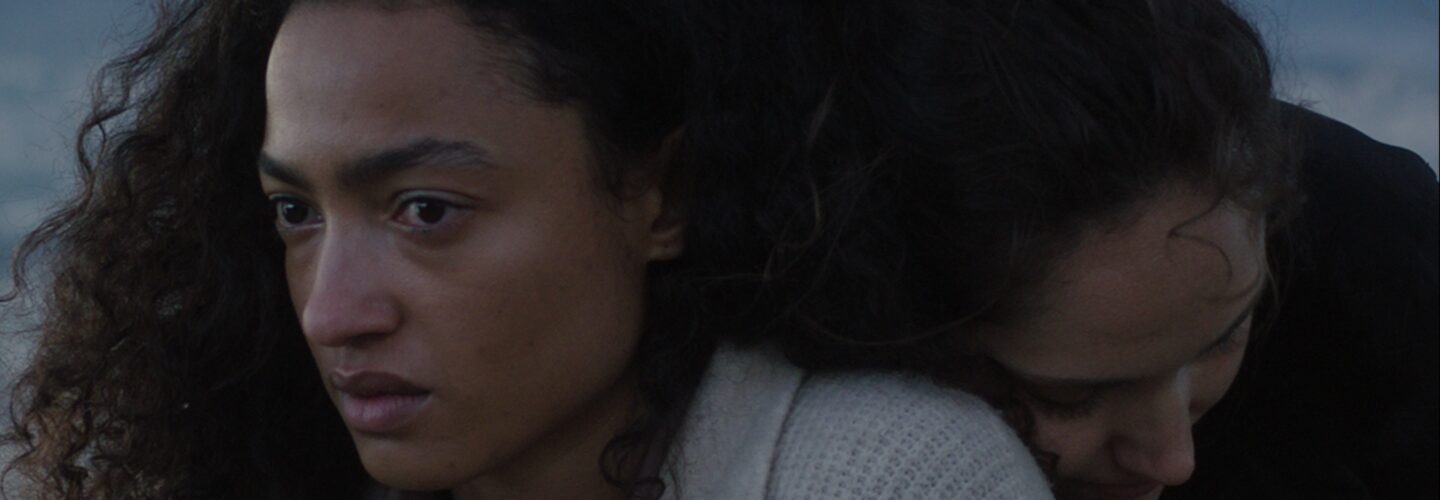
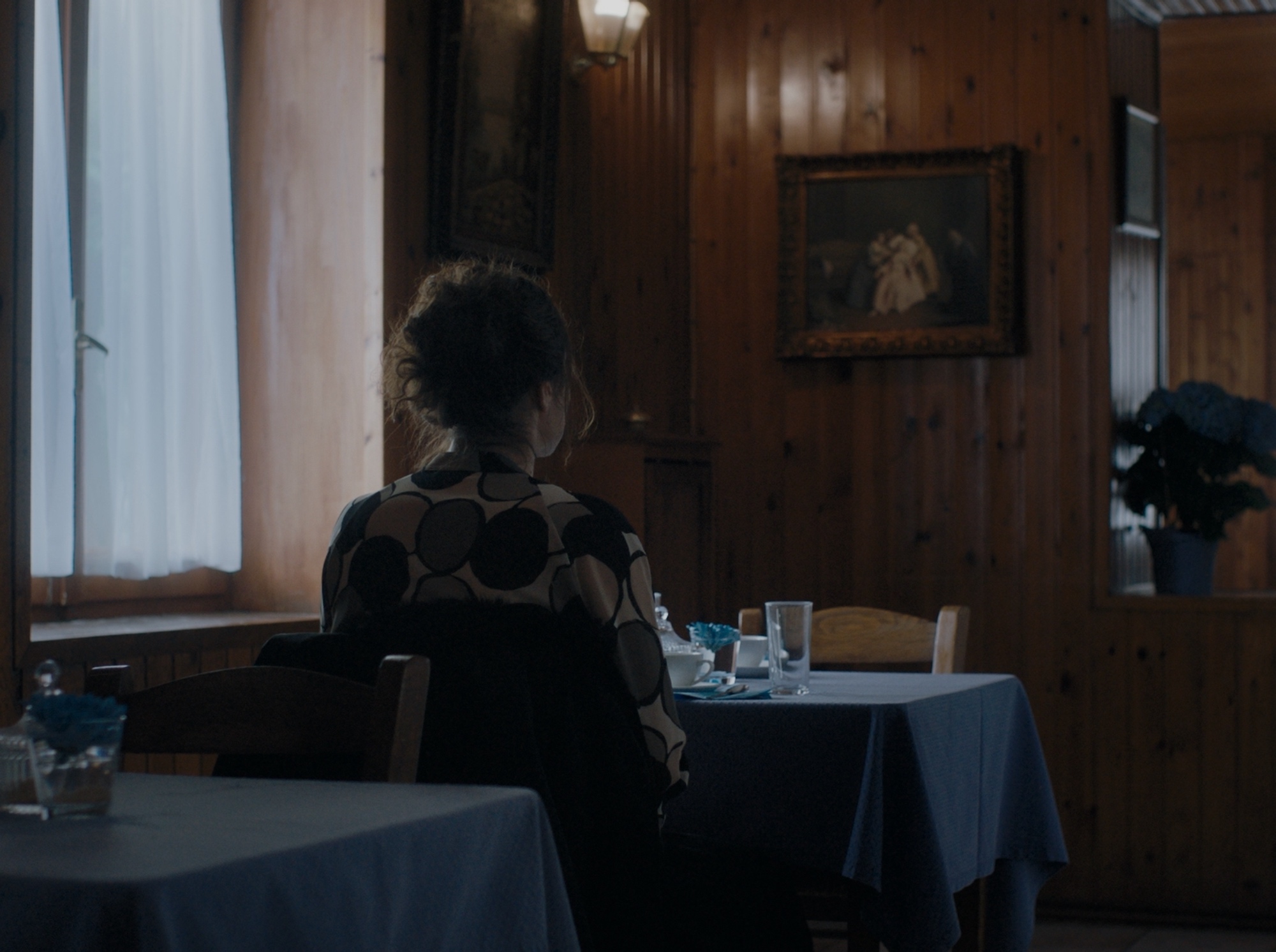
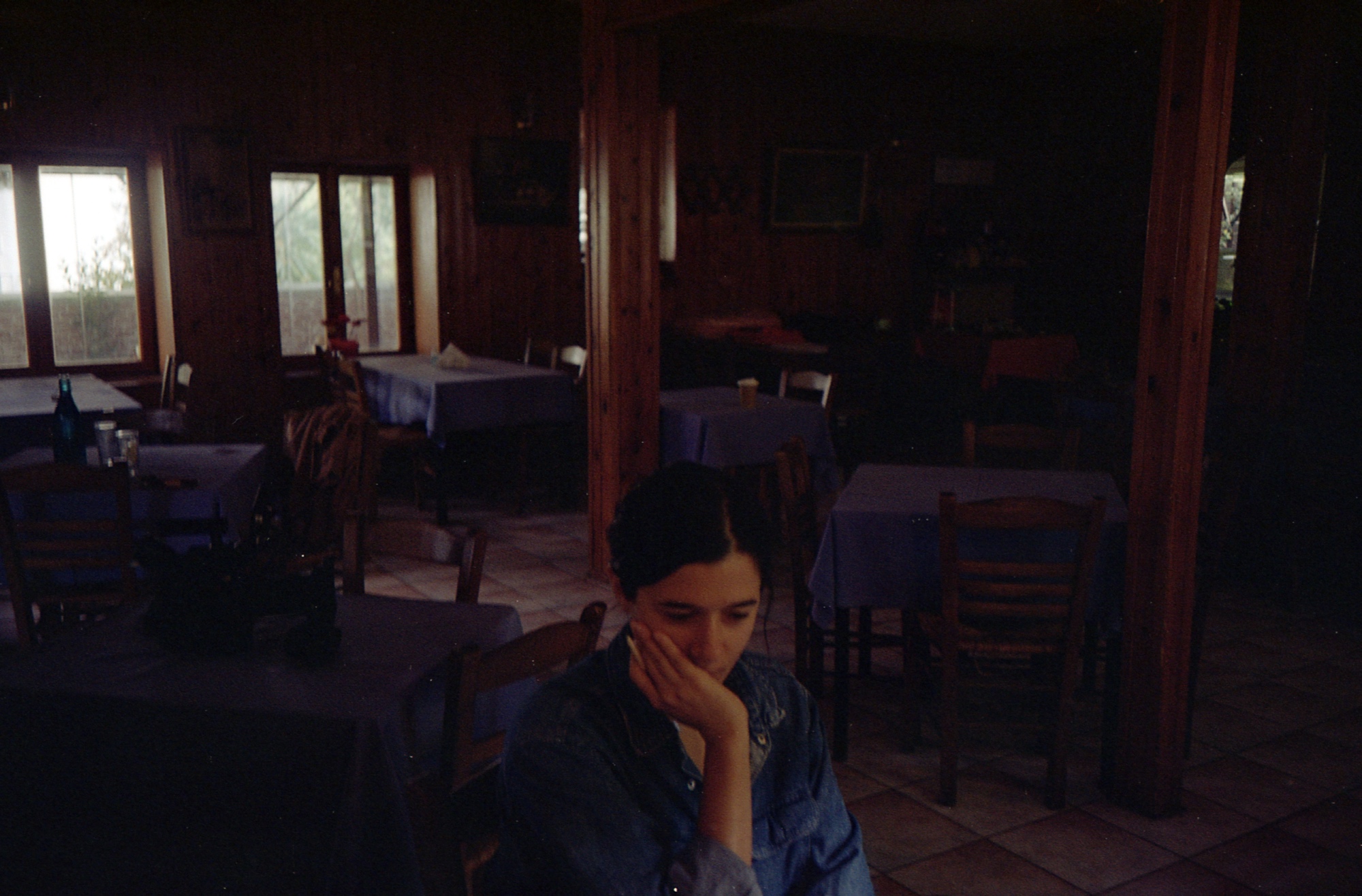
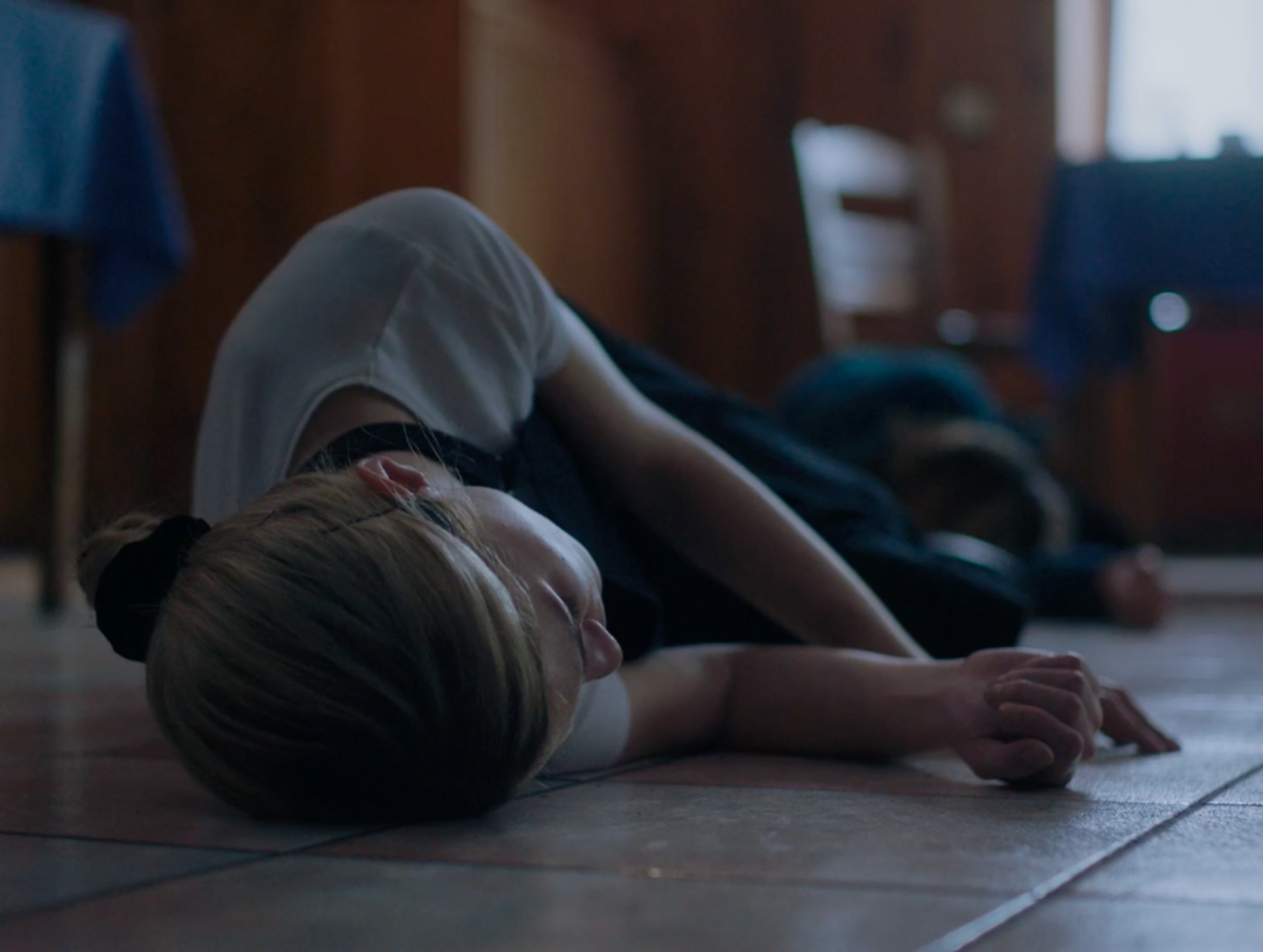
A woman waits at a restaurant table. Her girlfriend is late, again. When she finally collapses, it reads as theatrical, a manipulative gesture in a toxic game. But then strangers start falling too, and suddenly what seemed like emotional blackmail becomes something harder to name. Emma Doxiadi—who last featured on Directors Notes with her paranoid drama Automatic—returns to our pages with Something Like The End of The World, a short which operates in another queasy space. Here, personal dysfunction and collective collapse become indistinguishable, and a relationship’s quiet violence suddenly threatens to be contagious. Shot in a single day within the rigid geometry of 4:3, the film treats a restaurant in Athens as a closed system: a few bodies, confined, watched over time. Doxiadi builds a world that’s both mundane and inexplicable, where the banal gesture held too long becomes genuinely uncanny. Is it the water? Or has everyone simply stopped pretending to hold it together? Doxiadi draws from Marguerite Duras’s emotional tempo and Chantal Akerman’s radical patience to construct something genre-resistant: domestic drama bleeding into speculative horror, melodrama’s pressure system rehoused in silence rather than spectacle. Something Like The End of The World refuses to explain itself, offering instead a darkly comic nightmare where society’s failure to listen becomes literally, grimly physical. Some collapses arrive quietly. This one just happens to spread. As her short premieres on DN, Doxiadi discusses melodrama as a system of pressure rather than excess, the challenge of maintaining emotional intimacy at physical distance on the hillside, and how shooting in a single day gave the film its theatrical, unbroken pulse.
By looking at a woman’s heartbreak, you are engaging in a social commentary on our absurd world.
The film began not with a script, but with a sensation — a kind of soft implosion. The commission came from my producer in this film, Kiriaki Virou at AbFab Productions, asking for a cinematic response to the post-pandemic condition. But I was more drawn to what lingered beneath that frame: the quiet weight of suspended agency, a fatigue that wasn’t quite grief, not quite recovery.
At the centre of the story is a woman trying — maybe too hard — to win back her girlfriend’s attention. It’s a relationship defined by imbalance, by silence more than rupture. That emotional asymmetry felt familiar and urgent. The kind of slow, domestic collapse that doesn’t make headlines, but reshapes a person. A surreal portrait of collapse — personal, relational, and collective. There’s a long tradition of women fainting in cinema — from Douglas Sirk’s velvet melodramas to Brontëan heroines disappearing into drawing rooms. The act of swooning was a form of resistance, a way to speak what couldn’t be said. I was curious what would happen if you removed the embroidery. Could a gesture still carry meaning, stripped of its spectacle?
It began as a WhatsApp thread, but it’s really a way of thinking. A kind of shared awareness that keeps me from becoming too self-referential. It reminds me that cinema is always a conversation.
We featured one of your producers Savvas Stavrou with his cautionary tale A Jar of Nuts a few years ago, and love seeing connections between our filmmakers. Tell us about who you worked with in your production.
We shot the film in a single day in Athens. The heat helped — everything already felt heavy. It was co-produced by my longtime collaborator, Savvas — a brilliant director and dramaturgical mind — and script supervised by Alexandra Matheou, another brilliant director and one of my closest friends. The three of us — we call ourselves The Filmbreakers. It began as a WhatsApp thread, but it’s really a way of thinking. A kind of shared awareness that keeps me from becoming too self-referential. It reminds me that cinema is always a conversation — and that I’m always in it with them, even when I’m alone in the edit.
You’ve mentioned some disparate but wonderful influences. Who and what else guided the tone of the film?
The surrealism, if it’s there, is behavioural. I wasn’t interested in dreams — more in how the banal can become uncanny when held for long enough. Marguerite Duras, of course, was an influence — her sense of emotional tempo, of language as distance. Also Chantal Akerman, especially Jeanne Dielman — the moral clarity of her gaze, her radical patience. The film nods to melodrama, but not in its style. More in its stakes. The pain of needing something and not receiving it.
Most Popular
The film frames emotional neglect as a public health crisis. How did you balance the personal (a couple’s unravelling) with the allegorical (a society collapsing)?
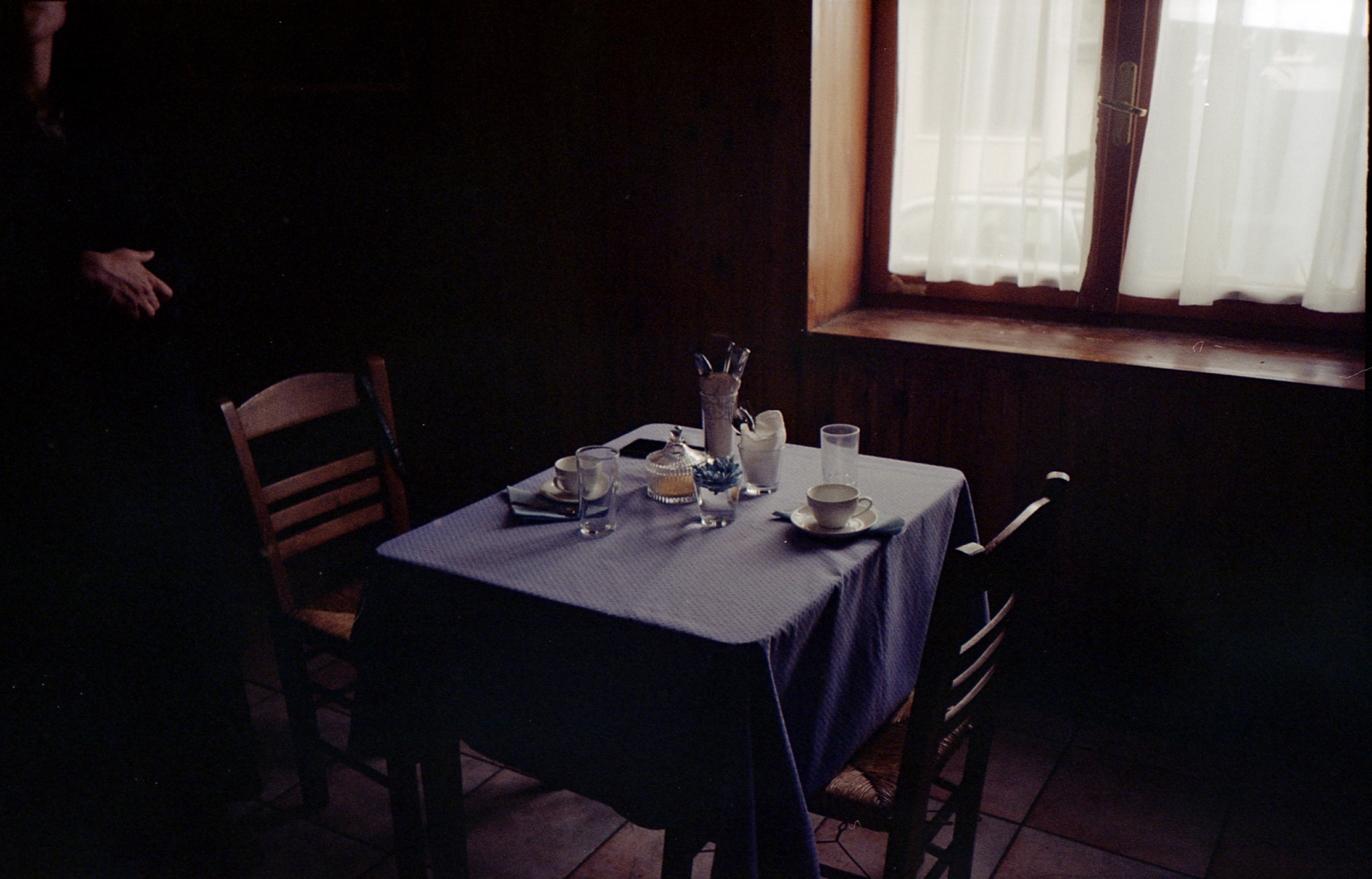
I don’t really separate them. Big collapses usually arrive through small lapses. We don’t feel society falling apart as an idea — we feel it as inattention, exhaustion, the moment no one bothers to correct something that feels off. The restaurant is a closed cinematic system: a few bodies, confined, watched over time. Once you let duration do its work, the allegory more or less announces itself. Two people failing to care for each other already tells you plenty about the world they’re in.
The fainting motif mirrors societal surrender. Is this a film about giving up as an act of defiance, or about the systems that make surrender inevitable?
Both, and I liked not choosing. Fainting has a wonderfully confused history in cinema, part melodrama, part medical event, part social malfunction. I was interested in it as a procedural refusal. Nothing heroic happens; the body just stops cooperating while the social script keeps running. It’s slightly comic, slightly tragic. Whether it reads as resistance or exhaustion depends on the viewer, which felt more honest than resolving it.
The 4:3 aspect ratio frames the characters like portraiture. Beyond containment, did it also heighten the tension between intimacy and surveillance?
Both. The 4:3 ratio has a split personality. It’s the format of domestic closeness, in early cinema, television and portraiture, but it’s also historically tied to control and regulation. Faces fill the frame, yet escape routes vanish. That tension felt right for a film where intimacy gradually turns observational. The frame doesn’t simply contain the characters; it also surveils them.
My cinematographer, Evan Maragkoudakis, and I worked with an ethic of distillation. Each frame needed to justify its existence.
It’s very much a genre-blending short. How did you devise cinematography which could coalesce those narrative modes?
Visually, we kept the palette and language restrained. We shot on the Alexa Mini LF with Zeiss Super Speeds Mk3. I like the way those lenses breathe at the edges — there’s softness, but also a kind of quiet distortion that mirrors emotional instability. My cinematographer, Evan Maragkoudakis, and I worked with an ethic of distillation. Each frame needed to justify its existence. No coverage, just composition.
Something Like The End of The World nods to melodrama’s stakes but rejects its style. How did you direct performance and the pace to balance the banal and the uncanny?
Melodrama is often confused with excess, when to me it’s really a system of pressure. Sirk, Minnelli, and later Fassbinder knew that feeling could be displaced into colour, architecture, and framing rather than behaviour. We borrowed that logic but changed the accent. No swoons or speeches, instead just pauses, misfires, gestures that almost resolve. When emotion has nowhere to go, the banal turns uncanny. The drama doesn’t explode; it builds.
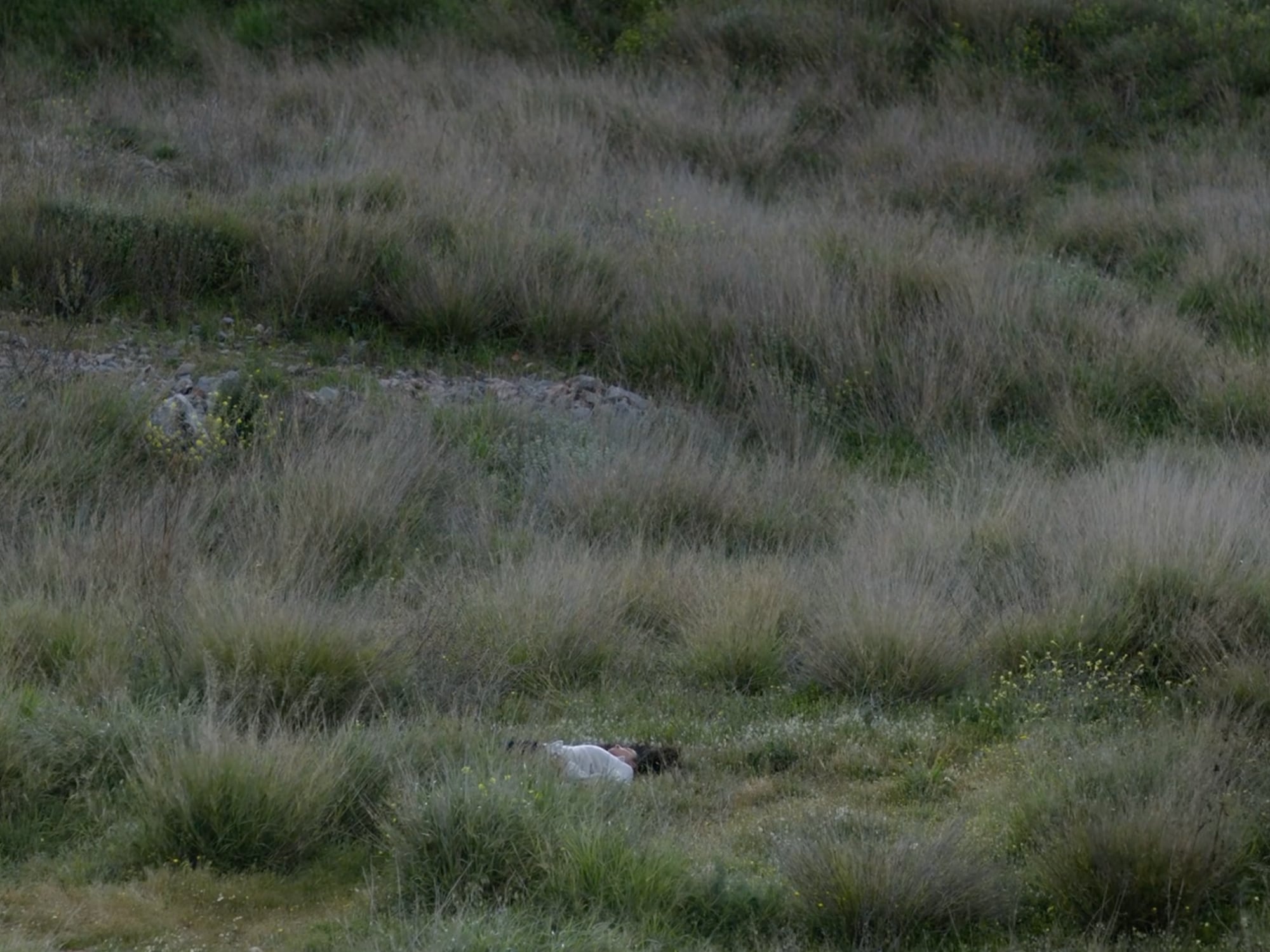
What made you take them outside into the hills, and what challenges did you face filming this part with them at a distance and the audience very much observers?
Moving them outside felt like pushing them off the edge of their emotional world, literally and metaphorically. It was important that, on the hill, they become even smaller, even more exposed. The challenge was maintaining their emotional intimacy at that physical distance. We used long takes and careful blocking so you feel like you’re eavesdropping on something too raw to fully capture. You want to move closer, but the film doesn’t let you. That discomfort felt essential.
Shooting in one day emphasises the intensity of your narrative. How did that time constraint shape the film’s rhythm or the actors’ immersion in their roles?
It gave the film an almost theatrical pulse, like no breaks, no dilution, just one continuous emotional thread. The actors carried their characters’ unravelling moment to moment, without ever stepping out of that shared reality. It kept the energy immediate and alive, as if we were watching a live performance unfold in real time. Rather than exhausting us, it sharpened every gesture and kept the stakes high from the first shot to the last.
I was already thinking about how intimacy can destabilise, how private dynamics quietly leak outward.
I very much agree with you about cinema being a conversation. Does that extend to the audience?
Always. Cinema only pretends to be complete. The audience supplies the missing half as well as their unease, their laughter, the moment they lean forward. In a film about failed listening, that act of attention matters. If no one’s watching, collapse is just background noise. If someone is, it starts to mean something.
If this commission hadn’t arrived, do you think you would have found your way to this film anyway?
Probably. As Godard said, “It’s not where you take things from – it’s where you take them to.” I was already thinking about how intimacy can destabilise, how private dynamics quietly leak outward. We were also living in that post-Covid moment where closeness felt faintly suspicious. The commission gave me permission to linger in that mood.
What short films have had the biggest impact on you as a filmmaker?
Two, for opposite reasons. László Nemes’s With a Little Patience watches patiently until the everyday becomes ethical. Ruben Östlund’s Incident by a Bank refuses drama so completely it exposes how much of cinema relies on it. Both prove that restraint can be deeply unsettling.
Now what?
I’m making another short that’s an existential dark comedy about a woman who is entirely certain she understands her life. This certainty is tested. Alongside that, I’m developing my first feature, a horror thriller in which the body becomes contested territory, shaped by bodily autonomy, bad boyfriends, and inherited trauma that predates consent or explanation.