

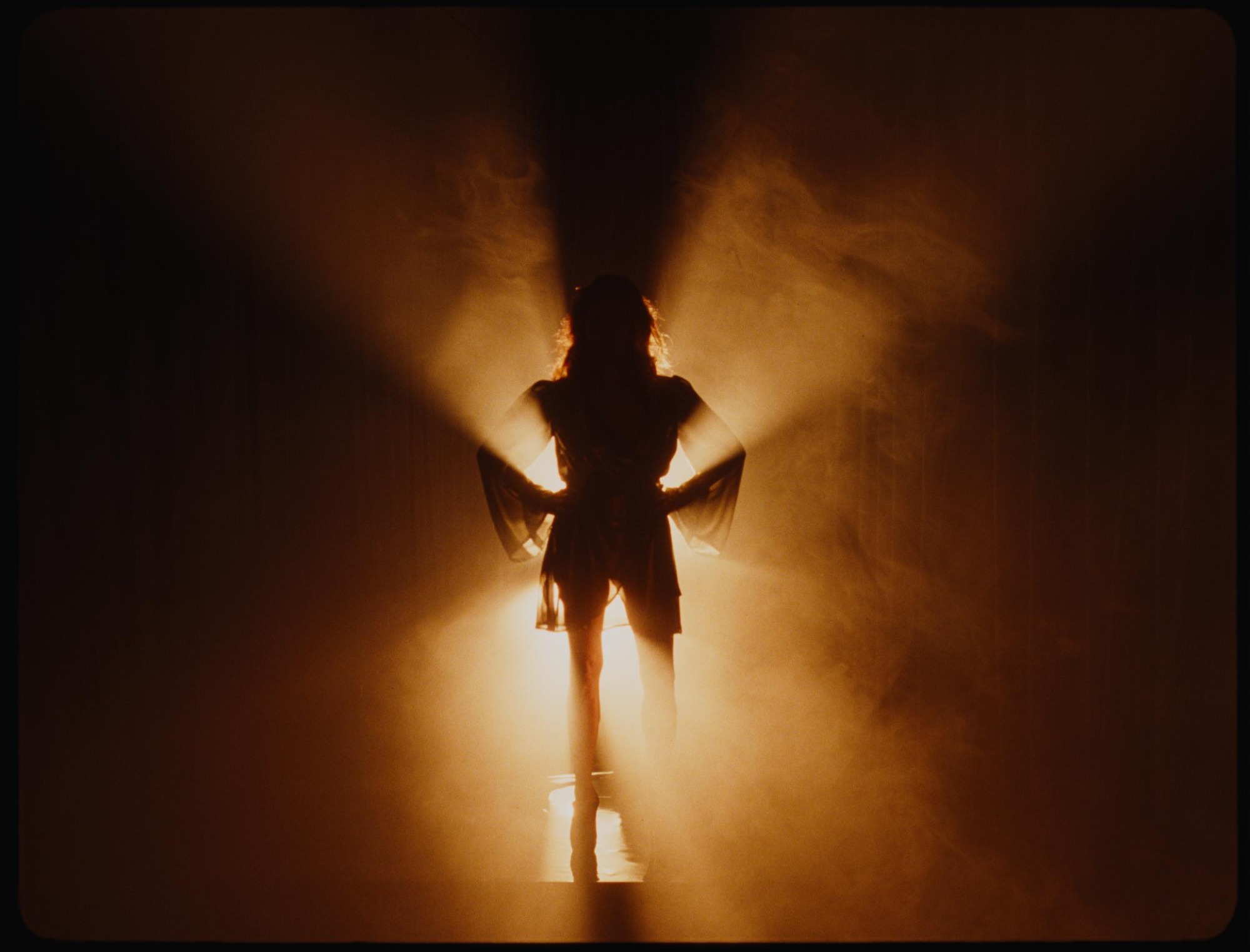
Original Sin [one of the highlights of our 2025 London Film Festival list] the new short from British-Iraqi writer-director-performer Amrou Al-Kadhi, is a 14-minute chamber piece that stages a mother-son duel as mythic combat—shot on 35mm, built entirely in-studio, and constructed with a formal precision that feels genuinely rare in the short form. It follows Amrou’s Sundance-premiering debut feature Layla, and lands as a full expression of a filmmaking voice that has been sharpening across four shorts, a memoir, and a run of television work. Commissioned by WePresent, WeTransfer’s digital arts and editorial arm, and here it’s worth pausing to consider what they’ve quietly built: a platform that has grown from wallpaper curation into an Oscar-winning production entity—Riz Ahmed and Aneil Karia’s The Long Goodbye took Best Live Action Short in 2022—reaching a monthly audience of roughly three million across 190 countries. Their proposition to Al-Kadhi allowed him to flourish: no studio notes, no commercial gatekeeping, no pressure to round off the edges. Original Sin is a vivid argument for why that model matters. What Al-Kadhi delivered back is a film that works as both an emotional exorcism and a structural thesis, with every craft decision load-bearing. The film’s shift from degraded Super8 to full 35mm tracks its protagonist’s advance from erasure into visibility; a 5:1 shooting ratio turns scarcity into surgical intentionality; off-axis eyelines convert a dressing room into a sealed chamber where two people speak past each other through reflections. The result is a short where form doesn’t decorate meaning, but enacts it. Watch Original Sin below, after which we speak to Al-Kadhi about the discipline of shooting on film for the first time, the choreography of a final confrontation that had to be won in inches of cinematic real estate, and why placing an Arab woman at the centre of this visual language was the whole point.

Original Sin feels like a film made with glorious and delightful creative freedom, with symbolic sets, an operatic tone, and cinematic melodrama. How did the commission with WeTransfer come about, and how did the partnership with them ensure that your vision and your ideas were protected?
I was extremely lucky to be honest. The wonderful Holly Fraser from WePresent, who was already aware of my work, got in touch. I talked to her about my relationship with my mother, and in particular, my mother telling me that she had an issue with me doing drag, not because of homophobia, but because of how hard she has found being a woman, and her confusion that I might try and perform as one. That conflict between my mother and my drag has been something I’ve ached to explore on screen for years. WePresent essentially gave me free rein to explore this relationship and theme however I wanted. And so I decided I would fully go for it, to express my fears, my fantasies, my subconscious, and to make a film as I felt the world without worrying about commerciality, studio notes, anything like that.
I’ve been wanting to put my mother on screen for a decade, a compulsion I had to exorcise – and this film provided me with the opportunity to have that creative exorcism. This was a really cathartic film to make. For so much of my career, I have worried agonisingly about convincing executives and commissioners to make my work, and have often played politely or submitted work I thought the industry might validate – it’s an immigrant people pleasing imposter syndrome mentality; try not to offend anyone, make yourself likeable and palatable, and do whatever you need to contort yourself into the room. With this short, I just thought…fuck it. I don’t even care if it terrifies people into never wanting to work with me. I don’t care if it’s so dark it gets me blacklisted. I’m just going to make a film as if I were placing my insides onto the screen without anyone censoring me. I am deeply grateful that platforms like WePresent exist to allow artists to fully express themselves like I did. This was honestly the most profound creative exercise of my life.
From the opening lip synchs to the final confrontation surrounded by mirrors, the film is consumed by two people trapped in each other’s image. Can you talk about how identity theft became the film’s central organising principle, and how that ancestral trauma loop informed your visual decisions?
I’m fascinated by this question of where trauma begins and where it ends. Traumatised people traumatise people. Our parents fuck us up, so we fuck them up, and then we probably fuck up our own kids, who go on to fuck us up and their own kids too. And this loop of trauma is ancestral, as if it has been on this earth forever, trying to be released. Instead, it just gets trapped in society’s body politic forever, bouncing back and forth between us all, with nowhere to go – and just look at the world now. It’s as if an ancestral plague of trauma is causing us to cannibalize ourselves into oblivion.
That feeling informed every single decision of the film – them lip-synching to each other’s voices, as if they cannot escape each other. Our phenomenal DOP Chris Aoun made the suggestion of projecting the mother’s face onto the son’s – which you see in the opening credits – as if they are speaking from inside each other, possessed by the other’s trauma. Besides the more obvious visual constructions of there being mirrors everywhere in the film, where both characters look the same inside multiple reflections, where we can’t tell who is who, or the fact that mother and son look the same, something that I was keen to do was to explore the narcissism of trauma. How it often traps us inside our own reality so that we cannot meaningfully connect with another / the outside world.
They’re talking to each other, but not looking at each other; so in effect they are talking just to themselves.
So one decision we made, for when mother and son confront each other in that extended dressing room scene, was that for the majority of the scene, we had their eye-lines completely off and didn’t worry about keeping the line – they’re talking to each other, but not looking at each other; so in effect they are talking just to themselves. Or they talk to each other through reflections – for that scene where they are having a conversation through their reflections, they are not actually looking at each other in real space – so it’s like a conversation in a trauma funhouse where they don’t actually know where the other is.

You’ve spoken about the film as an act of narrative justice—placing an iconic Arab woman inside a cinematic vocabulary that has historically refused her. How consciously were you holding that weight as you made the film?
I mean, this was one of the film’s key organising principles. As an Arab person who has genuinely played many terrorists on screen, and has consumed cinema from the UK and Hollywood for decades, I just do not see Arab characters meaningfully portrayed on screen. The diversity revolution in Film & TV barely included Arabs – if at all. Right now, the dehumanisation of Arabs across the world – fuelled by a dehumanising media – is devastating, and Film & TV is not stepping up to the plate in terms of representing Arab and Muslim lives meaningfully. And so I decided that this film would be unapologetically cinematic – this Arab woman WAS GOING TO GET HER HOLLYWOOD MOMENT, she would take up cinematic space – even if she has to murder in order to get there!
This is why we shot on 35mm – it was like giving this Arab character her space inside cinematic history herself, and we consciously shot in a way that made this film feel like something that lived forever, referencing old Hollywood in so many of our cinematographic choices. Mirrored in the story, of course, is the fact that the mother, whose story has been erased by her son – he literally gets to go on stage, dressed as her, telling HER stories of trauma, whilst she is in the sidelines, totally invisible – finally takes the narrative back and goes on stage for the first time in her life. So form very much mirrored content here. Our DOP Chris made the suggestion of starting the film on Super8, as if the mother exists only in fragments and decay…it’s only near the end, when she finally goes on stage and reclaims the narrative, that she is in the full majesty of 35mm. The film, narratively and visually, is about taking up cinematic space that has been denied of Arab women. I love Todd Haynes, and the way he tells queer stories inside the cinematographic grammar of Hollywood 50s movies, which was an influence to the approach here. You get the feeling that Todd Haynes is making the films Douglas Sirk wishes he got to make.


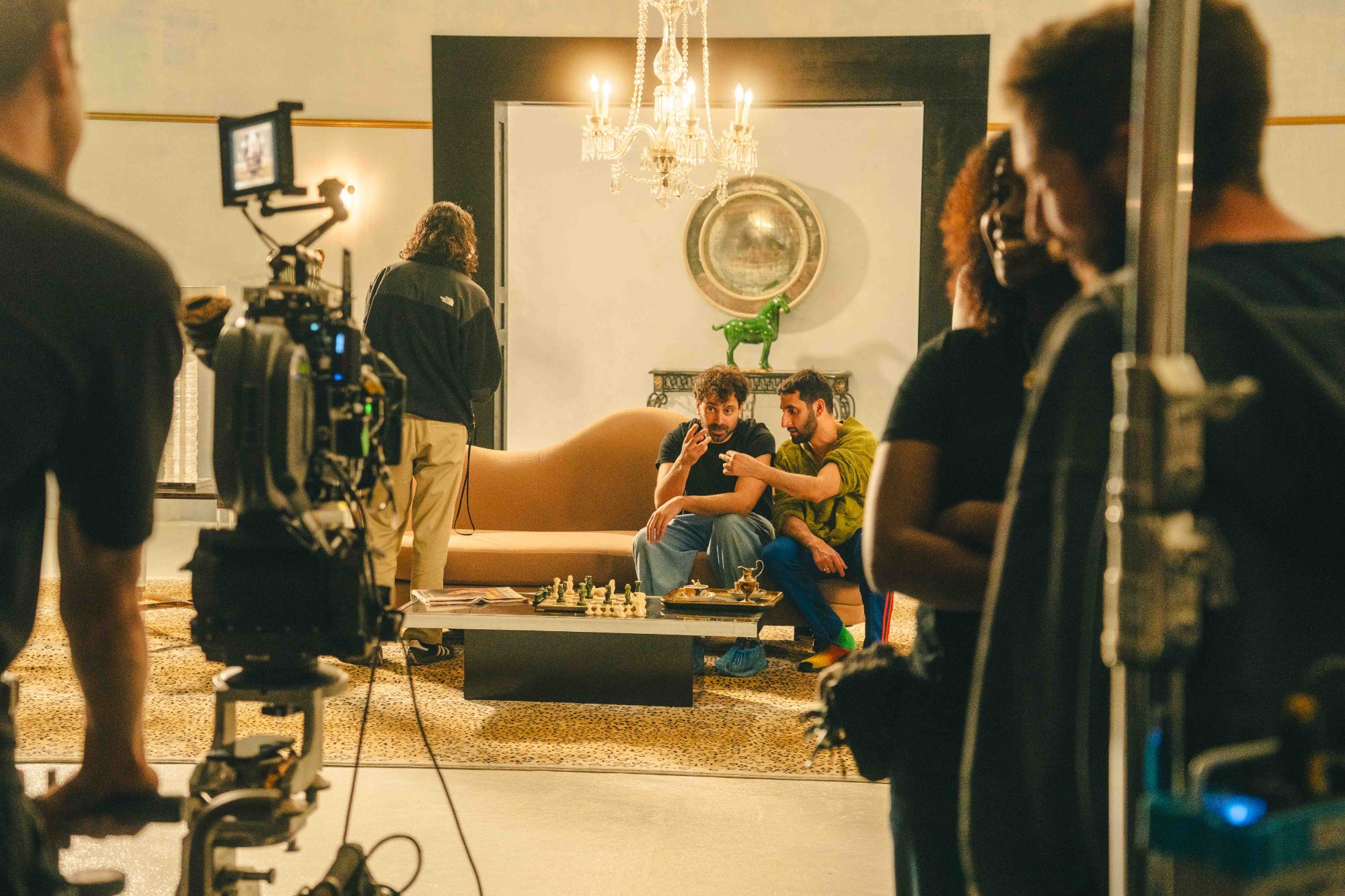
There is something about the construction of a studio, where you get to create sets as you FEEL them, rather than they are, which allows the truth to pierce through that much more.
The sets are brilliant, abstract, symbolic, yet completely emotionally legible. I know a lot of research went into the look. Can you walk us through the practical process of actually designing and building these locations?
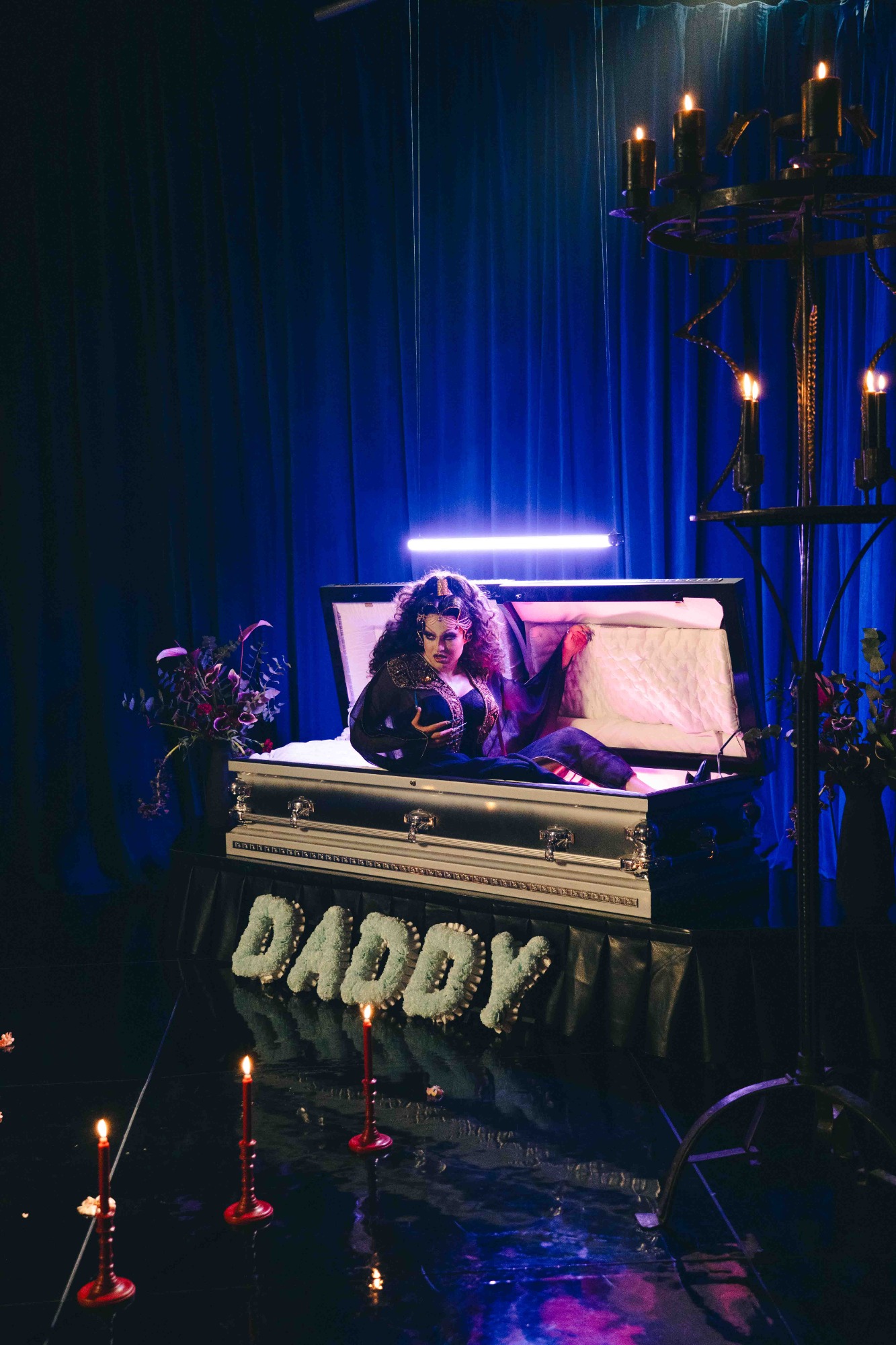
Soraya Gilanni Viljoen, my extraordinary production designer and long-time friend and collaborator, worked closely on the construction of the aesthetic. This film was always made as a kind of nightmare, but one rooted in very real emotional pain and fears. And like having an actual nightmare, I wanted this film to feel both surreal and emotionally very literal and raw. When we got the commission, Soraya and I went to a Francis Bacon exhibition together where I wept in front of a triptych. Bacon’s violent sparseness allows for this fusion of a nightmare logic with unfiltered emotional honesty, the queer rage piercing through the savage abstraction – we talked a lot about giving the production design that sense of nightmarish otherworldliness, without ever losing the raw emotion of the piece. I wanted it to feel like something in a dream – a subconscious experience that was both surreal and emotionally utterly real.
Soraya was able to give this subject utter cinematic majesty, and we watched a lot of Almodóvar, Lynch, and Fassbinder in preparation. And working in a studio in such a constructed set actually allowed the raw emotion to be more powerful – there is something about the construction of a studio, where you get to create sets as you FEEL them, rather than they are, which allows the truth to pierce through that much more. And in referencing the artifice of the construction, you end up revealing the truth behind this construction. The honesty of the fiction somehow makes it even more truthful. The sets mirrored the mechanics of drag in this regard – artifice costuming raw trauma; artifice revealing a painful truth. This film oscillates constantly between the image and the repressed rage behind it.
Most Popular
This was your first time shooting on film, and you’ve described it as transformative. How did that discipline change the relationship to your approach to the production and shoot?
I’m used to shooting digitally, yes. When I made my first feature, I did panic a bit, and we had SUCH limited time in each location – I really just wanted to ensure we had enough to edit the film with, and to make sure we had enough variations of performance so that we had a lot of flexibility in the edit. I think this was a financial fear and a panic about commercial potential – and I sacrificed a lot creatively in the pursuit of coverage in a way I deeply regretted afterwards. And given a short doesn’t have those kinds of commercial pressures, I decided I would really, really push myself not to rely on coverage. Due to the budget, we had around 70 minutes of 35mm stock (for a 14-minute film), which means our filming ratio was around 5:1, which isn’t very much. We were only able to do two takes per setup, which is quite mad, and didn’t even have space for masters of a whole scene, or anything like that. It was scary. But it forced me to almost edit the film in my head before we shot, and made every single thing we shot utterly essential to the story. That intentionality served the film completely, and it meant that every shot had a place in the edit, and every frame had a meaning. I can’t imagine shooting any other way now.


The camera feels like a conscious participant in the conflict, starting languid and observational for much of the film, before shifting into something far more aggressive in the final confrontation. How did you and Christopher choreograph that evolution?
Christopher Aoun is one of my filmmaking heroes, and to be able to work with a queer Arab DOP and someone as wildly talented as Chris was just a dream come true. He pushed me as a filmmaker in ways I had never before been pushed, asking me to understand how every cinematographic decision served meaning and story. I think this film is the first time I’ve fully fused narrative meaning with cinematography, and that is because of the way Chris interrogated the script in our countless prep meetings. He questioned me on literally every single comma in the script. It was such an exciting collaboration.
We talked a lot about the cinematography feeling like a chess game – precise movements, nothing wasted, each cut, each frame, a strategic proposition in this mythic Greek war between mother and son.
For us, one of the key moments is the final confrontation between mother and son – it was essential to us that for the mother to win the scene, not only would the camera position change to below her, but she would literally take up cinematic space at the expense of her son, who diminishes below her in a reverse of how the scene begins. The son starts the film in cinematic majesty, and ends the film diminished, on the floor and then dead. The mother starts in fragmented Super8, and ends the film defiantly taking up cinematic space. Pure narrative and visual theft. Like with Soraya’s production design, there are horror nods in a lot of the cinematography, and we wanted it to feel both emotionally legible yet somehow otherworldly in style and composition. That line between the surreal and emotional rawness was so key for us.
We talked a lot about the cinematography feeling like a chess game – precise movements, nothing wasted, each cut, each frame, a strategic proposition in this mythic Greek war between mother and son. The film is about who gets to win trauma, and so we needed the film to feel like a trauma duel between both entities. Our fabulous editor, Konstantin Bock, helped give the edit this feeling of it being a loaded gun, of tension being created with every cut, so precise it felt like a fever dream that could explode at any minute.

I’d also love to dig into your lighting, which does something quite precise; that warm, theatrical dressing room glow feels simultaneously like backstage drag and golden-era Hollywood, perfectly embodying the film’s tension between those two worlds.
I’d never worked in a studio like this before – it means you can control the lighting in a really exciting way, and it allowed me and Chris to sculpt light in a way I wasn’t able to do with my first feature and on location. I watched a lot of Todd Haynes in preparation for this film, especially May December, Carol. That sort of old Hollywood lighting fuelled the theme of this queer Arab and female Arab story occupying its position in cinema. This film feels like a forced and intentionally violent entry into a canon that has been denied us, as if we were literally cutting up old film and shoving our story in there. There was quite a conscious All That Jazz / Chicago style lighting to a lot of it – I love that line between horror and camp, and the irreverent violence in films like Chicago, which are so queer and drag coded. There’s quite a conscious lighting switch in the living room, when the mother kisses the bailiff, before the camera swivels, and we see a pure black void behind her. That was definitely about the sumptuous camp of maximalist films like Chicago that Arab stories never get. It’s us saying – we deserve Hollywood too, bitch.
Jonathan Lipman’s costumes do something quietly extraordinary—the mother dressed as a drag queen, the son dressed as his mother, and by the end, she’s wearing his dress, which he stole from her in the first place. How did that collaboration develop, and how central was costume to articulating the film’s thesis about identity theft?
I’ve had the pleasure of working with the legendary Sandy Powell before. I spoke to her about this film, and she recommended her long-time colleague, Jonathan Lipman, from Angels. And she was right – he’s a genius! We spoke a lot about Francis Bacon in terms of production design, and then he had the idea to give both mother and son this kind of liquid metal fabric for their dresses in the confrontation scene, which was genius – as if they are already dissolving, like a subject in a Bacon image, and fusing into one another.
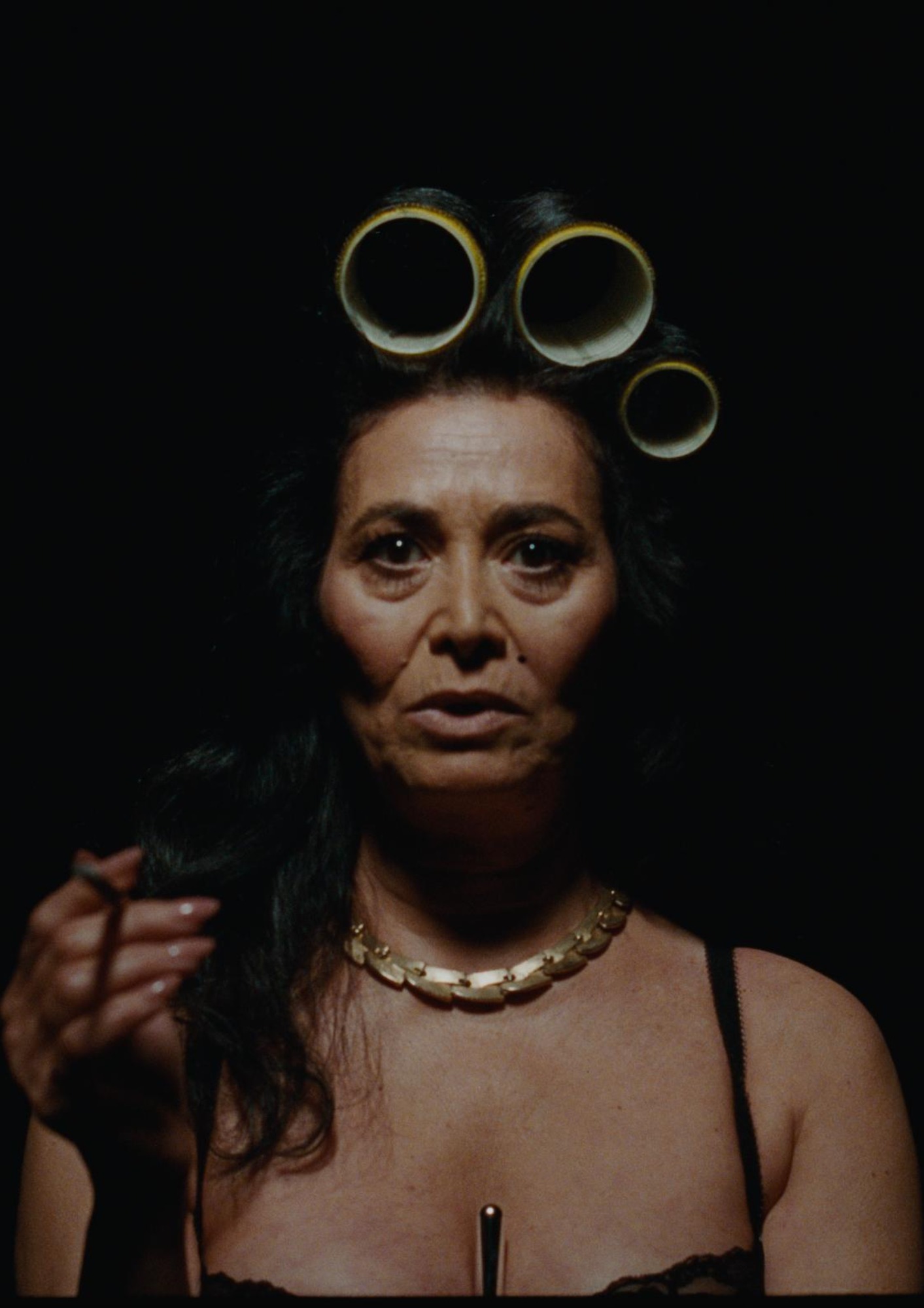

I really love what he gave the mother in the living room – sexy lingerie; we never get to see Muslim women dressing this flamboyantly on screen, and he just went for it. I think Darina Al Joundi, our actress, LOVED being in the costumes he found for her. I also love what he gives the drag queen in the performance scene – also wearing sexy lingerie, like the mother, but this time also wearing an Islamic abaya, fetishising his own race, pretending he is more Islamic than he is when we have just seen the mother at home looking anything but. His narrative theft and fictions are also in what he wears for a white liberal audience, and Jonathan understood that beautifully. And throughout, the costumes reinforced that central question – where does the trauma begin and end, or is it just bouncing between them forever and ever.
Darina Al Joundi and Mojean Aria give performances that commit fully to the operatic register without ever losing emotional truth. How did you work with them to find that fusion, and what did casting tell you about the state of roles available to MENA actors right now?
Being a MENA actor is really tough – roles are very limited, and engaging in queer work often means issues back in the Middle East. Both were so brave, and trusted me to guide them to the darkest depths – both their performances are completely fearless. It was interesting operating in this melodramatic, operatic tone – I wanted both their performances to fuse with the melodrama, without losing the emotional groundedness.
That is what’s amazing about their performances – they are so truthful, yet unapologetically operatic, which is incredibly hard to do. We talked a lot about Tár, and also May December – both innately dark, funny films that commit to the melodrama by playing it completely straight. I often work in comedy – the challenge in this film was for it to be funny – in a twisted way – to create that sense of ‘am I allowed to laugh.’ I read a review that called May December a Booby Trap of a movie – where you just don’t know what you are feeling. That was critical to me here – is the mother being serious? Is this kid lying? Whose side am I on? Both are saying horrid things? What do I feel? That feeling of being scared to laugh is something I love to create in my drag shows, and I hope that happened here. And praise be to Darina for her “Not my Furs” moment – camp and absurd – yet she delivers it with unadulterated truth. She’s a masterclass. And Mojean’s ability to be both bratty and camp, funny and sinister, defiant and vulnerable, is astonishing!
I just decided – I don’t care how nasty BOTH these characters are. Arabs and queers can be fucked up as hell too. Why must minorities fit into morally neat boxes to make it on screen?

We are compiling a mega list of filmmaker favourite shorts. What would you like to contribute and why?
The best short film I have ever seen is called Starfuckers [highlighted by DN in our 2022 Berlinale Best of Fest], written and directed by and starring Antonio Marziale – not only is it visually ASTOUNDING, it also oscillates between camp and horror in a way that really inspired Original Sin, and the way it explores similar questions about narrative theft, and queer subjects inserting themselves into a cinematic canon, deeply inspired me. It’s honestly just extraordinary, and I think I’ve watched it like 20 times. It’s astonishing. And SO precise. When we got Original Sin commissioned, I remember showing this to both my producer and cinematographer, and saying – look how intentional this is! No move wasted! No shot or camera movement that isn’t motivated! Honestly, everyone – JUST. WATCH. THIS. SHORT.
Original Sin and Layla feel like a significant one-two, and drag has always been at the heart of your practice. With MENA actors still fighting for space, and Arab queer stories so rarely told with this kind of cinematic ambition, what has the reception to both films told you about where audiences are? And where do you go from here?
I guess Original Sin and Layla are a response to the same frustrations about the limited representation of Arab stories. Often, minority stories are entirely about suffering and trauma, which robs us of our complexity and humanity – so Layla was an expression of joy, messiness and the FUN denied to Arab stories on screen. And I wanted Layla to be a fairly annoying, frustrating character who makes bad decisions out of their own internal conflict, without the world traumatising them in an overtly violent way.
But I have similarly been deeply frustrated in my career that I am often asked to make my characters likeable on screen – this seems to be another prerequisite for minority stories to make it through commissioning anxieties (and most commissioners in the UK are white, let’s face it). It’s not something any of my white writer friends and filmmakers have to deal with. I doubt that was a note given to the writers of Succession or White Lotus. More likeable? More empathetic? More empowered? Please. So in Original Sin, I just decided – I don’t care how nasty BOTH these characters are. Arabs and queers can be fucked up as hell too. Why must minorities fit into morally neat boxes to make it on screen? With Layla, I think I was still finding my cinematic voice, and I learned a lot making a debut feature, and made a lot of mistakes on the way too, though there’s so much of it I’m proud of.
Original Sin feels like a much truer and more controlled expression of my voice, and I am currently working on a slate of TV and Film projects with an Arab focus that are unapologetically nasty, sexy, funny, twisted – and most importantly FUN. Stay tuned!