
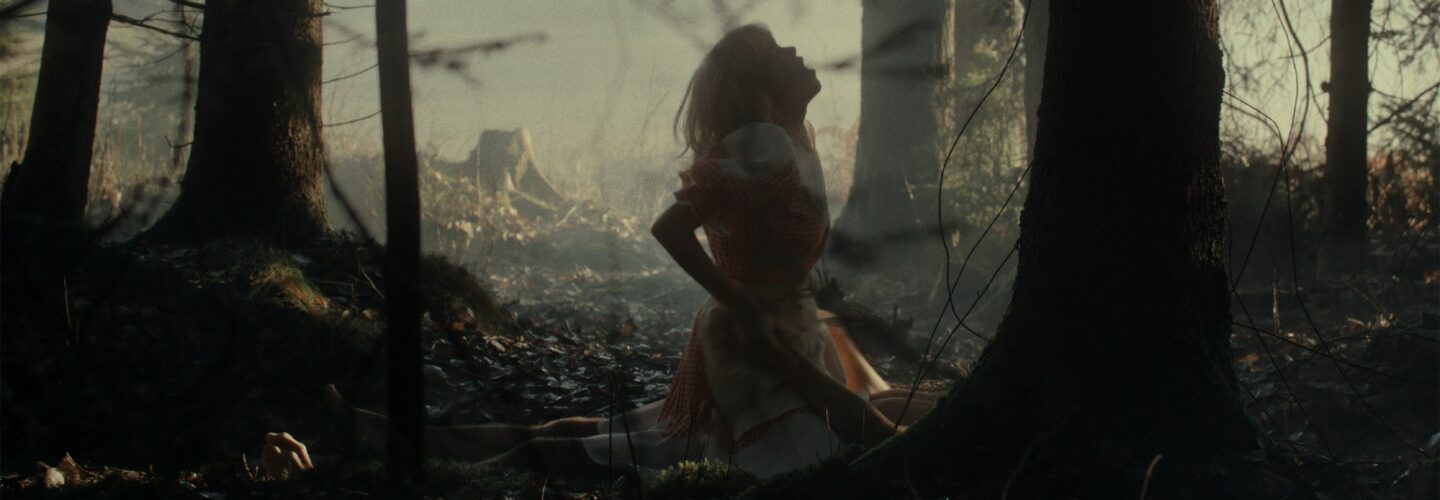

What begins as a documentary-esque macro examination of the beauty of a lush forest under dappled sunshine, a pastoral idyll quickly twists into a horny, surreal and darkly humorous fable in Tobias Frøystad and Tayo Cittadella’s brilliantly bizarre short, Fuck The Crops. The film, which sprouted from a playful challenge to outdo National Geographic, cultivates a world where the forbidden fruit ready to be harvested is perturbing to say the least. This is not a dystopia of rust and dust, but one of unsettlingly vibrant greens, fertile earth tones and a couple’s unorthodox farming practices. Despite the obvious draw of the title, Fuck The Crops lulls the viewer with serene, wide shots before plunging them into the film’s deliciously weird logic. The true intention of a film is, of course, always up for debate but the allegory for labour and exploitation, examining a society that has streamlined people into its grimly efficient practices, is at once absurd and hauntingly direct—especially when you see the crops sitting neatly above the soil with the crisp finality of vegetables soon to be reaped. The filmmaking mirrors this unique tone, employing a cleverly restrained visual language. Deliberate, long takes and artful rack focus shots guide the eye through this strange ecosystem, allowing each meticulously composed frame to unfold like a panel in a graphic novel. With Fuck The Crops premiering on DN today, the long-time directing duo chat to us about embracing the technical flaws of an old RED Epic camera and vintage lenses, strategically outsourcing VFX to skilled artists and their two-decade creative shorthand.
This fantastical horror is so brilliantly bizarre.
Tayo Cittadella: The idea for the script came unexpectedly while my girlfriend and I were watching bees pollinate a flower. I mentioned how incredible it would be to film them up close, to really capture their process. She immediately challenged me: ‘What makes you think you can do it any better than National Geographic?’ Without missing a beat, I fired back: ‘I’ll tell you what National Geographic can’t do.’ What followed was a five-minute rant that spilled out almost exactly as the story we ended up filming. It arrived in one sudden rush… surreal, strange, and oddly complete. It only grew deeper and more meaningful the further we developed it.
Tobias Frøystad: I interpreted it as a short horror-fantasy set in a near-alternative future with a surreal, uncomfortable vibe. Since the film is only three minutes long and has very little dialogue, it needed to be visually concise and clear so the audience could quickly grasp the characters, feel the tension, and stay curious.


TF: Tayo and I had a lot of discussions about the world this film takes place in, and what it might mean if humans could actually be grown like crops. The real question is about labour and exploitation. If society had the option to cultivate humans for work, for modern-day slavery, would we take it? And if so, how would we justify it? The sexual aspect felt like an inevitable byproduct of such a scenario, something that would naturally emerge from human behavior. Thinking through these possibilities helped us understand the logic of this world, and at the same time, opened it up for different interpretations.
Most Popular
How did you approach fulfilling the threat to film in the detail of National Geographic?
TF: Hehe, I don’t know if the look itself is very National Geographic in style, but it does have parallels with the slow pace and the steady, long shots. I have to admit that the mushroom shot at the beginning, with the light hitting it, is pretty National Geographic. What I like about that look and style is that it feels very straightforward, in the sense that you really feel like an observer, just watching the world and a story that unfolds. It doesn’t rely on heavy editing to keep you entertained.

With your colours and tones, you have built a delightfully quirky, specific atmosphere for this alternative world.
TF: We didn’t want to go for the full post-apocalyptic bleak industrial look, but instead tried to balance the colors so it feels both warm and cold, natural and abstract. Our color grader, Didrik Braathen, did a fantastic job. It should be said that we shot this just before winter in Norway, and normally at that time of year the sun rarely shows up. We were 90% sure it would be overcast with dramatic skies, and we planned for that. But on the actual shoot day we had blue skies and sun all day. So we ditched all our lights and only relied on bouncing, diffusing, and blocking the natural light.
Rack focus was a technique I used to avoid unnecessary cuts, why cut between two shots when you can tell it in one?
The short feels like its own ride through a mystical forest, playing with perspective in a very distinct way.
TF: It was important that each shot was visually descriptive. You could almost print out each frame, put it in a book, and it would read like a comic. Rack focus was a technique I used to avoid unnecessary cuts, why cut between two shots when you can tell it in one? I’ve always been a fan of framing with foreground, midground, and background, and when you switch focus between those, you guide the viewer’s eyes to look at the same shot but in a completely different way. That ability is also what makes the world feel more alive and three-dimensional, so to speak.


TF: We filmed everything chronologically in a single day, racing against the short daylight hours. I shot it on an old RED Epic we still have at our offices. Some people might wrinkle their noses at using a camera from 2011, but it still produces beautiful images and is very VFX friendly. I paired it with some Sigma high-speed T2 zooms for their low-light capabilities. While many complain about their focus breathing, I actually loved it for this project. It added a unique, kind of weird zoom-feeling to the rack focus shots, of which the film has several.
Some people might wrinkle their noses at using a camera from 2011, but it still produces beautiful images and is very VFX friendly.
Since Fuck The Crops relies on a few key VFX moments, how did you decide which challenges to solve on set versus in post?
TF: Figuring out VFX on set is not good for my nerves, haha! That’s why we did a test shoot at our office and made a scrappy version of each VFX shot. If it worked with my limited VFX skills, we knew it would definitely work once we hired a professional. It’s always useful to know the basics of VFX and what an VFX artist needs to create a solid shot. The only thing we hadn’t accounted for was how heavy it would be for the crew to carry the actor, while the farmer character had to look like he was only carrying the weight of a head. There are also some shots we did practically without VFX, like the head falling to the ground. That’s just our actor letting his head drop onto a sweater. A classic trick. Simple, but effective.
The first head pop was intentionally exaggerated—we wanted it to feel almost like a vegetable snapping in half. The walking head shot was trickier. We filmed it from behind, with the farmer holding the head, which made it easier to key out the body and crew. For the vegetable character in a green suit, we outsourced detailed rotoscoping via Fiverr. It’s a surprisingly useful tool for indie filmmakers: you can find skilled VFX artists and pay per shot or budget. A hot tip for indie filmmakers out there!
The planting head sequence was shot with a clean plate and our actor sitting with a DIY rig around his neck for the dirt. For the final shot, we simply had the vegetable character sit in each position where we wanted the heads, then masked and composited them in post.


Love the idea of outsourcing for this type of project. For those filmmakers out there, how easy was the process?
TJ: It’s pretty great when you have a clear plan from the start and don’t try to ‘save it in post’. It all comes down to knowing exactly what you’re asking for. I made a clear, easy-to-understand brief and sent it around on Fiverr. I wasn’t looking for the cheapest option, but for someone with solid experience who actually cared about doing a good job.
TF: Since I had already tested the VFX shots myself in pre-production, I knew what they would need. Clean plates, shots with real practical dirt, green screen, and so on. So I basically said, “I have all these components to make this VFX shot, can you do it?” The response was great. One guy did the walking head shot, and another handled the rest. It felt like a win-win situation that probably would have cost a lot more if I had hired someone locally.
The idea was that some crops were more ripe than others, some alive and ready to be harvested.
In that final shot, I really loved all of the different heads, movements, and bewildered expressions.
TF: The actor sat on top of each dirt pile and made weird faces with minimal movement. The idea was that some crops were more ripe than others, some alive and ready to be harvested, while others might only have a head without a body. In post, we tried to balance it out by picking the right ones and freezing some of them.

Having collaborated since you were 15, you’ve undoubtedly developed a unique creative shorthand. From a technical and directorial standpoint, how does that deep, shared history manifest on a complex set?
TF: I think the biggest thing is that we really understand each other. It can be challenging having two directors, since a film set usually works like a hierarchy where the director has to have a clear vision of what he or she is making. With two people, that can get complicated and make things less clear for both crew and actors. But because we know each other so well, we sort of operate as one when we work together. Tayo, being a professional actor, focuses more on directing the actors, while I handle a lot of the framing, scene structure, and blocking. Since I also edit, I also edit a bit in my head on set.
What are you two going to tackle next?
TF: Having operated between commercial work and fiction for a long time, we finally decided a couple of years ago to go all-in on more fictional projects, and it’s been really rewarding. Right now, we’re writing a new feature and also planning to release more short films like this in the future, focusing on the kind of stories we truly love to make.