


There are some things a child sees before they have language for them. The fallibility of a parent. The quiet, unanswerable weight of grief moving through a house. The first creeping understanding that the adult world, too, is improvising. Magic realism, at its most precise, doesn’t soften any of this but rather gives a child a framework large enough to hold it – a flood becomes feeling, a horse carries a soul. The fantastical isn’t an escape from emotional truth but the route to it, the only register honest enough to render what can’t yet be said aloud. Far From the Plains, the third short from writer-director Luigi Sibona and his second with award winning London film studio Grey Moth, works squarely within that tradition while finding its own distinctive voice. The short follows 14-year-old Frankie as great storms loom over South London and his mother fades into depression, drawing him toward an unlikely sanctuary: a Loughborough Junction stable rooted incongruously between the tower blocks. From that strange urban island, the film scales an intimate story of a boy and his mum to the proportions of what Sibona calls a personal apocalypse — an inner collapse mirrored by an outer one, weather and grief moving in step. Coming from a director with roots in genre and horror, the contemplative register is its own quiet surprise, holding brutal realism and quiet magic in the same frame. As Far From the Plains hits the pages of DN and we speak to Sibona about the train-window image that sparked the film, the visual grammar of an inner and outer apocalypse, and arriving at an ending that holds escape and acceptance in equal measure.
That glimpse of the Loughborough Junction stable from a train window — a strange island against the London skyline — sounds like the film found you rather than the other way around. How quickly did you know it was the emotional centrepiece of the story?
The film very much did find me rather than the other way around, as flowery as that sounds. Having a background in genre and horror, with that also being where I want to go with the feature, it was quite a surprise that I was drawn to this story so strongly. The initial idea came when I was getting on a train through south London and saw this horse in a stable rooted anachronistically between the white tower blocks like an oasis. I had, without knowing it at the time, been in a period of depression — maybe more reflective and squishy than I usually am — as well as, and I can really draw a direct line to it, having seen Charlotte Wells’ Aftersun recently, which profoundly moved me. I think this landed me in a certain mindset and I was also thinking a lot about growing up with my single mum and the pressures put on parents and guardians to always be a point of care and security for kids, even when the world can feel isolating and uncaring. This story was certainly a love letter to my mum in an indirect way, as well as one for single mums, a role that can often go under-appreciated.
At what point did the collaboration shift with Niellah Arboine from script editor to co-writer, and how did her drilling into the magical realist elements change the shape of the story?
Me and Niellah go way back to when we were little drama kids at the Battersea Arts Centre and she’s a wonderful writer. She’d always been my script editor and fed back on my writing — she’s great at dialling into the core ideas and helping them flourish. She’s big on theme and character and how they exist in the world, and we overlap a lot in our interests, whether that’s spirituality, theology, folklore, or the mystical. She was feeding back on an early draft of the script and really pulling out and expanding the more magical elements of the story, basically saying, “This is what the story is”, pointing out there’s a million stories about a sad kid and his mum.
Niellah dialled into the storms and floods elements, which were only cursorily referred to, and essentially made them the whole thematic backbone of the story.
The first draft I had was very much based on my experiences with my mum, a couple of sequences being verbatim from my childhood, but it was fairly thin. It had the stables as a kind of escape, and there were these aspirations cast to a kind of biblical flooding as an omnipresent backdrop but it was largely very literal. There was also an early version of the magical realist ending, though it was a bit more laboured and didn’t quite have the elegance I think we found in the final version. Niellah dialled into the storms and floods elements, which were only cursorily referred to, and essentially made them the whole thematic backbone of the story. She was able to distil the core themes of the script and from there it became a very cooperative process. She also grew up with a single mum, so there was a kind of kinship there with the emotional centre of the narrative. The film is ultimately, amidst the storms and floods, a story about a boy and his mum.

Magic realism is often at its most powerful when it gives children a framework for what adults can’t explain. How did you use it here specifically to articulate what Frankie can’t yet put into words?
I think using a child’s perspective in films allows us to find a kind of purity of idea and imagination, as well as a sort of emotional incisiveness that gets muddy as we get older. As adults I feel our imagination gets a bit dulled as we grow more cynical, framing a story from a child’s perspective allows us to draw outside the lines somewhat. There’s a long lineage of films that deal with bigger themes through the perspective of a child. We were really inspired by films like Pan’s Labyrinth, The Spirit of the Beehive and Beasts of the Southern Wild, as well as, I guess you’d say, more social realist films, all the way from Kes up to Ratcatcher and The Selfish Giant, which I think all contain a magic in their own right.
When that world starts to crack — when you see that they’re fallible, or struggling — it can feel like your whole understanding of the world is collapsing as well.
For the character of Frankie, he’s basically having to take on much more than he should, than any child should have to. He’s carrying the weight of a crumbling world, literally and figuratively, on his shoulders — whether that’s the grief his mother is processing or the isolation he feels as a result. There’s also this idea that, when you’re young, your parents or guardians are your entire world. And when that world starts to crack — when you see that they’re fallible, or struggling — it can feel like your whole understanding of the world is collapsing as well. None of these ideas would work if it weren’t for our lead Amari Bacchus. I really have to take every opportunity to sing his praises — he has to convey so much in a very understated manner, it’s all in his eyes and unsaid… Amari is a remarkable actor, able to deliver such nuance and emotional intelligence in his performance and, for me, he really makes the film.
Most Popular
Kojey Radical has spoken about imposter syndrome going into the project. As a director, how did you work with that rather than around it, and did it end up serving the character in any way?
It’s wild to me that he mentioned imposter syndrome on his side, knowing only his public persona as a musician, it was me who felt imposter syndrome when he turned up to rehearsal for the first time. I remember me and Niellah looking at each other like “this is crazy”, but then we all just stopped second guessing and cracked on with it. He’d done some TV work, but this was really his first proper foray into film — something he was very excited about. In that way he wasn’t Kojey Radical the musician or rapper, he was like the rest of us, learning our craft by doing, applying ourselves and trying our best.
I’d been a big fan of his for a long time — his music, seeing him live — and he was always someone I had in the back of my mind for a film. I just felt like he’d be amazing on screen so when we heard back that he was into the script, it was a dream come true. He’s got this warmth, this charisma, this presence, and honestly, any preconceived ideas you might have about ego with musicians, there was none of that. He was incredibly humble, eager to learn, and very responsive to direction. He never put himself above anyone else in the cast or crew and was a joy to work with. He brought everything we’d imagined on the page to life. I’d love to work with him again and actually have a role for him in a feature I’m writing at the moment. I think he’s a star, not just musically, but on screen as well.

When you’re in that state, it can feel like the world is quite literally ending.
The idea of a personal apocalypse mirroring a literal one is a striking concept — how did you develop that thematic link without one overwhelming the other?
The idea of the film is what I’d call a kind of personal apocalypse. When I was going through a period of depression, and reflecting on my mum’s experiences when I was growing up, it struck me how, when you’re in that state, it can feel like the world is quite literally ending. And when the world is — without being too dramatic — actually facing collapse at an ever alarming rate, largely through preventable, man-made issues that we continue to perpetuate, while leaders do very little. So I was grasping at this idea of an inner and outer apocalypse, and how one could reflect the other. With the limited budget, we tried to suggest that through the atmosphere; the sense of an oncoming storm, rising flood levels and so on. The news reports in the film actually come from real news footage in the UK over recent years of floods. It’s existentially concerning that we’re seeing such deadly fluctuations in weather so frequently.
The mother, although not named in the dialogue, is called Rhea, beautifully played by Faith Alabi. Niellah was keen to imbue characters with depth and symbolism, even if not explicitly stated, it all feeds into a texture that, even if no one ever notices, we know is there underpinning the thing. The horse is called Atlas, which is fairly self-explanatory, carrying the weight of the world, mirroring what Frankie is going through. And that was all Niellah, the characters and the tale were quite thin sketches before she came on, facsimiles of myself and my life growing up (other than the horses, I actually know nothing about them!) but then the story and the characters took on a life of their own.
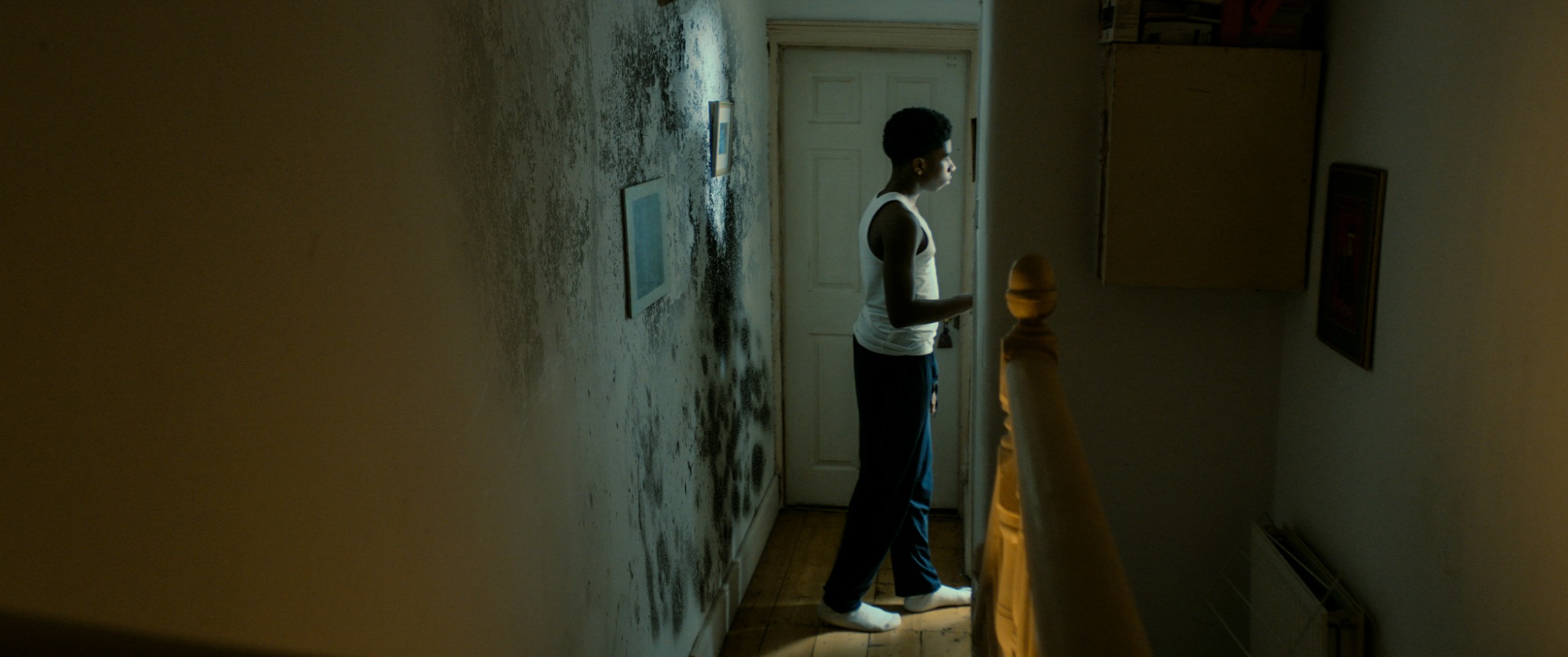
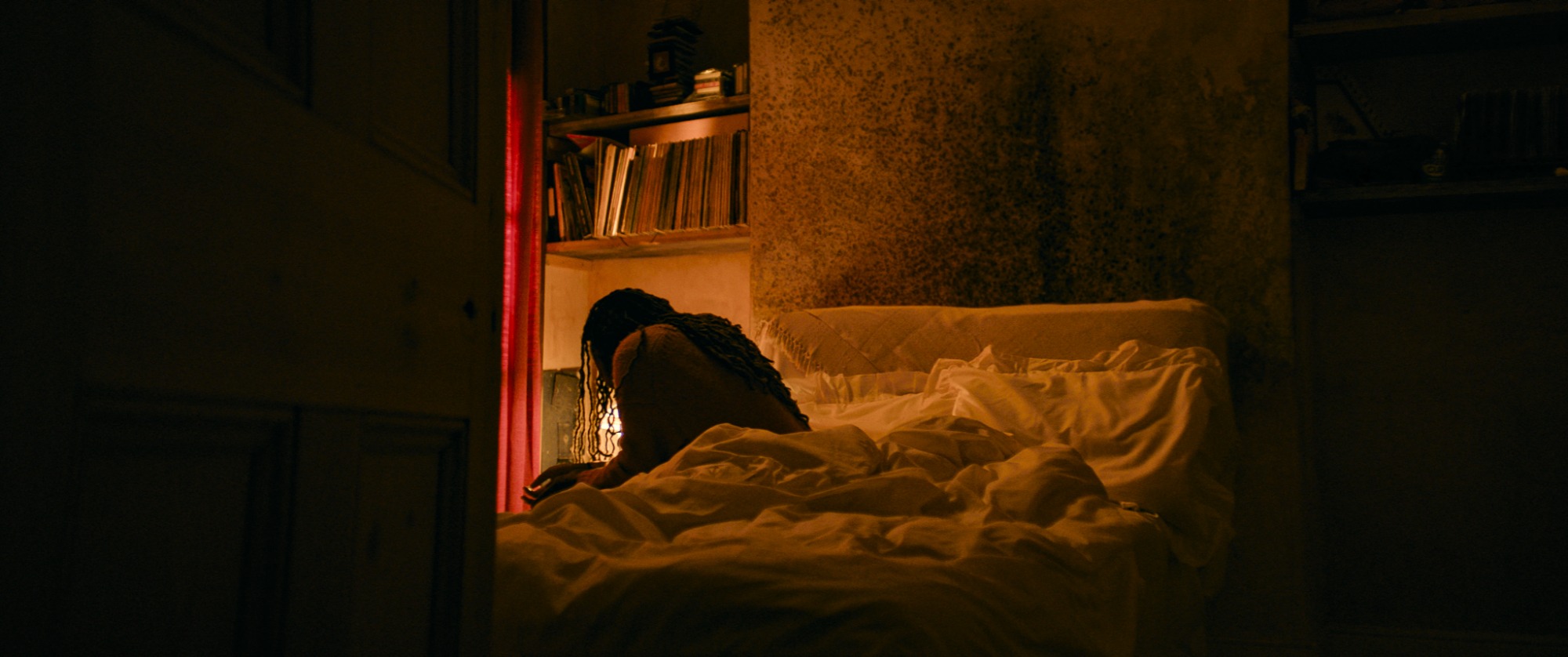


How did you translate the oppressive and looming city into the visual language of the film, particularly in the darker, more claustrophobic spaces like the family home?
The sense of place was really important for the film. We wanted to root it in South London, where the real life stables we based it on are, as well as where both me and Niellah grew up. The stables, Ebony Horse Club, were really pivotal to the whole film, having literally been foundational to the idea. It’s quite rare to find an urban stable like that on the Thames, with that backdrop. If we hadn’t been able to film there, it would’ve been a real challenge, because it was so central to the story. Probably a silly idea to write such a specific location into a script but we were lucky that Ebony Horse Club was so gracious and helpful, even giving the actors time to train and get comfortable around the horses so big shout out to them.
We approached the spaces very deliberately. The home is shot to feel static, cold, and oppressive — with the mould creeping into the house reinforcing that. While the external spaces, especially the stables, feel freer and more open and we really wanted to reflect that in the cinematography. We also enhanced things where we could within our means, with again, the fantastical use of the mould, as well as some sky replacements to create that sense of something ever looming.
How did your shared visual language with long-standing collaborator Jordan Stephens evolve for a film that needed to hold both brutal realism and quiet magic simultaneously?
I’ve worked with Jordan on everything I’ve directed so what you see on screen is really our shared DNA. I often joke that I don’t know if I’m a good director without him and I’m not super keen to find out. He’s usually one of the first people to read anything I write, and we start talking very early on about every little minutia of how the film should look and feel.
Even though this is a very intimate story, we didn’t want to box it in with something like 4:3, which feels a bit overused at the moment, and chose to shoot it anamorphic instead.
We dial in on the look, we reference films a lot — Terrence Malick’s sensory visual poetry was a big influence for the external sequences, though we didn’t have the luxury of some of his fabled 6 year shoots so we still had to be pretty economic with our shot list and where we were able to get those visual flourishes. And of course we spoke about other visual and tonal reference points. I remember talking about Remi Weekes’ incredible debut horror, His House, in the oppressive claustrophobia of the house for example, but we also drew on the mythical expanse of westerns and the symbology of horses in those stories.

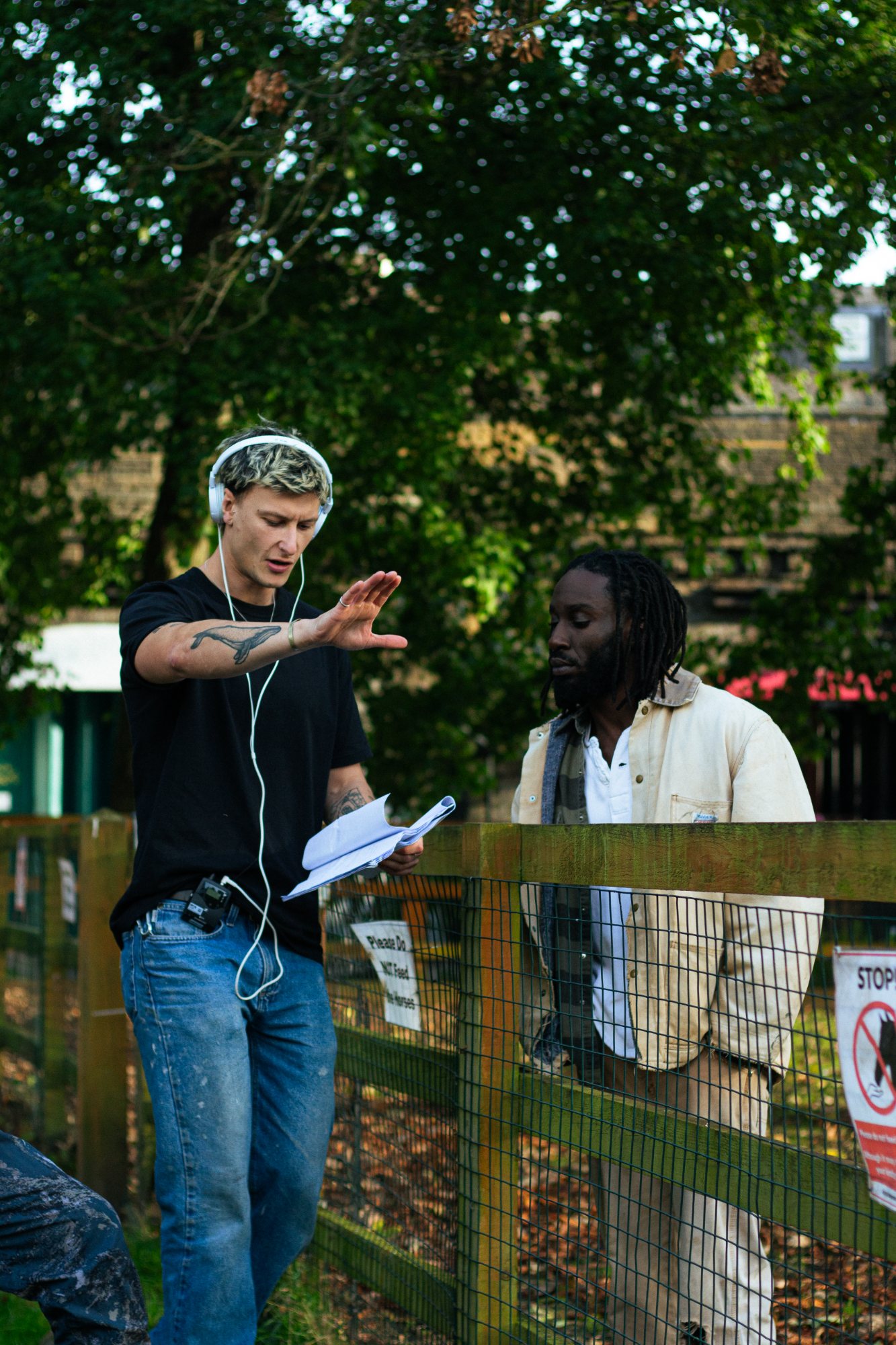


Every time we’re planning to shoot we’ll talk extensively about what aspect ratio suits the story and why, rather than what would just look cool. Even though this is a very intimate story, we didn’t want to box it in with something like 4:3, which feels a bit overused at the moment, and chose to shoot it anamorphic instead. Partly because of the association with the old westerns; the horses and landscapes, those sweeping, expansive images… but also because we wanted to reflect the emotional scale of the film. Not just physical landscapes, but emotional landscapes as well.
The final sequence, shot separately with just a skeleton crew, feels like it exists in a completely different register from the rest of the film. How did you arrive at that as the right ending, and how did you approach capturing something so openly fantastical?
I think everyone has that ending in them that’s just the ending of The 400 Blows. Whether it’s This Is England or Moonlight, consciously or not, we’re all ripping Truffaut off there! I guess this is a nod to that lineage. That open-ended question of an escape; a character looking out but also inside, a moment of reflection that also somehow finds an emotional landing place.
In the early draft of the script, it found the same note to end on but through a much more laboured sequence of social services turning up and Frankie running away and getting a train to this elysian plain. But Niellah was quick to steer us away from that as it becomes quite a different film then, and one we’ve maybe seen before. The version we ended up with also finds a neatness in the parallel with the scene of Frankie finding his mum crying, which I think is much more potent. There were also a whole bunch of horses running in the field originally that we quickly realised was well outside our budget! I also think it’s a bit thematically purer just having that one gorgeous black horse.

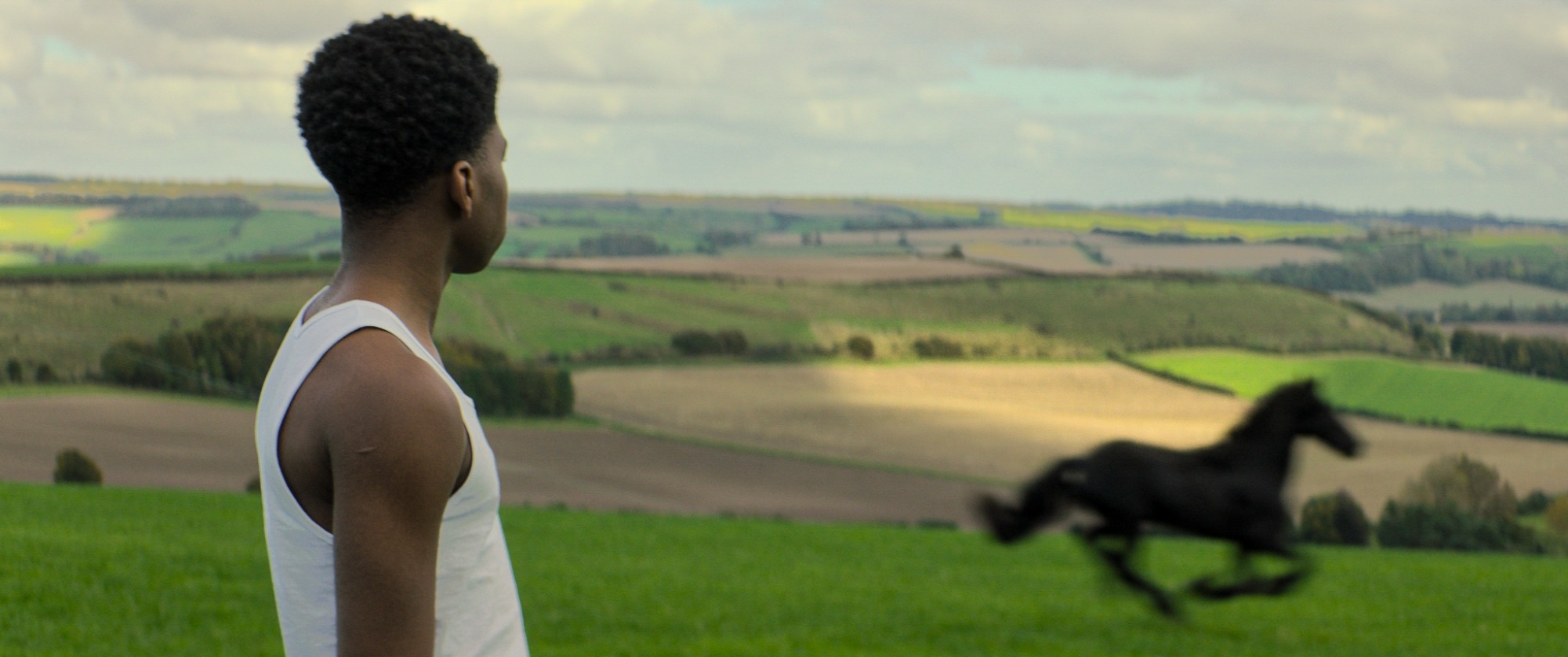
There’s a delicate question at the heart of that ending. How much is it escape, and how much is it acceptance? How consciously did you hold that ambiguity?
The ending was always very clear in my mind. It was probably the one point where I was a bit of a diva in the edit. Usually I’m very happy to defer to my editor, Olivia Bohac, she always knows where to trim and change and how to sequence things — but this was the one instance where it had to follow exactly the pre-ordained order and pacing I had in my head. There was only one way it could play out for me, beat for beat. We were so lucky to have Amari’s performance, which the whole film is hung around — especially in that final shot, which we were able to just hold on. It was done in a single take and it just worked. That guy is able to do so much with so little, it’s incredible!
We wanted to reflect the emotional scale of the film. Not just physical landscapes, but emotional landscapes as well.
I hope it means different things to different people; it’s a fine line to leave things open to interpretation but also satisfy on an emotional level. There’s the symbolism of the horse, historically tied to the idea of the soul, in this case the mother’s. Of course how literal or figurative it all is, is up to the viewer. For me, it represents a kind of release or peace. A realisation and acceptance for Frankie. It’s not fully happy or sad because there is great loss in the story but it’s maybe a glimpse of hope that, though his mum couldn’t find it in her life, there’s a peace somewhere where she can be free from the pain that weighed so heavily on her in life. And hopefully, after everything that comes before, it offers a moment of quiet resolution. A calm beyond the storm.
Please could you share with us your fave short(s) and why?
As a horror head I’ll stay on brand. Two short films that always really stuck with me are Part Forever, a Taiwanese horror short by Alan Ou Chung-An. It’s incredibly precise and fully realised. It’s scary, gnarly and beautifully crafted, just a complete piece. I’ve actually been dying to watch it again but haven’t been able to track it down so Alan, if you’re out there, hit me up.
The other is All Your Women Things by Madison Bloom, which I saw at Brooklyn Horror Film Festival a few years ago. It’s totally unhinged and really commits to its central conceit in a way that I found pretty staggering — it’s one for the freaks and I love that.
What do you find yourself drawn to next?
I’m really focusing on getting a feature off the ground called Child of Dying Wood, which is currently in development. It’s much more of a horror set in the highlands of Scotland but, like Far From the Plains, it has its roots in myths and folklore — ancient Celtic and Gaelic in this case — and, also like Far From the Plains, it’s about a parent and child relationship but it has a great big ancient forest god tearing people limb from limb, so that’s a hoot. It is also quite sad though…
At the same time, I’m writing another feature and directing a short called Magna Carta, which we’re aiming to shoot this summer. So, yeah, just trying to keep working, keep writing, keep making things. Lots of irons in the fire, but the feature is the main focus.