
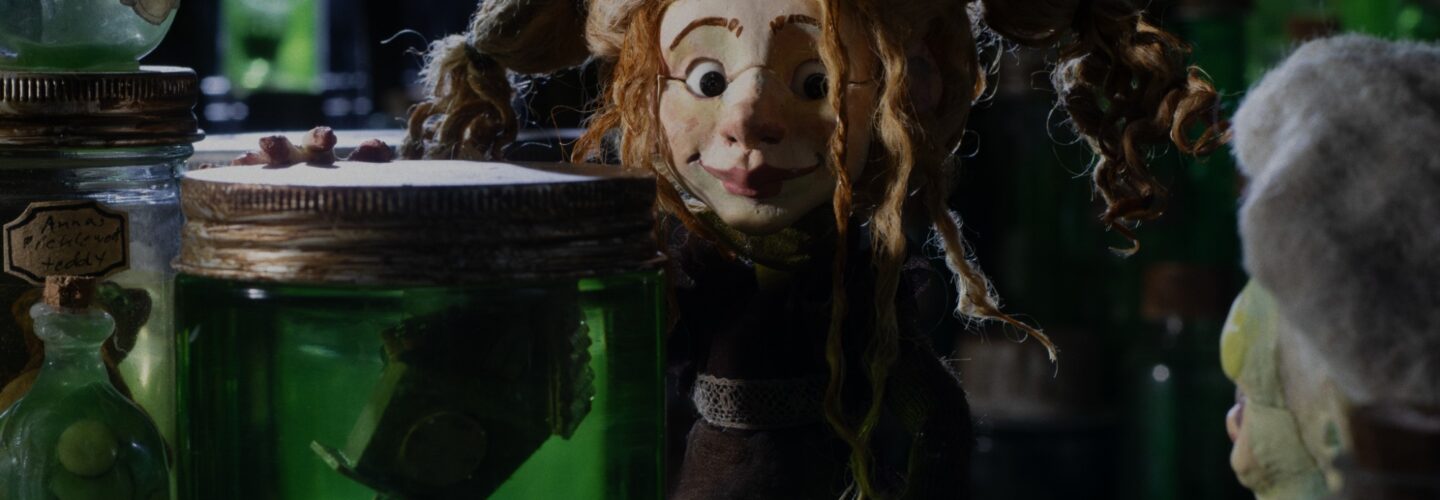
There is something quietly seditious about Fanny Capu’s Pickled, a film whose surface—a stop-motion fable of a grandmother and granddaughter in a crumbling mansion stuffed wall-to-wall with green-tinted preserves—reads as cosy until you notice what it is actually doing. Beneath the mossy palette and painstakingly hand-glued shelves of jars lies a delightfully radical proposition: that being forgotten might be the natural order of things, and that preserving everything leaves no room for those who come next. It is a film about hoarding as inheritance and the suffocating weight of legacy. It is also unmistakably a film about the generation making it and their future, piled high with the residue of those who refused to let go.
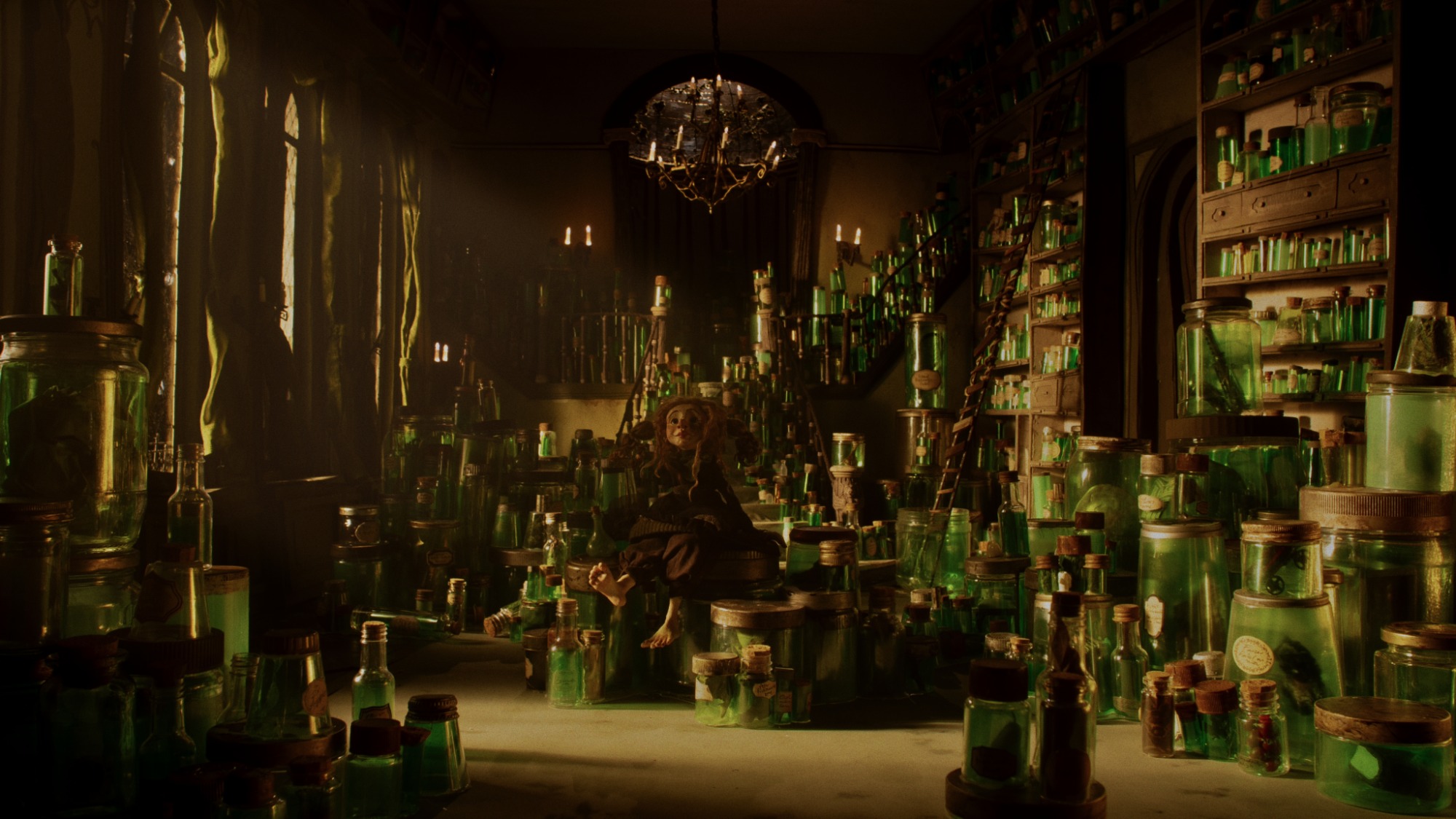
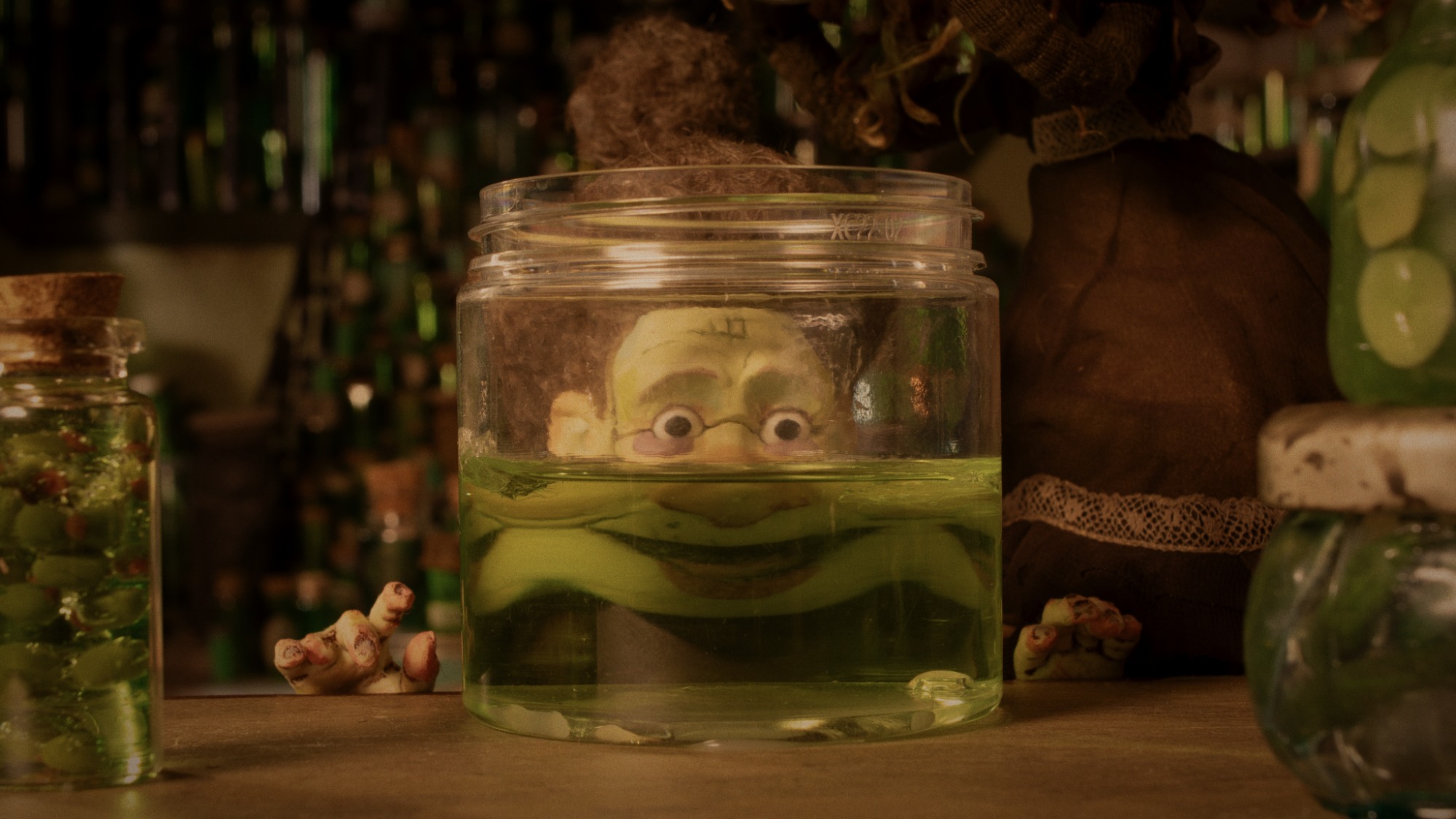
Capu, a National Film and Television School (NFTS) graduate who cut her professional teeth in the puppet department on Aardman’s Wallace & Gromit: Vengeance Most Fowl, brings to the short a technical fluency that lets her execute ambitious set-pieces and absorb the cheats they require. Of the roughly two thousand jars on screen, only the foreground hero glassware is actually filled; the receding shelves dissolve into a green blur of plastic cups, shot glasses, and rolled camera gels with cork hot-glued on top. The puppets carry the same intelligence: over thirty magnetic replacement faces, pigtails wired so Edie’s hair can mirror her mood the way a dog’s ears might, and bare toes individually rigged so the film’s joyous, choreographed dance sequences—the structural counterweight to all that pickled stillness—can register from the soles up. As Pickled premieres in La Cinef at the 79th Festival de Cannes, we sit down with Capu to discuss the editing-room genesis of its spine, the engineering of those jar-filled rooms, and dance as the antithesis of preservation.
Pickled started in your grandmother’s house with seeds of inspiration from dementia and hoarding, but lands somewhere refreshing. How did you arrive at that as the spine and then develop the story from there?
The film went through many iterations as my grandma’s condition changed. There were moments where we wanted to end it in a bleak way, with the main character accepting her fate and pickling herself alongside her ancestors. There were times when the story ended with her leaving the house and leaving everyone behind. In the end, we brought it back to a more realistic view of what you do when everyone in your family has hoarded, preserved and collected to the point where it is suffocating you. Do you have to follow in their footsteps?
It was really important to me that we never answer the question definitively. I think it’s important that everyone makes this choice for themselves, and so when our character puts them all in the attic, to me, that means that we all get to decide what is important to us, what is worth keeping and what is worth leaving behind. Making space for yourself and for those who come after is something I think we all care about.
In really broad terms, it’s what my generation grew up with: the knowledge that the generations before us have left us a planet filled with garbage, and we need to clean up now. It’s an issue that exists everywhere and has probably always existed: the rebellion of the generations after and the question of what legacy is worth preserving and what isn’t.
An important part of the process is to take in all the feedback but learn to recognise which of it is really helpful for the film you’re making.
What did the script even look like on the page when so much of the storytelling is texture, ritual and time-distortion rather than dialogue?
There were a lot of conversations and many different script versions, but in the end, the story and structure of the film were really born in the editing room with the animatics. My editor, Maria Munhoz, was cutting shots, and I was drawing them in real time, and the story formed from there.
At the NFTs, you have a lot of story tutorials with many different tutors who all have their own thoughts and suggestions. They’re all helpful individually, but when you try to make it right for everyone, there comes a moment where the film is clearly Frankensteined together from other people’s ideas, with none of them working together. So then we stripped it back to try and figure out what it was we had wanted to say in the first place. An important part of the process is to take in all the feedback but learn to recognise which of it is really helpful for the film you’re making.
I’d love to know more details about your working method with your editor, Maria.
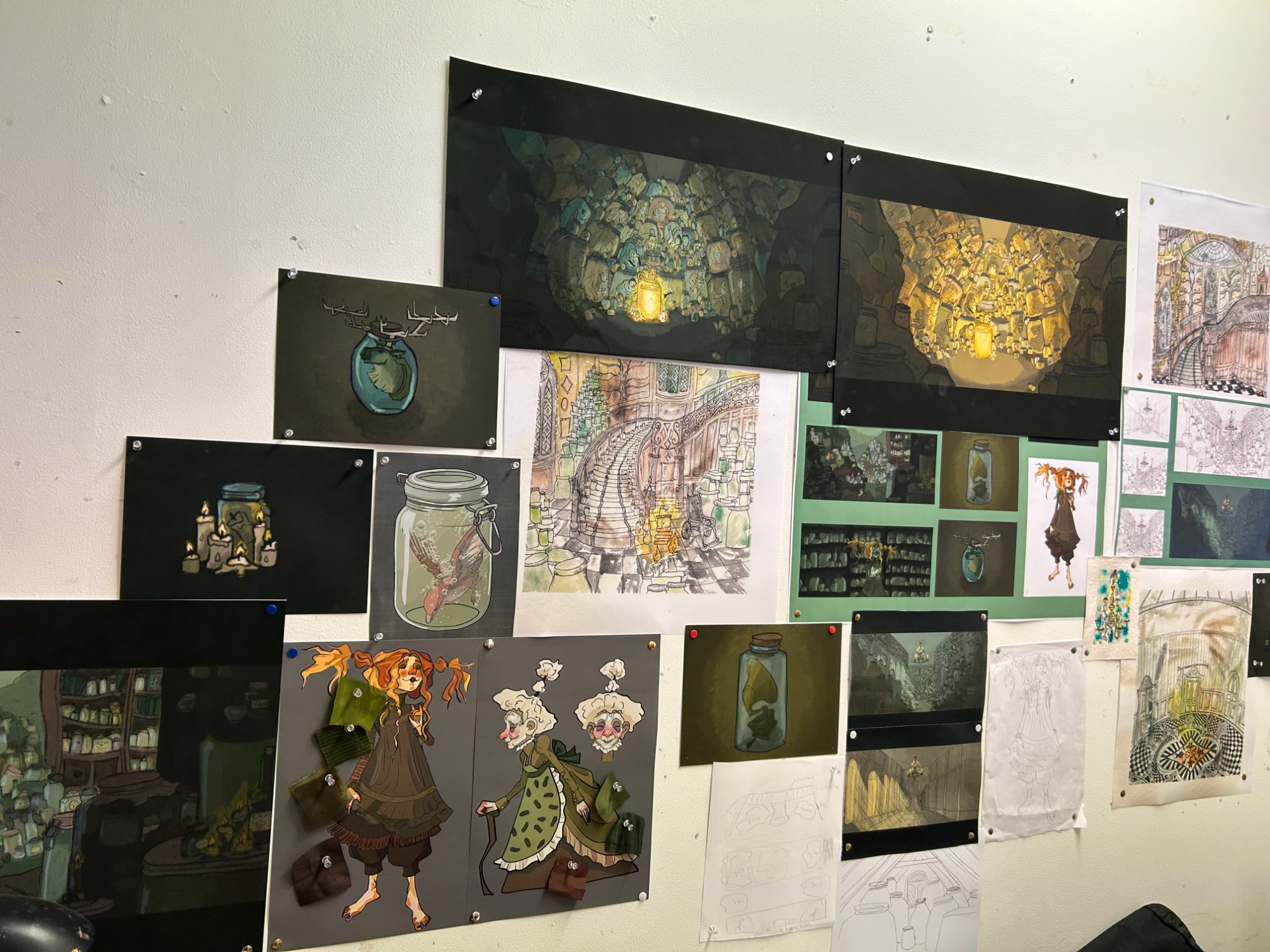
The way we worked in the editing room was a great help to feel secure in the story and our plans for what to shoot. I would draw storyboards, and we began by throwing them all on a timeline. It was 15 minutes, and when an animatic is that long, a film will be much longer because of how impossible it is to know the timings of the animation when you’re just staring at pictures.
So it was too long and overly complicated in every way, so then began the process of figuring out the least amount of beats necessary to understand the story. Anything that wasn’t strictly needed was cut, and then we built it back up. We decided quite early to drop the dementia angle, it was just one more thing that made everything too convoluted. The ending was quite hard to figure out, even though I now can’t imagine it ending any other way!
Most Popular
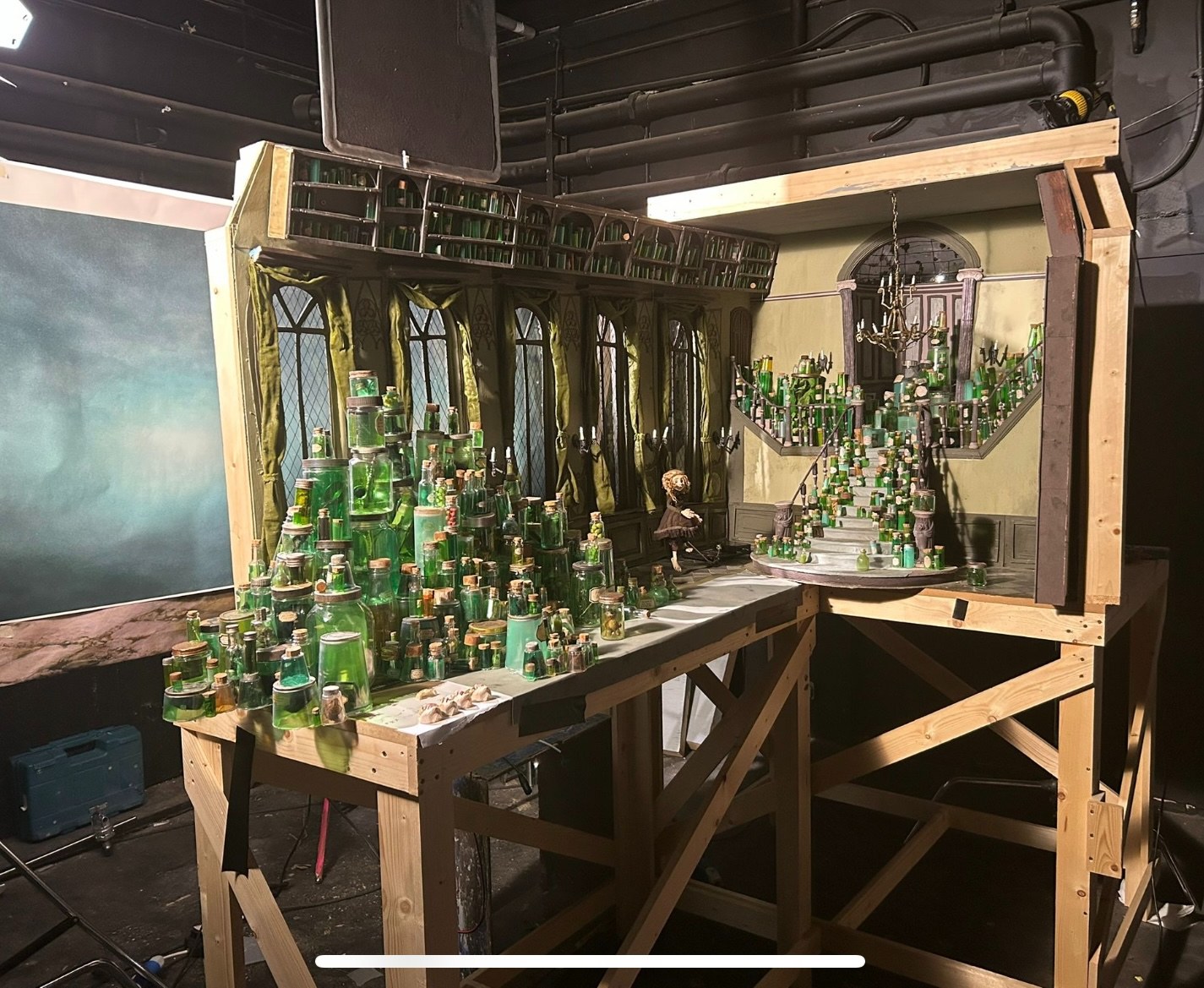
Let’s get into the jars. Hero foreground jars were real glass filled with tiny objects; the gradient backwards went through plastic cups, shot glasses, and rolled camera gels with cork hot-glued on top. What was inside the foreground jars? How far back could you push the cheat before a shot broke?
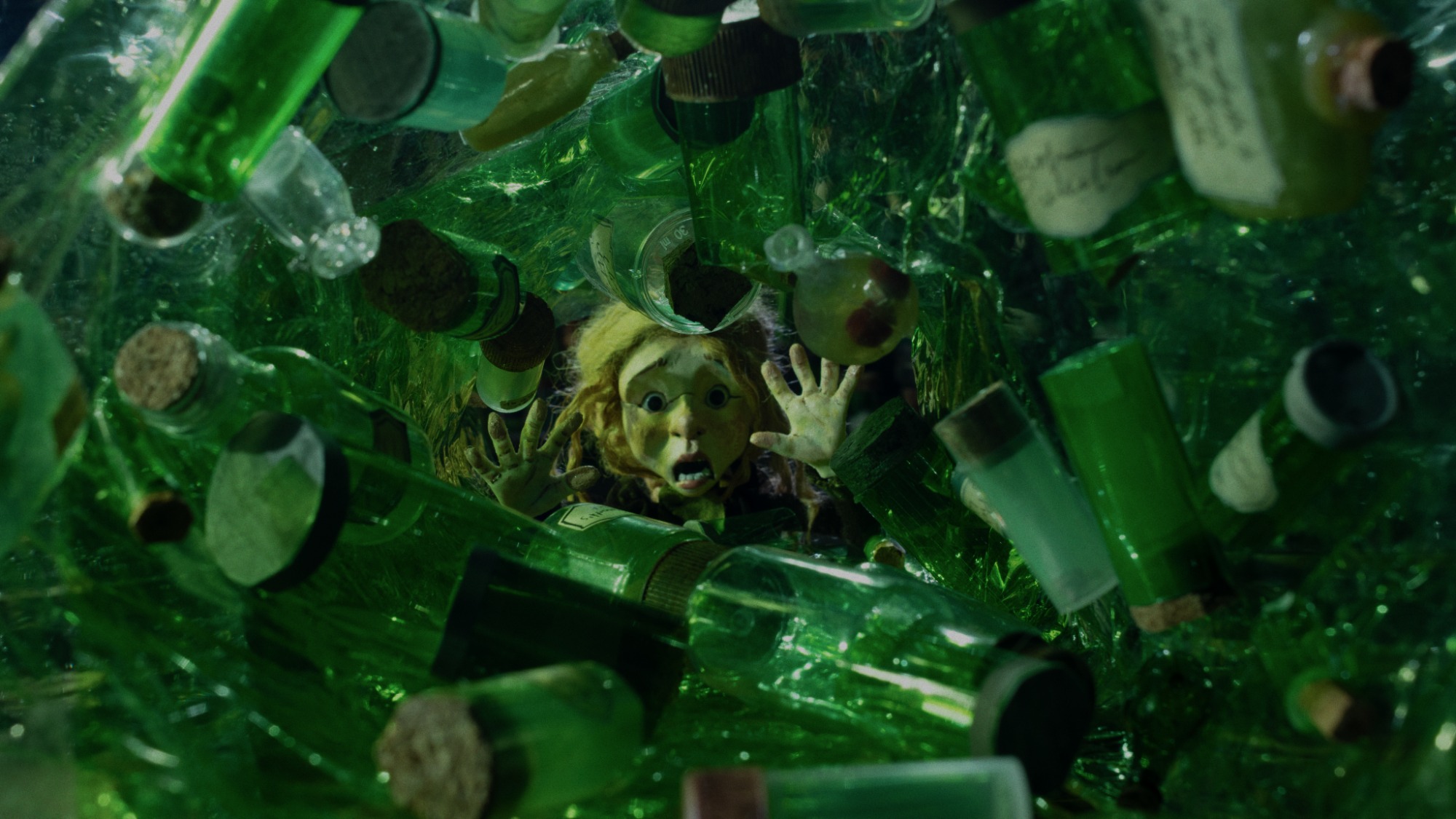
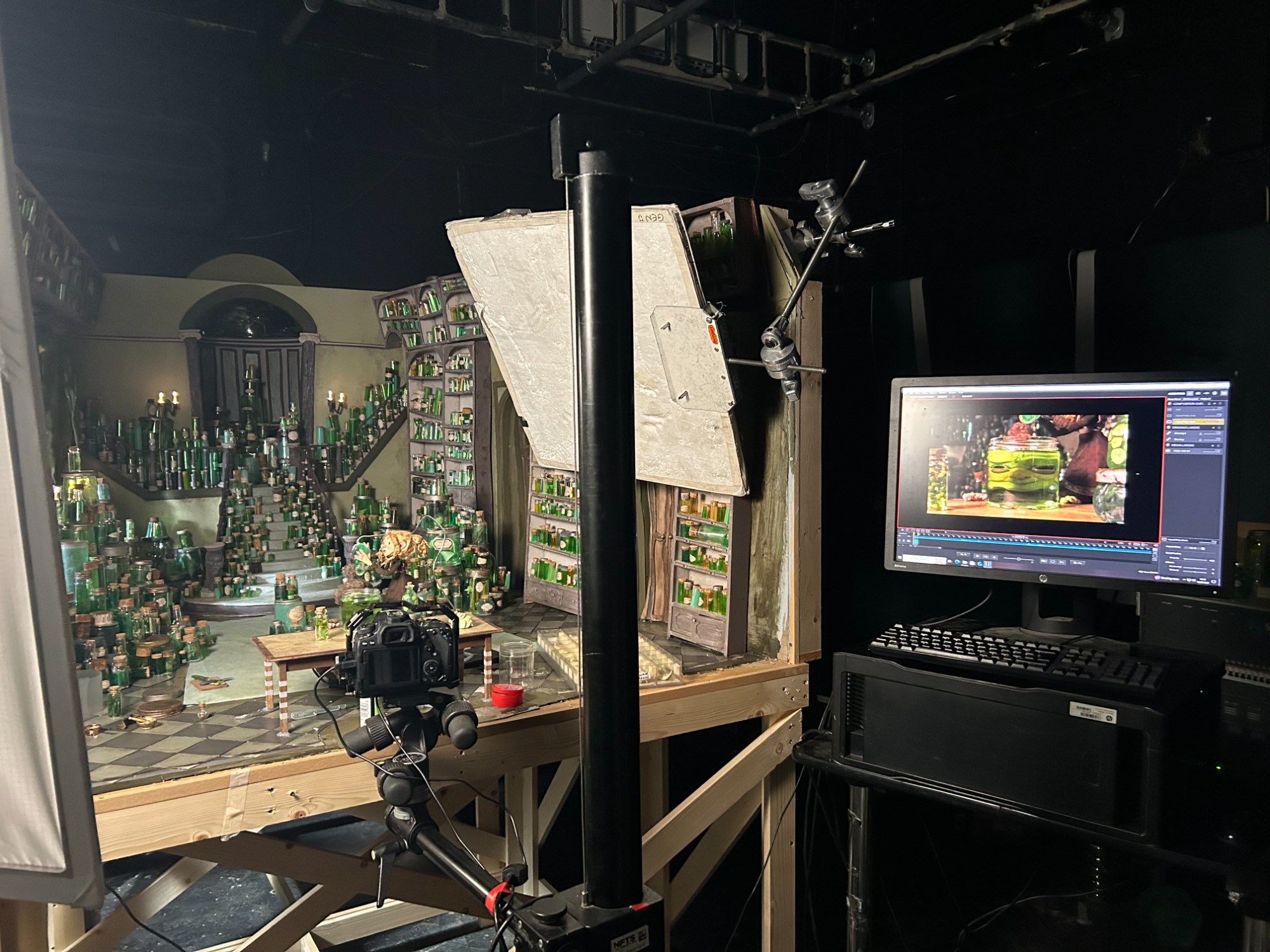
It turns out that when you have a lot of something on screen, in our case, thousands of jars, it all turns into one green blur, and it doesn’t matter how good or convincing the individual jars look. In the end, I only made sure that whatever was the focus of any given scene was a real jar with a real object, but the shelves were mostly filled with fakes and the piles of jars that were hot-glued into little islands that could easily be moved around the sets.
I always just made sure to mix some real jars in, but most of what’s on screen is not a real jar. Due to jars being round and with the green foil inside to act as our water, it was even hard to make out what was inside the jars. So, most of the jars are actually empty. If I wanted to get really fancy, I filled them with some brown-stained tissue paper, and then only about 50 of the 2000 jars actually had objects in them. Those ranged from dollhouse furniture and accessories to handmade objects.

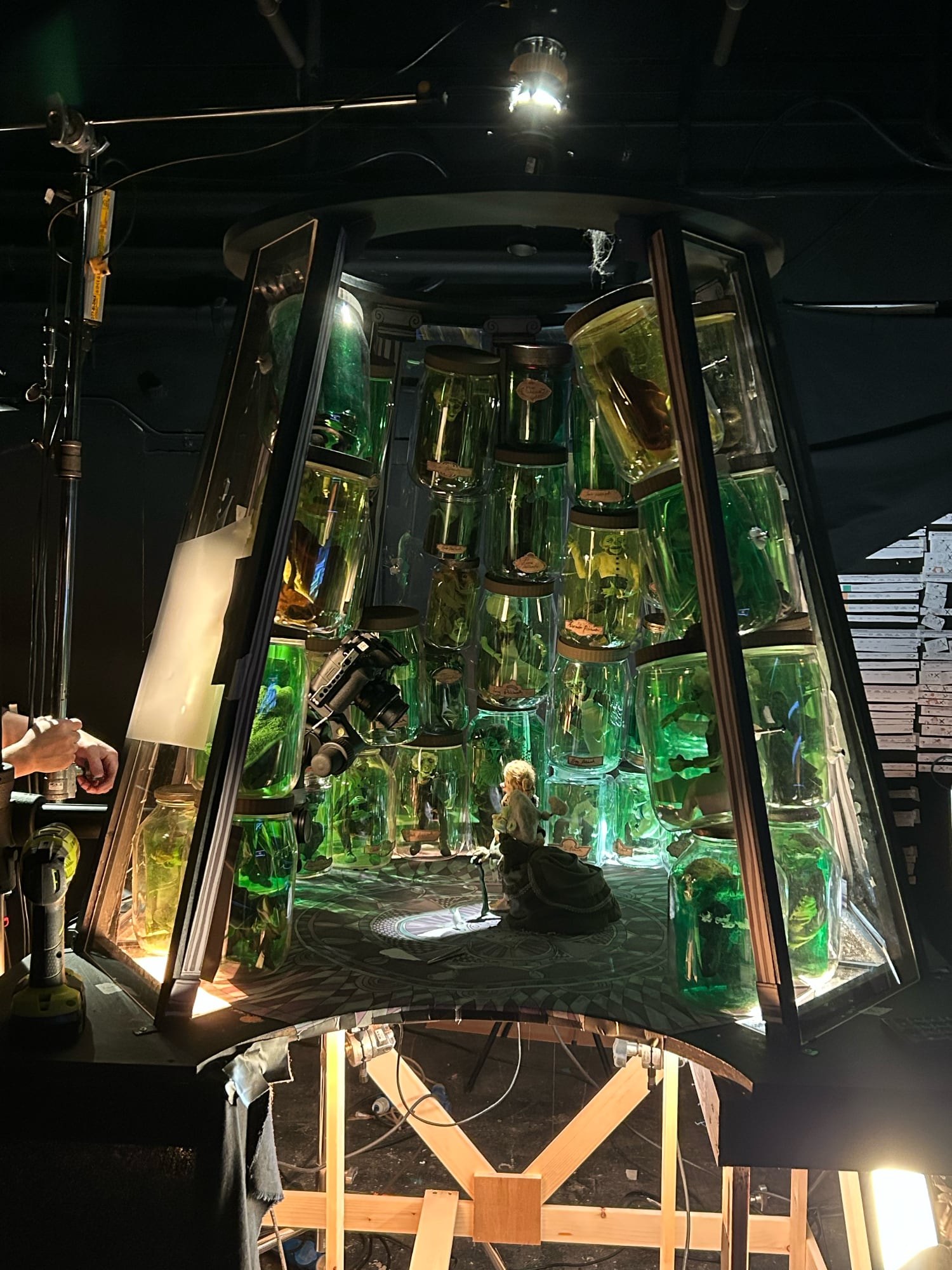
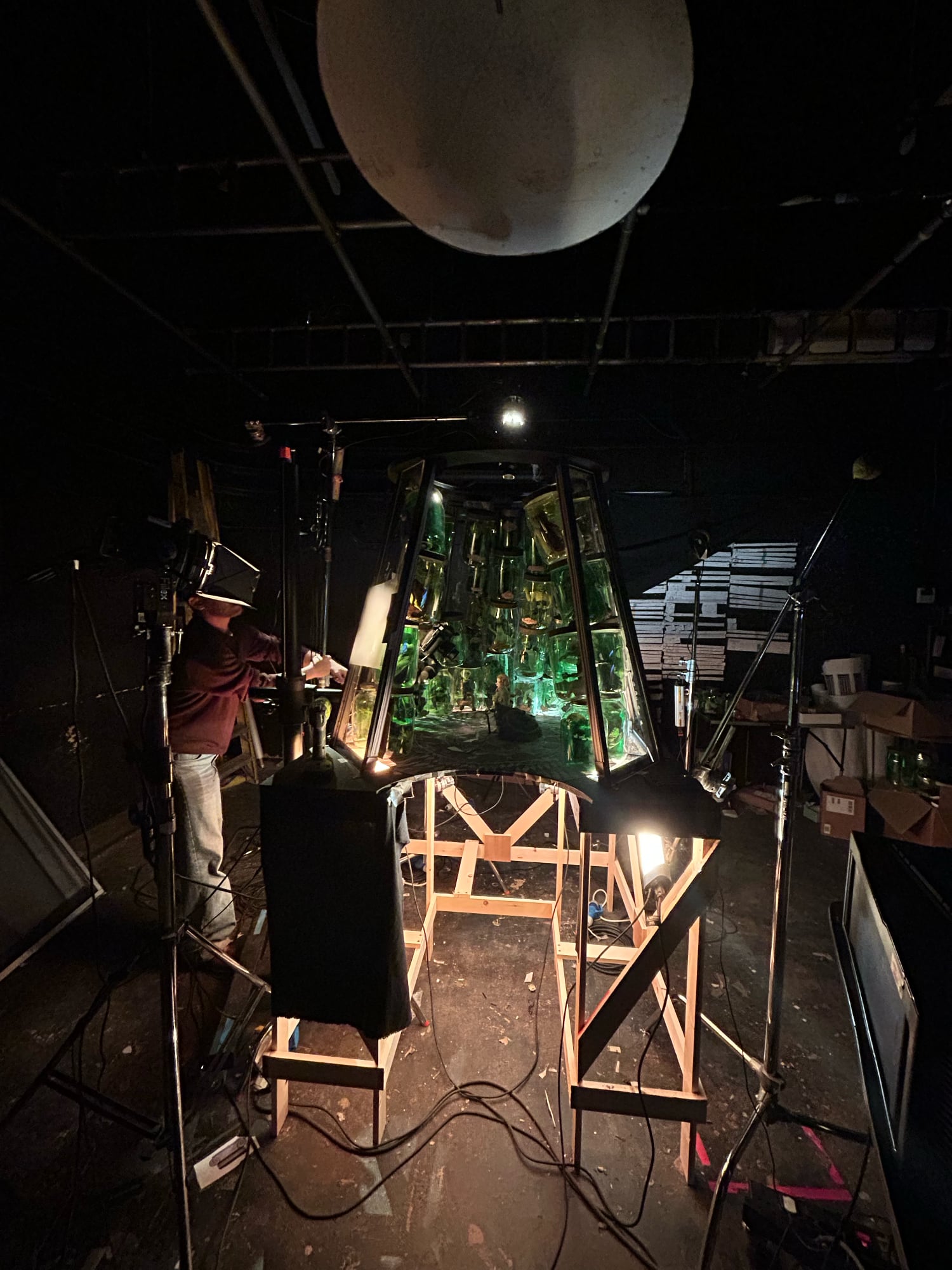
It was also supposed to feel like you were inside a jar when you were in it. We spent a long time trying to figure out what the architecture would look like. How can such a room exist?
The mansion is cavernous, then compressive, dust-thick in the corners. Practically, how was the set built and broken down for different camera positions, and how did you handle dust, ageing and continuity across a 100-day shoot?
There were three sets. The main room, the corpse room and the attic. I’ll start with the easiest: the attic was built as a one-angle set because we knew we’d only ever see it once from one angle. The main room could be split into three parts, with all the walls removable so you could get in from any side you wanted. Sometimes, we even had to suspend a wall mid-air because we needed it for lighting continuity, but the table had to go for the ease of the animator.
Making sure both the camera and animator could reach comfortably was a constant concern. You might not notice it at first, but if you spend 8 hours a day reaching across a table in an ever-so-slightly wrong position, you risk serious strain injury or even blowing out your back. Our cinematographer, Hayley Grant, is a mastermind at this. There were times when we had 7 different lamps pointed in different directions, cables everywhere, but the animator fit into the set as comfortably as the puppets did.
The last set, the corpse room, was the most complicated because we wanted it to feel like an otherworldly place, somewhere between a real room and more of an idea. To Grandma, the room is heaven to our girl Edie; it is hell. We also wanted the whole room to look like it was almost constructed out of the jars themselves, and we wanted the jars to lean forward, leaning and looming over the characters. It was also supposed to feel like you were inside a jar when you were in it. We spent a long time trying to figure out what the architecture would look like. How can such a room exist? We landed on it needing to be entirely see-through so we could light from all angles, bottom, sides, and top. But it also needed to all be completely removable to make sure we could reach in from all sides and shoot all angles, including shooting through the floor for the room reveal shot. In the end, we went with an octagon made from plexiglass that was all individually removable. It leans inward towards the top, and the jars were all drilled into the walls. I am very proud of that set. It was a headache, and we were really worried after all that it wouldn’t even look good, but as soon as we pointed the first lamp, it was clear it was gonna look fantastic.
As to the ageing and the dust, there isn’t actually any physical dust in the set; the illusion of the room being dusty is created by the use of light rays and dust particles that were added digitally in a few strategic scenes by Michael Crookes, our fantastic VFX artist. The gathering and ageing of the house was easy enough. There are two different paint jobs for the majority of the time; the set was painted in browns and greens, aged and weathered, with green curtains and shelves. And then when we shot the end of the film, the last thing we shot, we repainted the whole set in a warmer colour palette to make it look nice and clean and fresh and gave it pink curtains.

Your puppets mix resin, silicone and fabric over metal armatures, with 30-plus hand-sculpted magnetic replacement faces and your dog’s curly fur for Eddie’s hair. Talk us through the build, the armature spec, how the magnet system works face-to-face, and the specific decision to join the hair and wire the toes for the dance sequences.
The most important part of puppet making is that your puppets feel like real characters, like they could be alive. You don’t want them to feel like puppets or marionettes, you don’t want the viewer to see the strings, hear them speak or at least if they do, it’s important that it is not distracting.
I decided to make her barefoot which is an absolute nightmare in stop motion because once you see the toes, they really have to move like toes.
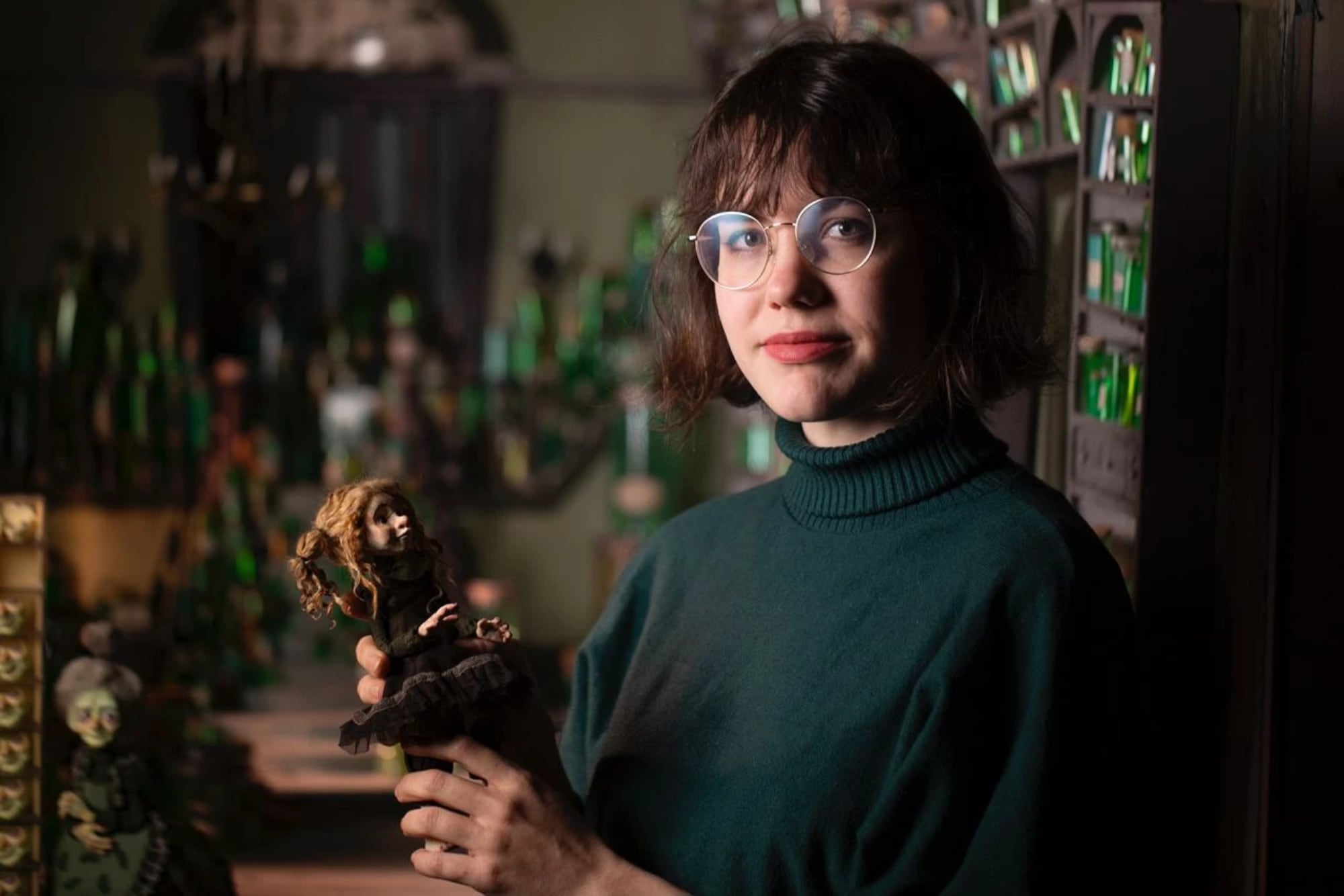
I wanted the lower half of the face and the eyebrows to be separately movable, but with the line where the two halves meet being as least distracting as possible. Another part of making a puppet feel real is the movement, making sure they can move as freely as possible. I put wire into Edie’s clothing to make sure her dress could swing with her movement and dance. I wanted Edie to feel a little feral, a strange girl that grew up in this house who has never been anywhere else so I decided to make her barefoot which is an absolute nightmare in stop motion because once you see the toes, they really have to move like toes or she might as well be wearing shoes again so I went to great lengths to wire each toe so that in the dancing sequence we can tell everything in her wants to move from the toes to her hair.
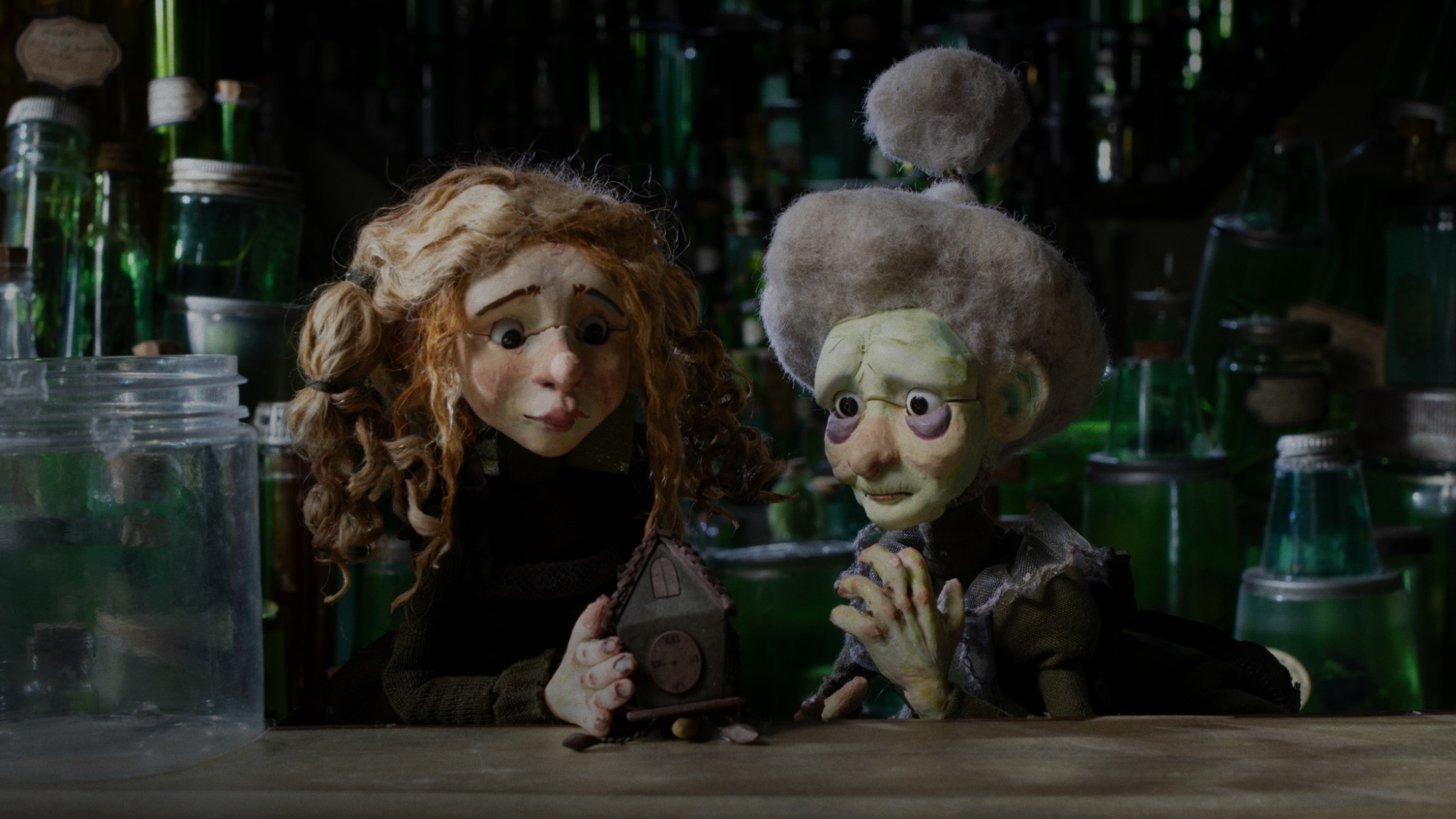
Grandma owns this world and feels comfortable in it, even her face was painted green. Edie’s hair is red, the direct opposite of green, and throughout the film, it slowly loses its colour, as if she herself is this little dying piece of sunlight in a house threatening to swallow her up. Edie had to feel like she’d rather be someplace else; everything about her is asking for more space, even her hair in two pigtails is demanding space.

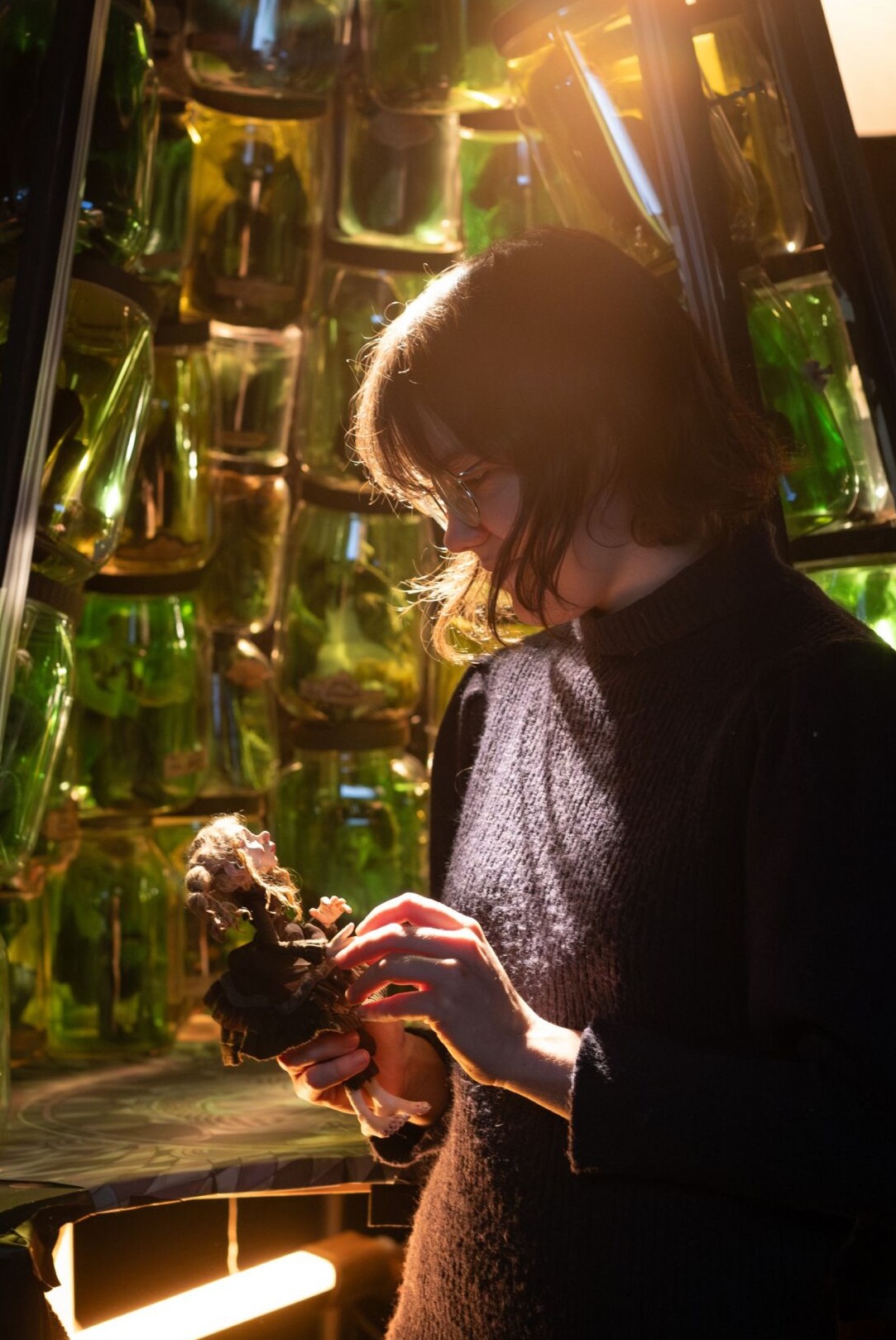
I wanted it to literally express her emotion like a dog would with its ears, so I built in tiny metal joints into Edie’s hair to make it movable.
I am a bit obsessed with hair and with how much you can say about a character through their hair, and I had this idea that hair can be used to express emotion. I wanted it to literally express her emotion like a dog would with its ears, so I built in tiny metal joints into Edie’s hair to make it movable, its up and perky when she’s happy, and it drops just as quickly as her face drops when she’s sad, shocked or defeated. In her dance, it demands space spreading away from her head, but when she’s around the pickle jars and the expectations on her, it hangs low, close to her head, making her smaller and literally take less space.
Grandma’s movement was an interesting challenge due to the length of her shirts. I could get away with not giving her legs; instead, she is mounted on a platform that can be screwed up and down, giving her the ability to not only look like she is walking but also making her visibly shrink throughout the film. The older she gets, the smaller and more vulnerable she looks.
Dance is the film’s release valve. How did you develop Eddie’s movement vocabulary? How was the choreography captured as reference for animation, and what does dance do structurally in a film that’s otherwise about stillness and preservation?
Edie’s dancing was something we developed really early on. I had just made a film about the exploitation of ballet dancers in the 1800s [Break pointe ], so dancing was on my mind anyway. I had so many great shot ideas still leftover from that film, and it was perfect for this film because of the themes of the film.
I think what fascinates me so much about pickling objects is that as soon as you preserve something that way, it kind of stops being the thing it used to be; it loses all function. Car keys in a pickle jar no longer open a car, glasses no longer give you better vision, and a teddy bear is no longer cuddly. So there is something strange about the process of preserving for the sake of preserving, forcing everything into stillness. The opposite of that is dance; the opposite of hoarding is dance because it requires space to move in. It’s also something that can’t be preserved or held onto, it’s something you do in the moment, and then it’s gone, making space for other movement and things to do. It doesn’t linger. I love the juxtaposition of that.
I myself did a lot of dancing as a kid and teenager, but I was never very good at it. I just enjoyed moving, it feels freeing its all nice to do something not for approval but just because you enjoy moving, that’s what I wanted to capture in Edie’s dance, her joy for moving for the sake of moving. We found a dancer and movement coach, Rebecca Wield, who was fantastic in not only choreographing the dance but also dancing for us so we could film reference material from the angles we had decided on during the animatic process. Every animator who worked from these references was also encouraged to move the puppet to keep the spontaneity of the dance alive. I wanted it to feel childish, free and happy and not like she was following a strict routine or any sort of dance rules.
You shot live-action reference of yourself for every shot. How did that reference travel onto the dial? Were you frame-counting against it, using it as gestural shorthand, something else? And how did the handover work when a volunteer animator was on the shot rather than you?
We used our reference footage by loading it into the program Dragon Frame. It plays alongside the animation one frame at a time. You can toggle between your last frame and your current image, helping you see how much you have moved the puppet. The reference then also toggles, showing you how much you still need to move it. You then watch both of them back and compare the two. References help enormously. When I animate, I forget how to human. Suddenly, it is really difficult to picture how someone would pick up a jar. Do you look at it first? Does your hand reach out first? If so, which hand? Do you turn your whole head, your body, or just your arm? Does your shoulder bend when something is heavy? Also, how often do we blink? When you film yourself, you don’t think about these things, you just do them, and then you can stare at it later and figure out how exactly humans human.
And of course, they are enormously helpful when you work with other animators. In live action, you can just let the actor do their thing, and then you can give them notes to do it again, try different versions and so on. In animation, we do not have the time for that, and the instructions need to be a lot more precise so you get exactly what you want for your shots. I like to use references for everything, but I treat it somewhat loosely. Sometimes, you have a great idea mid-shot, and then it would be a shame not to go for it.
When I animate, I forget how to human. Suddenly, it is really difficult to picture how someone would pick up a jar. Do you look at it first? Does your hand reach out first? If so, which hand? Do you turn your whole head, your body, or just your arm?
For example, there is a scene where Grandma hands over her apron to her granddaughter. This apron means the world to her; it’s everything she has and cares about, it’s her family legacy and purpose, so when she handed it over halfway through the action, it looked like Grandma was about to hug it. Grandma never hugs Edie. They have a loving relationship, but it’s always from a distance. She tugs her nose, she pats her head, but she never understands her. So in the middle of animating the hand over, I shifted gears and made Grandma hug the apron tightly before she gave it up. I don’t know if this means she loves what the apron represents to her more than she loves Edie, but she certainly understands it more and is closer to it. A moment that wouldn’t exist if I had held too close to the reference, so both are important: having something to follow but being flexible enough to diverge.
Pickled sits in a particular NFTS stop-motion lineage— Nina Gantz’s Edmond, Anushka Naanayakkara’s A Love Story, more recently José Prats’ Adiós and Lina Kalcheva’s Other Half. From inside the school, how did that lineage shape what you thought was possible, and where do you want to take stop-motion next?
I love the films that were made at the NFTS – it is incredible to see what previous students have been able to achieve. I came to the school because of those films. And once you see the finished product, you no longer see the issues, the late nights, the dramas; none of it matters. The only issue is you don’t always realise what is reasonable in the time frame, you don’t know what their schedule was or if they finished on time. So it can be a bit of a trap to orient yourself too much on what others have done because you can’t see the exact circumstances in the end product.
In my first year, my tutor Robert Bradbrook told me I was one of the fastest animators he had met, and that was maybe a mistake because, although probably true, it meant I was now convinced that it did not matter how complicated or big in scale my ideas were, they’d be doable. So he had to rein me back in a bit just to make sure it all made sense, was feasible and in the service of the story. My previous work experience also helped enormously when something broke; I could also spend a Sunday night fixing it, something I’d never expect from other team members.
All in all, my advice is still go big or go home. Anything is possible, and what isn’t, you can cheat. Maybe you can’t make 2000 glass jars with objects in them, but you can make 50, and the rest can be sold for its fine, the illusion of things is equally important to the actual thing.
Pickled premieres in La Cinef alongside Left Behind, Still Standing, both produced by Dóra Gálosi. What does that landing place mean for you, and what’s currently on your desk?
Being able to premiere this film in Cannes is an absolute dream come true; you couldn’t wish for a better place to first show the film to an audience. It’s too early to say what it means for me, but obviously, I hope it means opening doors and connecting me to more opportunities to keep making films. For now, it just means so much to get to attend with all of my team and celebrate the film together, including Dóra, who very deservedly gets to celebrate having now had three films at Cannes.
And finally, what are the short films that have stayed with you? The ones you’d put in front of someone who’s never quite understood what the form can do.
Oh, there are so many short films that have inspired me over the years. From the NFTS, I would probably say Edmond Nina Gantz and Facing It from Sam Gainsborough are classics for a reason. Bunnyhood from Mansi Maheshwari is an incredibly wild ride and demonstrates how simple, effective animation can be in its technique. And then outside the school, Negative Space from Ru Kuwahata and Max Porter is probably one of my all-time favourites, it’s so short and concise and has fantastic scene transitions. And honestly, anything by Joanna Quinn.