
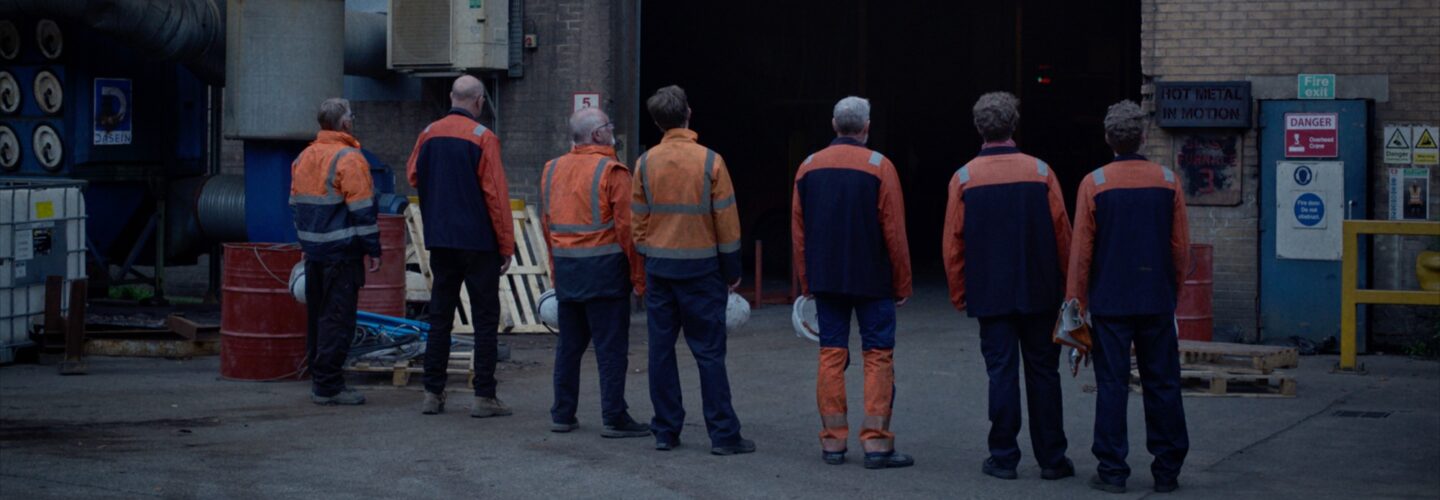

Vida Skerk’s Left Behind, Still Standing finds a devastating charge in the gap between two seemingly disparate worlds, and the slow, supernatural collapse of that gap. A small British steelworks is being dismantled. Morana, the Croatian immigrant overseeing its closure is fighting to hold her place in the country, her right to stay contingent on the very job ending the workers’ livelihoods. She and they would seem to have little in common: she is the institution’s hand, they are its casualties; she is the outsider, they are the locals. Skerk’s act of subversion is to let the factory itself reveal the lie of that distance. All of a sudden, the half-dismantled mill flickers back to life, the workers return to their stations, a song carries through the rafters, and Morana finds herself welcomed in. The ghost story is not a flourish; it is the means by which the film says what social realism alone could not, that the architecture of work outlasts the work itself, and that solidarity crosses borders and does not check papers at the door. Skerk sets the supernatural contract early, letting us feel the cost of vanishing from the inside before her outsider arrives, and from there the dead mill and the living one sit against each other like a pulse, until the question stops being whether the phantoms are real and becomes whether Morana belongs among them.
Skerk asks who, in the 21st century, still gets called a worker, and who profits from drawing the line ever tighter. Her second La Cinef selection at Cannes after Ether, which featured on DN last year, makes Skerk the first NFTS director chosen twice for the prestigious strand. Digging into the creation of her graduate short today on DN, Skerk discusses the industrial sublime, setting that contract early, and why fragmenting the working class only serves those at the top.
You’ve spoken about inheriting the legacy of Yugoslavia and witnessing the decline of that world in a post-industrial, late-capitalist economy and connecting that to the UK.
If we go back to, let’s say, 40 years ago, the UK and Yugoslavia had such different realities. While the UK was going through Thatcherism and workers were fighting to protect even their most basic rights, workers in Yugoslavia generally had far stronger protections and economic security. But over time, after the fall of Yugoslavia and Croatia’s transition to capitalism, those realities began to converge. Today, workers in Croatia and the UK face similar issues.
Both countries have strong traditions of workers’ movements and working-class solidarity. Although these movements emerged, developed, and solidified in very different historical contexts, in both cases, they originated in factories. Factories are the birthplace of these movements, and both countries are now losing them. There is something deeply symbolic in that loss, because we still haven’t fully developed new forms of workers’ solidarity outside of places like factories, which once brought people together politically and socially. In today’s economy, where we’re all on short-term contracts, freelancers, having to work increasingly long hours, we are still searching for new ways to unionize – though many communities are already beginning to find them.
I was struck by the parallels when watching footage from Port Talbot because, apart from the language, it felt very similar to scenes I had witnessed in Croatia and in Trieste, the Italian town where I grew up, which also lost its ironworks. I was also interested in how communities form around factories, not just in them. I loved discovering working men’s clubs in the UK. While we do not have an exact equivalent in Croatia, there is always a kafana or a local bar near factories where workers and the wider community gather.
I also wanted to experiment with comedy, which was new for me. I found that much more vulnerable than drama, because failing at comedy feels especially embarrassing.
The story of Left Behind, Still Standing had been developing in the back of my mind for so long that, by the time I sat down to write it, the world felt too rich to fit easily into a short film. I don’t like treating shorts as proofs of concept for features; a short should exist as a complete piece in itself. That said, even though I approached this project as a short from the start, the world the characters inhabit was so rich that I struggled to keep it brief. The first few drafts of the script were about 45 pages long. The longer I worked on it, the harder it became to kill my darlings. That’s when Tommy Hurst came on board. I needed someone who I could trust would kill the right darlings and keep the useful ones alive. He is very good at thinking about story structure and pacing.
What did the script look like at the point you knew it needed another pair of hands, and what was co-writer Tommy Hurst able to see in it that you couldn’t from where you were standing?
The first draft he wrote was only 13 pages, and although it was painful for me at first, it finally unblocked something in my brain which was stopping me from moving forward. From that point on, I was finally able to see the shape of the short forming as we discussed it and developed it together. Things changed a lot from that first draft he wrote, but I still feel like that was a crucial moment in the development process, and the collaboration with Tommy was crucial until the finished script. I think we worked well together because, although our writing voices are somewhat different, they complement each other nicely, as do our temperaments.
Secondly, with this film, I also wanted to experiment with comedy, which was new for me. I found that much more vulnerable than drama, because failing at comedy feels especially embarrassing. Tommy, meanwhile, has always been much braver in that regard, with a writing style that often leans into absurd comedy. I relied on his expertise to test out if my suggestions were working, and we built on top of that together. He was honest when something didn’t land, but also gave me the confidence to embrace my own sense of humour, and shaping those moments together became a lot of fun.

An inclination toward surrealism and an interest in ghost stories is very evident, but Left Behind, Still Standing doesn’t really behave like a horror; the ghostliness is quieter, more elegiac, almost matter-of-fact. How did you go about capturing the essence of a ghost story—that thing that echoes underneath every scene—without reaching for the genre’s usual machinery?
I enjoy creating atmospheres that feel uneasy and a bit nightmarish – but with this story, in the end, I always knew the ghosts should not be scary. They shouldn’t feel like a supernatural threat, but like a warm reminder, a visit from a loved one who’s passed away. I enjoy creating cinematic worlds in which the characters accept the surreal with more ease and less fearful screaming than maybe we’re used to. Kind of like in dreams, when something weird happens, but you somehow know that it’s okay, and it’s just how that dream world works.
Most Popular
When the worker first drops his pint, and we see his hand turning invisible, you tell the audience almost immediately what kind of story this was going to be—no slow burn, no ambiguity. Talk us through that moment: the trick itself, and the decision to set the contract with the audience so early.
I don’t know how to explain, really, rationally, why it’s so early. It just felt emotionally right. This is a film about workers disappearing, being ‘left behind’. So I wanted to show that at the start. It felt right to follow a worker, Peter, first, for a moment at the beginning, before moving on to the true main character, Morana, who doesn’t belong in this world. It felt right to follow him first so we could understand the world from the inside and how painful it is for the workers to disappear, before observing it from an outsider’s perspective. I am also a bit of a film nerd, so I appreciated that this story structure gave a little nod to Psycho.
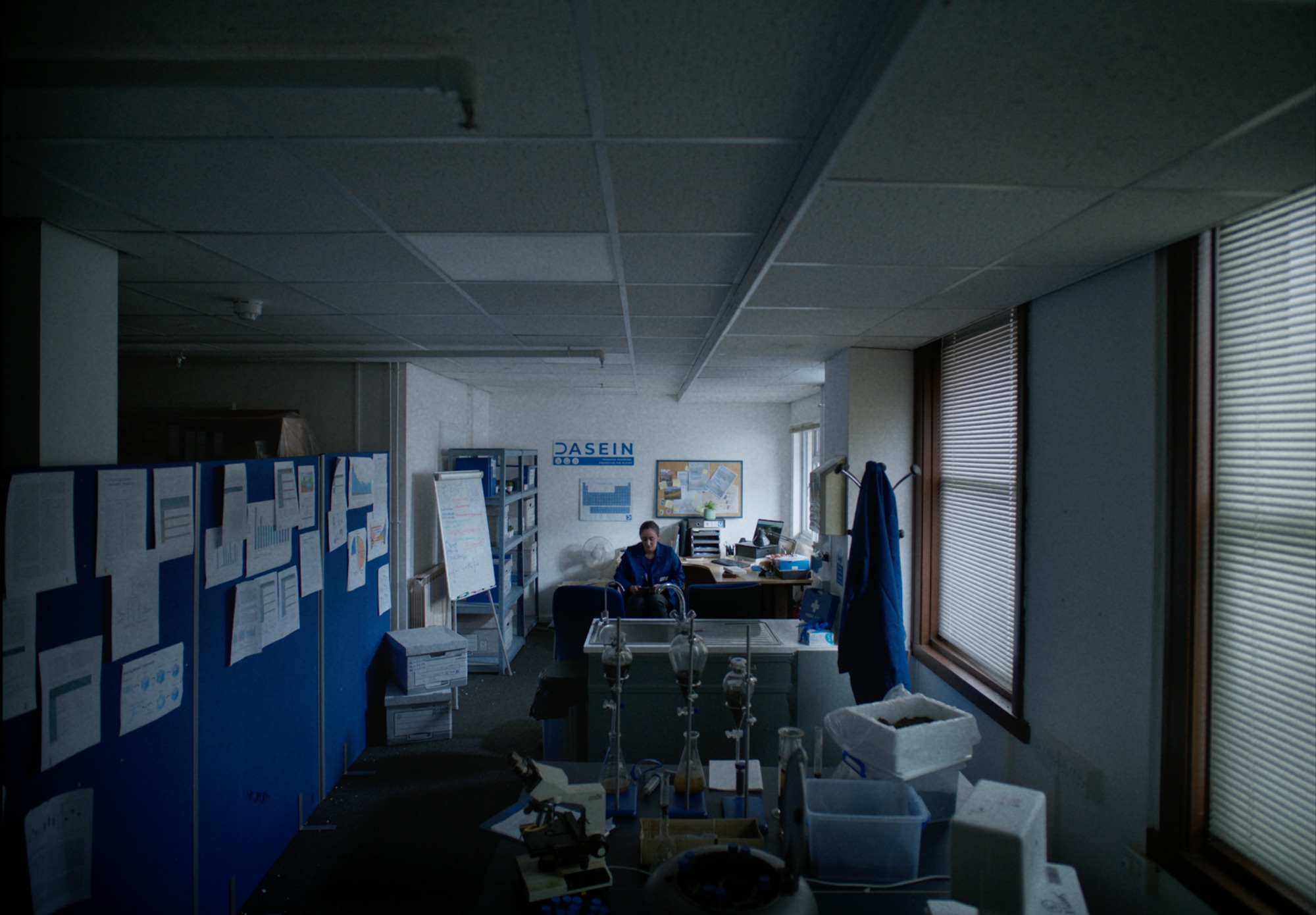
Morana represents a very specific kind of outsider: professional, institutional, the one whose presence formalises the closure even as she shares the workers’ precariousness. Why that role for her? What does it let you say about who gets to belong, and on what terms?
There is still a very fixed idea of what a worker is – one which still lingers from the 20th century. And it’s a very narrow definition: it’s the traditional, blue-collar worker, the kind we find in factories. But in this shifting world where industries are closing (at least on our side of the world), what it means to be a worker is changing. White-collar workers often feel they are not the right kind of workers to identify themselves as such, but what it means to me, as a worker in the 21st Century, it’s a complex definition that needs to be broader.
I wanted to question the rigid definition of who gets to be considered working class and who is allowed to belong in that category.
I wanted to put in comparison, against but also in dialogue with each other, the traditional blue-collar man, and a woman working in a white-collar job. Also, she is an immigrant, while the factory workers are locals. I wanted to question the rigid definition of who gets to be considered working class and who is allowed to belong in that category. I think the fragmentation of the working class only serves those who are already in power. When we argue over whose suffering and exploitation allows them to qualify as the ‘real’ working class, we are distracted from the structures and individuals much higher up the economic ladder who benefit from that exploitation. While we become consumed with defining categories and their boundaries, we forget that we are often arguing with people whose lives are far closer to our own than those who sit at the top of the hierarchy.
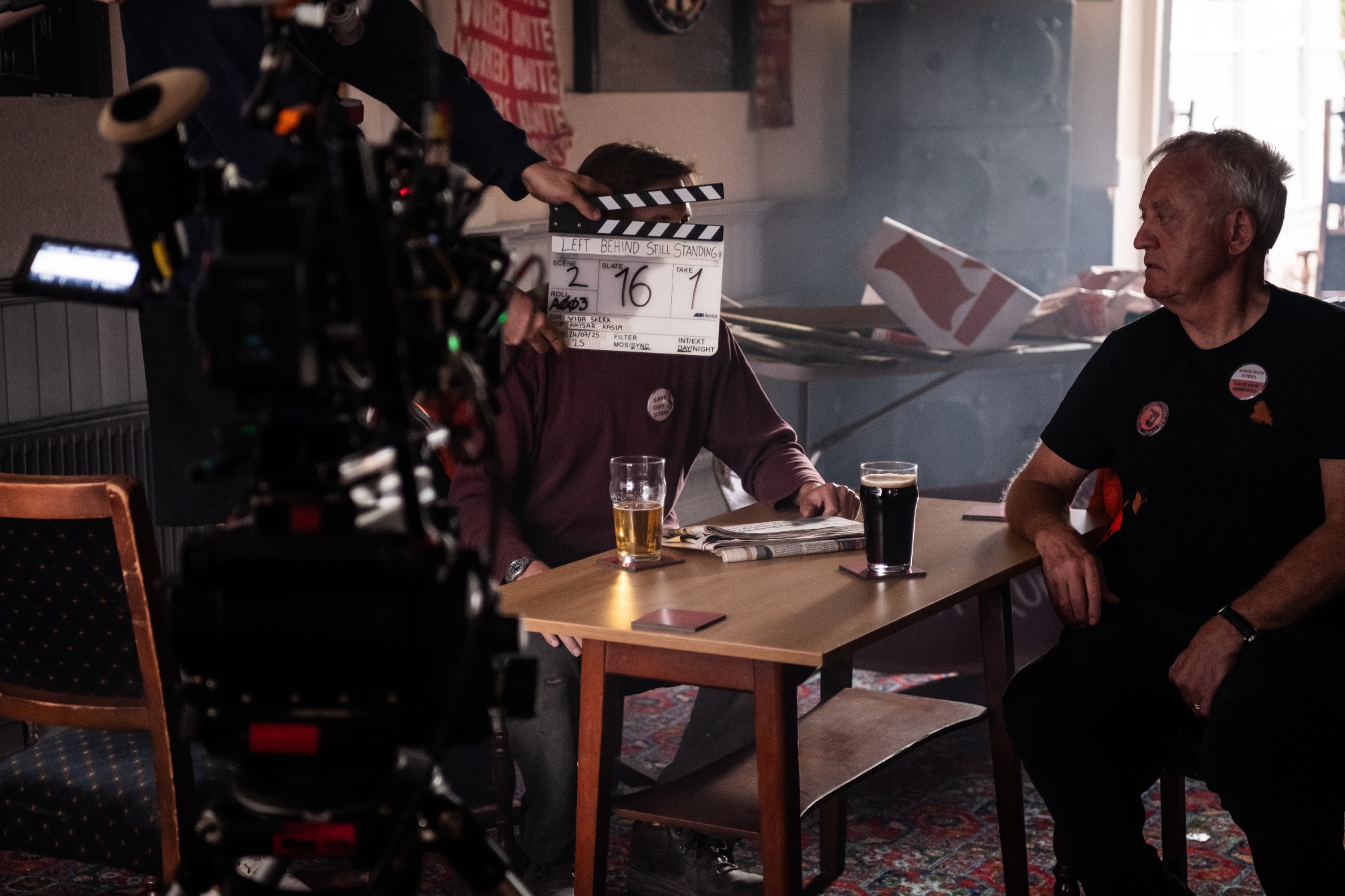
What did the constraints of shooting the factory on short summer nights give you that an unrestricted location wouldn’t have? And did scenes rewrite themselves once you were inside the space?
The cinematographer Kaysar Kasim and I made sure to plan the factory scenes in great detail before the shoot. We were very firm on this and made sure to have the opportunity to shot-list on location a few days before the shoot. We were lucky enough to find a day when the factory was not fully operational, and that’s when we went in to prepare everything.
That was incredibly important because a factory is such a complex space. It’s not simply four walls and a room. It’s very difficult to imagine or remember spatially unless you are physically there. It’s impossible to know whether certain shots will work without being on location. I think it was precisely because Kaysar and I had prepared so thoroughly that, when unexpected things and challenges happened during the shoot and disrupted parts of the plan, we were still able to adapt and get what we needed. So the scenes never had to be fundamentally rewritten on set because we knew the story well, we had planned thoroughly, we knew our priorities, and we shared the same vision. The preparation gave us stability, even when circumstances changed. Communication and prep are key. I’m very proud of the way we approached preparing those scenes together.

I think the feeling I was searching for is similar to the sublime in nature: the awe of something immense that could ultimately hurt you, but is also beautiful, and something we remain connected to.
I was so taken when Morana stepped into the factory and found it alive, breathing, full of men at work, and then her first real exchange with Peter. The whole thing has the texture of something half-remembered and half-impossible at once. Walk me through how you built it: from the choreography of the workers in the space, actions of the machinery and the moment she actually makes contact with Peter.
When the factory comes alive, I didn’t want it to feel just frightening. Morana is certainly a bit afraid, but mostly, she is fascinated by it. I wanted to create a feeling of warmth, and at the same time of danger. It’s about finding that balance. I imagined the factory almost like a large living, magical creature. Morana doesn’t yet know whether it wants to protect her or harm her, but she senses that it is inviting her in. And ultimately, her interaction with Peter confirms that she is welcome. I also thought about the factory almost as a kind of womb, a return to a place where solidarity once began. It is difficult, complex, and dangerous, but it is also, in some sense, a home. I think the feeling I was searching for is similar to the sublime in nature: the awe of something immense that could ultimately hurt you, but is also beautiful, and something we remain connected to. In that sense, I was trying to create a sort of industrial sublime.
Logistically, of course, it was very complicated. I have previous experience as a third AD, and I think that because of that, I pay particular attention to supporting artists within each shot. The AD team was crucial in making it happen, led by Jonas Ackermann, our first AD, who was really wonderful and led the set with precision and kindness. In terms of the visual language, I was genuinely amazed by the work of the camera and lighting teams. There were moments when they created such a convincing atmosphere that I genuinely felt the factory was operating at full capacity. I especially want to highlight the work of Kaysar Kasim alongside our gaffer, Finley Grover. They were an incredibly focused and precise team, but also wonderful collaborators who maintained a very calm, supportive, and friendly atmosphere on set. I cannot wait to work with them again.
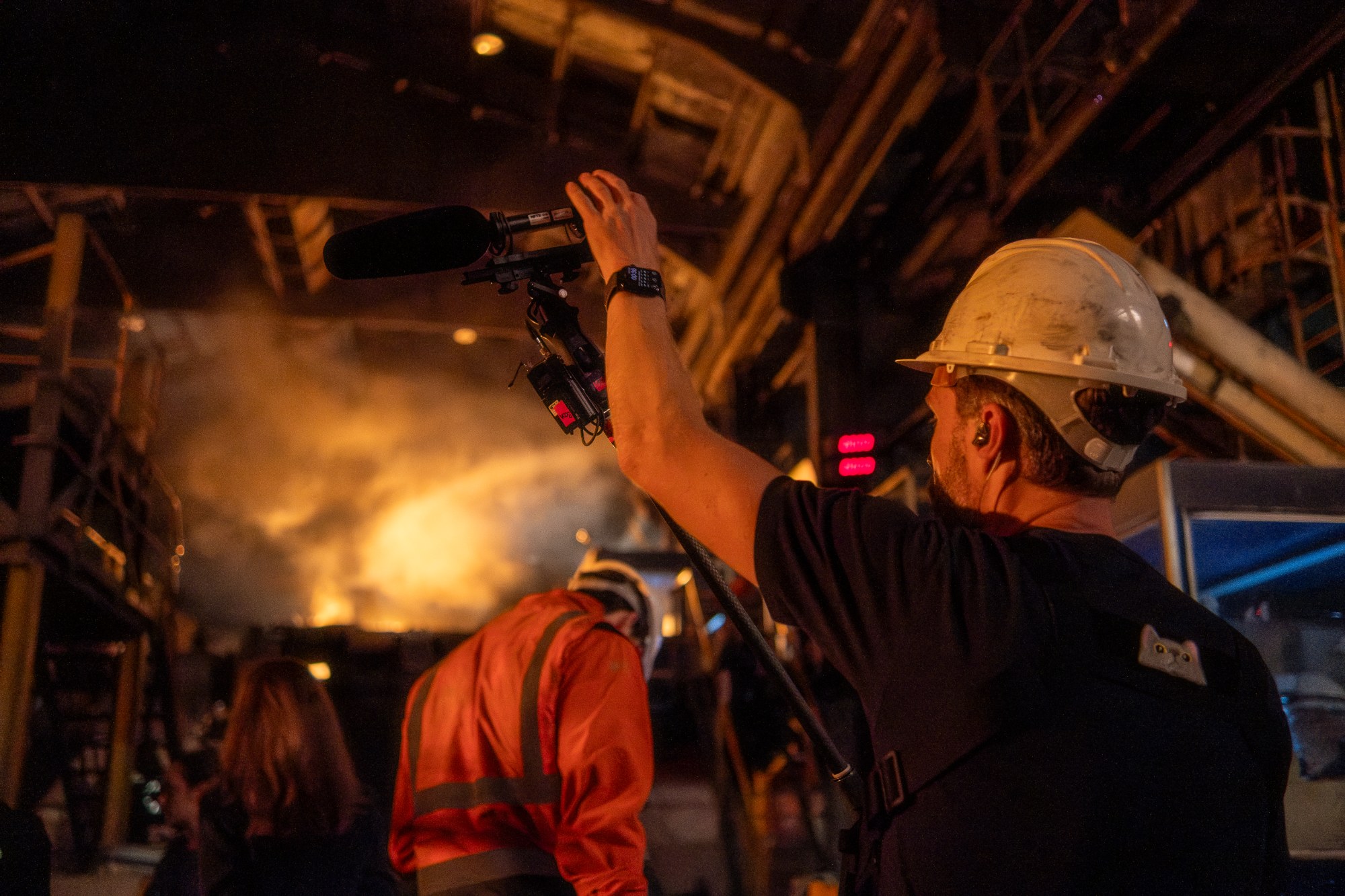


The other side of that is Morana wandering the dead factory, the same architecture, drained of everything. Those two versions of the space sit against each other like a pulse. How did you think about the relationship between them in the writing and on set?
I think the only way for the audience to truly perceive that the factory was closing down, and how that feels, was seeing it empty. And there is something especially painful about encountering a place that had only recently been shut down, before the machinery is taken away, with all those little bits and bops that help us imagine what daily life was like inside of it, while it was still alive – like the forgotten safety gloves still abandoned on chairs and such.
The workers’ song at the heart of the film is something you’ve said has stayed with you (and me as the audience) ever since. Is the song original, written for the film and how did it find its form?
The strength of that song is a testament to Dominic Carrington’s enormous talent; not only his ability to write something memorable, but to create something that so perfectly encapsulates the atmosphere and emotional core of the film. I knew very early on, while writing the screenplay, that I wanted there to be a workers’ song in the film. So during development, I began speaking with Dom about what kind of song it should be. We looked at traditional workers’ songs from across the UK, especially Welsh working-class songs, which he introduced me to. But I also shared references from my region. One song we listened to together was Konjuh Planinom by the Joža Vlahović choir, a partisan resistance song from World War II. I wanted to share it with Dom, because it mourns loss without surrendering to hopelessness. It carries immense tragedy and pain, but also an incredible sense of resilience and dignity.

Could you share some of your favourite short films with us?
Maya Deren’s Meshes of the Afternoon holds a deep influence on me. It was one of the first surrealist films I watched when I was a teenager, and something in me changed since then. I felt it deeply resonated with something deep within me. So, she and David Lynch remained strong influences on me since my teenage years, and they are two of my favourite filmmakers. Last year at La Cinef, I watched 12 Moments Before the Flag-Raising Ceremony by Qu Zhizheng, and its precision really stayed with me. I admired how it explored the tension between individual desire and collective pressure through small moments, without feeling didactic. I was also impressed by The Man Who Could Not Remain Silent by Nebojša Slijepčević because, although it appears very simple in terms of production and camerawork at first glance, it is actually incredibly complex. It creates enormous tension without relying on artifice or formal tricks, and it draws you into a profound sense of empathy for the characters. I am certain I am forgetting a film which I will remember only when this gets published – there are truly so many wonderful short films out there.
You’re now the first NFTS director ever selected twice for La Cinef, you’ve just graduated, and you’re stepping out of school into the world with two consecutive Cannes credits behind you. That’s an extraordinary launching pad, and also a lot to follow. What’s next, and how are you thinking about the move from student film into whatever comes after it?
It is an incredible opportunity, and one I never imagined I would be given, so part of me still cannot fully believe it. I feel immensely grateful to everyone who supported me along the way. And I feel especially grateful to the crews of Left Behind, Still Standing and Ether, because those films only exist because of their collective work.
In terms of the future, as I mentioned earlier, fitting Left Behind, Still Standing into a short film already felt challenging because the world of it seemed so rich and expansive. I realized I could remain in that world for much longer, so my next step will likely be to begin developing it as a feature. At the same time, these past two years have been incredibly intense, and after Cannes I’m really looking forward to spending more time engaging with other people’s art again — reading more, going to exhibitions and plays, watching more films (which to be fair, I’m already doing in Cannes in between meetings), and allowing myself space to look for inspiration in places I may not have discovered yet.