
Over the years of writing for Directors Notes (almost 20 now!), one institution has consistently stood out as a source of emerging animation talent: the Royal College of Art. Animation remains one of my favourite mediums (to watch and to write about) and so the filmmakers from that school who I’ve been lucky to interview for DN – Sophie Koko Gate, Nicolas Ménard, The Moth Collective, Eamonn O’Neill, to name just a few – remain some of my favourites to this day. Their work not only pushes the boundaries of visual storytelling but also reflects the school’s reputation for nurturing distinctive artistic voices. One such voice we’ve been following closely since 2018 is that of Polish animator Natasza Cetner. Her uniquely surreal and symbol-laden narratives have made a lasting impression on us, and today we’re thrilled to welcome her back to Directors Notes for the premiere of her latest short film, And the Cranes Kept Dancing – her fourth feature on our site.
Welcome back to Directors Notes Natasza. Last time we spoke, we were talking about your RCA grad film Nigel, how has life been since you left the school and what have you been up to?
Hello hello and thank you for having me on Directors Notes again! It’s actually been quite busy since my graduation in 2019. I’ve worked a bit with studios assisting on projects and directed animation for a few commissioned films – one of them, Inside, The Valley Sings, just won an Oscar-Qualifying award, so that film is doing pretty well! But, I guess the commercial highlight of this year is contributing two little animated pieces to Coldplay’s A Film For the Future. I’m so happy I was able to animate one of them on paper.
The dry patches between projects still freak me out – 2024 was very rough in that way, but I signed up to various agencies as a film extra for some rent money and adventures. Hopefully, I will learn at some point that the gaps between projects pass and maybe I’ll figure out how not to go insane from anxiety. When a few projects got cancelled over the winter last year, I used that time to develop a new film with a Polish studio called Yellow Tapir.
My main priority in making this film was for the audience to be lost with the dancing cranes and feel the appeal of the escape from monotony.
So today we’re going to talk about your latest short film, And the Cranes Kept Dancing. In the synopsis for the short, you describe the story as being about a man needing to decide what his priorities in life are – what were your priorities when making this film?
I think I was in a state of feeling quite guilty about being constantly worried about my work and my films, as a result, I was probably overlooking some of the priorities in life myself. While And the Cranes Kept Dancing was inspired by some personal stories, overall it was a concoction of ruminations on how obsessed you need to be about your craft (I really don’t like using the word art – makes me cringe!) in order to make it successful ( with success being a relative concept for everyone), and what has to be left behind in exchange.
The film portrays just one of the many possible fates of a person who loses himself in beauty and creativity, while also leaving so much suffering behind him. My main priority in making this film was for the audience to be lost with the dancing cranes and feel the appeal of the escape from monotony. The man’s life at home is not a paradise, as there is clearly some tension between him and his wife, but he is not trying to make things better either. I wish I had more time to spend on clarifying certain aspects of the plot and the relationships between characters, but it was a mad rush to get everything done in time.

Your previous short film Nigel featured a lonely bird looking for company and when we last talked, you mentioned developing a film about Headless Mike, a chicken from the 1940s that lived without its head for 18 months. As the title suggests, this new film once again features birds – although in a more abstract way – what appeals to you about our feathered friends and makes you want to keep featuring them in your films?
Hah, maybe it’s my eternal love for dinosaurs finding its way out. I think it’s because they are just insane creatures and the stories they’re involved in couldn’t possibly be scripted. I don’t know any story about a mammal surviving decapitation and becoming a circus star like Mike. I’ve been stuck with the script for that film for years and it’s kind of embarrassing that I still don’t really know what to do with it.
I was fascinated to learn that it could symbolise upcoming destructions and tragedies or be associated with Satan.
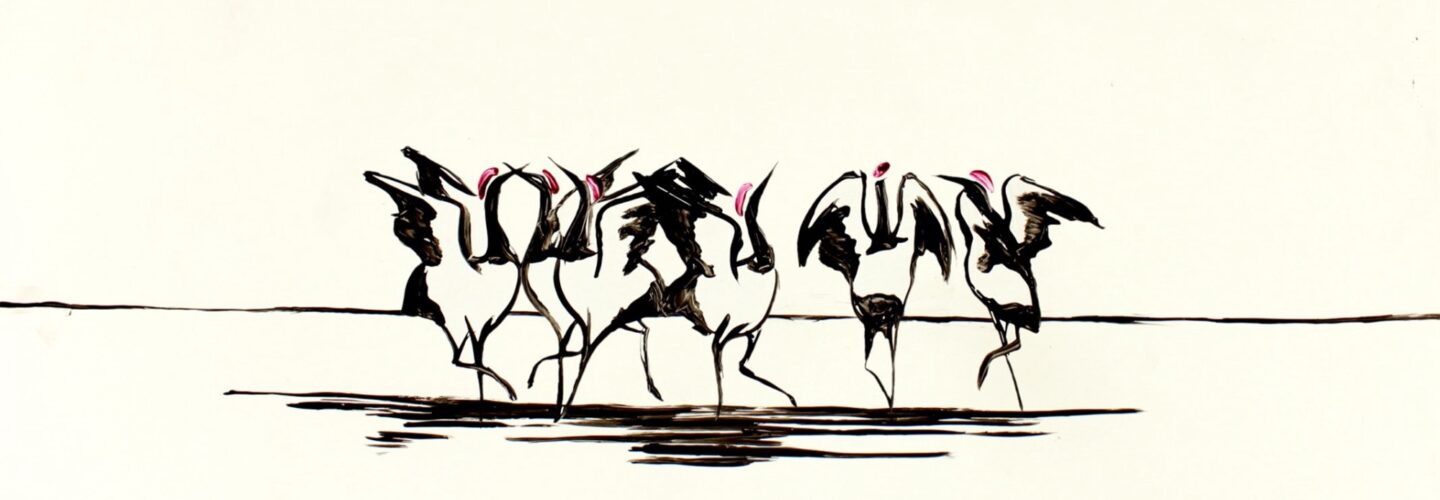
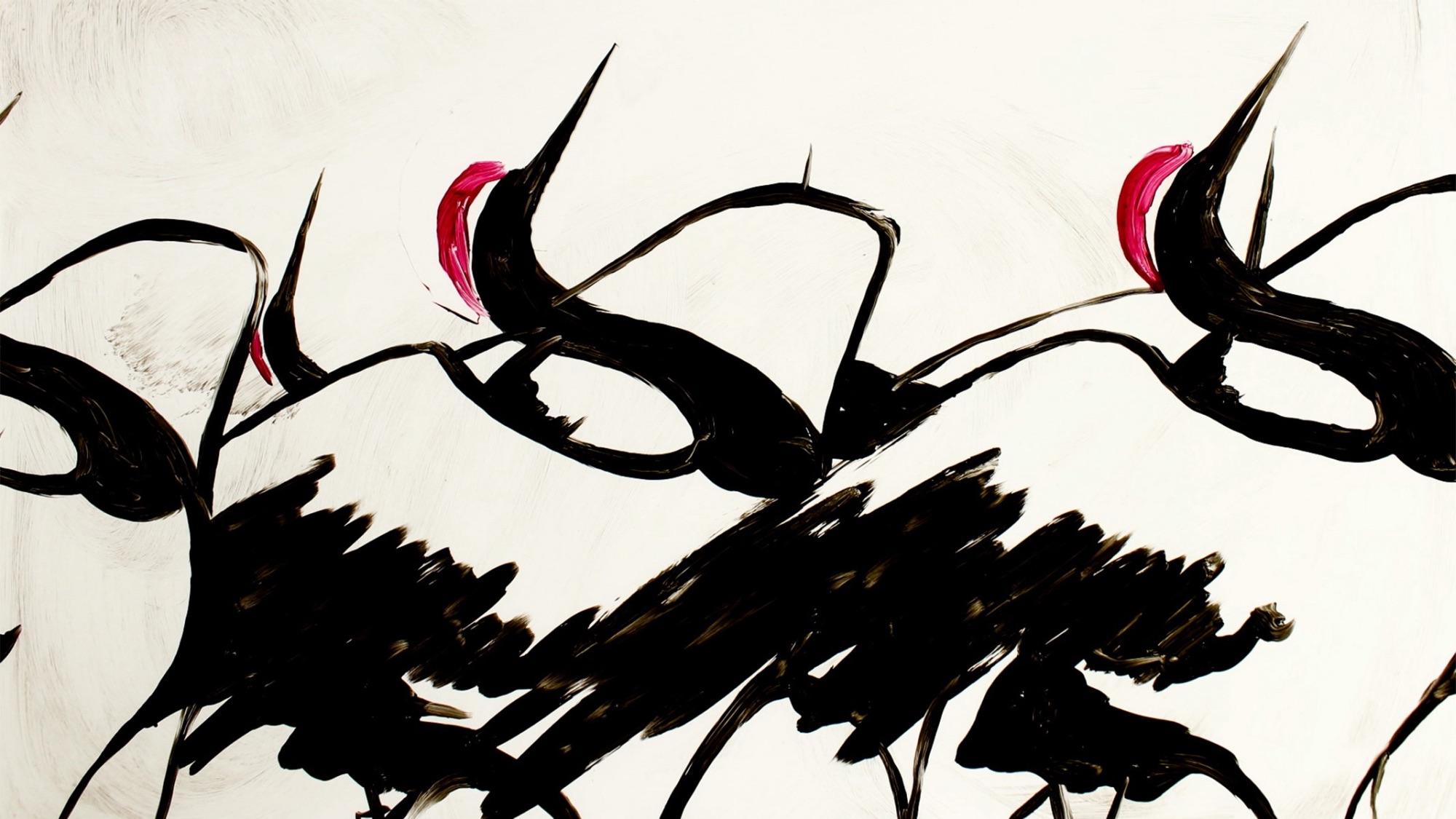
I have another film in mind about a famous penguin – but that’s a secret for now, as I need to think about which angle I’d like to take on it. The theme of dancing cranes has been done in so many ways and always portrayed as something beautiful and poetic. I was eager to take that theme, but make it villainous. Show them more as mermaids leading this man away from his life and family. After researching the symbolism of a crane in various Arabic cultures, I was fascinated to learn that it could symbolise upcoming destructions and tragedies or be associated with Satan. While other literature would focus on their beauty and associate these birds with human souls, etc.
Nigel felt like a more straightforward piece of storytelling than And the Cranes Kept Dancing, which is much more surreal. What made you change direction for this new short film?
I pitched the project after working as a lead animator on Joseph Pierce’s new film, Scale, as well as on some other digital projects for theatres. After those, I really craved a return to more tactile, hands-on analogue animation. I also wanted to step away from highly controlled, storyboarded, script-driven narratives and play around with chopped-up editing and dreamlike plot evolution. At that point, I was also reading short stories by Franz Kafka and I think I got a bit jealous of his ability to create those loosely connected, fleeting images that let your mind just wander. I let the film guide me, in a way – as a kind of detox from the structured stages of productions. I’m really grateful to Pigeon Productions for allowing me to simply have fun and take risks with the more surreal aspects of narrative development.
It was the effect I was aiming for, but seeing it blown up on the big screen was still surprising.
Most Popular
At times And the Cranes Kept Dancing is almost overwhelming to watch. Was this something you were naturally aiming for or did that happen more organically?
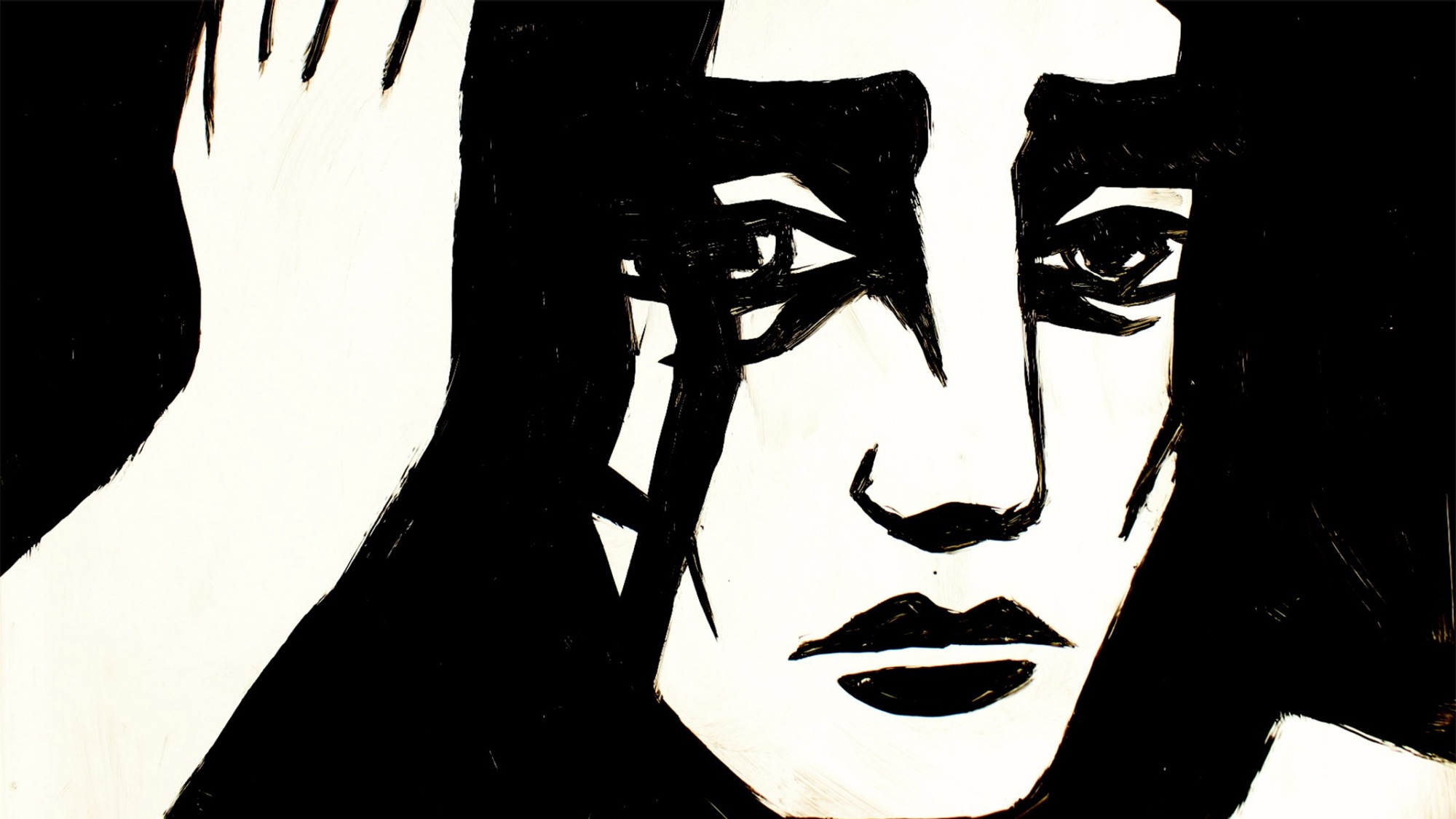
I guess it just happened that way! I knew that animating woodcut-inspired visuals might be intense in terms of contrast on screen, but it was a bit of a shock when I saw it screened in a cinema for the first time. It was the effect I was aiming for, but seeing it blown up on the big screen was still surprising. My next film is going to be much more ethereal, inspired by etchings and I will play around with building the environment using empty space on the screen. I do tend to jump around from aesthetic to aesthetic. I don’t like sitting still or staying within my comfort zone – it makes me feel lazy.
With Nigel, we discussed how the stark aesthetic of the piece was used to heighten the isolation felt by your lead character. With this film, the visual style feels more complex and rich, while still maintaining an element of that starkness. What were you hoping to convey with the style of the film?
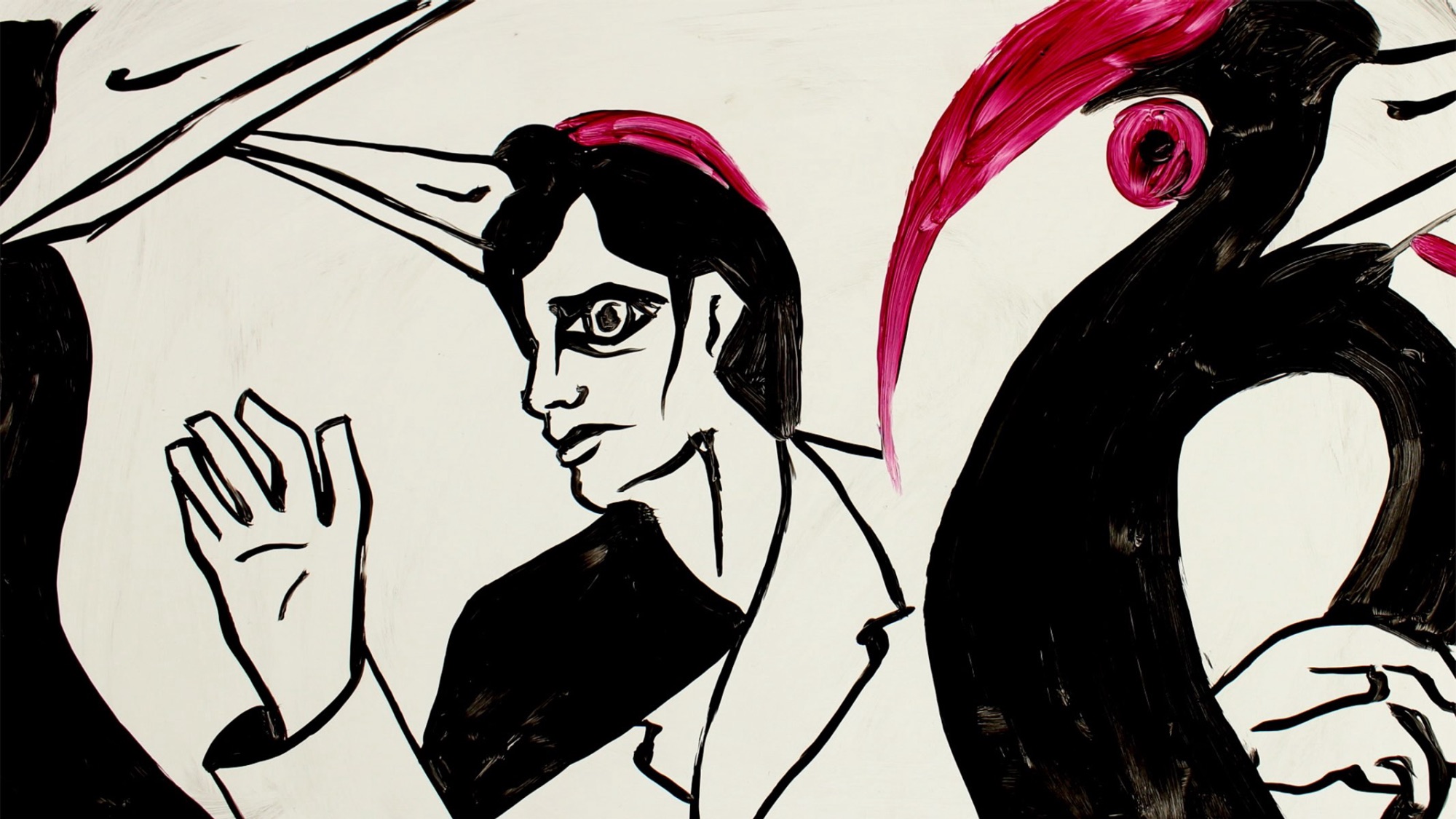
I really enjoyed the idea of merging a more dreamlike, flow-of-consciousness style of storytelling with quite stark, German Expressionism-inspired visuals. I wanted the viewers to get lost in the black paint and in the spaces between light and shadow. I aimed to keep the human world more angular and crude, while the Cranes’ dimension is more organic and fluid. That idea may have gotten a bit lost during the actual production, but that’s where it originated from.
Main inspirations for the style were, of course, Käthe Kollwitz, but also – among others – Emil Nolde and Edvard Munch’s graphics. I know myself well enough by now to know that 10 months of production for a full film is a tricky ask, especially when you overthink everything like I do. So, stripping the style of the details and keeping it graphic and technically quite simple was a way for me to make this film doable – and to force myself to embrace new aesthetics.
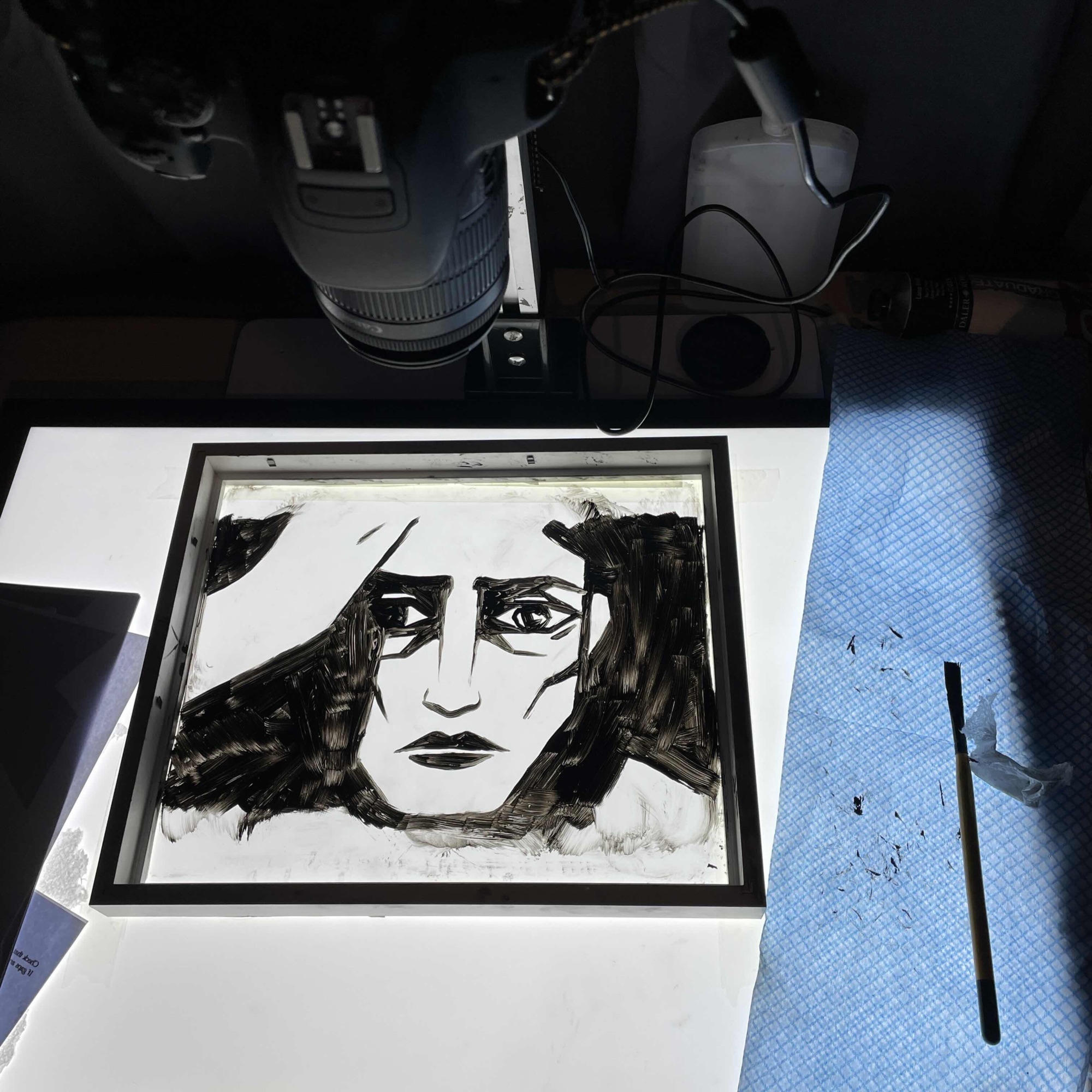
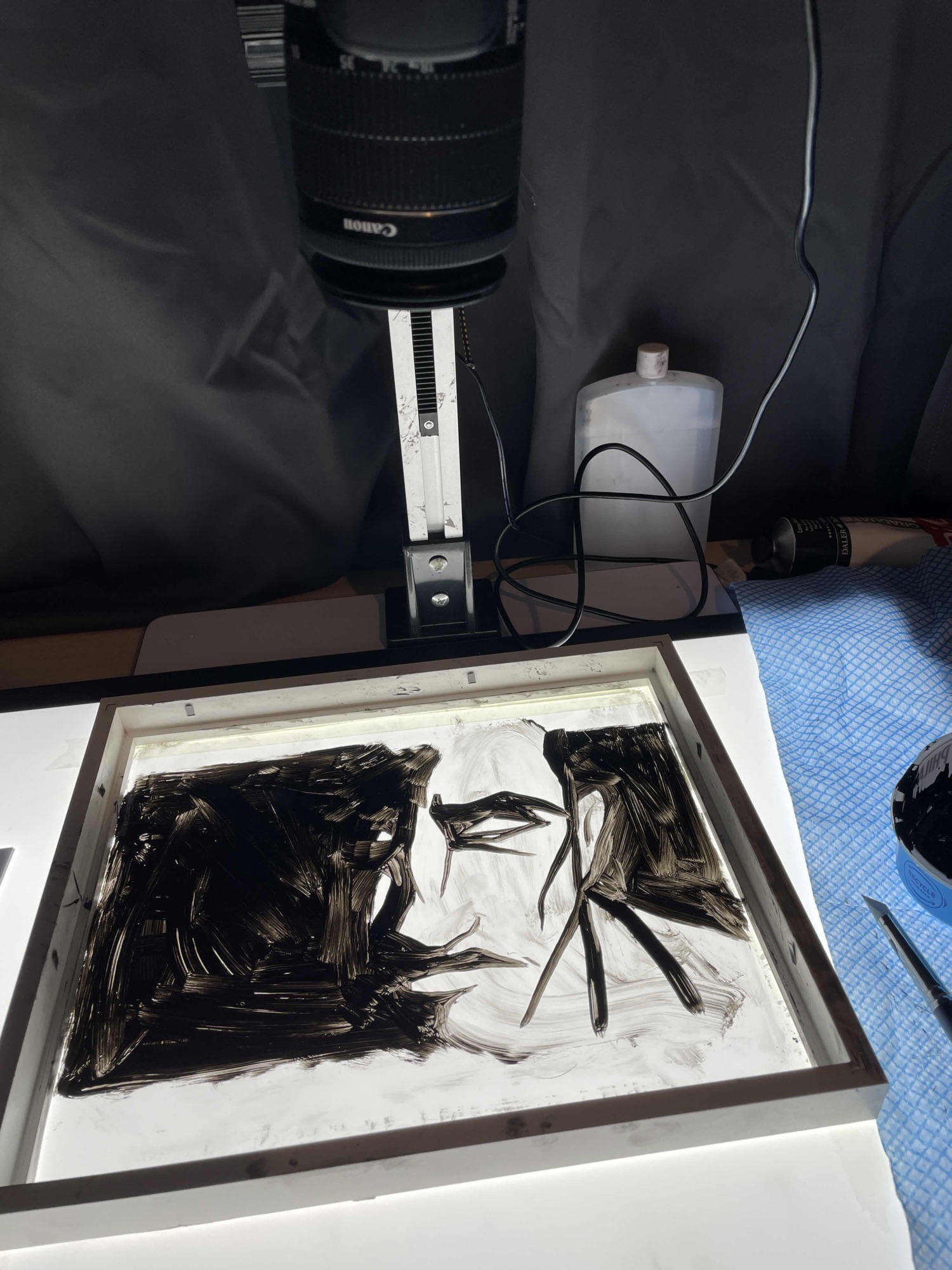
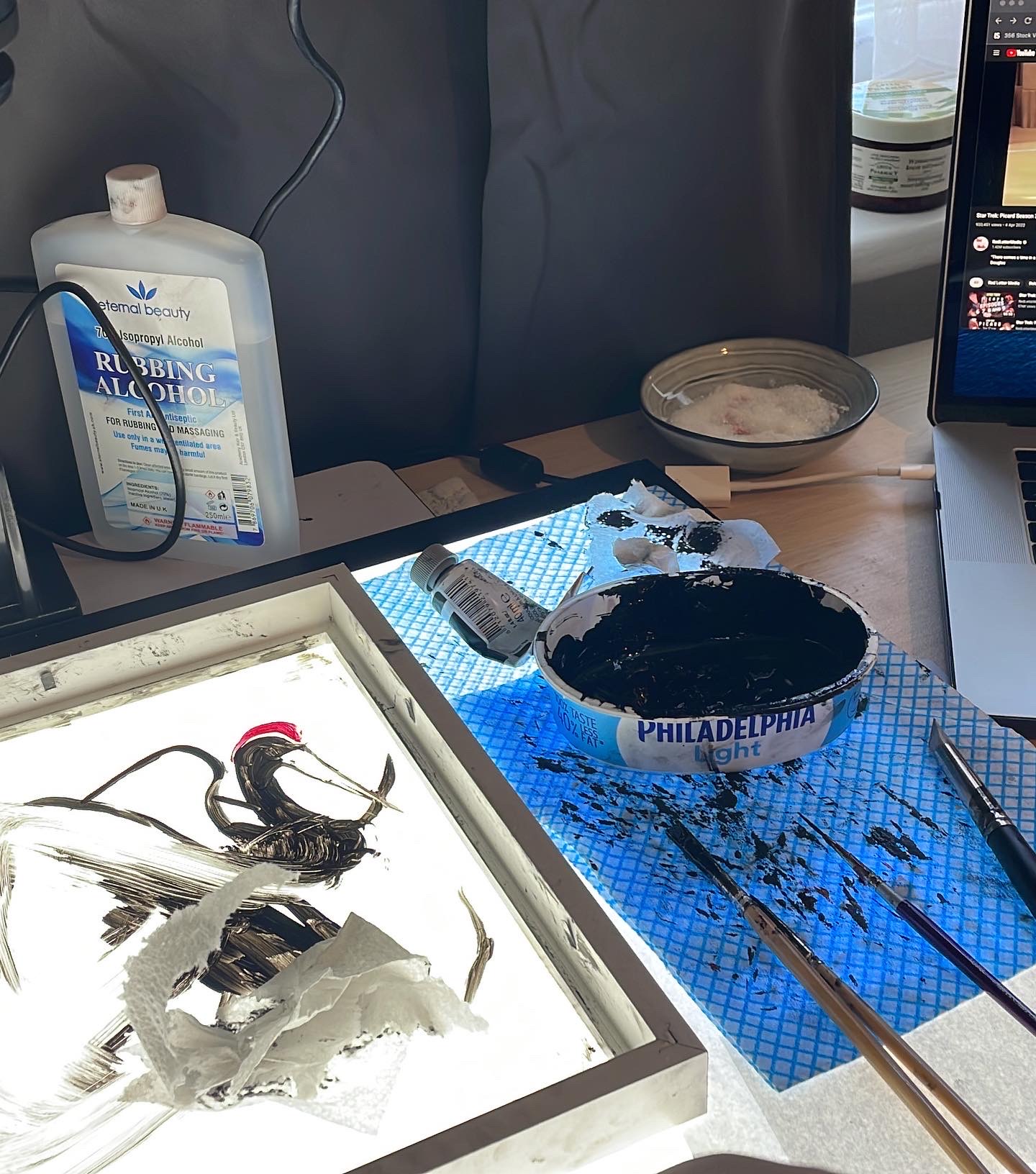
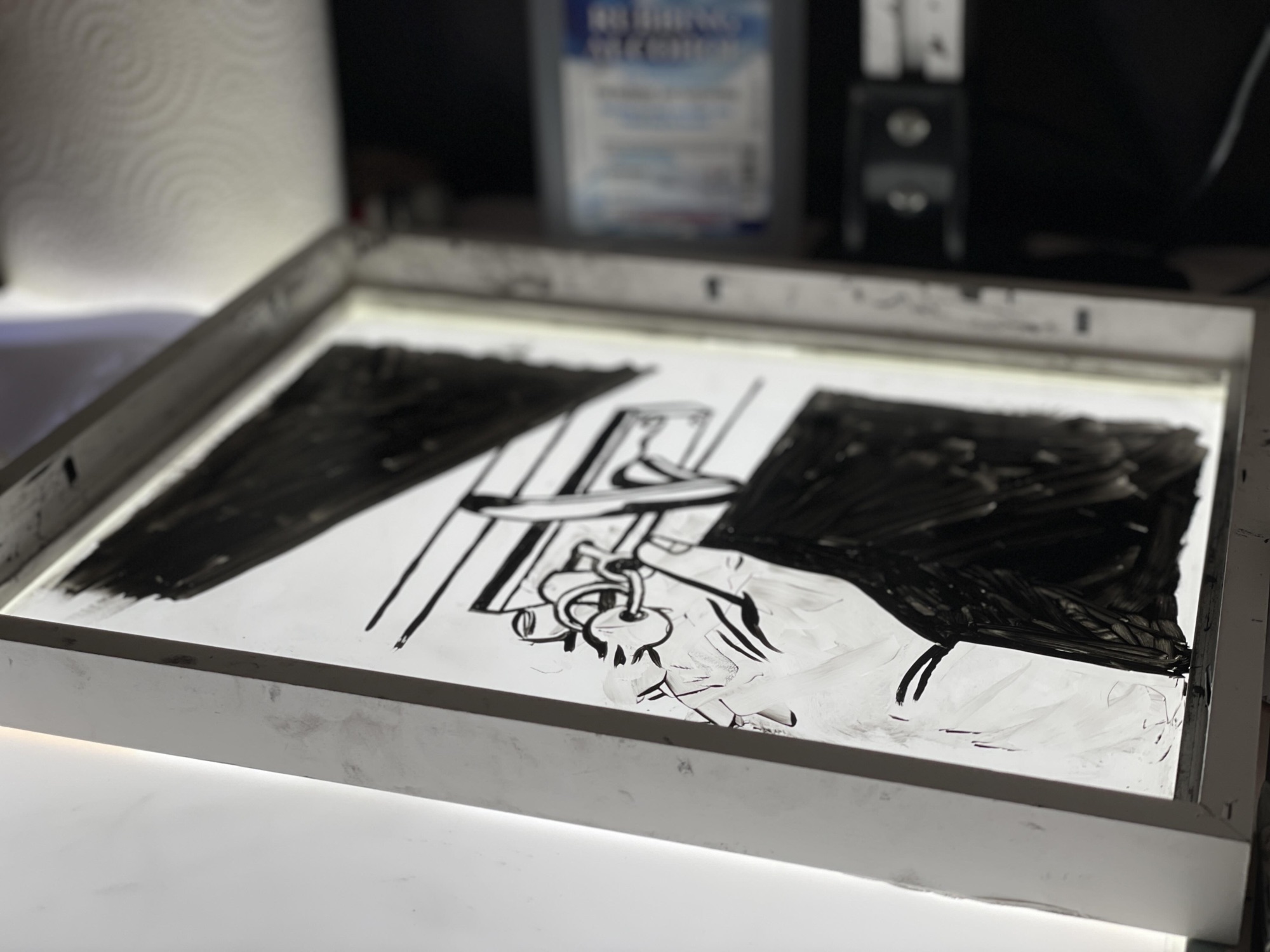
Can you talk us through the production of the film – how long did it take, what tools did you use, who did you work with?
I was approached by this amazing Polish studio, Pigeon Productions, and their producer, Mikołaj Błoński, to pitch a film that would be a part of an anthology commissioned by the Ithra gallery in Saudi Arabia. As I remember, I had just a few days to come up with a pitch and as long as I stayed away from portraying nudity, sex, politics, etc., I would have a lot of artistic freedom. I had around 10 months for the full production and it was just me working on it day and night, as the budget was too low for me to hire anyone.
I really wanted something more graphic, with harsh lines that would imitate the woodcut effects.
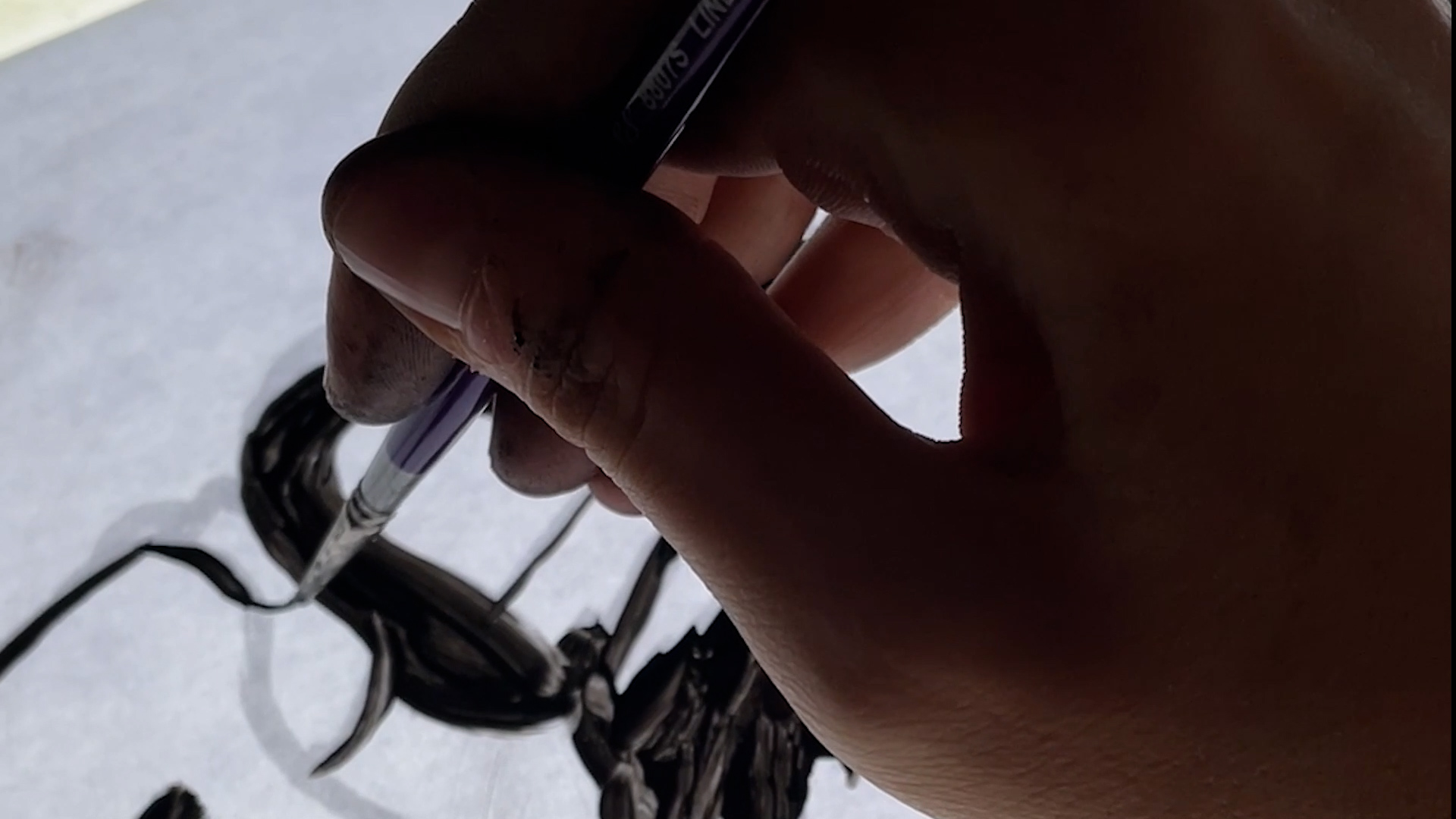
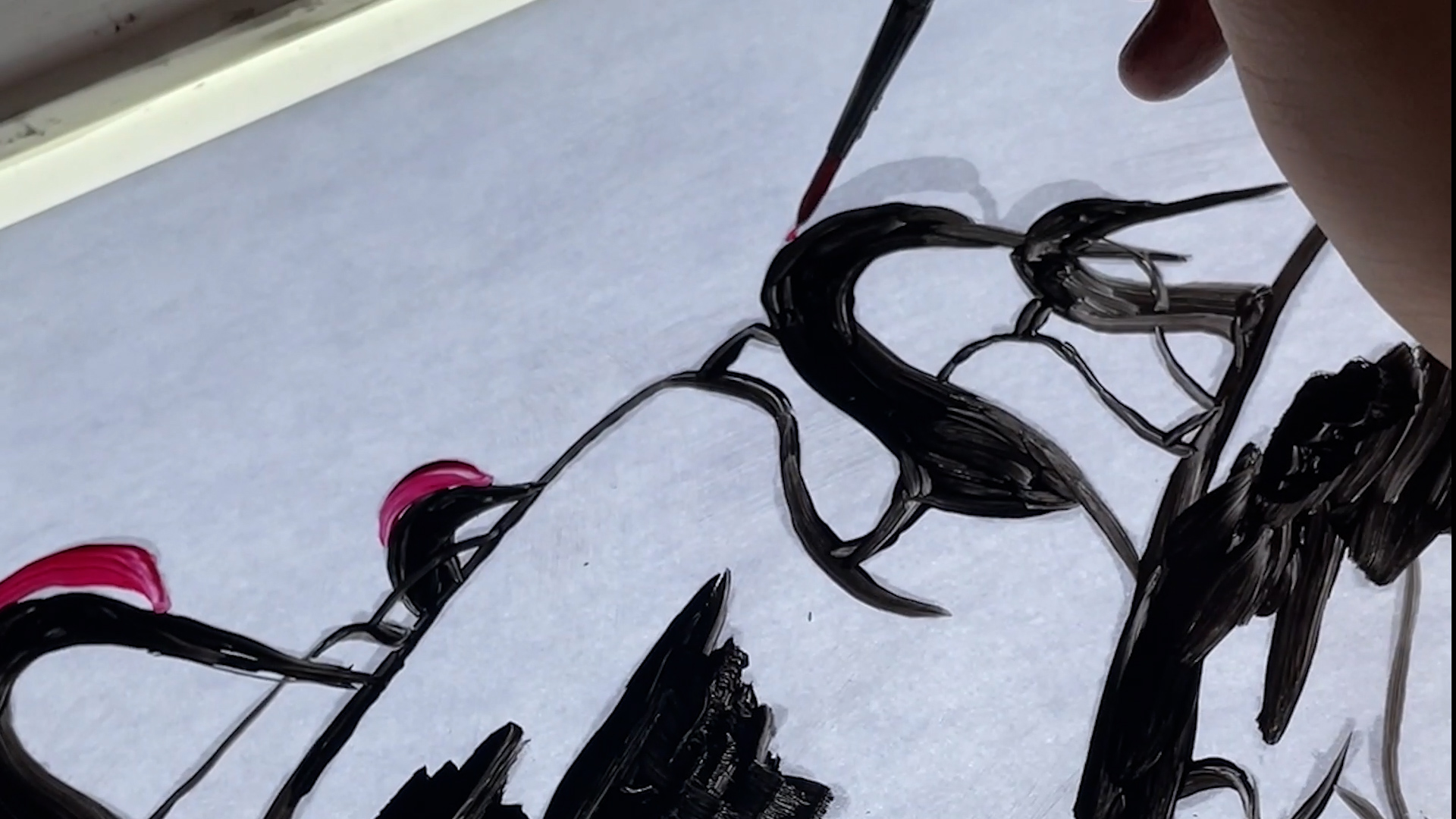
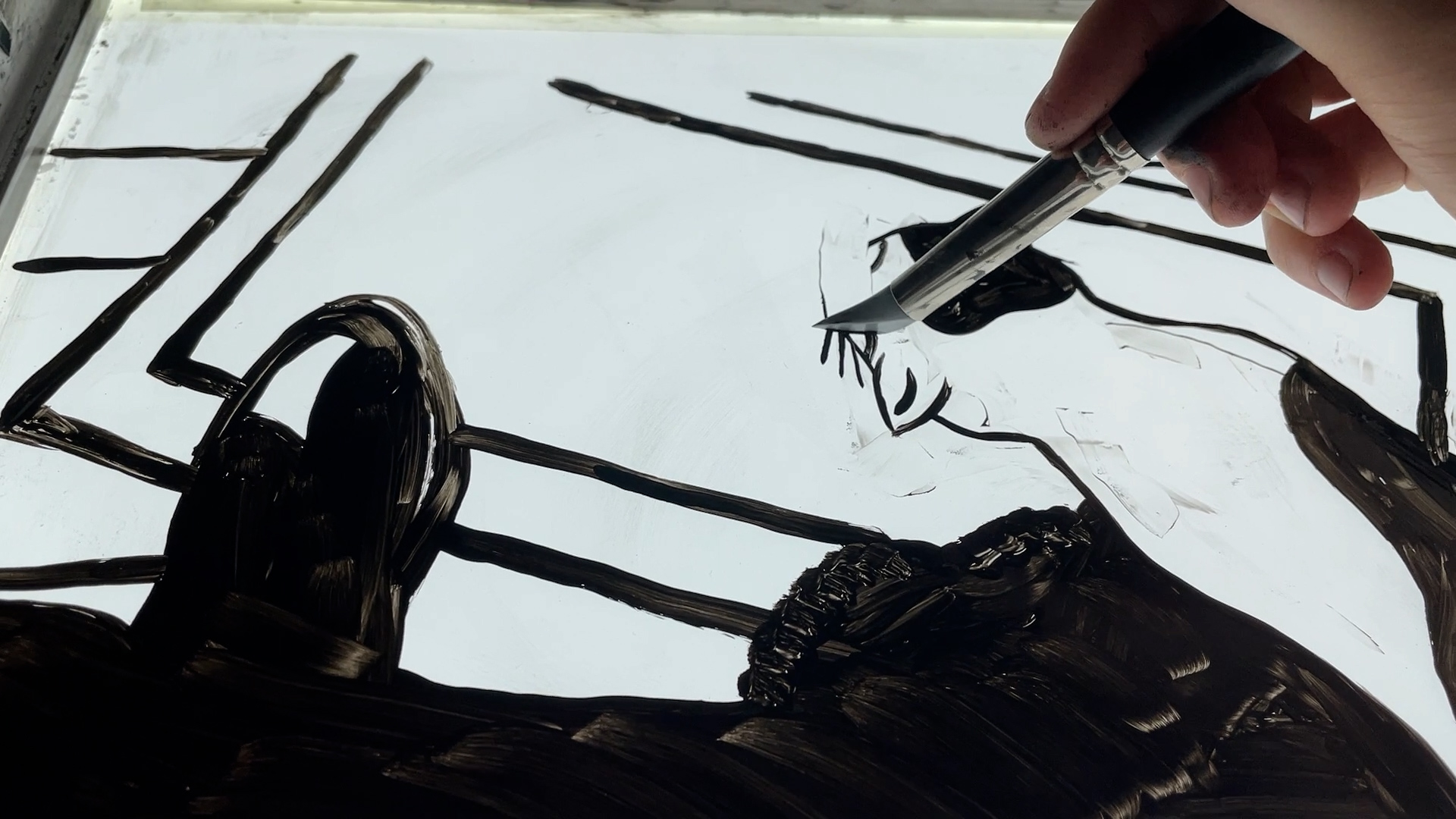
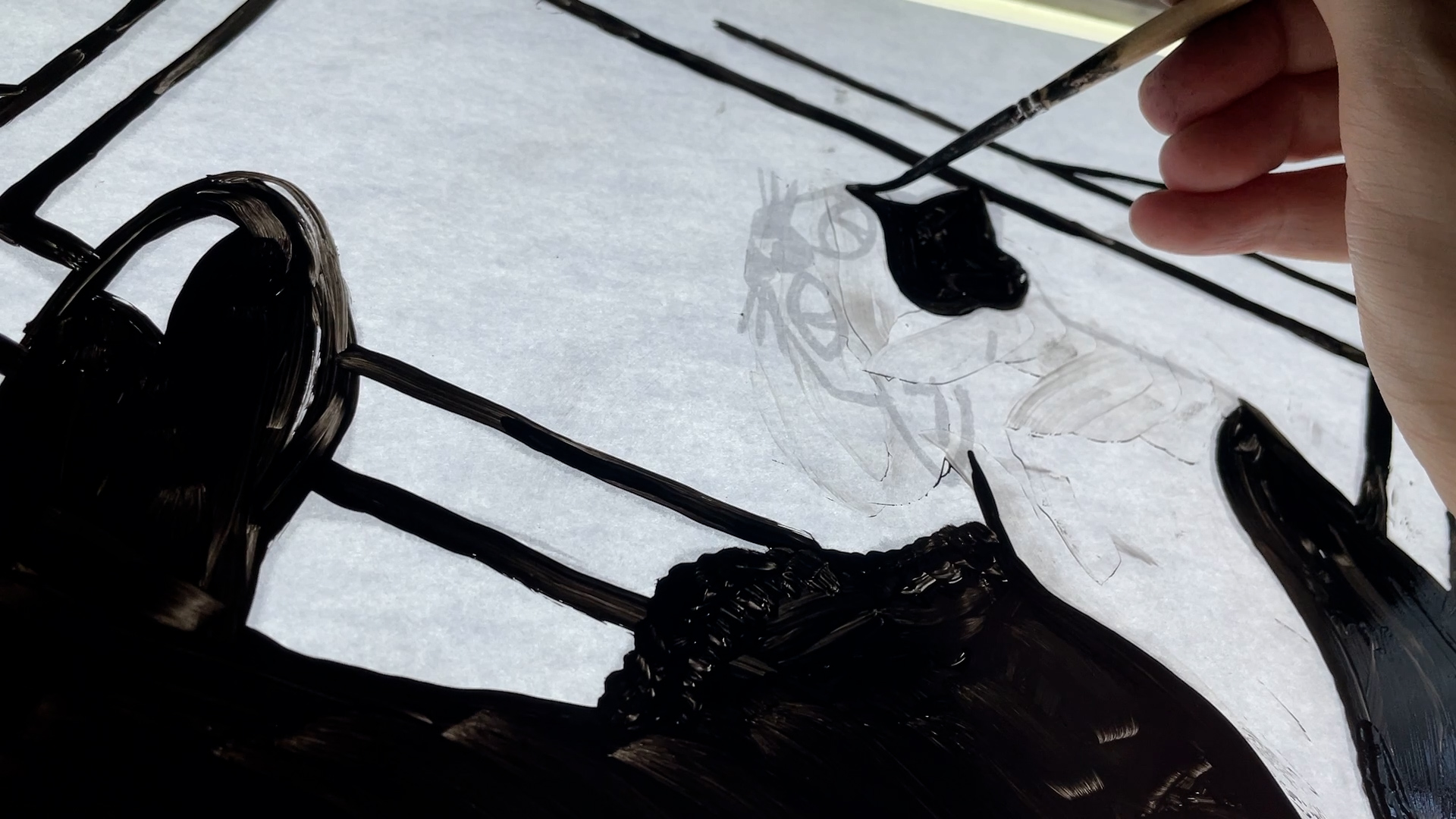
I really love exploring various mediums, so I thought it was the perfect chance for me to learn paint on glass. I experimented a lot with different formulas – mixing liquid glycerine with gouache – but I really wanted something more graphic, with harsh lines that would imitate the woodcut effects. The glycerine mixture was looking too soft. In the end, mixing ordinary vegetable oil with oil paint did the trick. There was no need for turpentine – just a spray of window cleaner and a paper towel – so that was great to avoid those toxic fumes. The animation was done digitally first, to get the whole film confirmed and approved. Then, at 6fps, the frames were printed out in light gray and I would slide them under the sheet of glass to trace and shoot them under the rostrum.
Sound also plays an important role in the film, with heightened sound effects and a subtle score (until that dance sequence) working alongside the visuals. How did you work with Phil Brookes to create the sound design for the short?
We were instructed to incorporate some elements of Arabic culture, so from the beginning, my goal was to tie the Cranes’ dance with Arabic music. That choice also helped to keep them more distant from the rest of the film and push those scenes towards surrealism. The sound design was mostly inspired by my first-year RCA film Baraa, and therefore, it was also linked to Eraserhead – an inspiration I tend to come back to a lot.
I asked Phil to compose a little 1930-40s-style track to come out of the record player, which would emphasise the hominess of the interior environment and he did an amazing job with the Arabic-influenced soundtrack. Meanwhile, I took care of the synthesizer tracks, which then served as the main tool to convey the increase of delusional visions and the man losing his touch with reality.
What would you say was the biggest challenge throughout your production?
I think it was the process of building increasing tension throughout the film. I wanted the relationship between the man and the cranes to intensify, while we see the woman finally gather the courage to leave the house and follow him to the shore. I wanted the tension to finally diffuse at the end, when he sees her on the shore, witnessing his delusional dances with the cranes. It was the first film since my BA first-year project where I experimented with a fragmented, broken up narrative – and I really enjoyed the more intuitive, freer approach to production. I possibly overflooded the film with metaphors and allegories, though.
What are you working on next?
I’m quite busy at the moment, as I have a secret (and very cool) summer commission – on paper – with a studio in Poland I’ve wanted to work with for a while. After that, I have two feature documentaries I’m making some animations for. Everything on paper this year, which is insane but gives me hope that people are returning to hand-drawn mediums, especially now the market is flooded with digital/AI work.
So yeah, I’m really happy with this year’s projects so far! I should be starting production on my new film – which just got funding from the Polish Film Institute (funding is actually better in Poland than in the UK, which is shocking) – around late autumn/winter. For now, I need to learn more about gardening and catch up with some gaming and films!